
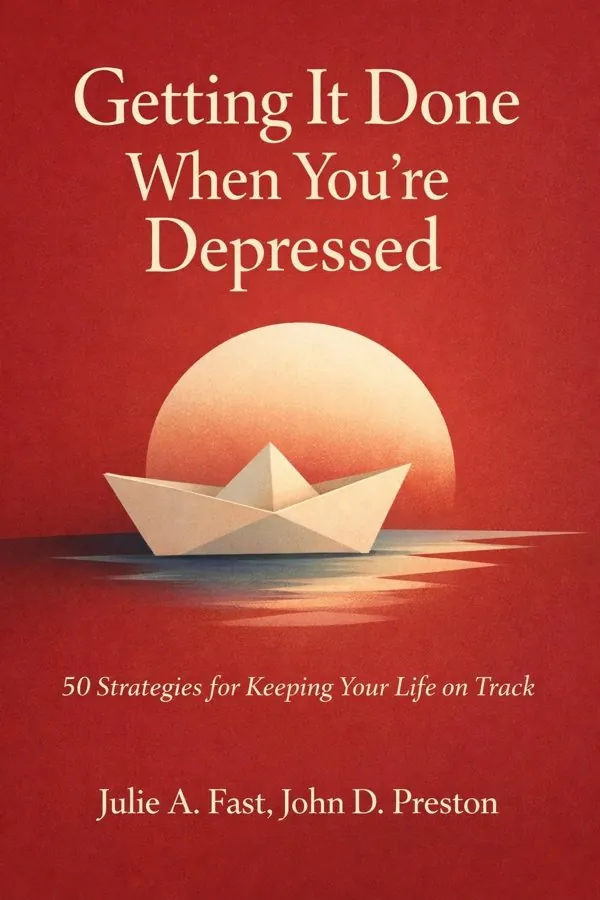
Getting It Done When You're Depressed: 50 Strategies for Keeping Your Life on Track: Summary & Key Insights
by Julie A. Fast, John D. Preston
 10 min9 chaptersAudio available
Key Takeaways from Getting It Done When You're Depressed: 50 Strategies for Keeping Your Life on Track
One of the most damaging myths about depression is that it is simply sadness intensified.
A powerful insight in the book is that depression is predictable in highly personal ways.
When depression makes motivation vanish, the biggest barrier is often not the task itself but the size of the task in your head.
A common mistake during depression is relying on motivation to dictate the day.
Depression speaks in convincing absolutes.
What Is Getting It Done When You're Depressed: 50 Strategies for Keeping Your Life on Track About?
Getting It Done When You're Depressed: 50 Strategies for Keeping Your Life on Track by Julie A. Fast, John D. Preston is a mental_health book spanning 6 pages. Depression does not only affect mood; it disrupts the ordinary machinery of life. Tasks that once felt automatic—answering email, paying bills, making meals, showering, showing up to work—can suddenly seem impossibly heavy. In Getting It Done When You're Depressed, Julie A. Fast and psychologist John D. Preston address this often-overlooked reality with unusual clarity and compassion. Rather than offering abstract encouragement, they provide fifty concrete strategies designed to help people function even when energy, concentration, and motivation have collapsed. What makes this book so valuable is its practical realism. Fast writes from lived experience with mood disorders, while Preston brings clinical expertise in depression and treatment. Together, they reject the idea that productivity during depression is a matter of willpower or character. Instead, they show how depression alters thinking, behavior, and daily rhythms—and how small, structured adjustments can reduce the damage. The result is a guide that feels less like a lecture and more like a survival manual. For readers who feel ashamed of falling behind, or for loved ones trying to help, this book offers something powerful: workable tools, honest understanding, and a path toward stability one manageable step at a time.
This FizzRead summary covers all 9 key chapters of Getting It Done When You're Depressed: 50 Strategies for Keeping Your Life on Track in approximately 10 minutes, distilling the most important ideas, arguments, and takeaways from Julie A. Fast, John D. Preston's work. Also available as an audio summary and Key Quotes Podcast.
Getting It Done When You're Depressed: 50 Strategies for Keeping Your Life on Track
Depression does not only affect mood; it disrupts the ordinary machinery of life. Tasks that once felt automatic—answering email, paying bills, making meals, showering, showing up to work—can suddenly seem impossibly heavy. In Getting It Done When You're Depressed, Julie A. Fast and psychologist John D. Preston address this often-overlooked reality with unusual clarity and compassion. Rather than offering abstract encouragement, they provide fifty concrete strategies designed to help people function even when energy, concentration, and motivation have collapsed.
What makes this book so valuable is its practical realism. Fast writes from lived experience with mood disorders, while Preston brings clinical expertise in depression and treatment. Together, they reject the idea that productivity during depression is a matter of willpower or character. Instead, they show how depression alters thinking, behavior, and daily rhythms—and how small, structured adjustments can reduce the damage. The result is a guide that feels less like a lecture and more like a survival manual. For readers who feel ashamed of falling behind, or for loved ones trying to help, this book offers something powerful: workable tools, honest understanding, and a path toward stability one manageable step at a time.
Who Should Read Getting It Done When You're Depressed: 50 Strategies for Keeping Your Life on Track?
This book is perfect for anyone interested in mental_health and looking to gain actionable insights in a short read. Whether you're a student, professional, or lifelong learner, the key ideas from Getting It Done When You're Depressed: 50 Strategies for Keeping Your Life on Track by Julie A. Fast, John D. Preston will help you think differently.
- ✓Readers who enjoy mental_health and want practical takeaways
- ✓Professionals looking to apply new ideas to their work and life
- ✓Anyone who wants the core insights of Getting It Done When You're Depressed: 50 Strategies for Keeping Your Life on Track in just 10 minutes
Want the full summary?
Get instant access to this book summary and 100K+ more with Fizz Moment.
Get Free SummaryAvailable on App Store • Free to download
Key Chapters
One of the most damaging myths about depression is that it is simply sadness intensified. Fast and Preston challenge that idea immediately by showing that depression is also a disorder of functioning. It attacks attention, memory, decision-making, problem-solving, and the capacity to initiate action. That is why someone with depression may care deeply about a task and still be unable to begin it. The issue is not laziness or irresponsibility. It is a real impairment in the mental systems required to translate intention into behavior.
This distinction matters because mislabeling the problem leads to the wrong solution. If you believe your struggle comes from weakness, you may respond with self-criticism, impossible standards, or frantic attempts to "try harder." But if you understand that depression changes how your brain and body manage daily tasks, you can start building supports that fit the condition. The authors encourage readers to observe their own patterns: Which chores become hardest? What time of day is worst? Do bills, calls, meals, or hygiene collapse first? What thoughts appear when you consider starting?
For example, one person may notice that mornings are nearly nonfunctional, making early appointments unrealistic. Another may realize that paperwork triggers paralysis because concentration disappears after ten minutes. These observations are not excuses; they are data. Once you see the pattern, you can reduce friction, adjust expectations, and create systems that make action more possible.
Actionable takeaway: stop judging your depression through a moral lens and start tracking it like a condition. Identify the three daily tasks most affected by your depression and note when, where, and why they become difficult.
A powerful insight in the book is that depression is predictable in highly personal ways. Many people experience their struggles as random failure: some days they collapse, some days they cope, and the inconsistency feels confusing and shameful. Fast and Preston argue that there is usually a pattern underneath the chaos. Learning your pattern turns depression from an invisible saboteur into something you can anticipate and plan around.
The authors invite readers to look beyond mood labels and focus on functional warning signs. Maybe your first sign is unread email piling up. Maybe you stop returning texts, begin skipping meals, or leave dishes untouched for days. Perhaps your thinking grows more absolute: "There is no point," "I’ll never catch up," or "One mistake ruins everything." These signals often appear before a full downward spiral, and noticing them early gives you a chance to intervene while the problem is still manageable.
Consider how useful this can be in practice. If you know that three nights of poor sleep are followed by worsening indecision and isolation, you can treat those nights as a serious signal rather than a temporary annoyance. If you know that clutter increases your sense of defeat, you can create a plan for one daily reset before the environment overwhelms you. If social withdrawal predicts a crash, you can ask a trusted person to check in when you go silent.
This self-knowledge also helps you communicate with others. Instead of saying, "I’m a mess," you can say, "When I stop opening mail and start oversleeping, I’m entering a bad phase and need help simplifying tasks."
Actionable takeaway: make a personal depression profile with your early warning signs, common thinking traps, and the first three daily functions that decline when symptoms worsen.
When depression makes motivation vanish, the biggest barrier is often not the task itself but the size of the task in your head. Fast and Preston emphasize that depressed thinking turns ordinary responsibilities into total systems failures. Laundry becomes all the laundry. Cleaning the kitchen becomes restoring your entire life. Replying to one message becomes confronting every neglected relationship. In that mental state, avoidance is almost inevitable.
Their solution is deceptively simple: shrink the task until it is absurdly manageable. Do not aim to clean the house; aim to put one plate in the sink. Do not aim to work all afternoon; aim to open the document and read one paragraph. Depression often permits movement only after movement has already begun. Waiting to feel ready may mean waiting indefinitely.
This approach works because it bypasses the all-or-nothing logic that depression loves. A five-minute effort does not require hope, inspiration, or confidence. It requires only willingness to do something incomplete. Once started, some people continue. Others stop after the minimum. Both outcomes count as success because they rebuild the habit of initiation instead of reinforcing paralysis.
The authors also recommend reducing activation costs. Lay clothes out the night before. Keep trash bags visible. Use a timer. Put medications where they are hard to forget. If a task has too many hidden steps, separate them. For example, "pay the bill" might become find envelope, place on table, open envelope, note due date, log in, pay.
Actionable takeaway: choose one avoided task today and break it into the smallest physical action possible. Complete only that step, then decide whether to continue.
A common mistake during depression is relying on motivation to dictate the day. Fast and Preston show why that rarely works. Depression weakens internal drive, so if you wait until you feel like acting, much of life remains undone. Structure becomes a substitute for motivation: routines, lists, external reminders, time blocks, and pre-decided sequences that reduce the number of choices you must make while depleted.
This is not about becoming rigid or hyperproductive. It is about conserving mental energy. Decision-making is expensive when depressed. Even simple questions—What should I do first? Should I shower now or later? Can this wait?—can create exhausting loops. Structure removes some of that burden. A written morning checklist, for example, can carry you through basic care when your mind is foggy: get up, drink water, take meds, shower, eat something, check calendar.
The book suggests using visible and external systems because memory and concentration are unreliable during episodes. Sticky notes, alarms, printed lists, pill organizers, whiteboards, and calendars become practical supports rather than signs of inadequacy. One reader might schedule just three nonnegotiable tasks for the day. Another might use a ten-minute timer for tidying and stop guilt-free when the timer ends. Someone working from home might create a start-up ritual—sit down, open laptop, review one list, begin easiest task—to cue action automatically.
The deeper point is liberating: you do not need to feel organized in order to use organizational tools. You can borrow order from the system until your own capacity returns.
Actionable takeaway: build one tiny daily routine for your most vulnerable time of day and write it somewhere visible so you do not have to reinvent it tomorrow.
Depression speaks in convincing absolutes. It says, "If I can’t do it well, I shouldn’t do it at all," or "I’m already so behind that one step won’t matter." Fast and Preston explain that these thoughts do more than reflect mood—they directly interfere with functioning. They turn tasks into verdicts about identity, making every action feel loaded with shame. When thinking becomes hostile, paralysis makes emotional sense.
The authors do not ask readers to force cheerful affirmations. Instead, they propose more grounded mental interventions. Learn to identify depressive thoughts as symptoms rather than facts. Replace catastrophic conclusions with usable questions: What is the next step? What would count as enough for today? Is there a smaller version of this task? What evidence says I must finish everything now? This shift moves the mind from judgment to problem-solving.
Practical examples make the point. If the thought is, "I missed one bill payment, so I’m hopeless with money," a more functional response might be, "I missed a payment because I’m struggling. Today I can check the account and make one call." If the thought is, "The apartment is disgusting; I’ve failed," the alternative becomes, "The room reflects my current symptoms. I can clear one surface." Notice the difference: the new thought does not deny difficulty, but it restores agency.
The authors also stress that emotional pain can coexist with action. You do not need to resolve your feelings before doing a task. Often, the task becomes easier after you begin, not before.
Actionable takeaway: write down one recurring depressive thought and prepare a neutral replacement statement that turns shame into a next step.
Depression thrives in isolation, partly because isolation removes the external cues that keep life moving. Fast and Preston make a compelling case that support is not optional for many people with depression—it is part of treatment. When memory, motivation, and self-trust are compromised, other people can provide structure, perspective, accountability, and practical help.
Importantly, the book distinguishes effective support from vague encouragement. Telling someone with depression to "hang in there" may be kind, but it usually does not help them wash dishes, get to appointments, or manage overdue paperwork. Useful support is specific. A friend might sit on the phone while you open mail. A family member might help create a short grocery list. A coworker might clarify priorities when your brain turns every task into an emergency. A therapist might help identify the thought patterns that derail action.
The authors also encourage readers to communicate needs concretely. Instead of asking, "Can you help me?" try, "Can you text me at 7 p.m. and ask whether I took my medication?" or "Can you stay with me for fifteen minutes while I clean the kitchen counter?" Clear requests reduce misunderstandings and make it easier for supporters to say yes.
For caregivers, the message is equally important: compassion works best when paired with practicality. Support should reduce overwhelm, not increase dependency or criticism. The goal is to help the depressed person function at a realistic level while preserving dignity.
Actionable takeaway: identify one trusted person and make one highly specific support request this week—something measurable, simple, and directly tied to daily functioning.
A central theme in the book is that depression radically narrows usable energy. Many people continue planning as if they had normal stamina, then feel defeated when they cannot execute. Fast and Preston advise readers to stop budgeting only time and start budgeting energy. This shift changes everything. Two tasks may each take thirty minutes, but one may require intense concentration and emotional regulation while the other is nearly automatic. In depression, that difference matters more than the clock.
The authors recommend sorting tasks by demand. Some are high-focus tasks, such as budgeting, writing, or difficult conversations. Others are low-focus tasks, like folding laundry, taking out trash, or loading the dishwasher. On a low-capacity day, your goal is not to conquer your entire list but to match tasks to the energy you actually have. This reduces failure cycles and makes progress more sustainable.
The same principle applies to scheduling. If mornings are cognitively better, reserve them for essential decisions. If afternoons bring a crash, assign simpler routines then. If a workday drains all social energy, do not also expect yourself to host dinner, sort taxes, and deep clean the bathroom. The book gives implicit permission to stop pretending that every hour is equally usable.
This is not settling for less forever. It is adjusting intelligently during illness. By protecting limited energy, you improve the chance that critical tasks actually get done and reduce the self-punishment that comes from chronic overplanning.
Actionable takeaway: divide tomorrow’s tasks into high-, medium-, and low-energy categories and commit to completing only what fits your realistic capacity.
Perhaps the most compassionate idea in the book is that functioning during depression should not depend entirely on daily heroics. Fast and Preston encourage readers to build safety nets in advance—systems that keep life from collapsing when symptoms intensify. This is preventive thinking, and it can dramatically reduce the chaos that often follows a depressive downturn.
Safety nets can be simple. Automate bills when possible. Keep backup meals available for low-energy days. Use medication organizers. Prepare a short emergency checklist for when concentration disappears: contact doctor, tell one support person, reduce commitments, focus on food, sleep, hygiene, and essential tasks only. Store frequently used items in consistent places so you do not waste scarce energy searching. Keep a written list of what has helped in past episodes because depression makes it easy to forget your own coping tools.
The emotional value of these systems is profound. When depression worsens, people often feel as if everything is suddenly at risk: work, finances, relationships, health. Safety nets do not remove the pain, but they reduce the number of decisions and prevent small failures from becoming major crises. For example, if groceries are impossible one week, frozen meals may protect basic nourishment. If remembering appointments becomes difficult, calendar alerts and support check-ins can preserve treatment continuity.
The authors frame this as self-respect, not pessimism. Preparing for bad days does not mean expecting permanent defeat. It means accepting that episodes may recur and choosing not to be blindsided every time.
Actionable takeaway: build one practical safety net today—automate one recurring task, prepare an emergency contact list, or stock three easy meals for future low-functioning days.
The final lesson running through the book is that recovery in daily functioning is rarely dramatic. It is iterative, personal, and maintained through ongoing adjustment. Fast and Preston resist one-size-fits-all formulas because depression does not affect everyone in the same way. Some readers need help with household order; others struggle most with work tasks, self-care, or social obligations. The point is not to master all fifty strategies at once. It is to discover which few reliably support your life and build from there.
This perspective is especially important for preventing discouragement. Many people approach self-help expecting a breakthrough that permanently restores normality. When that does not happen, they conclude the advice failed. The authors suggest a more realistic model: experiment, observe, revise. A routine may work for two weeks and then need simplification. A support system may need clearer boundaries. A task-management method may be useful during moderate depression but too complex during severe episodes. Flexibility is a strength, not inconsistency.
Long-term maintenance also means measuring success differently. Instead of asking, "Am I fully back to myself?" ask, "What helps me stay more functional than I would be otherwise?" Maybe success is getting out of bed by 9 instead of noon. Maybe it is paying bills on time with automated support. Maybe it is recognizing a downward spiral three days earlier than before. These gains matter.
The book ultimately offers hope without fantasy: life can become more manageable even if depression does not disappear overnight.
Actionable takeaway: choose the three strategies from this summary that feel most doable, test them for one week, and review what actually improved your functioning.
All Chapters in Getting It Done When You're Depressed: 50 Strategies for Keeping Your Life on Track
About the Authors
Julie A. Fast is a mental health author, speaker, and advocate widely known for her practical writing on bipolar disorder, depression, and daily symptom management. Her work is often shaped by lived experience, which gives her advice an unusually direct and compassionate tone. John D. Preston, Psy.D., ABPP, is a clinical psychologist, professor, and respected expert in psychopharmacology and mood disorders. He has written extensively on depression treatment and helped translate clinical knowledge into accessible guidance for general readers. Together, Fast and Preston combine firsthand understanding with professional expertise, creating mental health books that are both credible and deeply usable. Their collaboration in this book makes it especially valuable for readers who need realistic strategies, not just theory, for functioning during depressive episodes.
Get This Summary in Your Preferred Format
Read or listen to the Getting It Done When You're Depressed: 50 Strategies for Keeping Your Life on Track summary by Julie A. Fast, John D. Preston anytime, anywhere. FizzRead offers multiple formats so you can learn on your terms — all free.
Available formats: App · Audio · PDF · EPUB — All included free with FizzRead
Download Getting It Done When You're Depressed: 50 Strategies for Keeping Your Life on Track PDF and EPUB Summary
Key Quotes from Getting It Done When You're Depressed: 50 Strategies for Keeping Your Life on Track
“One of the most damaging myths about depression is that it is simply sadness intensified.”
“A powerful insight in the book is that depression is predictable in highly personal ways.”
“When depression makes motivation vanish, the biggest barrier is often not the task itself but the size of the task in your head.”
“A common mistake during depression is relying on motivation to dictate the day.”
“Depression speaks in convincing absolutes.”
Frequently Asked Questions about Getting It Done When You're Depressed: 50 Strategies for Keeping Your Life on Track
Getting It Done When You're Depressed: 50 Strategies for Keeping Your Life on Track by Julie A. Fast, John D. Preston is a mental_health book that explores key ideas across 9 chapters. Depression does not only affect mood; it disrupts the ordinary machinery of life. Tasks that once felt automatic—answering email, paying bills, making meals, showering, showing up to work—can suddenly seem impossibly heavy. In Getting It Done When You're Depressed, Julie A. Fast and psychologist John D. Preston address this often-overlooked reality with unusual clarity and compassion. Rather than offering abstract encouragement, they provide fifty concrete strategies designed to help people function even when energy, concentration, and motivation have collapsed. What makes this book so valuable is its practical realism. Fast writes from lived experience with mood disorders, while Preston brings clinical expertise in depression and treatment. Together, they reject the idea that productivity during depression is a matter of willpower or character. Instead, they show how depression alters thinking, behavior, and daily rhythms—and how small, structured adjustments can reduce the damage. The result is a guide that feels less like a lecture and more like a survival manual. For readers who feel ashamed of falling behind, or for loved ones trying to help, this book offers something powerful: workable tools, honest understanding, and a path toward stability one manageable step at a time.
You Might Also Like

Big Feelings: How to Be Okay When Things Are Not Okay
Liz Fosslien, Mollie West Duffy
10 min
Creative Arts Therapies Handbook: Art, Music and Dance Therapy Practices for Wellbeing
Susan I. Buchalter
10 min
Emotional First Aid: Healing Rejection, Guilt, Failure, and Other Everyday Hurts
Guy Winch
10 min
Lost Connections: Why You're Depressed and How to Find Hope
Johann Hari
10 min
No Time to Panic: How to Stop Worrying and Embrace Life
Matt Gutman
10 min
Overcoming Mobbing: A Recovery Guide for Workplace Aggression and Bullying
Maureen Duffy, Len Sperry
10 minBrowse by Category
Ready to read Getting It Done When You're Depressed: 50 Strategies for Keeping Your Life on Track?
Get the full summary and 100K+ more books with Fizz Moment.