
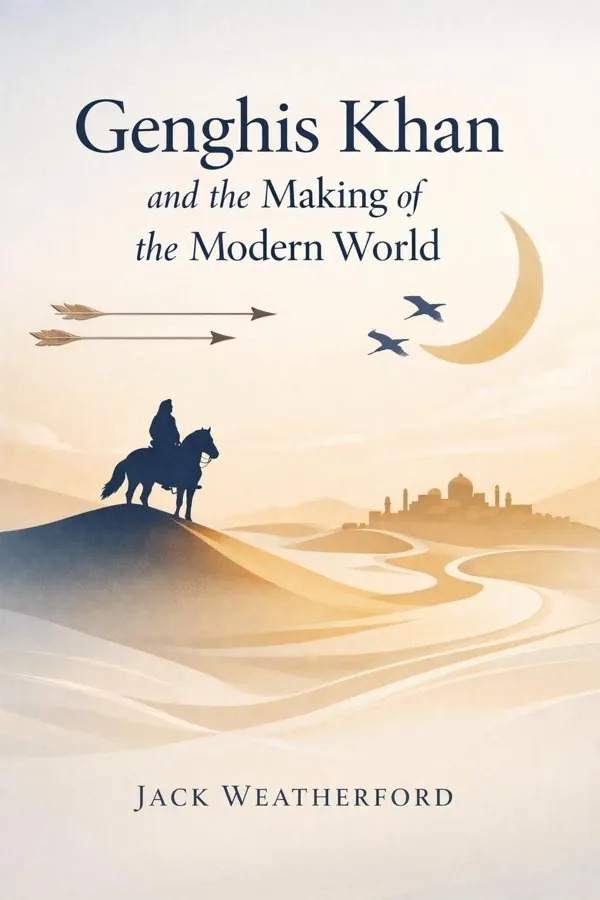
Genghis Khan and the Making of the Modern World: Summary & Key Insights
 10 min10 chaptersAudio available
Key Takeaways from Genghis Khan and the Making of the Modern World
Great leaders are often shaped less by privilege than by instability, and Temüjin’s early life is the clearest proof of that principle.
The most revolutionary thing Genghis Khan did may not have been conquering empires, but redesigning power itself.
Military dominance is rarely just about courage; it is usually about systems, speed, and information.
Conquest often destroys, but it can also reorder entire civilizations in unexpected ways.
History often remembers the Mongol invasions of Central Asia and the Islamic world for their destruction, but Weatherford insists that this is only half the story.
What Is Genghis Khan and the Making of the Modern World About?
Genghis Khan and the Making of the Modern World by Jack Weatherford is a world_history book spanning 12 pages. Jack Weatherford’s Genghis Khan and the Making of the Modern World is a bold revisionist history that challenges one of the most entrenched images in world history. Rather than depicting Genghis Khan solely as a savage conqueror, Weatherford presents him as a political innovator, military strategist, and empire builder whose rule reshaped Eurasia and helped lay foundations for the modern age. Drawing on newly available Mongolian sources, Persian chronicles, and anthropological insight, the book argues that the Mongol Empire did more than conquer territory: it connected civilizations, accelerated trade, spread technologies, protected merchants, promoted religious tolerance, and encouraged cross-cultural exchange on an unprecedented scale. This matters because it forces readers to rethink how modernity emerged—not just from Europe, but through vast networks linking East and West. Weatherford writes with the authority of both a scholar and a field researcher deeply familiar with nomadic societies and Mongolian history. The result is a vivid, accessible, and often surprising account of how a man born on the steppe transformed the world in ways that still echo through global commerce, governance, communication, and international exchange.
This FizzRead summary covers all 10 key chapters of Genghis Khan and the Making of the Modern World in approximately 10 minutes, distilling the most important ideas, arguments, and takeaways from Jack Weatherford's work. Also available as an audio summary and Key Quotes Podcast.
Genghis Khan and the Making of the Modern World
Jack Weatherford’s Genghis Khan and the Making of the Modern World is a bold revisionist history that challenges one of the most entrenched images in world history. Rather than depicting Genghis Khan solely as a savage conqueror, Weatherford presents him as a political innovator, military strategist, and empire builder whose rule reshaped Eurasia and helped lay foundations for the modern age. Drawing on newly available Mongolian sources, Persian chronicles, and anthropological insight, the book argues that the Mongol Empire did more than conquer territory: it connected civilizations, accelerated trade, spread technologies, protected merchants, promoted religious tolerance, and encouraged cross-cultural exchange on an unprecedented scale. This matters because it forces readers to rethink how modernity emerged—not just from Europe, but through vast networks linking East and West. Weatherford writes with the authority of both a scholar and a field researcher deeply familiar with nomadic societies and Mongolian history. The result is a vivid, accessible, and often surprising account of how a man born on the steppe transformed the world in ways that still echo through global commerce, governance, communication, and international exchange.
Who Should Read Genghis Khan and the Making of the Modern World?
This book is perfect for anyone interested in world_history and looking to gain actionable insights in a short read. Whether you're a student, professional, or lifelong learner, the key ideas from Genghis Khan and the Making of the Modern World by Jack Weatherford will help you think differently.
- ✓Readers who enjoy world_history and want practical takeaways
- ✓Professionals looking to apply new ideas to their work and life
- ✓Anyone who wants the core insights of Genghis Khan and the Making of the Modern World in just 10 minutes
Want the full summary?
Get instant access to this book summary and 100K+ more with Fizz Moment.
Get Free SummaryAvailable on App Store • Free to download
Key Chapters
Great leaders are often shaped less by privilege than by instability, and Temüjin’s early life is the clearest proof of that principle. Before he became Genghis Khan, he was a boy abandoned to danger on the Mongolian steppe after his father’s poisoning. His family was cast out, left to survive through hunting, scavenging, and vigilance. In this harsh environment, Temüjin learned that inherited status meant little if it could not protect people, and that loyalty was more valuable than lineage. These early experiences became the foundation of his later political philosophy.
Weatherford shows that Temüjin’s rise was not inevitable. He endured betrayal, enslavement, shifting alliances, and the constant threat of annihilation from rival tribes. Yet each crisis taught him something crucial: fragmented societies cannot endure, and fear alone cannot produce durable loyalty. He began to value competence over aristocratic bloodlines and personal trust over tribal tradition. This was radical in a world organized around clan identity.
A practical modern parallel can be seen in organizations facing rapid disruption. Leaders who emerge from hardship often focus less on preserving hierarchy and more on building resilient systems based on performance, adaptability, and mutual commitment. Temüjin’s early struggles made him skeptical of inherited elites and attentive to practical talent—traits that later enabled him to unify a fractured people.
The larger lesson is that adversity can sharpen strategic clarity. Instead of seeing difficult beginnings as purely limiting, Weatherford invites readers to see how hardship can reveal what actually holds communities together. Actionable takeaway: examine whether your own team, institution, or personal network is built on titles and assumptions, or on proven trust, shared purpose, and competence under pressure.
The most revolutionary thing Genghis Khan did may not have been conquering empires, but redesigning power itself. On the steppe, tribal politics had long been dominated by aristocratic lineage, hereditary privilege, and chronic feuds. Weatherford argues that Genghis Khan broke this pattern by creating a new social order based on loyalty, military ability, and administrative talent rather than noble birth. This shift transformed the Mongols from a loose cluster of rival clans into a disciplined and expandable political community.
He reorganized society in decimal units, mixing people from different tribes so old loyalties would weaken and a broader Mongol identity could emerge. Men who proved themselves in battle or governance could rise, even if they came from humble origins. Trusted companions from difficult years became generals and advisors. At the same time, aristocrats who resisted unity could be sidelined or eliminated. This was harsh state-building, but it was also organizational innovation.
The importance of this idea extends far beyond medieval history. Merit-based systems are more adaptable because they reward performance and create incentives for excellence. Companies, governments, and institutions often fail when status is inherited, insulated, or detached from real ability. Genghis Khan understood that a mobile, expansionist society needed capable people in the right roles, not simply prestigious names at the top.
Weatherford does not romanticize the process; force and fear were part of unification. Yet he insists that violence alone cannot explain Mongol success. The deeper reason was structural: Genghis Khan built an order in which talent could be mobilized at scale. Actionable takeaway: if you want a group to perform beyond its limits, reduce dependence on entrenched hierarchy and create clear paths for trustworthy, capable people to rise.
Military dominance is rarely just about courage; it is usually about systems, speed, and information. Weatherford shows that the Mongol army succeeded not because it was merely brutal, but because it was one of the most sophisticated fighting forces of its era. Genghis Khan combined mobility, discipline, intelligence gathering, psychological warfare, and flexible tactics into a machine that repeatedly outmaneuvered larger and wealthier enemies.
The Mongol cavalry moved with extraordinary speed, often carrying multiple horses per rider to maintain momentum. Archers could attack while in motion, retreat deceptively, and return with devastating precision. Communication was efficient, chain of command was clear, and units were trained to coordinate rather than fight as isolated bands. Just as important, the Mongols adapted. They absorbed siege techniques from Chinese engineers, administrative methods from conquered peoples, and regional knowledge from local allies.
Weatherford emphasizes that the Mongols treated information as a weapon. Scouts, spies, and merchants helped map routes, resources, rivalries, and weaknesses. They attacked where enemies were divided and avoided predictable engagements. Fear also became part of their strategy: cities that resisted could be annihilated, while those that surrendered might be spared and incorporated.
Modern readers can recognize familiar principles here. Agile organizations often beat larger rivals by moving faster, learning faster, and coordinating better. Success comes not from rigidity but from disciplined adaptability. Whether in business, public policy, or personal projects, superior execution often depends on logistics, communication, and intelligence more than raw force.
Actionable takeaway: do not confuse strength with size. Build systems that prioritize speed, accurate information, adaptability, and coordinated execution, because these are the real force multipliers in any competitive environment.
Conquest often destroys, but it can also reorder entire civilizations in unexpected ways. Weatherford presents the Mongol expansion into northern China not simply as an episode of devastation, but as a turning point that changed the political and technological landscape of East Asia. Genghis Khan and his successors confronted a sophisticated sedentary civilization vastly different from steppe life, and in doing so they learned to govern complexity on a new scale.
The campaigns against the Jin dynasty were brutal, yet they also pushed the Mongols to adopt tools they did not previously possess. They incorporated Chinese engineers, siege experts, administrators, and tax systems. This interaction expanded Mongol capacity from tribal confederation to imperial governance. Over time, Mongol rule in China helped circulate paper money, gunpowder-related technologies, printing techniques, and bureaucratic practices across Eurasia. Weatherford argues that the Mongols were not passive borrowers; they became carriers and accelerators of exchange.
For modern readers, this chapter illustrates a difficult but important truth: contact between radically different systems often produces innovation. The Mongols did not remain isolated nomads after meeting Chinese urban civilization; they selectively absorbed what was useful and integrated it into their own model. Strong cultures are not necessarily those that resist outside influence, but those that can evaluate, adapt, and redeploy it effectively.
This has clear application today in organizations facing globalization or technological change. The instinct to reject unfamiliar methods can be costly. Learning from more advanced or simply different systems can expand what is possible. Actionable takeaway: when entering unfamiliar territory, do not ask only how to dominate it; ask what capabilities, tools, and knowledge you can learn from it and integrate into your own structure.
History often remembers the Mongol invasions of Central Asia and the Islamic world for their destruction, but Weatherford insists that this is only half the story. The campaigns against the Khwarazmian Empire were triggered in part by diplomatic and commercial conflict, especially the killing of Mongol envoys and merchants. The Mongol response was catastrophic for the region’s ruling elites and urban centers, yet from that violence emerged a new political geography: the heart of Eurasia became more connected than it had been in centuries.
Once conquered, many areas of Central Asia were folded into a transcontinental network of routes, protections, and exchanges. Scholars, artisans, doctors, traders, and religious figures moved more widely under Mongol rule than before. Technologies and ideas traveled across boundaries that had once been fragmented by hostile states and local tolls. Weatherford highlights the paradox: an empire built through war also became an engine of circulation.
This does not excuse the suffering. Cities were destroyed, populations massacred, and local orders uprooted. But Weatherford’s broader point is that historical consequences cannot be reduced to moral labels alone. The Mongols did not merely tear down; they restructured space. In practical terms, they made long-distance exchange more feasible by suppressing rival powers and standardizing protection.
Modern application can be found in infrastructure and institutional design. Regions stagnate when movement is blocked by fragmentation, corruption, and insecurity. They flourish when networks are reliable and barriers are lowered. Actionable takeaway: if you want innovation, trade, and collaboration to thrive, focus on creating secure, trusted corridors—whether physical, digital, or organizational—that allow people, goods, and ideas to move efficiently across former divides.
Empires do not endure through fear alone; they require rules that make power legible. One of Weatherford’s most important arguments is that Genghis Khan was not merely a conqueror but a lawgiver and institutional thinker. He developed a governing framework, often associated with the Yassa, that emphasized order, discipline, loyalty, military obligation, protection of envoys, and regulation of public life across a vast and diverse empire.
Whether every detail traditionally attributed to the Yassa is historically certain matters less than the larger point: Genghis Khan sought predictable administration. He promoted census-taking, organized taxation, established systems of communication and relay posts, and delegated authority through trusted officials. He also practiced a form of religious tolerance unusual for the period, allowing Buddhists, Muslims, Christians, and others to coexist so long as they did not challenge imperial order. This reduced ideological friction and made pragmatic governance possible across many cultures.
Weatherford suggests that this administrative flexibility was one reason the empire grew so quickly. Instead of imposing a single culture everywhere, the Mongols often preserved local administrators, artisans, and clerics while integrating them into imperial systems. This approach resembles modern governance models that prize interoperability over uniformity.
The broader lesson is highly relevant today: sustainable leadership depends on institutions, not charisma alone. A founder may inspire action, but only clear rules, efficient administration, and reliable channels of communication can scale a system beyond one individual. Actionable takeaway: if you are building anything meant to last—a business, movement, or institution—translate vision into repeatable processes, transparent expectations, and practical structures that others can operate without constant personal intervention.
Prosperity often follows safety more than brilliance, and Weatherford argues that one of the Mongols’ greatest achievements was making exchange safer across enormous distances. Under Mongol dominion, major portions of the Silk Road were brought under unified or coordinated rule. Merchants gained protections, passports or safe-conduct systems eased travel, relay stations improved communication, and commercial activity became more predictable. The result was not just more trade, but denser interaction between civilizations.
Goods moved across Eurasia—silk, spices, metals, textiles, medicines—but so did techniques and knowledge. Paper, printing methods, gunpowder applications, artistic styles, agricultural products, astronomical insights, and medical practices crossed boundaries more quickly. Weatherford portrays the Mongol Empire as a giant circulatory system through which the inventions of one region could become the tools of another.
This exchange also affected culture. Court life, cuisine, diplomacy, religion, and scholarship were shaped by new forms of contact. Travelers like Marco Polo became possible because the empire created routes where movement was more secure than before. Though Europe often later claimed many advances as part of its own rise, Weatherford insists that these developments emerged from a much broader Eurasian network.
For contemporary readers, the lesson is straightforward: innovation thrives in ecosystems that lower friction between different people and domains. Creativity is rarely isolated; it is usually imported, remixed, and transmitted. Teams and societies that protect exchange tend to outgrow those that hoard it. Actionable takeaway: create environments where information, talent, and resources can circulate widely and safely, because long-term advancement depends less on isolated genius than on well-connected networks.
Sometimes the most transformative empires are those that connect worlds that barely understood each other before. Weatherford uses the term Pax Mongolica to describe the relative stability imposed across much of Eurasia after the initial waves of conquest. This peace was imperfect and uneven, but it enabled merchants, diplomats, missionaries, and scholars to travel farther and faster than they previously could. In that sense, the Mongol Empire became an early framework for globalization.
Europe, though never fully conquered at its western edge, was deeply affected. Mongol pressure shattered assumptions about military superiority, stimulated diplomatic outreach to Asia, and widened Europe’s awareness of other civilizations. Routes opened or stabilized under Mongol influence helped transmit technologies, luxuries, and knowledge westward. Weatherford suggests that aspects of the European Renaissance and later global expansion cannot be fully understood without recognizing the connective role of the Mongol world.
At the same time, this integration carried risks. Along with trade came disease, most notably the plague, which also traveled through interconnected networks. Weatherford does not ignore this dark side; instead, he underscores a modern truth: connectivity magnifies both opportunity and vulnerability.
This idea is highly applicable today. Global systems create access to markets, ideas, and partnerships, but they also spread shocks—financial crises, pandemics, cyber threats, and political instability. The solution is not isolation, but more intelligent resilience within connected systems. Actionable takeaway: embrace the power of networks, but build safeguards as well. The same channels that carry growth can also carry disruption, so every interconnected system needs both openness and preparedness.
Building an empire is one challenge; transferring it is another entirely. Weatherford shows that after Genghis Khan’s death, the central problem became succession. He had created institutions strong enough to survive him initially, but no system could fully eliminate rivalry among descendants ruling immense and profitable territories. As the empire expanded, it became harder to preserve unity across vast distances, diverse populations, and competing family branches.
His successors, especially Ögedei, continued expansion and administration effectively for a time. But over generations, the empire divided into major khanates: the Yuan in China, the Ilkhanate in Persia, the Chagatai Khanate in Central Asia, and the Golden Horde in the western steppes and Russia. These successor states shared Mongol origins but increasingly pursued their own political interests, cultural adaptations, and dynastic ambitions. Some embraced local religions and customs. Others fought one another. The very flexibility that had once made Mongol rule effective also made fragmentation easier.
Weatherford’s analysis has broad relevance. Founders often assume that a strong mission will naturally persist, but succession reveals whether an organization truly has durable alignment. Without clear mechanisms for leadership transfer, conflict resolution, and distributed legitimacy, even the most successful system can splinter.
The decline of Mongol unity was not simply failure; many successor states remained powerful and culturally significant. Still, the imperial whole could not hold indefinitely. Actionable takeaway: if you are building something larger than yourself, plan early for succession. Clarify authority, decision-making, and continuity before success makes those questions more dangerous and more expensive to answer.
Historical reputations often say as much about later storytellers as about the people being judged. Weatherford’s final and most provocative contribution is his reassessment of Genghis Khan’s legacy. In many Western narratives, Genghis Khan appears as the embodiment of barbarism, remembered mainly for slaughter and destruction. Weatherford does not deny the bloodshed, but he argues that this image is incomplete and politically shaped. Sedentary civilizations that suffered under the Mongols wrote many of the surviving accounts, while Mongol achievements in administration, exchange, and statecraft were minimized or ignored.
By drawing on Mongolian sources and reconsidering Eurasian history as an interconnected whole, Weatherford presents Genghis Khan as a catalyst of modernity in unexpected ways. He promoted meritocracy, protected commerce, practiced relative religious tolerance, facilitated diplomatic immunity, and fostered transcontinental flows of knowledge. These contributions, Weatherford argues, mattered profoundly to the development of the modern world.
The deeper lesson is methodological. History is not just a list of facts; it is also an argument about significance, perspective, and voice. The book teaches readers to question inherited narratives, especially those that divide peoples too neatly into civilized and uncivilized, advanced and backward. Such categories often hide complexity.
In practical terms, this approach can change how we evaluate leaders, institutions, and cultures today. Simplistic labels obscure mixed legacies and prevent serious understanding. Actionable takeaway: when assessing any controversial figure or system, look beyond dominant stereotypes. Ask who created the narrative, what evidence was excluded, and what becomes visible when you widen the frame.
All Chapters in Genghis Khan and the Making of the Modern World
About the Author
Jack Weatherford is an American anthropologist, historian, and bestselling author known for making global history more inclusive and accessible. He served as the DeWitt Wallace Professor of Anthropology at Macalester College, where he focused on culture, power, and the histories of peoples often overlooked in traditional Western narratives. Weatherford’s scholarship frequently explores indigenous societies and non-European civilizations, with particular attention to the Mongol Empire and its world-changing influence. His best-known work, Genghis Khan and the Making of the Modern World, helped reshape popular understanding of Genghis Khan by highlighting the Mongol role in trade, governance, religious tolerance, and cultural exchange across Eurasia. Combining academic rigor with engaging storytelling, Weatherford has earned a wide readership among both scholars and general readers interested in rethinking world history.
Get This Summary in Your Preferred Format
Read or listen to the Genghis Khan and the Making of the Modern World summary by Jack Weatherford anytime, anywhere. FizzRead offers multiple formats so you can learn on your terms — all free.
Available formats: App · Audio · PDF · EPUB — All included free with FizzRead
Download Genghis Khan and the Making of the Modern World PDF and EPUB Summary
Key Quotes from Genghis Khan and the Making of the Modern World
“Great leaders are often shaped less by privilege than by instability, and Temüjin’s early life is the clearest proof of that principle.”
“The most revolutionary thing Genghis Khan did may not have been conquering empires, but redesigning power itself.”
“Military dominance is rarely just about courage; it is usually about systems, speed, and information.”
“Conquest often destroys, but it can also reorder entire civilizations in unexpected ways.”
“History often remembers the Mongol invasions of Central Asia and the Islamic world for their destruction, but Weatherford insists that this is only half the story.”
Frequently Asked Questions about Genghis Khan and the Making of the Modern World
Genghis Khan and the Making of the Modern World by Jack Weatherford is a world_history book that explores key ideas across 10 chapters. Jack Weatherford’s Genghis Khan and the Making of the Modern World is a bold revisionist history that challenges one of the most entrenched images in world history. Rather than depicting Genghis Khan solely as a savage conqueror, Weatherford presents him as a political innovator, military strategist, and empire builder whose rule reshaped Eurasia and helped lay foundations for the modern age. Drawing on newly available Mongolian sources, Persian chronicles, and anthropological insight, the book argues that the Mongol Empire did more than conquer territory: it connected civilizations, accelerated trade, spread technologies, protected merchants, promoted religious tolerance, and encouraged cross-cultural exchange on an unprecedented scale. This matters because it forces readers to rethink how modernity emerged—not just from Europe, but through vast networks linking East and West. Weatherford writes with the authority of both a scholar and a field researcher deeply familiar with nomadic societies and Mongolian history. The result is a vivid, accessible, and often surprising account of how a man born on the steppe transformed the world in ways that still echo through global commerce, governance, communication, and international exchange.
More by Jack Weatherford
You Might Also Like
The Age of Capital
Eric Hobsbawm
10 min
The Gulag Archipelago
Aleksandr Solzhenitsyn
10 min
Jerusalem: The Biography
Simon Sebag Montefiore
10 min
The Anglo-Saxons
James Campbell
10 min
The Boer War
Thomas Pakenham
10 min
The Industrial Revolutionaries: The Making of the Modern World 1776–1914
Gavin Weightman
10 minBrowse by Category
Ready to read Genghis Khan and the Making of the Modern World?
Get the full summary and 100K+ more books with Fizz Moment.