
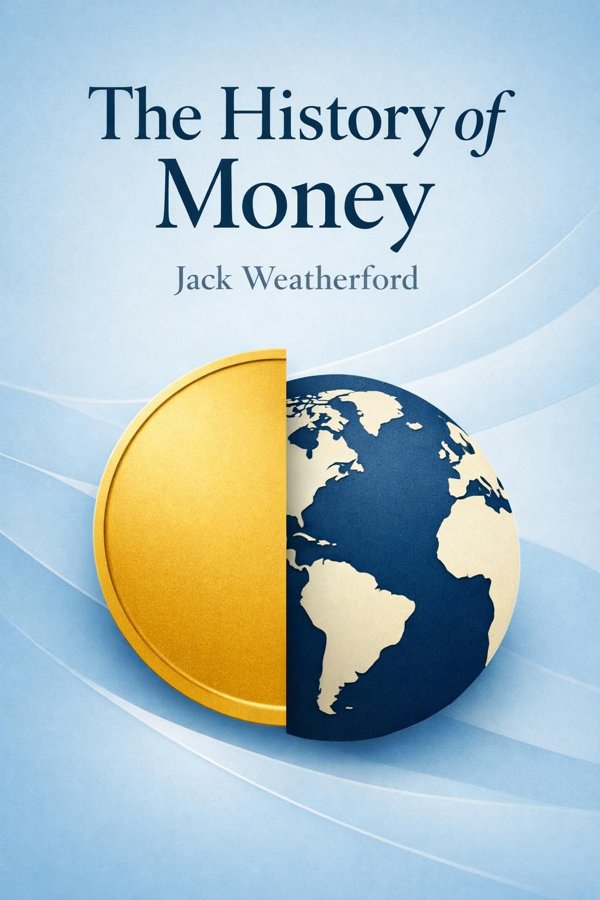
The History of Money: Summary & Key Insights
 10 min9 chaptersAudio available
Key Takeaways from The History of Money
A society can survive without formal money for a time, but it cannot grow very far on barter alone.
Money began not as economics in the modern sense, but as social trust made tangible.
Coins did more than make trade easier; they helped build political order.
Money is never only about buying and selling; it also reflects what a society believes is right, sacred, or dangerous.
One of the boldest leaps in financial history occurred when societies agreed that a piece of paper could represent value as effectively as metal.
What Is The History of Money About?
The History of Money by Jack Weatherford is a economics book spanning 13 pages. Money is so familiar that most people rarely stop to ask what it really is. Yet behind every coin, banknote, credit card, and digital transfer lies a deep human story about trust, power, exchange, and imagination. In The History of Money, Jack Weatherford traces that story across centuries, showing how money evolved from simple barter and ritual valuables into the vast global financial systems that shape modern life. Rather than treating money as a purely economic tool, Weatherford reveals it as a cultural invention that transformed politics, religion, warfare, social status, and international trade. What makes this book especially valuable is Weatherford’s broad perspective. As an anthropologist as well as a historian of culture, he looks beyond markets and numbers to explore how different societies understood value itself. He connects ancient shells and metal ornaments to imperial coinage, paper currency, banking, capitalism, and electronic money, making a complex topic feel human and accessible. The result is a rich, engaging account of how money did not simply emerge to serve civilization, but actively helped create the world we live in today.
This FizzRead summary covers all 9 key chapters of The History of Money in approximately 10 minutes, distilling the most important ideas, arguments, and takeaways from Jack Weatherford's work. Also available as an audio summary and Key Quotes Podcast.
The History of Money
Money is so familiar that most people rarely stop to ask what it really is. Yet behind every coin, banknote, credit card, and digital transfer lies a deep human story about trust, power, exchange, and imagination. In The History of Money, Jack Weatherford traces that story across centuries, showing how money evolved from simple barter and ritual valuables into the vast global financial systems that shape modern life. Rather than treating money as a purely economic tool, Weatherford reveals it as a cultural invention that transformed politics, religion, warfare, social status, and international trade.
What makes this book especially valuable is Weatherford’s broad perspective. As an anthropologist as well as a historian of culture, he looks beyond markets and numbers to explore how different societies understood value itself. He connects ancient shells and metal ornaments to imperial coinage, paper currency, banking, capitalism, and electronic money, making a complex topic feel human and accessible. The result is a rich, engaging account of how money did not simply emerge to serve civilization, but actively helped create the world we live in today.
Who Should Read The History of Money?
This book is perfect for anyone interested in economics and looking to gain actionable insights in a short read. Whether you're a student, professional, or lifelong learner, the key ideas from The History of Money by Jack Weatherford will help you think differently.
- ✓Readers who enjoy economics and want practical takeaways
- ✓Professionals looking to apply new ideas to their work and life
- ✓Anyone who wants the core insights of The History of Money in just 10 minutes
Want the full summary?
Get instant access to this book summary and 100K+ more with Fizz Moment.
Get Free SummaryAvailable on App Store • Free to download
Key Chapters
A society can survive without formal money for a time, but it cannot grow very far on barter alone. Weatherford begins with this basic but powerful insight: direct exchange is too limited to support complex communities. In a barter system, each side must want exactly what the other offers at the same moment. A fisher may have more catch than he can eat, while a weaver may need tools rather than fish. Even when trade is possible, barter makes it difficult to compare value, store wealth, or pay obligations over time.
This is why early societies searched for better ways to organize exchange. Money did not appear because people suddenly became more rational; it emerged because human life became more interconnected. As villages grew into towns and trade routes expanded, people needed a shared medium that could simplify transactions and reduce uncertainty. Weatherford shows that money solved practical problems, but it also changed how people thought. Once value could be measured, saved, and transferred more easily, economic relationships became more abstract and more scalable.
You can still see the limits of barter today. Imagine trying to pay rent with homemade bread, or trade a used bicycle for several months of electricity. Modern life depends on a system where value is portable and widely recognized. Even digital payment apps are, in essence, a refined response to the same ancient problem.
Actionable takeaway: When thinking about money, start by seeing it as a solution to coordination problems. This perspective helps explain why stable, trusted payment systems matter so much for everyday life and economic growth.
Money began not as economics in the modern sense, but as social trust made tangible. Weatherford explores how shells, beads, feathers, salt, cattle, and metal ornaments served as early forms of money in different parts of the world. These objects were not valuable merely because they were useful. They mattered because communities collectively agreed they represented worth, obligation, status, or exchange power.
This is one of the book’s most important themes: money works because people believe in it. Cowrie shells traveled across continents not because of any intrinsic superiority, but because enough people accepted them. Wampum beads could carry ceremonial and economic meaning at once. Cattle represented both wealth and social standing. In each case, money was tied to culture as much as commerce.
Weatherford also shows that so-called primitive money was not primitive in intelligence. These systems reflected sophisticated social needs. Some forms of money were designed to circulate daily, while others were used for marriages, alliances, tribute, or ritual compensation. In other words, early societies understood that value is layered. A community may use one object for ordinary trade and another for sacred or political purposes.
Modern readers can apply this insight by looking beyond physical form. A dollar bill, a brand reputation, a loyalty point, and a cryptocurrency token all depend on collective belief. Their power comes from trust networks, not from substance alone.
Actionable takeaway: Ask of any form of money, investment, or asset: who trusts it, why do they trust it, and what would happen if that trust weakened? The answer reveals its real strength.
Coins did more than make trade easier; they helped build political order. Weatherford explains that the rise of coinage marked a turning point because stamped metal combined material value with state authority. A coin carried the image, guarantee, and power of the ruler who issued it. This made money not just a medium of exchange, but an instrument of governance.
Standardized coinage allowed states to tax more effectively, pay soldiers consistently, and manage trade across larger territories. Markets could expand because merchants no longer had to weigh metal or negotiate value from scratch in every transaction. Coinage created speed, comparability, and confidence. These practical improvements gave empires a major advantage. From Lydia and Greece to Rome and beyond, money became intertwined with military administration and imperial expansion.
But Weatherford also highlights a darker side. When rulers debased currency by reducing precious metal content, they undermined public confidence. Coinage thus exposed a recurring truth: money can strengthen a state, but misuse of money can weaken it just as quickly. Monetary stability became a test of political legitimacy.
This pattern still matters. Today’s central banks do not stamp silver denarii, but governments still rely on trusted currency to collect taxes, fund institutions, and maintain order. Inflation, currency collapse, and loss of confidence remain political as well as economic crises.
Actionable takeaway: Pay attention to how money and political power interact. To understand a nation’s stability, look not only at its laws or leaders, but also at the credibility of its currency and financial institutions.
Money is never only about buying and selling; it also reflects what a society believes is right, sacred, or dangerous. Weatherford traces how religions and moral traditions shaped attitudes toward wealth, lending, debt, and profit. In many civilizations, money existed within ethical boundaries. Certain forms of accumulation were admired, while others were condemned. Some transactions were considered legitimate commerce; others were seen as exploitation or spiritual corruption.
One recurring issue was usury, or charging interest on loans. Religious traditions often treated it with suspicion, especially when lending preyed on the vulnerable. Yet growing commercial life made credit indispensable. This tension pushed societies to debate an enduring question: when does finance support human flourishing, and when does it become predatory?
Weatherford’s broader point is that every monetary system carries a moral framework, whether explicit or hidden. Even modern capitalism rests on assumptions about fairness, obligation, risk, merit, and property. We often speak about markets as if they are neutral mechanisms, but they are shaped by values and power relations. The way a society taxes inheritance, regulates banks, forgives debt, or defines fraud reflects moral choices.
For modern readers, this insight is practical. When evaluating financial systems, it is not enough to ask whether they are efficient. We must also ask whether they distribute opportunities fairly, protect the vulnerable, and reward productive behavior rather than manipulation.
Actionable takeaway: In your own financial decisions, include an ethical lens. Ask not only, “Can this make money?” but also, “What incentives does this create, and whom does it help or harm?”
One of the boldest leaps in financial history occurred when societies agreed that a piece of paper could represent value as effectively as metal. Weatherford shows how paper money emerged out of practical pressures: coins were heavy, transport was risky, and expanding trade demanded more flexible systems. Once people accepted redeemable notes and state-backed paper currency, economies could move faster and operate at a larger scale.
China’s early innovations in paper money demonstrated both the promise and danger of this shift. Paper made long-distance trade easier and allowed governments to mobilize resources more efficiently. But it also created temptation. If authorities issued too much currency without maintaining trust or discipline, inflation followed. Here Weatherford illustrates a central paradox of monetary history: the more abstract money becomes, the more essential credibility becomes.
Paper money also changed the psychology of value. Gold and silver seemed naturally valuable because they were tangible and scarce. Paper exposed the truth more clearly: all money depends on shared confidence. This prepared the way for modern fiat currencies, which are valuable not because they can be exchanged for precious metals, but because states, markets, and citizens accept them.
Today, most people use money that is already highly abstract. Direct deposits, mobile transfers, and account balances are descendants of the same conceptual breakthrough that made paper currency possible.
Actionable takeaway: Treat monetary stability as a matter of trust, not just supply. When assessing a currency or economy, look at institutional credibility, fiscal discipline, and public confidence, because these are what give abstract money its real force.
Banking changed money from something people merely possessed into something they could multiply, borrow against, and project into the future. Weatherford explains how banks and credit systems transformed economic life by enabling people to move value across time as well as space. Instead of waiting until they had full resources in hand, merchants, rulers, and eventually ordinary citizens could finance plans in advance.
This was revolutionary. Credit made it possible to fund voyages, build infrastructure, expand businesses, and survive temporary shortages. It connected savers to borrowers and turned idle wealth into productive capital. Banking also reduced the need to transport physical money, lowering risk and increasing the efficiency of trade networks.
Yet the expansion of credit introduced fragility. Banks promise liquidity while lending for longer-term purposes, which creates structural tension. If too many depositors demand cash at once, panic can spread quickly. Weatherford’s historical account helps readers understand why bank failures, debt crises, and speculative bubbles are not accidents but recurring features of systems built on confidence.
This lesson remains highly relevant. Mortgages, student loans, venture funding, and government bonds all depend on trust in future repayment. Used wisely, credit expands opportunity. Used recklessly, it can trap individuals and destabilize entire economies.
Actionable takeaway: Think of credit as borrowed time. Before taking on debt or evaluating financial institutions, ask whether future income, productive use, and risk management truly support the promise being made.
Money does not move through history innocently. Weatherford shows that as monetary systems matured, they became powerful tools of colonial expansion and global trade. European empires did not simply conquer land and labor; they reorganized the world’s flows of silver, gold, goods, and credit. Money linked distant regions into a single economic web, but that integration often came through violence, extraction, and unequal exchange.
Colonial powers imposed currencies, redirected resources, and built trade systems designed to enrich imperial centers. Precious metals from the Americas fueled European finance. Plantation economies turned enslaved labor into profit. Indigenous systems of value were often displaced or absorbed into foreign monetary frameworks. In this sense, monetary history is also a history of domination.
At the same time, Weatherford does not present globalization as purely destructive. Expanding trade networks also spread technologies, institutions, and new forms of economic coordination. The same systems that intensified exploitation also enabled modern commerce and interdependence. This duality is central to the book: money connects the world, but the terms of connection matter enormously.
Modern globalization carries similar tensions. International capital can fund development, but it can also create dependency. Reserve currencies can stabilize trade, but they can also reinforce power imbalances. Supply chains generate abundance, yet often hide unequal labor conditions.
Actionable takeaway: When evaluating global markets, follow the money beneath the surface. Ask who sets the rules, who captures the gains, and who bears the costs. Understanding those patterns leads to more informed economic and civic choices.
Industrialization did not just increase production; it transformed the meaning of money itself. Weatherford describes how capitalism converted money from a medium of exchange into a dynamic engine of investment, wage labor, profit, and large-scale economic calculation. In preindustrial settings, money often circulated within relatively visible social relationships. In capitalist economies, it became embedded in factories, corporations, stock markets, and national finance systems that few individuals could fully grasp.
This shift made extraordinary growth possible. Capital could be pooled, machinery financed, labor specialized, and output expanded on a massive scale. Wealth was no longer tied mainly to land or treasure, but to productive enterprise and financial organization. The result was a dramatic increase in both prosperity and inequality.
Weatherford shows that industrial capitalism also deepened abstraction. Most people no longer handled money only as coins or notes; they encountered it as wages, prices, debts, shares, insurance, and financial claims. As economies grew more complex, the connection between real work and financial reward sometimes became harder to see. This widened the gap between productive investment and speculation, a theme that continues into the modern era.
Think about retirement funds, stock options, or algorithmic trading today. These are normal parts of economic life, yet they depend on layers of abstraction far removed from the earliest functions of money.
Actionable takeaway: In a capitalist economy, not all money activity creates equal value. Learn to distinguish between money that supports real production, useful services, and long-term resilience, and money that merely circulates through speculation without durable benefit.
Perhaps the most surprising lesson in Weatherford’s history is that modern money has become less physical, but not less real. The decline of the gold standard and the rise of electronic and digital money reveal a long-term trend: value increasingly rests on institutional trust, technical systems, and collective expectation rather than on precious metal reserves. Gold once seemed to anchor money in something objective and permanent. Yet the modern economy outgrew that model.
Weatherford explains that tying currency too rigidly to gold could limit economic flexibility, especially during crises. As governments moved away from gold-backed systems, fiat money became the norm. This gave states and central banks more room to respond to recessions, wars, and financial instability, but it also increased the importance of credibility, policy discipline, and sound governance.
Electronic payments pushed abstraction even further. Today, money moves instantly across borders through code, databases, and financial networks. Digital wallets, online banking, and cashless commerce feel radically new, yet they continue the same historical pattern: money evolves toward greater efficiency while demanding stronger systems of trust.
The future may include central bank digital currencies, private digital tokens, and new hybrid forms of payment. But Weatherford’s deeper point remains unchanged. Whether money is metal, paper, or pixels, its power depends on belief, authority, and social coordination.
Actionable takeaway: To navigate the future of finance, focus less on the form money takes and more on the trust architecture behind it: regulation, transparency, security, and the institutions that sustain confidence.
All Chapters in The History of Money
About the Author
Jack Weatherford is an American anthropologist and bestselling author known for bringing large historical subjects to life through clear, engaging storytelling. He taught anthropology at Macalester College and has written widely on culture, economics, empire, and the development of civilization. His work often combines scholarly research with a strong narrative sense, making complex historical processes accessible to general readers. Weatherford is especially interested in how human institutions evolve and how overlooked cultural forces shape the modern world. In addition to The History of Money, he is well known for Genghis Khan and the Making of the Modern World and Indian Givers. His anthropological perspective gives his writing unusual breadth, allowing him to connect economics not just to markets, but to belief systems, social organization, and political power.
Get This Summary in Your Preferred Format
Read or listen to the The History of Money summary by Jack Weatherford anytime, anywhere. FizzRead offers multiple formats so you can learn on your terms — all free.
Available formats: App · Audio · PDF · EPUB — All included free with FizzRead
Download The History of Money PDF and EPUB Summary
Key Quotes from The History of Money
“A society can survive without formal money for a time, but it cannot grow very far on barter alone.”
“Money began not as economics in the modern sense, but as social trust made tangible.”
“Coins did more than make trade easier; they helped build political order.”
“Money is never only about buying and selling; it also reflects what a society believes is right, sacred, or dangerous.”
“One of the boldest leaps in financial history occurred when societies agreed that a piece of paper could represent value as effectively as metal.”
Frequently Asked Questions about The History of Money
The History of Money by Jack Weatherford is a economics book that explores key ideas across 9 chapters. Money is so familiar that most people rarely stop to ask what it really is. Yet behind every coin, banknote, credit card, and digital transfer lies a deep human story about trust, power, exchange, and imagination. In The History of Money, Jack Weatherford traces that story across centuries, showing how money evolved from simple barter and ritual valuables into the vast global financial systems that shape modern life. Rather than treating money as a purely economic tool, Weatherford reveals it as a cultural invention that transformed politics, religion, warfare, social status, and international trade. What makes this book especially valuable is Weatherford’s broad perspective. As an anthropologist as well as a historian of culture, he looks beyond markets and numbers to explore how different societies understood value itself. He connects ancient shells and metal ornaments to imperial coinage, paper currency, banking, capitalism, and electronic money, making a complex topic feel human and accessible. The result is a rich, engaging account of how money did not simply emerge to serve civilization, but actively helped create the world we live in today.
More by Jack Weatherford

You Might Also Like
Business Adventures
John Brooks
10 min
Nudge
Richard H. Thaler, Cass R. Sunstein
10 min
The Hitchhiker"s Guide to the Galaxy
Douglas Adams
10 minThe Muqaddimah
Ibn Khaldun
10 minThe Outsiders
William N. Thorndike
10 min
A Little History of Economics
Niall Kishtainy
10 minBrowse by Category
Ready to read The History of Money?
Get the full summary and 100K+ more books with Fizz Moment.