
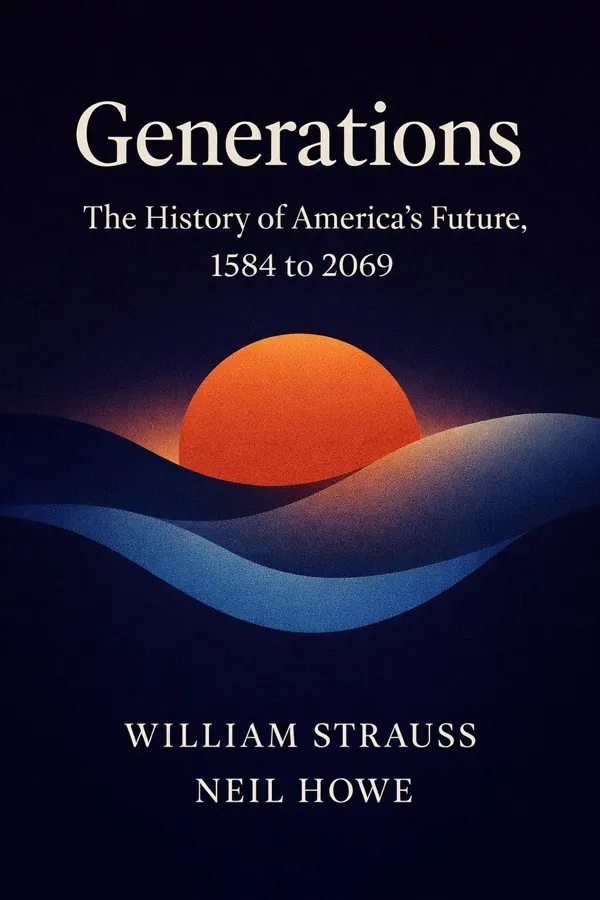
Generations: The History of America's Future, 1584 to 2069: Summary & Key Insights
 10 min9 chaptersAudio available
Key Takeaways from Generations: The History of America's Future, 1584 to 2069
A generation is more than an age bracket; it is a social personality formed by history.
Societies do not merely drift; they pass through recurring moods.
The deepest claim in Generations is that America’s recurring rhythms began long before the modern United States existed.
America’s great upheavals are not isolated explosions; in Strauss and Howe’s telling, they are recurring climax points in a larger civic rhythm.
One of the book’s most provocative contributions is its application of the generational cycle to modern American history.
What Is Generations: The History of America's Future, 1584 to 2069 About?
Generations: The History of America's Future, 1584 to 2069 by William Strauss, Neil Howe is a sociology book spanning 7 pages. Generations: The History of America's Future, 1584 to 2069 is a bold work of social history that argues America does not simply move forward through random change or steady progress. Instead, William Strauss and Neil Howe propose that national life unfolds in recurring cycles shaped by generational succession. From the first English settlers to projected future Americans, they trace how each generation develops a distinct personality based on the era in which its members come of age, and how these generational identities combine to create repeating patterns in politics, culture, family life, and public institutions. What makes this book so influential is its ambition. Strauss, a historian and cultural analyst, and Howe, a historian, economist, and demographer, bring together archival research, demographic analysis, and a sweeping interpretation of American history. Their framework connects seemingly separate eras such as the Revolution, the Civil War, the Great Depression, and modern social change into one larger rhythm. Whether you find the theory convincing or controversial, it offers a powerful lens for understanding social mood, intergenerational conflict, and the forces that may shape America’s future.
This FizzRead summary covers all 9 key chapters of Generations: The History of America's Future, 1584 to 2069 in approximately 10 minutes, distilling the most important ideas, arguments, and takeaways from William Strauss, Neil Howe's work. Also available as an audio summary and Key Quotes Podcast.
Generations: The History of America's Future, 1584 to 2069
Generations: The History of America's Future, 1584 to 2069 is a bold work of social history that argues America does not simply move forward through random change or steady progress. Instead, William Strauss and Neil Howe propose that national life unfolds in recurring cycles shaped by generational succession. From the first English settlers to projected future Americans, they trace how each generation develops a distinct personality based on the era in which its members come of age, and how these generational identities combine to create repeating patterns in politics, culture, family life, and public institutions.
What makes this book so influential is its ambition. Strauss, a historian and cultural analyst, and Howe, a historian, economist, and demographer, bring together archival research, demographic analysis, and a sweeping interpretation of American history. Their framework connects seemingly separate eras such as the Revolution, the Civil War, the Great Depression, and modern social change into one larger rhythm. Whether you find the theory convincing or controversial, it offers a powerful lens for understanding social mood, intergenerational conflict, and the forces that may shape America’s future.
Who Should Read Generations: The History of America's Future, 1584 to 2069?
This book is perfect for anyone interested in sociology and looking to gain actionable insights in a short read. Whether you're a student, professional, or lifelong learner, the key ideas from Generations: The History of America's Future, 1584 to 2069 by William Strauss, Neil Howe will help you think differently.
- ✓Readers who enjoy sociology and want practical takeaways
- ✓Professionals looking to apply new ideas to their work and life
- ✓Anyone who wants the core insights of Generations: The History of America's Future, 1584 to 2069 in just 10 minutes
Want the full summary?
Get instant access to this book summary and 100K+ more with Fizz Moment.
Get Free SummaryAvailable on App Store • Free to download
Key Chapters
A generation is more than an age bracket; it is a social personality formed by history. Strauss and Howe argue that across American history, generations tend to reappear in four recurring archetypes: Prophet, Nomad, Hero, and Artist. Each archetype is shaped by the social environment of childhood and then expresses itself differently in adulthood. Prophets are values-driven, moralistic, and visionary, often born after a major crisis when society feels confident and orderly. Nomads grow up during cultural upheaval and become pragmatic, skeptical, and independent. Heroes are protected as children during unsettled times and later emerge as institution-building, team-oriented adults. Artists are overprotected in crisis eras and grow into sensitive, process-minded, and adaptive adults.
This framework is not meant to erase individuality. Rather, it highlights how common formative experiences can leave broad marks on a cohort. For example, a generation raised during social conformity may rebel as young adults, while one raised amid instability may prioritize safety and structure later in life. The authors use this pattern to explain why generations often clash at work, in politics, and in family life: they are responding not only to age, but to deeply different collective memories.
In practical terms, this idea can help explain why one generation may prize institutions while another distrusts them, or why some cohorts lead with ideals while others lead with realism. Managers, educators, and policymakers can use this lens to better anticipate communication styles, motivations, and blind spots across age groups.
Actionable takeaway: When analyzing social conflict or workplace tension, ask not just “How old are these people?” but “What historical conditions shaped their worldview?”
Societies do not merely drift; they pass through recurring moods. Strauss and Howe claim that American history unfolds through a cycle of four “turnings,” each lasting roughly two decades: High, Awakening, Unraveling, and Crisis. Together, these four phases form a saeculum, an approximately eighty- to ninety-year cycle roughly equal to a long human life.
A High follows a major crisis. Institutions are strong, social order is valued, and collective confidence runs high. An Awakening comes next, as people begin to resist conformity and seek inner meaning, spiritual authenticity, and personal liberation. Then comes an Unraveling, when institutions weaken, individualism intensifies, and social trust decays. Finally, a Crisis arrives: a period of emergency in which the nation is forced to rebuild public life through conflict, sacrifice, and institutional transformation.
The power of this model lies in how it ties cultural mood to generational timing. Different archetypes occupy different life stages during each turning, creating recurring social dramas. For example, idealistic midlife leaders may clash with pragmatic younger adults during an Unraveling, while a Hero generation may come of age just in time to confront a Crisis.
This framework helps readers reinterpret major historical periods. The post-World War II era resembles a High. The cultural revolutions of the 1960s and 1970s resemble an Awakening. The polarization and fragmentation of later decades fit the Unraveling pattern. Whether one accepts the pattern fully or not, it offers a compelling way to think about why social mood changes in waves rather than straight lines.
Actionable takeaway: When evaluating current events, consider which turning best matches the national mood; this can improve strategic thinking about what kinds of leadership and reform are likely to succeed.
The deepest claim in Generations is that America’s recurring rhythms began long before the modern United States existed. Strauss and Howe trace the pattern back to the colonial period, arguing that early settlers did not simply build institutions from scratch; they also began reproducing a long cycle of generational succession. Puritan, Cavalier, and other early Anglo-American cohorts were shaped by migration, religious struggle, frontier insecurity, and imperial politics, and these experiences created recognizably different collective temperaments.
By starting in 1584, the authors suggest that generational dynamics are not a side effect of industrialization, mass media, or modern consumer culture. Instead, they are rooted in how communities remember hardship, socialize children, and respond to changing public conditions over time. A generation raised amid religious mission and strict order develops different habits than one raised amid disorder, war, or expansion. Over decades, these differences produce predictable tensions between moral reformers, practical survivors, institution-builders, and sensitive adapters.
The colonial sections matter because they show the model operating in conditions very different from modern America. This broadens the theory’s ambition: if the same rhythm appears across agricultural colonies, revolutionary republics, industrial powers, and postwar superstates, then perhaps there really is a durable structure beneath national life.
For readers today, the practical lesson is historical humility. The emotional atmosphere of any era feels unique while you are living in it, yet many conflicts over authority, faith, family, and civic order have older echoes. Leaders who study long-range history may respond to present disruptions with less panic and more perspective.
Actionable takeaway: To better understand current American tensions, look beyond recent headlines and examine how similar debates about order, liberty, and identity appeared in early colonial generations.
America’s great upheavals are not isolated explosions; in Strauss and Howe’s telling, they are recurring climax points in a larger civic rhythm. The Revolutionary era and the Civil War era, though separated by generations and circumstances, both function as crisis periods in which institutional breakdown, moral conflict, and national danger force a redefinition of the American order. These crises do not emerge overnight. They are prepared gradually by earlier awakenings and unravelings that loosen consensus and intensify ideological division.
The authors show how generations play specific roles in these moments. Some cohorts provide fiery moral vision, framing the stakes in absolute terms. Others supply hard-bitten realism, surviving chaos and mistrusting lofty rhetoric. Still others come of age just as the nation requires disciplined collective action, making them especially suited to military service, institution-building, or reconstruction. This interplay helps explain why crises often feel both destructive and creative: one generation tears down illusions, another mobilizes, another rebuilds.
This perspective can sharpen how we read major turning points. The Revolution was not merely a tax revolt, nor the Civil War merely a constitutional dispute. Both were moments when accumulated social tensions and generational realignments made old compromises unsustainable. The result was not just victory or defeat, but a remaking of national identity.
In everyday application, this idea reminds us that institutions often resist change until pressure becomes overwhelming. Families, companies, and governments may postpone hard reforms until a crisis makes adaptation unavoidable. By then, the people best prepared to lead are often those whose formative years taught them either idealism, endurance, or coordinated action.
Actionable takeaway: When systems seem increasingly brittle, do not focus only on the triggering event; examine the generational buildup that has made transformative conflict more likely.
One of the book’s most provocative contributions is its application of the generational cycle to modern American history. Strauss and Howe connect the Progressive era, the world wars, the postwar boom, and the cultural revolutions of the late twentieth century into a coherent sequence rather than a series of disconnected episodes. In their view, the Progressive generation, the GI or Great Power generation, and the Baby Boom generation each embodied recurring archetypal traits and occupied different life stages during corresponding turnings.
This helps explain why twentieth-century America swung so dramatically between collective confidence and cultural rebellion. The civic mobilization of the Depression and World War II resembles a crisis-driven consolidation, while the postwar decades produced a High marked by strong institutions, growing prosperity, and social conformity. Then came the values revolts associated with the 1960s and 1970s, a classic Awakening in the authors’ model, followed by a late-century Unraveling characterized by distrust, fragmentation, and intensifying individualism.
What makes this useful is not just historical pattern-matching, but interpretive power. The model gives readers a framework for understanding why certain policy ideas, leadership styles, and cultural narratives resonate at some times and fail at others. Calls for sacrifice land differently in a High than in an Unraveling. Spiritual searching thrives where institutional confidence weakens. Polarization deepens when no common civic story holds.
For professionals in media, education, politics, or business, this lens can aid long-term forecasting. Public appetite shifts not randomly but according to larger mood patterns, especially as new generations enter adulthood and old ones exit positions of power.
Actionable takeaway: To make sense of modern political and cultural swings, map them against changing social moods and generational life stages rather than treating every decade as an isolated anomaly.
Strauss and Howe became especially well known for applying their framework to living and emerging generations. In Generations, they identify Generation X as a cohort shaped by institutional neglect, rising divorce, economic uncertainty, and cultural fragmentation. As a result, they portray this generation as pragmatic, self-protective, skeptical of authority, and highly adaptive, traits associated with the Nomad archetype. By contrast, they forecast that the generation following them, later widely labeled Millennials, would become a more group-oriented, civically minded, and institutionally engaged Hero archetype.
Whether one agrees with every characterization, the exercise reveals the practical ambition of the book. The authors are not merely cataloging the past; they are trying to infer likely social behaviors from childhood conditions. A generation raised amid anxiety and weak institutions may grow up independent but distrustful. A generation raised with intense parental investment and public concern for children may become more cooperative and achievement-oriented.
This has obvious applications in management, education, and public policy. Schools can ask how changing parenting styles affect classroom expectations. Employers can examine why some younger workers value autonomy while others seek teamwork and mission. Political strategists can consider whether an emerging generation is more responsive to freedom narratives, moral narratives, or civic-duty narratives.
The broader point is that generational labels are most useful when tied to formative experiences, not stereotypes. They become shallow when reduced to fashion, slang, or consumer preference. Strauss and Howe invite readers to connect social outcomes to childhood environment and public mood.
Actionable takeaway: When thinking about younger or older cohorts, focus less on clichés and more on what crises, family structures, and institutions shaped their early years.
The most daring part of Generations is its subtitle: The History of America’s Future. Strauss and Howe argue that if generational archetypes and turnings recur in sequence, then broad features of the future can be anticipated, even if specific events cannot. Their goal is not prophecy in the narrow sense, but pattern-based forecasting. By locating America late in an Unraveling at the time of writing, they suggested that a future crisis era was likely, one that would demand collective action and reorder institutions.
This kind of forecasting works more like seasonal prediction than event prediction. You may not know the exact storm, but you can identify the climate. In a Crisis era, for example, one might expect escalating institutional breakdown, demands for stronger authority, increased public sacrifice, and a redefinition of national purpose. During an Awakening, by contrast, the likely themes are personal authenticity, cultural rebellion, and spiritual searching.
The practical value of this approach lies in preparation. Governments can stress-test institutions. Businesses can rethink assumptions about consumer confidence, regulation, and labor expectations. Families can understand why young adults may be entering a more demanding civic climate than their parents did. Even if the theory is not perfectly predictive, it encourages long-range thinking in a culture often trapped in short-term reaction.
Of course, forecasting through historical analogy carries risks. Patterns can be forced, exceptions can be overlooked, and human agency still matters. But the authors’ central point remains useful: societies often ignore deep structural signals until they become unavoidable.
Actionable takeaway: Use generational theory not to predict exact events, but to prepare for broad shifts in social mood, institutional trust, and collective behavior.
Every generation thinks it is correcting the mistakes of the last one, yet Strauss and Howe show that generations also depend on one another to complete history’s cycle. Prophets challenge complacency. Nomads cut through illusion. Heroes rally institutions. Artists humanize power and soften rigid structures. These roles often produce conflict, but they are complementary as much as adversarial.
This insight matters because public debate often treats generations as moral caricatures: selfish elders, entitled youth, cynical middle-aged adults, fragile children. The book argues for a more structural view. Different cohorts are responding to different historical training. The idealists who seem unrealistic may be preserving moral purpose. The pragmatists who seem unromantic may be preventing chaos. The conformists who seem conventional may be holding institutions together. The sensitive mediators may be preserving social cohesion during stress.
You can see this dynamic in organizations. Founders often act like Prophets, animated by mission. Managers in chaotic growth phases often resemble Nomads, making hard choices under pressure. Expansion periods favor Heroic team-builders who can scale operations. Later, in more regulated and fragile conditions, Artist-like leaders may become essential for negotiation, process, and institutional healing.
This perspective can reduce unproductive blame. Instead of asking which generation is ruining society, we can ask what role each cohort is playing and what role is currently missing. Social systems break down not only when one type dominates, but when balance disappears.
Actionable takeaway: In teams, families, and public life, stop treating generational differences as defects alone; identify the strengths each cohort brings and the role needed most in the current moment.
The enduring influence of Generations comes partly from its elegance and partly from its controversy. The theory offers a strikingly coherent map of American history, but it also raises serious questions. Do generations truly fit four repeating archetypes, or does the model oversimplify diverse experiences? Can a nation as large and unequal as the United States really share one social mood at a time? Are historical events shaping generations, or are the authors fitting generations to events after the fact?
These critiques do not make the book irrelevant; they make it more useful when read critically. A strong framework should invite testing, comparison, and refinement. Readers can ask where the model illuminates hidden connections and where it smooths over regional, racial, class, or immigrant differences. They can compare the theory with other approaches from sociology, political science, and demography. In that sense, the book is best used not as unquestionable law but as a high-level interpretive tool.
Its practical value remains considerable. Even skeptics can benefit from its insistence that age cohorts matter, that childhood conditions leave lasting marks, and that social optimism and pessimism come in waves. The danger lies only in turning the framework into dogma. Once any theory becomes too neat, reality starts to disappear.
For serious readers, the right posture is disciplined openness: use the model to generate better questions, not to end inquiry. That is especially important when applying it to the present, where hindsight is unavailable and uncertainty is real.
Actionable takeaway: Read the book as a strategic lens, not a deterministic script; use its patterns to think more deeply, then test them against evidence and lived complexity.
All Chapters in Generations: The History of America's Future, 1584 to 2069
About the Authors
William Strauss and Neil Howe are the co-creators of one of the most influential modern theories of generational change. Strauss was an American writer, historian, playwright, and lecturer whose work often explored civic life, culture, and historical identity. Howe is an American historian, economist, and demographer known for his research on age cohorts, social trends, and long-term public dynamics. Together, they wrote several books that shaped public discussion about Baby Boomers, Generation X, and Millennials, including Generations and later The Fourth Turning. Their work blends historical narrative with demographic interpretation, offering a large-scale framework for understanding how generations form, clash, and reshape institutions. Though often debated, their ideas have had lasting impact in sociology, business, politics, and cultural analysis.
Get This Summary in Your Preferred Format
Read or listen to the Generations: The History of America's Future, 1584 to 2069 summary by William Strauss, Neil Howe anytime, anywhere. FizzRead offers multiple formats so you can learn on your terms — all free.
Available formats: App · Audio · PDF · EPUB — All included free with FizzRead
Download Generations: The History of America's Future, 1584 to 2069 PDF and EPUB Summary
Key Quotes from Generations: The History of America's Future, 1584 to 2069
“A generation is more than an age bracket; it is a social personality formed by history.”
“Societies do not merely drift; they pass through recurring moods.”
“The deepest claim in Generations is that America’s recurring rhythms began long before the modern United States existed.”
“America’s great upheavals are not isolated explosions; in Strauss and Howe’s telling, they are recurring climax points in a larger civic rhythm.”
“One of the book’s most provocative contributions is its application of the generational cycle to modern American history.”
Frequently Asked Questions about Generations: The History of America's Future, 1584 to 2069
Generations: The History of America's Future, 1584 to 2069 by William Strauss, Neil Howe is a sociology book that explores key ideas across 9 chapters. Generations: The History of America's Future, 1584 to 2069 is a bold work of social history that argues America does not simply move forward through random change or steady progress. Instead, William Strauss and Neil Howe propose that national life unfolds in recurring cycles shaped by generational succession. From the first English settlers to projected future Americans, they trace how each generation develops a distinct personality based on the era in which its members come of age, and how these generational identities combine to create repeating patterns in politics, culture, family life, and public institutions. What makes this book so influential is its ambition. Strauss, a historian and cultural analyst, and Howe, a historian, economist, and demographer, bring together archival research, demographic analysis, and a sweeping interpretation of American history. Their framework connects seemingly separate eras such as the Revolution, the Civil War, the Great Depression, and modern social change into one larger rhythm. Whether you find the theory convincing or controversial, it offers a powerful lens for understanding social mood, intergenerational conflict, and the forces that may shape America’s future.
More by William Strauss, Neil Howe
You Might Also Like
Between the World and Me
Ta-Nehisi Coates
10 min
Half the Sky
Nicholas D. Kristof, Sheryl WuDunn
10 min
Men Explain Things To Me
Rebecca Solnit
10 min
Rational Ritual
Michael Suk-Young Chwe
10 min
The New Jim Crow
Michelle Alexander
10 min
Beyond Culture
Edward T. Hall
10 minBrowse by Category
Ready to read Generations: The History of America's Future, 1584 to 2069?
Get the full summary and 100K+ more books with Fizz Moment.