
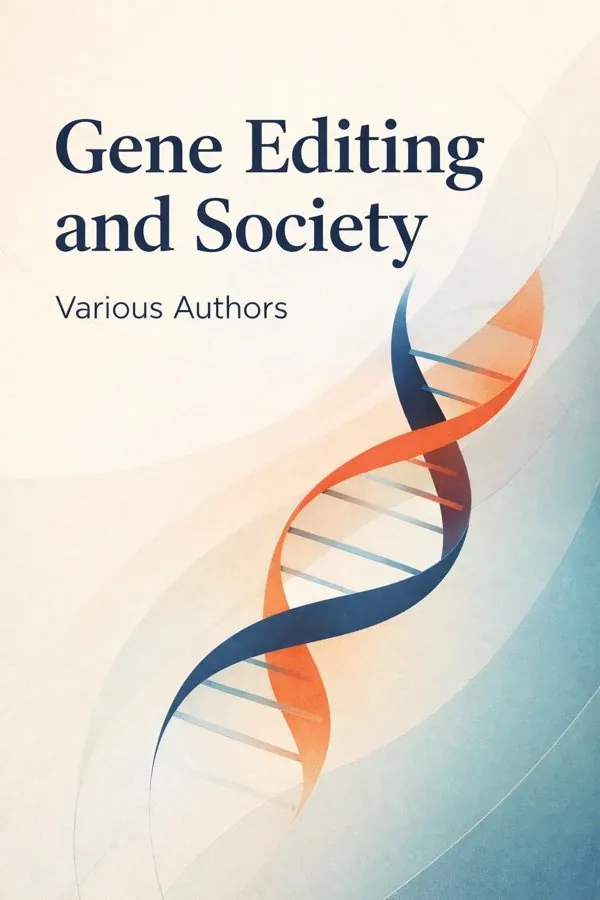
Gene Editing and Society: Summary & Key Insights
 10 min8 chaptersAudio available
Key Takeaways from Gene Editing and Society
This chapter traces that idea from the earliest recombinant DNA experiments to the rise of CRISPR-Cas9, showing how scientists moved from reading genes to actively revising them.
Few developments in modern medicine inspire as much hope and anxiety as the ability to edit disease at its genetic root.
Humanity has always edited nature indirectly through breeding, but gene editing compresses centuries of selection into a few targeted interventions.
The power to alter genes forces a deeper question than whether we can change life: what kinds of human futures should we choose to create?
A technology that can alter life itself cannot be left to scientific enthusiasm alone; it requires governance that is flexible, legitimate, and globally aware.
What Is Gene Editing and Society About?
Gene Editing and Society by Various Authors is a life_science book spanning 5 pages. Gene editing is no longer a distant scientific dream; it is a living force reshaping medicine, farming, public health, law, and even the way people think about what it means to be human. Gene Editing and Society brings together the perspectives of scientists, ethicists, and policy thinkers to examine this profound shift with both excitement and caution. At the center of the book is CRISPR and related technologies, tools that make it possible to alter DNA with unprecedented speed, accuracy, and affordability. But this is not just a book about laboratory technique. It is about power, responsibility, inequality, risk, and the social choices that will determine whether gene editing becomes a tool for shared human benefit or a source of division and harm. The contributors are especially credible because they write from across disciplines, combining technical knowledge with ethical and political insight. The result is a wide-ranging, accessible exploration of one of the most important questions of our age: now that we can rewrite life, how should we decide when, why, and for whom to do it?
This FizzRead summary covers all 8 key chapters of Gene Editing and Society in approximately 10 minutes, distilling the most important ideas, arguments, and takeaways from Various Authors's work. Also available as an audio summary and Key Quotes Podcast.
Gene Editing and Society
Gene editing is no longer a distant scientific dream; it is a living force reshaping medicine, farming, public health, law, and even the way people think about what it means to be human. Gene Editing and Society brings together the perspectives of scientists, ethicists, and policy thinkers to examine this profound shift with both excitement and caution. At the center of the book is CRISPR and related technologies, tools that make it possible to alter DNA with unprecedented speed, accuracy, and affordability. But this is not just a book about laboratory technique. It is about power, responsibility, inequality, risk, and the social choices that will determine whether gene editing becomes a tool for shared human benefit or a source of division and harm. The contributors are especially credible because they write from across disciplines, combining technical knowledge with ethical and political insight. The result is a wide-ranging, accessible exploration of one of the most important questions of our age: now that we can rewrite life, how should we decide when, why, and for whom to do it?
Who Should Read Gene Editing and Society?
This book is perfect for anyone interested in life_science and looking to gain actionable insights in a short read. Whether you're a student, professional, or lifelong learner, the key ideas from Gene Editing and Society by Various Authors will help you think differently.
- ✓Readers who enjoy life_science and want practical takeaways
- ✓Professionals looking to apply new ideas to their work and life
- ✓Anyone who wants the core insights of Gene Editing and Society in just 10 minutes
Want the full summary?
Get instant access to this book summary and 100K+ more with Fizz Moment.
Get Free SummaryAvailable on App Store • Free to download
Key Chapters
The most revolutionary technologies often begin with a deceptively simple idea, and gene editing is built on one of the simplest and most powerful ideas in science: if DNA stores biological instructions, then changing DNA can change life itself. This chapter traces that idea from the earliest recombinant DNA experiments to the rise of CRISPR-Cas9, showing how scientists moved from reading genes to actively revising them. Earlier tools such as zinc finger nucleases and TALENs demonstrated that targeted genome editing was possible, but they were expensive, complex, and difficult to scale. CRISPR changed the landscape because it made editing faster, cheaper, and more precise, allowing researchers around the world to test genetic changes in plants, animals, and human cells.
The book explains the underlying mechanism clearly: a guide RNA directs the Cas enzyme to a chosen DNA sequence, where it cuts the genome and triggers cellular repair processes. Scientists can then disable a gene, replace a faulty sequence, or insert a new one. That technical explanation matters because it helps readers understand why gene editing is so potent. It is not magic. It is programmable biology.
Practical applications already include editing crops for drought resistance, creating research models for disease, and correcting inherited mutations in experimental therapies. Yet the chapter also reminds us that precision is never absolute. Off-target effects, mosaicism, and incomplete understanding of gene interactions mean that every edit carries uncertainty.
Actionable takeaway: Before forming strong opinions about gene editing, learn the basic mechanics. Clear judgment on ethics and policy starts with understanding what the technology can and cannot actually do.
Few developments in modern medicine inspire as much hope and anxiety as the ability to edit disease at its genetic root. Gene Editing and Society shows why gene editing feels transformative: instead of only managing symptoms, scientists may be able to correct the mutations that cause suffering in the first place. This possibility is especially important for monogenic disorders such as sickle cell disease, cystic fibrosis, and certain inherited forms of blindness, where one faulty genetic instruction can have life-altering consequences.
The book explores how gene editing is being used in two major ways. In somatic editing, changes are made to non-reproductive cells, meaning they affect only the treated patient. This has already led to promising therapies in blood disorders and cancer immunotherapy. In germline editing, by contrast, changes would be made to embryos, sperm, or eggs, meaning future generations could inherit them. That distinction is scientifically crucial and ethically explosive.
Real-world examples help ground the discussion. Researchers have edited immune cells to better attack tumors, and experimental CRISPR treatments have restored or improved function in some patients with severe genetic conditions. But the contributors avoid hype. They note that delivery systems remain challenging, long-term side effects are not fully known, and access to treatment may be highly unequal. A cure that exists only for wealthy patients is not a complete medical victory.
The broader point is that medicine is never just about biology. It is also about cost, informed consent, trust, and the social meaning of normality and disability.
Actionable takeaway: When evaluating medical breakthroughs, ask not only whether a therapy works, but also who can access it, what risks remain, and how patient communities are included in decision-making.
Humanity has always edited nature indirectly through breeding, but gene editing compresses centuries of selection into a few targeted interventions. This chapter examines how CRISPR and related tools are transforming agriculture and environmental management, offering solutions to pressing problems such as food insecurity, crop disease, climate stress, and pesticide dependence. By editing genes linked to drought tolerance, nutrient efficiency, shelf life, and disease resistance, researchers can potentially create crops that are both more productive and more resilient.
The book highlights practical examples that make the stakes concrete. Scientists have developed rice varieties with improved tolerance to harsh conditions, tomatoes with altered ripening characteristics, and livestock with enhanced disease resistance. Gene editing can also support conservation and environmental goals, such as controlling invasive species or reducing the spread of vector-borne diseases. These possibilities make the technology attractive not only to commercial agriculture but also to public health and climate adaptation efforts.
Yet the chapter insists that technological promise does not erase ecological complexity. Genes operate within living systems and ecosystems, not in isolation. A crop edited for one trait may produce unintended consequences in soil interactions, biodiversity, or farming economics. There are also concerns about corporate concentration, seed ownership, and the possibility that farmers become more dependent on patented biotechnologies.
The authors push readers to think beyond the narrow question of whether a gene-edited organism is safe in the laboratory. The deeper question is whether its introduction supports sustainable food systems and equitable agricultural development.
Actionable takeaway: Treat gene-edited agriculture as a systems issue. Evaluate not just the trait being engineered, but also its environmental effects, ownership model, and impact on small farmers and long-term food resilience.
The power to alter genes forces a deeper question than whether we can change life: what kinds of human futures should we choose to create? This chapter explores the ethical terrain opened by gene editing, moving from familiar medical dilemmas into the more unsettling territory of identity, enhancement, disability, and human self-understanding. Correcting a devastating mutation may seem straightforward, but what about increasing height, memory, athletic ability, or resistance to aging? The line between therapy and enhancement is not always clear, and the book shows how quickly that ambiguity expands into larger moral debates.
A central insight is that genes are not merely technical targets. They are tied to how societies define normality, excellence, and worth. If some traits become editable, social pressure may grow to conform to preferred standards. Communities that have long argued for dignity and inclusion, including disability advocates, raise an important warning: reducing difference to defect can narrow our understanding of human value. Gene editing may relieve suffering, but it could also deepen stigma if society treats unedited or atypical lives as failures of optimization.
The book also engages with the notion of “playing God,” not to dismiss it, but to unpack what people mean when they use it. Often the concern is less theological than civic: no small group of experts should unilaterally decide what future humanity ought to become.
The chapter invites humility. Biological capability does not automatically equal moral legitimacy.
Actionable takeaway: In any discussion about human enhancement, ask whose values define improvement, whose voices are missing, and whether the change reduces suffering without reducing respect for human diversity.
A technology that can alter life itself cannot be left to scientific enthusiasm alone; it requires governance that is flexible, legitimate, and globally aware. This chapter examines how laws, institutions, and public norms struggle to keep pace with gene editing. Different countries regulate research, clinical use, agriculture, and embryo editing in very different ways. Some permit limited experimentation under strict oversight, while others impose broader prohibitions. This uneven landscape creates both opportunity and risk, including regulatory tourism, inconsistent safety standards, and ethical loopholes.
The book argues that governance is not just about restriction. Good governance enables beneficial innovation while creating accountability, transparency, and public trust. It asks practical questions: Who gets to approve human trials? How should off-target harms be monitored? What counts as meaningful informed consent when long-term consequences are uncertain? Who is liable if edited organisms cause ecological damage or if therapies produce unexpected effects years later?
A major contribution of the chapter is its emphasis on justice. If gene editing remains concentrated in wealthy countries, elite hospitals, or large agribusiness firms, its benefits will be distributed unevenly while its risks may be shared widely. The contributors stress that global responsibility includes affordable access, open scientific collaboration, and the inclusion of low- and middle-income countries in rule-setting.
The book makes clear that governance cannot be an afterthought added once products reach market. Social legitimacy must be built into research pathways from the start.
Actionable takeaway: Support policy frameworks that combine scientific oversight with public participation, international coordination, and explicit attention to fairness, affordability, and long-term accountability.
Breakthroughs do not succeed in society simply because they work in the lab; they succeed when people trust the institutions that develop, regulate, and explain them. This chapter focuses on the role of public understanding and scientific communication in shaping the future of gene editing. The contributors note that gene editing is especially vulnerable to misunderstanding because it sits between technical complexity and emotionally charged questions about disease, reproduction, and nature.
The book criticizes two common failures. The first is exaggerated optimism, where scientists, companies, or media outlets present gene editing as a near-miraculous solution to major problems. The second is fear-based simplification, where every genetic intervention is framed as dangerous tampering or a path to designer babies. Both distortions weaken democratic debate by replacing informed judgment with hype or panic.
Practical examples illustrate the stakes. Public backlash against poorly explained biotechnology can stall useful innovation, while secrecy or arrogance from experts can deepen mistrust. The unauthorized embryo editing case in China became a powerful example of how scientific misconduct can damage confidence far beyond a single experiment. In contrast, public engagement efforts that include patient groups, farmers, educators, and local communities can improve both policy quality and social legitimacy.
The authors emphasize that communication should not be a one-way process in which experts merely transmit facts to passive audiences. It should be a dialogue in which public concerns are heard as morally relevant, not treated as obstacles to progress.
Actionable takeaway: When discussing gene editing, avoid both hype and alarmism. Seek evidence, explain uncertainty honestly, and create space for non-experts to ask questions that shape the conversation.
Scientific revolutions are also economic revolutions, and gene editing is no exception. This chapter explores how patents, venture capital, pharmaceutical strategy, and intellectual property disputes influence which applications are pursued and who benefits from them. CRISPR became famous partly because of its scientific elegance, but also because control over its commercial use quickly became the subject of fierce legal and institutional competition. The book shows that ownership structures can shape innovation just as profoundly as technical possibility.
In medicine, companies may prioritize treatments for conditions with strong market returns rather than diseases that affect poorer populations. In agriculture, patent portfolios can increase corporate control over seeds, licensing, and supply chains. This does not mean private investment is inherently harmful; in many cases, commercial funding is essential for moving therapies from the lab to patients. But market logic can skew priorities away from the public good if not balanced by regulation, public funding, and alternative innovation models.
The contributors discuss practical tensions such as pricing gene therapies at levels that strain health systems, limiting access through exclusive licenses, or restricting research through aggressive patent enforcement. They also point to more collaborative possibilities, including patent pools, public-private partnerships, and nonprofit development pathways for neglected diseases.
The larger lesson is that gene editing is not just a scientific capability waiting to be applied wherever needed. It moves through institutions shaped by competition, ownership, and profit incentives. If society ignores that reality, it may celebrate innovation while overlooking exclusion.
Actionable takeaway: When assessing a gene-editing breakthrough, examine the business model behind it. Ask how patents, pricing, and licensing will affect affordability, research openness, and who ultimately receives the benefits.
Some technological decisions feel different because they do not merely affect current lives; they alter the inheritance of future generations. That is why germline editing occupies such a central place in debates about gene editing. This chapter examines the special significance of editing embryos, eggs, or sperm, where changes could be passed down indefinitely. The issue is not only medical risk, though that is substantial. It is also moral permanence, consent across generations, and the possibility of setting social norms that are difficult to reverse.
The book carefully distinguishes between compelling motivations and dangerous overreach. Preventing severe inherited disease may appear to justify germline intervention, especially when no other reproductive option seems adequate. Yet even in those cases, the technical risks remain serious. Off-target edits, unanticipated developmental effects, and incomplete knowledge about gene functions could create harms that are inherited rather than contained.
The chapter also explains why the global reaction to premature clinical embryo editing was so strong. Many people saw it as a violation not just of research norms but of collective decision-making. A scientist had acted as though the social debate were already settled when it was not. That episode revealed a key principle of the book: some applications require broad democratic legitimacy before they can be considered responsible.
The authors do not claim the debate is simple or permanently closed. Instead, they argue for caution, transparency, and international deliberation before crossing thresholds that would reshape human heredity.
Actionable takeaway: On germline editing, default to restraint. Support research and discussion, but insist that heritable human interventions require exceptional evidence, global oversight, and broad social consent before clinical use.
All Chapters in Gene Editing and Society
About the Author
Various Authors refers to a collaborative group of contributors drawn from genetics, molecular biology, medicine, bioethics, law, public policy, and the social sciences. Together, they bring a multidisciplinary perspective to one of the most consequential scientific developments of the modern era: the ability to edit DNA. Their combined expertise allows the book to move beyond technical explanations of CRISPR and related tools to address wider questions of justice, governance, identity, risk, and public responsibility. Rather than offering a single viewpoint, the contributors reflect the complexity of the topic itself, combining scientific authority with ethical and social analysis. This collective approach makes Gene Editing and Society especially valuable for readers seeking a balanced, informed understanding of how gene editing may shape both present institutions and future generations.
Get This Summary in Your Preferred Format
Read or listen to the Gene Editing and Society summary by Various Authors anytime, anywhere. FizzRead offers multiple formats so you can learn on your terms — all free.
Available formats: App · Audio · PDF · EPUB — All included free with FizzRead
Download Gene Editing and Society PDF and EPUB Summary
Key Quotes from Gene Editing and Society
“This chapter traces that idea from the earliest recombinant DNA experiments to the rise of CRISPR-Cas9, showing how scientists moved from reading genes to actively revising them.”
“Few developments in modern medicine inspire as much hope and anxiety as the ability to edit disease at its genetic root.”
“Humanity has always edited nature indirectly through breeding, but gene editing compresses centuries of selection into a few targeted interventions.”
“The power to alter genes forces a deeper question than whether we can change life: what kinds of human futures should we choose to create?”
“A technology that can alter life itself cannot be left to scientific enthusiasm alone; it requires governance that is flexible, legitimate, and globally aware.”
Frequently Asked Questions about Gene Editing and Society
Gene Editing and Society by Various Authors is a life_science book that explores key ideas across 8 chapters. Gene editing is no longer a distant scientific dream; it is a living force reshaping medicine, farming, public health, law, and even the way people think about what it means to be human. Gene Editing and Society brings together the perspectives of scientists, ethicists, and policy thinkers to examine this profound shift with both excitement and caution. At the center of the book is CRISPR and related technologies, tools that make it possible to alter DNA with unprecedented speed, accuracy, and affordability. But this is not just a book about laboratory technique. It is about power, responsibility, inequality, risk, and the social choices that will determine whether gene editing becomes a tool for shared human benefit or a source of division and harm. The contributors are especially credible because they write from across disciplines, combining technical knowledge with ethical and political insight. The result is a wide-ranging, accessible exploration of one of the most important questions of our age: now that we can rewrite life, how should we decide when, why, and for whom to do it?
More by Various Authors



You Might Also Like

The Selfish Gene
Richard Dawkins
10 min
Awakenings
Oliver Sacks
10 min
Parasite Rex: Inside the Bizarre World of Nature's Most Dangerous Creatures
Carl Zimmer
10 min
The Atlas of Life on Earth
Various
10 min
The Book of Humans: The Story of How We Became Us
Adam Rutherford
10 min
The Horse
Wendy Williams
10 minBrowse by Category
Ready to read Gene Editing and Society?
Get the full summary and 100K+ more books with Fizz Moment.