
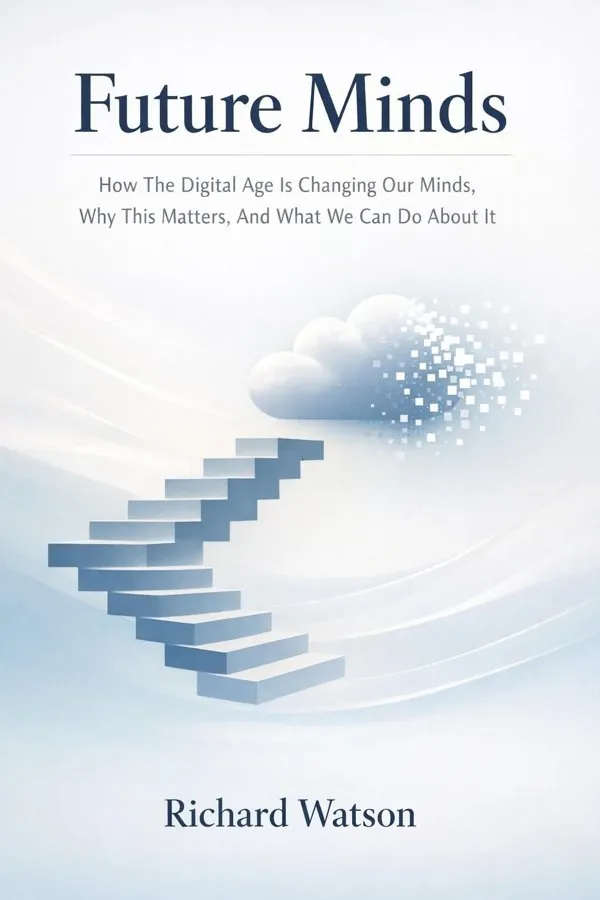
Future Minds: How The Digital Age Is Changing Our Minds, Why This Matters, And What We Can Do About It: Summary & Key Insights
 10 min10 chaptersAudio available
What Is Future Minds: How The Digital Age Is Changing Our Minds, Why This Matters, And What We Can Do About It About?
Future Minds: How The Digital Age Is Changing Our Minds, Why This Matters, And What We Can Do About It by Richard Watson is a future_trends book spanning 10 pages. Future Minds explores how digital technology is reshaping the way we think, work, and interact. Richard Watson examines the cognitive and cultural consequences of constant connectivity, multitasking, and information overload, offering insights into how individuals and organizations can preserve creativity, focus, and deep thinking in an age dominated by screens and instant communication.
This FizzRead summary covers all 10 key chapters of Future Minds: How The Digital Age Is Changing Our Minds, Why This Matters, And What We Can Do About It in approximately 10 minutes, distilling the most important ideas, arguments, and takeaways from Richard Watson's work. Also available as an audio summary and Key Quotes Podcast.
Future Minds: How The Digital Age Is Changing Our Minds, Why This Matters, And What We Can Do About It
Future Minds explores how digital technology is reshaping the way we think, work, and interact. Richard Watson examines the cognitive and cultural consequences of constant connectivity, multitasking, and information overload, offering insights into how individuals and organizations can preserve creativity, focus, and deep thinking in an age dominated by screens and instant communication.
Who Should Read Future Minds: How The Digital Age Is Changing Our Minds, Why This Matters, And What We Can Do About It?
This book is perfect for anyone interested in future_trends and looking to gain actionable insights in a short read. Whether you're a student, professional, or lifelong learner, the key ideas from Future Minds: How The Digital Age Is Changing Our Minds, Why This Matters, And What We Can Do About It by Richard Watson will help you think differently.
- ✓Readers who enjoy future_trends and want practical takeaways
- ✓Professionals looking to apply new ideas to their work and life
- ✓Anyone who wants the core insights of Future Minds: How The Digital Age Is Changing Our Minds, Why This Matters, And What We Can Do About It in just 10 minutes
Want the full summary?
Get instant access to this book summary and 100K+ more with Fizz Moment.
Get Free SummaryAvailable on App Store • Free to download
Key Chapters
One of the defining shifts of our century is how we process information. In the past, learning and reasoning required a kind of immersive commitment — time spent analyzing, questioning, and constructing mental models. The digital age replaced that depth with speed. The infinite scroll invites skimming rather than studying; hyperlinks fragment reading into bursts of curiosity that rarely coalesce into comprehension.
Research I discuss throughout *Future Minds* reveals that multitasking, once considered an asset of modern workers, degrades real cognitive performance. When our minds continually switch between tasks — emails, messages, tabs — we sacrifice the neurological conditions that foster insight. It’s not the amount of information that burdens us but the nature of its flow: fast, fractured, unrelenting.
Deep thinking, the kind that builds wisdom rather than just knowledge, depends on uninterrupted attention. But constant connectivity trains us towards shallow engagement. We become experts at scanning yet novices at pondering. Consider how meetings increasingly begin with flickering screens and end with fleeting conclusions; how students now learn facts but struggle to weave them into frameworks of understanding. We are losing the art of sustained concentration, and with it, the patience to explore complexity.
I believe the antidote lies in reclaiming periods of mental stillness. By limiting digital interruptions — creating zones of focused work — we rebuild neural endurance. True productivity arises from presence, not perpetual motion. The future belongs to those who can still think deeply amid a world that rewards distraction.
Information, once scarce and precious, is now a flood. We swim in data but drown in detail. The human brain evolved to handle patterns, not torrents, and the sheer quantity of daily input overwhelms our filters for relevance. Emails, texts, news alerts, updates — everything feels urgent, yet little is truly meaningful.
In *Future Minds*, I explore the phenomenon of cognitive saturation: when mental capacity is exceeded by stimuli and our ability to reflect collapses into reaction. The result is decision fatigue, a subtle erosion of clarity that leaves us anxious and inefficient. We scroll for answers rather than thinking through problems; we outsource memory to devices and lose the richness of internal reflection.
Psychologically, this overload triggers stress responses akin to those caused by physical exhaustion. We become restless, distracted, and disinclined to engage with ideas that require patience. The paradox of the information age is that the very abundance meant to empower us instead diminishes wisdom. True insight demands boundaries — moments when the mind is allowed to digest rather than continuously consume.
I argue for designing personal and cultural filters. Not technological firewalls, but cognitive habits: pauses, structured focus, and intentional disengagement. The human brain can encode deep knowledge only when it has silence to sort and integrate experience. The challenge of the future is therefore not to access more data but to cultivate discernment amid excess.
+ 8 more chapters — available in the FizzRead app
All Chapters in Future Minds: How The Digital Age Is Changing Our Minds, Why This Matters, And What We Can Do About It
About the Author
Richard Watson is a British futurist, author, and lecturer known for his work on trends, foresight, and scenario planning. He has advised major corporations and governments on future strategy and is the author of several books on technology and society, including 'Future Files' and 'Digital Vs. Human'.
Get This Summary in Your Preferred Format
Read or listen to the Future Minds: How The Digital Age Is Changing Our Minds, Why This Matters, And What We Can Do About It summary by Richard Watson anytime, anywhere. FizzRead offers multiple formats so you can learn on your terms — all free.
Available formats: App · Audio · PDF · EPUB — All included free with FizzRead
Download Future Minds: How The Digital Age Is Changing Our Minds, Why This Matters, And What We Can Do About It PDF and EPUB Summary
Key Quotes from Future Minds: How The Digital Age Is Changing Our Minds, Why This Matters, And What We Can Do About It
“One of the defining shifts of our century is how we process information.”
“Information, once scarce and precious, is now a flood.”
Frequently Asked Questions about Future Minds: How The Digital Age Is Changing Our Minds, Why This Matters, And What We Can Do About It
Future Minds: How The Digital Age Is Changing Our Minds, Why This Matters, And What We Can Do About It by Richard Watson is a future_trends book that explores key ideas across 10 chapters. Future Minds explores how digital technology is reshaping the way we think, work, and interact. Richard Watson examines the cognitive and cultural consequences of constant connectivity, multitasking, and information overload, offering insights into how individuals and organizations can preserve creativity, focus, and deep thinking in an age dominated by screens and instant communication.
You Might Also Like
Futureproof: 9 Rules for Humans in the Age of Automation
Kevin Roose
10 min
The Third Wave
Alvin Toffler
10 min
2030: How Today's Biggest Trends Will Collide and Reshape the Future of Everything
Mauro F. Guillén
10 min
A Very Human Future: Enriching Humanity in a Digitized World
Rohit Talwar, Steve Wells, Alexandra Whittington
10 min
AI 2041: Ten Visions for Our Future
Kai-Fu Lee, Chen Qiufan
10 min
Abundance: The Future Is Better Than You Think
Peter H. Diamandis, Steven Kotler
10 minBrowse by Category
Ready to read Future Minds: How The Digital Age Is Changing Our Minds, Why This Matters, And What We Can Do About It?
Get the full summary and 100K+ more books with Fizz Moment.