
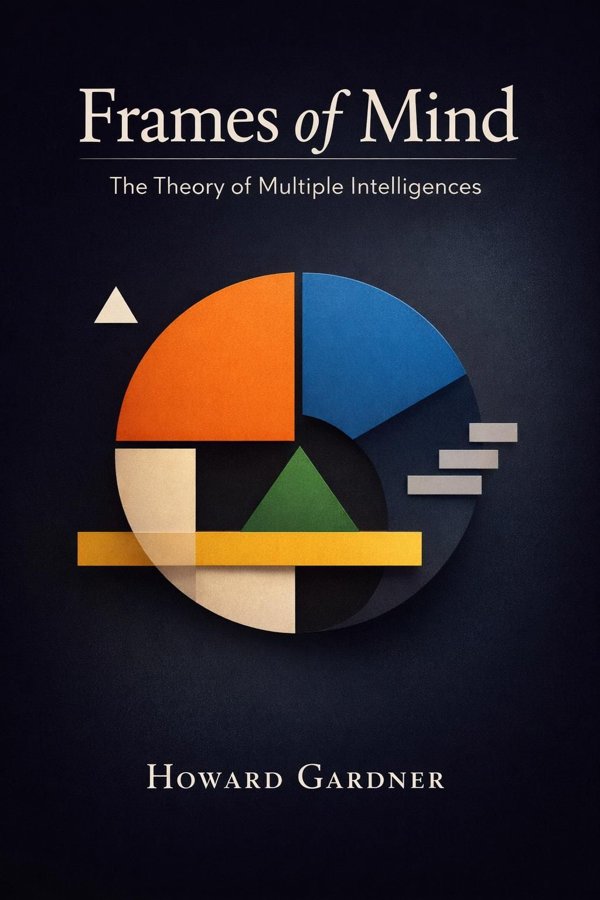
Frames of Mind: The Theory of Multiple Intelligences: Summary & Key Insights
 10 min13 chaptersAudio available
What Is Frames of Mind: The Theory of Multiple Intelligences About?
Frames of Mind: The Theory of Multiple Intelligences by Howard Gardner is a education book spanning 13 pages. In this groundbreaking work, psychologist Howard Gardner challenges the traditional notion of a single, unitary intelligence. He proposes the theory of multiple intelligences, identifying distinct modalities such as linguistic, logical-mathematical, spatial, musical, bodily-kinesthetic, interpersonal, intrapersonal, and later naturalistic intelligence. Gardner’s framework revolutionized education and psychology by emphasizing that human potential is multifaceted and context-dependent.
This FizzRead summary covers all 13 key chapters of Frames of Mind: The Theory of Multiple Intelligences in approximately 10 minutes, distilling the most important ideas, arguments, and takeaways from Howard Gardner's work. Also available as an audio summary and Key Quotes Podcast.
Frames of Mind: The Theory of Multiple Intelligences
In this groundbreaking work, psychologist Howard Gardner challenges the traditional notion of a single, unitary intelligence. He proposes the theory of multiple intelligences, identifying distinct modalities such as linguistic, logical-mathematical, spatial, musical, bodily-kinesthetic, interpersonal, intrapersonal, and later naturalistic intelligence. Gardner’s framework revolutionized education and psychology by emphasizing that human potential is multifaceted and context-dependent.
Who Should Read Frames of Mind: The Theory of Multiple Intelligences?
This book is perfect for anyone interested in education and looking to gain actionable insights in a short read. Whether you're a student, professional, or lifelong learner, the key ideas from Frames of Mind: The Theory of Multiple Intelligences by Howard Gardner will help you think differently.
- ✓Readers who enjoy education and want practical takeaways
- ✓Professionals looking to apply new ideas to their work and life
- ✓Anyone who wants the core insights of Frames of Mind: The Theory of Multiple Intelligences in just 10 minutes
Want the full summary?
Get instant access to this book summary and 100K+ more with Fizz Moment.
Get Free SummaryAvailable on App Store • Free to download
Key Chapters
To understand why the idea of multiple intelligences needed to be born, we must first revisit how the scientific community came to conceive of intelligence in the first place. At the dawn of the twentieth century, psychologists such as Alfred Binet sought ways to measure intellectual potential objectively. Binet’s test, designed originally to identify French schoolchildren in need of special educational assistance, was later transformed into the modern IQ test—a tool supposedly capturing general intelligence.
Over time, this notion hardened. Charles Spearman proposed that all mental abilities shared a single underlying factor, which he called ‘g.’ This became the cornerstone of psychometric theory. A person’s performance across varied cognitive tasks—verbal reasoning, spatial manipulation, arithmetic—was thought to express this one underlying general capacity. For many decades, such a view dominated psychology, education, and even public policy.
Yet as I investigated human cognition across cultures and disciplines, the cracks in this monolithic understanding began to appear. Not all forms of excellence correlate neatly with IQ. The virtuoso cellist, the gifted athlete, the empathic counselor, the visionary architect—each demonstrates an unmistakable intelligence that standard tests cannot touch. Neuropsychological research further confirmed that distinct areas of the brain governed different kinds of processing, suggesting intelligence was plural by nature.
By the time I set out to write *Frames of Mind*, I had spent years studying developmental patterns in children, reviewing case histories of individuals with selective impairments due to brain injury, and examining exceptional talents. These studies persuaded me that intelligence should not be seen as one uniform capacity, but as a constellation of relatively autonomous systems. Each system, or intelligence, operates with its own internal logic and can be cultivated or impaired independently. That realization set the stage for the model to come.
To avoid the trap of calling any ability an ‘intelligence,’ I established specific criteria to decide when a capacity truly deserves that designation. An intelligence, I proposed, must satisfy several lines of evidence. First, neural isolation—if damage to a certain brain region selectively impairs one ability while leaving others intact, that ability likely represents a distinct form of intelligence. Second, evolutionary plausibility—an intelligence should correspond to a capacity that evolved because it offered adaptive advantages throughout our species’ history. Third, there should be identifiable core operations or symbolic systems through which the intelligence expresses itself.
Further support might come from developmental trajectories—cases where a skill unfolds in predictable stages, from primitive beginnings to mature forms—and from experimental and psychometric findings showing independent variation among individuals. Finally, cross-cultural and historical evidence must show that societies value and refine these abilities in meaningful ways.
Using these criteria kept the theory disciplined and scientific. It guarded against treating ‘intelligence’ as a mere synonym for talent or interest. Instead, it identified genuine cognitive capacities with roots in our biology and culture. Applying these tests led me ultimately to propose seven distinct intelligences—each standing on robust empirical ground.
+ 11 more chapters — available in the FizzRead app
All Chapters in Frames of Mind: The Theory of Multiple Intelligences
About the Author
Howard Gardner is an American developmental psychologist and professor at the Harvard Graduate School of Education. He is best known for his theory of multiple intelligences, which has profoundly influenced educational theory and practice worldwide. Gardner has authored numerous books on psychology, creativity, and education, and has received multiple awards for his contributions to cognitive science.
Get This Summary in Your Preferred Format
Read or listen to the Frames of Mind: The Theory of Multiple Intelligences summary by Howard Gardner anytime, anywhere. FizzRead offers multiple formats so you can learn on your terms — all free.
Available formats: App · Audio · PDF · EPUB — All included free with FizzRead
Download Frames of Mind: The Theory of Multiple Intelligences PDF and EPUB Summary
Key Quotes from Frames of Mind: The Theory of Multiple Intelligences
“To understand why the idea of multiple intelligences needed to be born, we must first revisit how the scientific community came to conceive of intelligence in the first place.”
“To avoid the trap of calling any ability an ‘intelligence,’ I established specific criteria to decide when a capacity truly deserves that designation.”
Frequently Asked Questions about Frames of Mind: The Theory of Multiple Intelligences
Frames of Mind: The Theory of Multiple Intelligences by Howard Gardner is a education book that explores key ideas across 13 chapters. In this groundbreaking work, psychologist Howard Gardner challenges the traditional notion of a single, unitary intelligence. He proposes the theory of multiple intelligences, identifying distinct modalities such as linguistic, logical-mathematical, spatial, musical, bodily-kinesthetic, interpersonal, intrapersonal, and later naturalistic intelligence. Gardner’s framework revolutionized education and psychology by emphasizing that human potential is multifaceted and context-dependent.
You Might Also Like

Bedtime Biography: Florence Nightingale
Isabel Thomas
10 min
Introduction To Museum Studies
Howard H. Hoyt
10 min
A Mind for Numbers: How to Excel at Math and Science (Even If You Flunked Algebra)
Barbara Oakley
10 min
AI for Educators: Learning Strategies, Teacher Empowerment, and the Future of Education
Matt Miller
10 min
Animation For Beginners
Morr Meroz
10 min
Artificial Intelligence for Learning
Donald Clark
10 minBrowse by Category
Ready to read Frames of Mind: The Theory of Multiple Intelligences?
Get the full summary and 100K+ more books with Fizz Moment.