
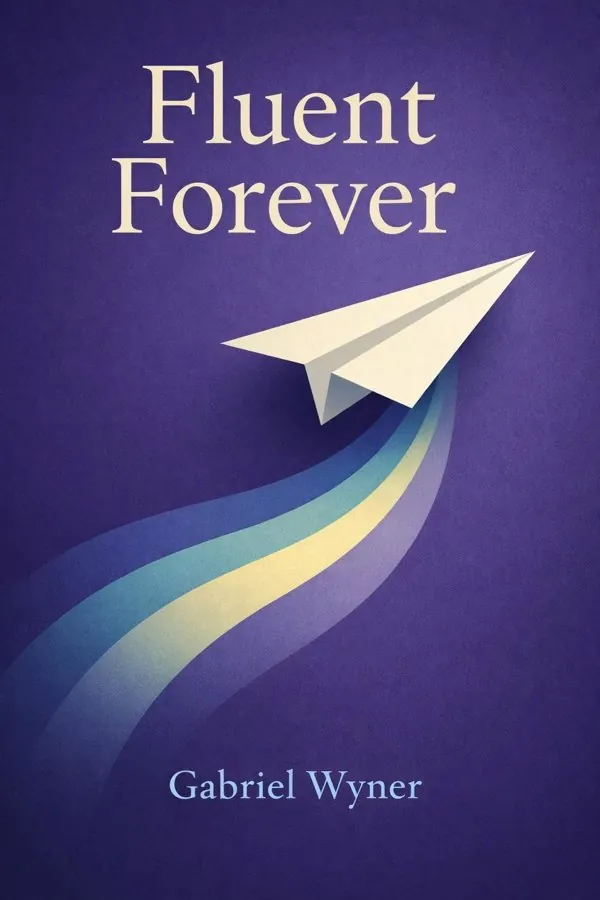
Fluent Forever: How to Learn Any Language Fast and Never Forget It: Summary & Key Insights
 10 min11 chaptersAudio available
What Is Fluent Forever: How to Learn Any Language Fast and Never Forget It About?
Fluent Forever: How to Learn Any Language Fast and Never Forget It by Gabriel Wyner is a education book spanning 11 pages. Fluent Forever es una guía moderna y práctica para aprender idiomas de manera rápida y duradera. Gabriel Wyner combina principios de la memoria, la fonética y la psicología del aprendizaje para enseñar cómo adquirir vocabulario, gramática y pronunciación de forma efectiva. El libro propone un método basado en la personalización, la repetición espaciada y la inmersión auditiva, ayudando a los lectores a alcanzar la fluidez en cualquier idioma sin olvidar lo aprendido.
This FizzRead summary covers all 11 key chapters of Fluent Forever: How to Learn Any Language Fast and Never Forget It in approximately 10 minutes, distilling the most important ideas, arguments, and takeaways from Gabriel Wyner's work. Also available as an audio summary and Key Quotes Podcast.
Fluent Forever: How to Learn Any Language Fast and Never Forget It
Fluent Forever es una guía moderna y práctica para aprender idiomas de manera rápida y duradera. Gabriel Wyner combina principios de la memoria, la fonética y la psicología del aprendizaje para enseñar cómo adquirir vocabulario, gramática y pronunciación de forma efectiva. El libro propone un método basado en la personalización, la repetición espaciada y la inmersión auditiva, ayudando a los lectores a alcanzar la fluidez en cualquier idioma sin olvidar lo aprendido.
Who Should Read Fluent Forever: How to Learn Any Language Fast and Never Forget It?
This book is perfect for anyone interested in education and looking to gain actionable insights in a short read. Whether you're a student, professional, or lifelong learner, the key ideas from Fluent Forever: How to Learn Any Language Fast and Never Forget It by Gabriel Wyner will help you think differently.
- ✓Readers who enjoy education and want practical takeaways
- ✓Professionals looking to apply new ideas to their work and life
- ✓Anyone who wants the core insights of Fluent Forever: How to Learn Any Language Fast and Never Forget It in just 10 minutes
Want the full summary?
Get instant access to this book summary and 100K+ more with Fizz Moment.
Get Free SummaryAvailable on App Store • Free to download
Key Chapters
Before you can learn a language effectively, you have to understand how memory actually functions. Memory is not a simple container—it’s a dynamic system shaped by time, emotion, and context. Our brains forget quickly when information has no meaningful structure. Hermann Ebbinghaus discovered in the nineteenth century that we forget most newly learned facts within days unless we review them strategically, giving birth to the concept of spaced repetition. This insight became the cornerstone of my entire approach.
When you space your reviews—revisiting information just as you’re about to forget it—you transform fragile impressions into stable knowledge. Combining this with active recall, the process of forcing your brain to retrieve information without assistance, you create robust neural pathways. Every time you recall a word, you strengthen its connection. Every time you struggle a little before remembering, you accelerate learning. The so-called "forgetting curve" isn’t a curse—it’s the timing mechanism that allows us to plan perfect reviews.
The practical implication is liberating: you don’t need endless hours to memorize vocabulary or grammar rules. You need smart timing. Spaced repetition systems, or SRS, became my digital assistant in this process. They organize my learning rhythm so I can forget less and remember for life. But memory is more than time; it thrives on meaning. When you emotionally connect to a word—when you visualize it, use it, and feel it—it stops being arbitrary. That’s the second piece of science behind this method: emotion anchors memory. Whether it’s joy, curiosity, or relevance, personal connection transforms study into experience.
When you harness both timing and emotional depth, learning ceases to be rote memorization. It becomes effortless accumulation. That’s the true science of memory and the foundation upon which the Fluent Forever method stands.
Many learners treat pronunciation as an afterthought, something to correct once vocabulary grows. I discovered the opposite is true. Pronunciation is the gateway to every other skill. If your ears can’t distinguish new sounds, your brain won’t accurately store words, and if your mouth can’t reproduce them, communication feels frustrating from the start. So my method begins with training the ear.
When I tackled French, I realized the word boundaries, vowel nuances, and rhythm were invisible to me. So I approached pronunciation as a musician would: listening deeply, training my vocal apparatus to emulate subtle shifts. I used minimal pairs—words that differ by a single sound—to refine my perception. I mapped every sound using the International Phonetic Alphabet (IPA), which gave me a physical representation of speech. That visual precision helped me know exactly what to listen for.
Once your ears and mouth learn the new set of sounds, every subsequent word becomes easier to memorize. You’re not struggling with foreign noises; you’re recognizing familiar patterns. This early investment accelerates fluency dramatically because pronunciation training creates neural distinctions that will later serve reading, listening, and speaking all at once.
When I teach learners now, I stress the joy of mastering sounds. It’s an art form—the sound palette of a culture. Once you can truly *hear* Spanish rolled r’s or the melody of Italian vowels, you start perceiving meaning through tone and rhythm. Fluency becomes not just intellectual understanding, but a physical mastery of resonance. Pronunciation first isn’t about perfection—it’s about awakening your ability to perceive and replicate reality as natives do.
+ 9 more chapters — available in the FizzRead app
All Chapters in Fluent Forever: How to Learn Any Language Fast and Never Forget It
About the Author
Gabriel Wyner es un ingeniero y cantante de ópera estadounidense que se convirtió en experto en aprendizaje de idiomas. Tras dominar varios idiomas utilizando sus propios métodos, fundó Fluent Forever, una empresa dedicada a la enseñanza de idiomas mediante técnicas de memorización y pronunciación científica.
Get This Summary in Your Preferred Format
Read or listen to the Fluent Forever: How to Learn Any Language Fast and Never Forget It summary by Gabriel Wyner anytime, anywhere. FizzRead offers multiple formats so you can learn on your terms — all free.
Available formats: App · Audio · PDF · EPUB — All included free with FizzRead
Download Fluent Forever: How to Learn Any Language Fast and Never Forget It PDF and EPUB Summary
Key Quotes from Fluent Forever: How to Learn Any Language Fast and Never Forget It
“Before you can learn a language effectively, you have to understand how memory actually functions.”
“Many learners treat pronunciation as an afterthought, something to correct once vocabulary grows.”
Frequently Asked Questions about Fluent Forever: How to Learn Any Language Fast and Never Forget It
Fluent Forever: How to Learn Any Language Fast and Never Forget It by Gabriel Wyner is a education book that explores key ideas across 11 chapters. Fluent Forever es una guía moderna y práctica para aprender idiomas de manera rápida y duradera. Gabriel Wyner combina principios de la memoria, la fonética y la psicología del aprendizaje para enseñar cómo adquirir vocabulario, gramática y pronunciación de forma efectiva. El libro propone un método basado en la personalización, la repetición espaciada y la inmersión auditiva, ayudando a los lectores a alcanzar la fluidez en cualquier idioma sin olvidar lo aprendido.
You Might Also Like

Bedtime Biography: Florence Nightingale
Isabel Thomas
10 min
Introduction To Museum Studies
Howard H. Hoyt
10 min
A Mind for Numbers: How to Excel at Math and Science (Even If You Flunked Algebra)
Barbara Oakley
10 min
AI for Educators: Learning Strategies, Teacher Empowerment, and the Future of Education
Matt Miller
10 min
Animation For Beginners
Morr Meroz
10 min
Artificial Intelligence for Learning
Donald Clark
10 minBrowse by Category
Ready to read Fluent Forever: How to Learn Any Language Fast and Never Forget It?
Get the full summary and 100K+ more books with Fizz Moment.