
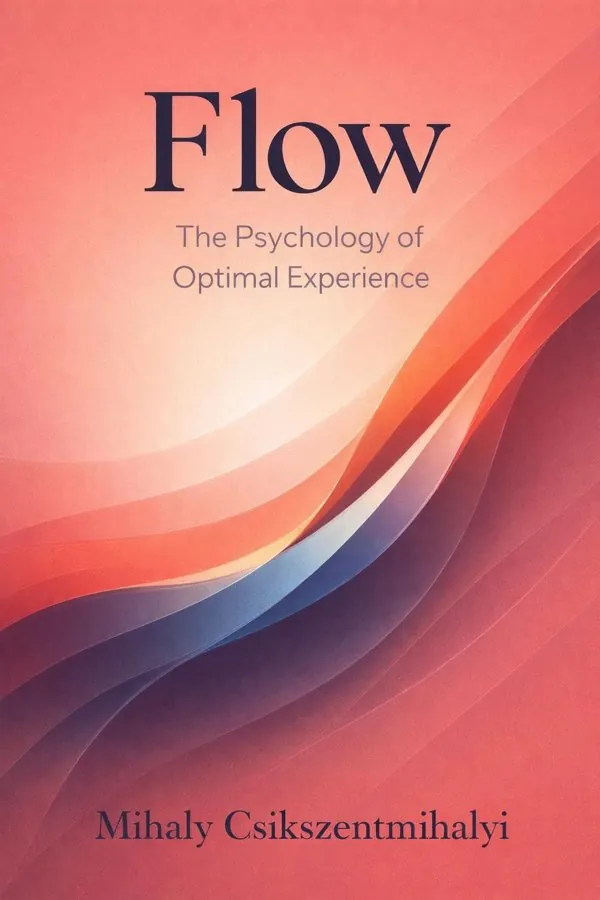
Flow: The Psychology of Optimal Experience: Summary & Key Insights
 10 min9 chaptersAudio available
Key Takeaways from Flow: The Psychology of Optimal Experience
The quality of life depends less on what happens to us than on how our consciousness is organized.
Pleasure feels good, but enjoyment transforms us.
People are happiest not when they are doing nothing, but when they are fully engaged in something difficult enough to matter.
Many people think of the body as something to maintain, discipline, or indulge.
An untrained mind is easily hijacked by anxiety, resentment, and distraction.
What Is Flow: The Psychology of Optimal Experience About?
Flow: The Psychology of Optimal Experience by Mihaly Csikszentmihalyi is a positive_psych book spanning 9 pages. What makes life genuinely satisfying? In Flow, Mihaly Csikszentmihalyi argues that the best moments of our lives do not come from passive comfort, luck, or material success, but from periods of deep involvement in meaningful activity. He calls this state “flow”: a condition in which attention is fully absorbed, skills are stretched by a worthy challenge, and action seems to unfold effortlessly. In such moments, people often lose track of time, forget self-consciousness, and feel intensely alive. This idea matters because it shifts the pursuit of happiness away from external rewards and toward the quality of everyday experience. Rather than waiting for ideal circumstances, Csikszentmihalyi shows that people can actively shape consciousness to create more order, purpose, and enjoyment. Drawing on decades of research, interviews, and psychological observation, he explains how flow appears in work, art, sports, relationships, learning, and even solitude. As one of the foundational thinkers in positive psychology, Csikszentmihalyi offers more than a theory of happiness. He provides a practical framework for building a life that feels richer from the inside out.
This FizzRead summary covers all 9 key chapters of Flow: The Psychology of Optimal Experience in approximately 10 minutes, distilling the most important ideas, arguments, and takeaways from Mihaly Csikszentmihalyi's work. Also available as an audio summary and Key Quotes Podcast.
Flow: The Psychology of Optimal Experience
What makes life genuinely satisfying? In Flow, Mihaly Csikszentmihalyi argues that the best moments of our lives do not come from passive comfort, luck, or material success, but from periods of deep involvement in meaningful activity. He calls this state “flow”: a condition in which attention is fully absorbed, skills are stretched by a worthy challenge, and action seems to unfold effortlessly. In such moments, people often lose track of time, forget self-consciousness, and feel intensely alive.
This idea matters because it shifts the pursuit of happiness away from external rewards and toward the quality of everyday experience. Rather than waiting for ideal circumstances, Csikszentmihalyi shows that people can actively shape consciousness to create more order, purpose, and enjoyment. Drawing on decades of research, interviews, and psychological observation, he explains how flow appears in work, art, sports, relationships, learning, and even solitude. As one of the foundational thinkers in positive psychology, Csikszentmihalyi offers more than a theory of happiness. He provides a practical framework for building a life that feels richer from the inside out.
Who Should Read Flow: The Psychology of Optimal Experience?
This book is perfect for anyone interested in positive_psych and looking to gain actionable insights in a short read. Whether you're a student, professional, or lifelong learner, the key ideas from Flow: The Psychology of Optimal Experience by Mihaly Csikszentmihalyi will help you think differently.
- ✓Readers who enjoy positive_psych and want practical takeaways
- ✓Professionals looking to apply new ideas to their work and life
- ✓Anyone who wants the core insights of Flow: The Psychology of Optimal Experience in just 10 minutes
Want the full summary?
Get instant access to this book summary and 100K+ more with Fizz Moment.
Get Free SummaryAvailable on App Store • Free to download
Key Chapters
The quality of life depends less on what happens to us than on how our consciousness is organized. Csikszentmihalyi begins with a powerful claim: experience is filtered through attention, and attention is our most precious psychological resource. We cannot attend to everything at once, so whatever receives our focus effectively becomes our reality. If attention is constantly scattered by worry, distraction, and conflicting desires, inner life becomes chaotic. If it is directed toward meaningful goals, experience becomes ordered and rewarding.
Consciousness is not a passive mirror. It is an active system that selects information, interprets events, and creates a sense of self. This means that improving life is not only about changing external conditions, but about learning to govern attention. People often assume happiness will arrive once their circumstances improve, yet many who gain wealth, status, or leisure still feel restless. Without control over consciousness, advantages do not automatically produce fulfillment.
Think of two people in the same waiting room. One spirals into irritation, boredom, and resentment. The other uses the time to observe, reflect, read, or plan. The outer situation is identical, but the inner experience is radically different because attention is handled differently.
Csikszentmihalyi’s insight is both liberating and demanding. We may not control every event, but we can develop greater mastery over what we notice, what we dwell on, and what we invest energy in. Actionable takeaway: treat attention like a limited asset. Each day, deliberately choose one activity, thought, or goal worthy of your full mental focus.
Pleasure feels good, but enjoyment transforms us. One of the book’s most important distinctions is between pleasure and enjoyment. Pleasure restores balance: eating when hungry, resting when tired, or relaxing after stress. These experiences are valuable, but they mainly return us to equilibrium. Enjoyment, by contrast, occurs when we stretch ourselves beyond routine and bring new order to consciousness. It requires active engagement, not passive consumption.
This helps explain why many comfortable lives still feel empty. Entertainment, convenience, and indulgence can provide relief, but they rarely create lasting fulfillment on their own. Enjoyment comes from doing something that calls forth our abilities: solving a demanding problem, playing music, learning a language, mentoring someone, building a garden, or mastering a sport. These moments often involve effort, uncertainty, and even frustration, yet afterward we feel expanded rather than merely soothed.
A practical example is the difference between watching cooking shows and preparing a challenging meal. The first may be pleasant and relaxing. The second can become enjoyable because it demands planning, skill, attention, adaptation, and creativity. We emerge from it with a stronger sense of competence and vitality.
Csikszentmihalyi is not dismissing pleasure. Instead, he warns against confusing it with the foundation of a meaningful life. A life organized solely around comfort tends to shrink. A life that includes regular enjoyment grows in complexity, skill, and depth.
Actionable takeaway: each week, schedule at least one activity that is not merely relaxing but absorbing, effortful, and skill-building—something that leaves you more capable than before.
People are happiest not when they are doing nothing, but when they are fully engaged in something difficult enough to matter. This is the core principle of flow. Flow arises when a person faces a clear challenge that matches their current abilities closely enough to demand effort, but not so much that it triggers helplessness. If the challenge is too low, boredom appears. If it is too high, anxiety takes over. Between those extremes lies the sweet spot of optimal experience.
Csikszentmihalyi identifies several common features of flow: clear goals, immediate feedback, intense concentration, a sense of control, merging of action and awareness, reduced self-consciousness, and an altered sense of time. In these moments, people are not obsessing over themselves or chasing approval. They are simply immersed.
This can happen in elite performance, but it also appears in ordinary life. A teacher guiding a lively discussion, a programmer debugging a hard problem, a climber navigating a route, and a child building an intricate structure can all enter flow. The key is not the status of the activity, but the structure of the experience.
Importantly, flow is not accidental magic. Activities can be designed to support it. Games do this well because they provide goals, rules, challenges, and feedback. Work, exercise, study, and hobbies can be reshaped the same way by clarifying objectives and progressively increasing difficulty.
Actionable takeaway: for any important task, define a clear goal, identify the next level of difficulty, and create immediate feedback so your skills are stretched without being overwhelmed.
Many people think of the body as something to maintain, discipline, or indulge. Csikszentmihalyi invites us to see it differently: the body can be a powerful instrument for optimal experience. Physical movement, sensory refinement, and bodily discipline can all generate flow when they involve skill, challenge, and focused attention.
Sports are the obvious example. A runner finding rhythm, a swimmer synchronizing breath and motion, or a dancer losing self-consciousness in choreography experiences a profound union of body and awareness. But flow through the body is not limited to athletics. It can emerge in yoga, martial arts, hiking, cooking, gardening, craftsmanship, sexuality, and even attentive eating or listening. What matters is whether the activity turns the body into a vehicle for concentration and mastery rather than mere consumption.
The modern world often encourages passive bodily habits: endless snacking, screen-based entertainment, and convenience that minimizes effort. These habits may bring comfort, but they rarely produce vitality. Physical flow, by contrast, requires training perception and movement. A person learning to bake bread, for example, begins by following steps mechanically. Over time, they learn to feel the dough, sense timing, adjust intuitively, and become absorbed in the process.
This perspective also reframes exercise. Instead of treating it only as a health obligation, we can structure it as a source of enjoyment by setting goals, measuring progress, and choosing forms of movement that reward concentration.
Actionable takeaway: choose one physical practice—walking, lifting, dancing, stretching, cooking, or another craft—and turn it into a flow activity by setting progressive challenges and giving it your full sensory attention.
An untrained mind is easily hijacked by anxiety, resentment, and distraction. A disciplined mind, however, can transform thinking into one of the richest sources of flow. Csikszentmihalyi shows that mental activities such as reading, writing, mathematics, philosophy, science, chess, or creative imagination can become intrinsically rewarding when they are structured by goals and sustained concentration.
The challenge is that thought can either liberate us or trap us. When the mind drifts without direction, it often defaults to rumination. But when it is engaged in a meaningful pattern—solving a puzzle, developing an argument, composing a story, understanding a complex idea—it begins to generate order. This is why intellectually demanding work can feel energizing rather than draining.
Consider the difference between scrolling through fragmented information and studying a difficult concept until it clicks. The first keeps attention moving but rarely deepens it. The second may be effortful, even uncomfortable at first, yet it produces genuine satisfaction because it expands competence. The same is true for creative thought. A writer revising a paragraph repeatedly may feel frustrated in the moment, but as structure emerges, immersion grows.
Csikszentmihalyi also emphasizes the importance of cultivating internal resources. People who can entertain themselves with ideas, memories, reflection, and curiosity are less dependent on external stimulation. They are better able to resist boredom and recover from adversity.
Actionable takeaway: build one regular practice of focused thinking—such as reading with notes, journaling, solving problems, or studying a complex subject—for at least 30 uninterrupted minutes several times a week.
One of the book’s most surprising findings is that people often report more flow at work than during leisure. This seems counterintuitive because many people think of work as obligation and free time as freedom. Yet work frequently contains the very ingredients that support flow: clear goals, structured rules, immediate feedback, measurable progress, and demands that challenge skill. Leisure, by contrast, can become passive and directionless.
This does not mean all jobs are naturally fulfilling. Many are repetitive, constrained, or stressful. But Csikszentmihalyi argues that the way people approach work matters enormously. Individuals who treat work as a craft often find ways to increase complexity, autonomy, and skill even within limitations. A factory worker may track ways to improve precision. A nurse may focus on human connection and technical mastery. A manager may transform routine coordination into a challenge of communication and leadership.
The key insight is that work becomes more enjoyable when we stop seeing it only as a means to a paycheck and begin shaping it as a field for engagement. This may involve setting personal standards, seeking feedback, learning adjacent skills, organizing tasks into meaningful goals, or reframing daily responsibilities as opportunities for mastery.
Of course, organizational design matters too. Good workplaces create conditions for flow by granting responsibility, defining goals clearly, and allowing room for development. But even before institutions change, individuals can begin redesigning their own experience.
Actionable takeaway: identify one part of your work you can make more game-like this week by setting a specific challenge, measuring progress, and seeking faster feedback on your performance.
Other people can be our greatest source of joy or our deepest source of disorder. Csikszentmihalyi explores both solitude and relationships to show that optimal experience is not limited to solitary achievement. Family life, friendship, conversation, love, and community can all generate flow when they involve shared goals, mutual responsiveness, and genuine presence.
Yet relationships do not automatically produce fulfillment simply because we have them. They require psychic energy. A distracted dinner, a conversation dominated by ego, or a friendship maintained by habit rather than interest will rarely create enjoyment. By contrast, a lively exchange in which both people are fully listening and responding can feel as absorbing as a game. Parenting can become flow-like when adults engage children with creativity and attention rather than mere supervision.
Csikszentmihalyi also warns that dependence on others for constant stimulation can weaken inner freedom. The ability to enjoy solitude is equally important. People who can be alone without feeling empty have developed internal order. They can read, reflect, create, observe, and renew themselves rather than treating silence as a threat.
Healthy lives require both capacities: investing deeply in relationships and becoming comfortable in one’s own company. This balance protects against loneliness, neediness, and emotional chaos. It also improves social life, because people who are inwardly resourced bring more curiosity and generosity to others.
Actionable takeaway: create one device-free period this week for either high-quality conversation or meaningful solitude, and enter it with a clear intention to be fully present rather than half-distracted.
Suffering is unavoidable, but disintegration is not. One of Csikszentmihalyi’s most profound arguments is that people can respond to adversity by reorganizing consciousness rather than surrendering to chaos. Illness, loss, frustration, and limitation threaten to fragment attention and destroy meaning. Yet some individuals turn hardship into a challenge that deepens character, skill, and perspective.
This is not naive optimism. The book does not deny pain. Instead, it studies how resilient people preserve agency under pressure. They do this by setting goals even in restricted conditions, focusing on what remains controllable, interpreting hardship as information rather than pure catastrophe, and refusing to let identity collapse around one event. Such people convert passive suffering into active engagement.
Examples abound: a patient approaching rehabilitation as a disciplined project, an unemployed person using the period to learn and rebuild, or a person facing grief by creating rituals, service, or art that gives shape to pain. In each case, the external hardship remains real, but consciousness becomes more ordered through purposeful action.
The opposite response is psychic entropy: attention overwhelmed by fear, bitterness, or helplessness. This state drains energy and narrows possibility. Flow-oriented coping does not remove difficulty, but it restores direction. It asks, in effect: what can be done now that is worthy of full attention?
Actionable takeaway: when facing a stressful situation, define one controllable goal, one immediate next action, and one way to measure progress so adversity becomes a challenge to engage rather than a fog to endure.
A meaningful life is not built from isolated moments of happiness but from a coherent pattern of goals. In the book’s final movement, Csikszentmihalyi argues that flow experiences are essential, but they matter most when they are integrated into an overall sense of purpose. Without a unifying direction, even enjoyable episodes can remain disconnected. Meaning arises when a person organizes energy around values that create continuity across time.
This idea elevates the conversation beyond momentary well-being. It is possible to be highly engaged in many tasks and still feel lost if those tasks do not connect to a larger aim. People need projects, commitments, and ideals that help them interpret struggle and decide what deserves devotion. For one person this might be raising a family well; for another, advancing knowledge, serving a community, making art, building a business, or deepening spiritual practice.
Purpose does not have to be grand or public. What matters is that it is chosen and internalized rather than borrowed uncritically from social pressure. Meaningful goals channel attention, reduce inner conflict, and make sacrifice intelligible. They also help people recover from setbacks because disappointment is placed within a larger narrative.
Csikszentmihalyi suggests that the best life is one in which enjoyment and meaning reinforce each other. Daily flow builds vitality, while long-term purpose gives those experiences direction.
Actionable takeaway: write a short personal mission statement for the next year, then identify how your recurring activities can better align with that larger purpose.
All Chapters in Flow: The Psychology of Optimal Experience
About the Author
Mihaly Csikszentmihalyi was a Hungarian-American psychologist and one of the most influential thinkers in positive psychology. Born in 1934 in what is now Croatia and later educated in the United States, he became widely known for his research on happiness, creativity, and optimal human functioning. He taught for many years at the University of Chicago and later at Claremont Graduate University. Csikszentmihalyi’s signature contribution was the concept of “flow,” the state of deep absorption in challenging and meaningful activity. His work helped shift psychology’s focus beyond mental illness toward the study of what makes life rewarding and worth living. Through books, research, and public speaking, he influenced fields ranging from education and sports to leadership, design, and personal development.
Get This Summary in Your Preferred Format
Read or listen to the Flow: The Psychology of Optimal Experience summary by Mihaly Csikszentmihalyi anytime, anywhere. FizzRead offers multiple formats so you can learn on your terms — all free.
Available formats: App · Audio · PDF · EPUB — All included free with FizzRead
Download Flow: The Psychology of Optimal Experience PDF and EPUB Summary
Key Quotes from Flow: The Psychology of Optimal Experience
“The quality of life depends less on what happens to us than on how our consciousness is organized.”
“Pleasure feels good, but enjoyment transforms us.”
“People are happiest not when they are doing nothing, but when they are fully engaged in something difficult enough to matter.”
“Many people think of the body as something to maintain, discipline, or indulge.”
“An untrained mind is easily hijacked by anxiety, resentment, and distraction.”
Frequently Asked Questions about Flow: The Psychology of Optimal Experience
Flow: The Psychology of Optimal Experience by Mihaly Csikszentmihalyi is a positive_psych book that explores key ideas across 9 chapters. What makes life genuinely satisfying? In Flow, Mihaly Csikszentmihalyi argues that the best moments of our lives do not come from passive comfort, luck, or material success, but from periods of deep involvement in meaningful activity. He calls this state “flow”: a condition in which attention is fully absorbed, skills are stretched by a worthy challenge, and action seems to unfold effortlessly. In such moments, people often lose track of time, forget self-consciousness, and feel intensely alive. This idea matters because it shifts the pursuit of happiness away from external rewards and toward the quality of everyday experience. Rather than waiting for ideal circumstances, Csikszentmihalyi shows that people can actively shape consciousness to create more order, purpose, and enjoyment. Drawing on decades of research, interviews, and psychological observation, he explains how flow appears in work, art, sports, relationships, learning, and even solitude. As one of the foundational thinkers in positive psychology, Csikszentmihalyi offers more than a theory of happiness. He provides a practical framework for building a life that feels richer from the inside out.
Compare Flow: The Psychology of Optimal Experience
More by Mihaly Csikszentmihalyi
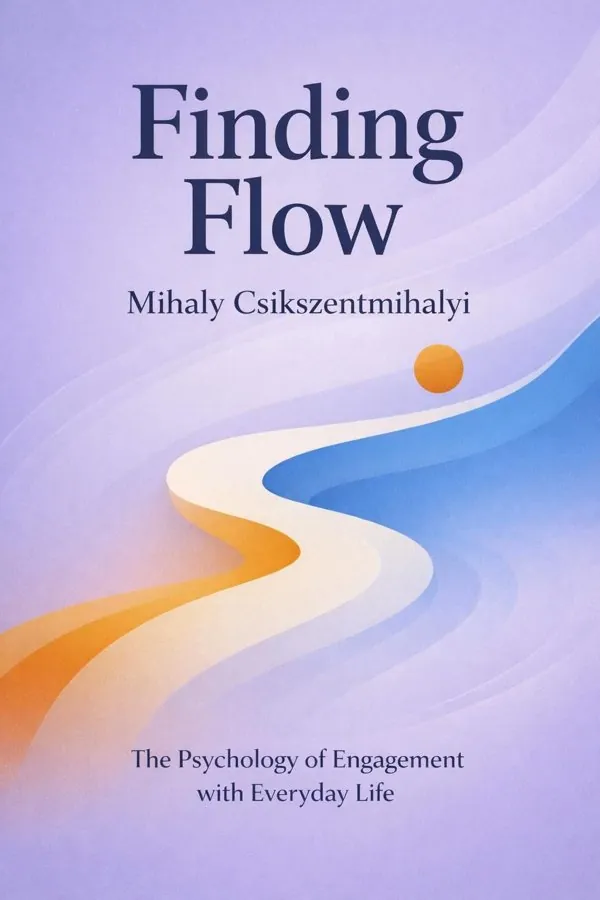
You Might Also Like
Don't Sweat the Small Stuff... and It's All Small Stuff
Richard Carlson
10 min
Option B
Sheryl Sandberg & Adam Grant
10 min
Hallelujah Anyway: Rediscovering Mercy
Anne Lamott
10 min
I Can Do It: How to Use Affirmations to Change Your Life
Louise Hay
10 min
The Coffee Bean: A Simple Lesson to Create Positive Change
Jon Gordon, Damon West
10 min
The Happiness Hypothesis: Finding Modern Truth in Ancient Wisdom
Jonathan Haidt
10 minBrowse by Category
Ready to read Flow: The Psychology of Optimal Experience?
Get the full summary and 100K+ more books with Fizz Moment.