
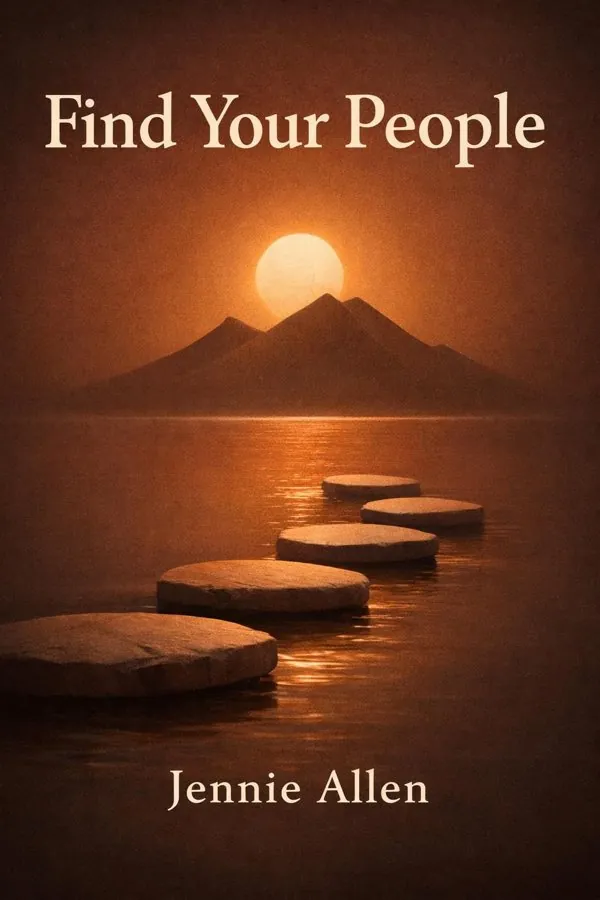
Find Your People: Building Deep Community in a Lonely World: Summary & Key Insights
by Jennie Allen
 10 min9 chaptersAudio available
Key Takeaways from Find Your People: Building Deep Community in a Lonely World
One of the most unsettling truths of contemporary life is that people can be constantly connected and still deeply alone.
A powerful idea runs through Allen’s book: community is not a lifestyle accessory but part of God’s design for human flourishing.
Deep friendship often fails to develop not because people do not want it, but because invisible barriers quietly block it.
Many relationships stay shallow because both people are waiting for safety before being honest.
A striking message in Allen’s book is that meaningful community rarely appears passively.
What Is Find Your People: Building Deep Community in a Lonely World About?
Find Your People: Building Deep Community in a Lonely World by Jennie Allen is a relationships book spanning 9 pages. In Find Your People, Jennie Allen confronts one of the defining struggles of modern life: loneliness in an age of constant connection. Surrounded by social media, busy schedules, and endless digital interaction, many people still lack the kind of relationships where they feel fully known, supported, and loved. Allen argues that this is not just emotionally painful but spiritually significant, because human beings were created for real community, not isolation. Drawing on biblical teaching, social research, and candid stories from her own life, she shows that deep friendship rarely happens by accident. It must be pursued with courage, honesty, and intention. The book matters because it offers more than a diagnosis of loneliness; it provides a practical path toward building meaningful relationships in everyday life. Allen writes with authority as a Bible teacher, speaker, and founder of IF:Gathering, an organization built around helping women live out their faith in community. Her message is clear and hopeful: lasting connection is possible, but it begins when we stop waiting for community to find us and start creating it.
This FizzRead summary covers all 9 key chapters of Find Your People: Building Deep Community in a Lonely World in approximately 10 minutes, distilling the most important ideas, arguments, and takeaways from Jennie Allen's work. Also available as an audio summary and Key Quotes Podcast.
Find Your People: Building Deep Community in a Lonely World
In Find Your People, Jennie Allen confronts one of the defining struggles of modern life: loneliness in an age of constant connection. Surrounded by social media, busy schedules, and endless digital interaction, many people still lack the kind of relationships where they feel fully known, supported, and loved. Allen argues that this is not just emotionally painful but spiritually significant, because human beings were created for real community, not isolation. Drawing on biblical teaching, social research, and candid stories from her own life, she shows that deep friendship rarely happens by accident. It must be pursued with courage, honesty, and intention. The book matters because it offers more than a diagnosis of loneliness; it provides a practical path toward building meaningful relationships in everyday life. Allen writes with authority as a Bible teacher, speaker, and founder of IF:Gathering, an organization built around helping women live out their faith in community. Her message is clear and hopeful: lasting connection is possible, but it begins when we stop waiting for community to find us and start creating it.
Who Should Read Find Your People: Building Deep Community in a Lonely World?
This book is perfect for anyone interested in relationships and looking to gain actionable insights in a short read. Whether you're a student, professional, or lifelong learner, the key ideas from Find Your People: Building Deep Community in a Lonely World by Jennie Allen will help you think differently.
- ✓Readers who enjoy relationships and want practical takeaways
- ✓Professionals looking to apply new ideas to their work and life
- ✓Anyone who wants the core insights of Find Your People: Building Deep Community in a Lonely World in just 10 minutes
Want the full summary?
Get instant access to this book summary and 100K+ more with Fizz Moment.
Get Free SummaryAvailable on App Store • Free to download
Key Chapters
A powerful idea runs through Allen’s book: community is not a lifestyle accessory but part of God’s design for human flourishing. From the opening pages of Scripture, relationship is central. God exists in perfect relational unity, and human beings are created in His image. That means our longing for connection is not random; it is woven into who we are. Allen emphasizes that when God said it was not good for Adam to be alone, He revealed a principle that extends far beyond marriage. Human beings are made to live in interdependence, not isolation.
This biblical lens reframes loneliness. Instead of seeing the desire for friendship as emotional neediness, Allen presents it as evidence of healthy design. To crave belonging is human. To need support is normal. To seek people who will celebrate, grieve, pray, laugh, and grow with you is part of living the life God intended. Community is where faith becomes embodied. It is where encouragement happens, burdens are shared, and spiritual growth is strengthened through real relationships.
Allen also challenges the highly individualistic approach many people bring to faith. It is easy to think of spirituality as private: my beliefs, my devotions, my goals. But Christian life, as she explains, is communal. We need one another for correction, comfort, accountability, and mission. Even strong, capable, mature people are not meant to carry life alone.
In practical terms, this means treating community as a priority, not an optional bonus after everything else is done. Build rhythms that make shared life possible, whether through a small group, regular meals, church involvement, or honest friendships.
Actionable takeaway: Stop viewing community as something nice to have and begin treating it as a necessary part of your spiritual and emotional health.
Deep friendship often fails to develop not because people do not want it, but because invisible barriers quietly block it. Allen encourages readers to examine the internal and external obstacles that keep them from building community. Some of these barriers are practical: overloaded calendars, demanding jobs, parenting pressures, relocation, and the convenience of digital communication. Others are emotional: fear of rejection, past betrayal, insecurity, comparison, and the belief that everyone else already has their people.
One of Allen’s most important insights is that many adults expect friendship to happen naturally, the way it often did in school or early life. But adult community rarely forms without intention. If we do not actively make space for relationships, our schedules will fill with tasks while our hearts remain empty. Another barrier is self-protection. Many people crave intimacy while simultaneously resisting the very openness it requires. We want people to know us, but we hide our struggles, polish our image, and wait for others to go first.
Allen also addresses comparison, especially in a social-media-saturated culture. Seeing curated images of other people’s friendships can make us feel excluded before we have even tried. We assume everyone else has easy, effortless community, when in reality most people are longing for the same thing. Recognizing this can free us from passivity and shame.
To apply this idea, readers must ask honest questions: Am I too busy for the life I say I want? Am I avoiding closeness because of old wounds? Am I expecting perfect friends instead of real people? Naming the barrier helps break its power.
Actionable takeaway: Choose the biggest obstacle to connection in your life right now and make one concrete adjustment, such as clearing one evening a week or initiating one honest conversation.
Many relationships stay shallow because both people are waiting for safety before being honest. Allen argues that, in reality, vulnerability is often what creates safety. Deep community is built when someone has the courage to go first and move beyond polished conversation into real life. This does not mean oversharing recklessly or unloading every pain onto strangers. It means gradually offering your true self instead of only the version that seems impressive, composed, or easy to love.
Allen shows that vulnerability is costly because it risks discomfort, misunderstanding, or rejection. Yet without it, friendship stalls at the level of convenience. We can attend the same events, exchange friendly messages, and still remain unknown. Real connection begins when people speak truthfully about fears, disappointments, needs, hopes, and struggles. Saying, "I am lonely," "My marriage is hard right now," or "I need prayer" can become the doorway to deeper trust.
This principle matters in everyday life. A small group can meet for months and never become a true community if everyone stays guarded. A friendship can remain pleasant but thin if no one shares what is actually happening beneath the surface. Allen’s point is that vulnerability is not weakness; it is relational courage. It gives other people permission to be honest too.
Practically, vulnerability can start small. Instead of giving a rehearsed answer to "How are you?" offer a real one. Instead of waiting for someone to ask, tell a trusted friend what you are carrying. Over time, consistent honesty builds trust and mutual care.
Actionable takeaway: In your next meaningful conversation, replace one surface-level response with one truthful sentence about what is really going on in your life.
A striking message in Allen’s book is that meaningful community rarely appears passively. Many people are waiting to be invited, noticed, or chosen, but deep friendship often begins when someone decides to initiate. Allen urges readers to stop assuming they have been left out and start taking relational responsibility. If you want your people, you may need to go first, ask first, invite first, and try again after awkward moments or disappointment.
This can feel vulnerable because initiative exposes desire. Inviting someone to coffee, asking a family over for dinner, joining a small group, or following up after church carries the risk of being ignored or misunderstood. But Allen insists that courage is part of building community. The people we admire for their strong relationships often did not stumble into them. They created opportunities for connection through repeated, intentional effort.
Allen is especially helpful in turning abstract longing into practical movement. She suggests looking at the people already around you rather than fantasizing about ideal friendships somewhere else. Your people may be in your neighborhood, church, workplace, children’s school, or existing circles. Community usually grows through proximity plus intentionality. You do not need a perfect social life; you need a willingness to pursue a few relationships with consistency.
Examples are simple but powerful: host a casual gathering, start a recurring walk, invite two people to lunch after church, or ask someone if they want to read a book together. The goal is not instant intimacy but repeated contact that allows trust to develop.
Actionable takeaway: Make one specific invitation within the next 48 hours to someone you would like to know better, and do not overcomplicate it.
Strong community is usually less about dramatic moments and more about regular patterns. Allen explains that lasting friendship grows through shared rhythms that make connection normal rather than occasional. Good intentions are not enough. If relationships depend only on spontaneous availability, they will often lose to busyness. But when people create repeatable habits of gathering, they give friendship a structure in which depth can grow.
This idea is deeply practical. Community can be built through weekly dinners, monthly gatherings, morning walks, prayer groups, standing coffee dates, neighborhood traditions, or group texts that lead to real-life meetups. What matters is consistency. Repeated time together allows people to move beyond first impressions and enter one another’s real lives. It also lowers the pressure. Not every gathering has to be profound. Familiarity itself becomes fertile ground for trust, laughter, support, and spiritual growth.
Allen’s emphasis here pushes back against the perfectionism that keeps people from hosting or organizing. You do not need a spotless house, elaborate meals, or ideal circumstances. You need a willingness to make room. Simplicity often works better than grandeur because it is sustainable. Soup on a weeknight, children running around, and honest conversation around a table may do more for community than occasional polished events.
Intentional rhythms also communicate value. When you put friendship on the calendar, you are saying that people matter. Over time, these patterns create a sense of belonging that helps people weather hardship and celebrate joy together.
Actionable takeaway: Start one simple recurring rhythm this month, such as a weekly meal, monthly gathering, or regular check-in, and commit to keeping it sustainable rather than impressive.
Many people secretly believe that true friendship should feel easy, natural, and free of disappointment. Allen challenges this illusion by showing that conflict is not a sign that community was a mistake. It is a normal part of relationships between imperfect people. When expectations, preferences, personalities, and wounds collide, tension will happen. The question is not whether conflict will come but whether we will handle it in ways that deepen trust rather than destroy it.
Allen is realistic about the pain that relationships can bring. Friends forget important things, misunderstand motives, exclude unintentionally, and fail to show up when we hoped they would. In some cases, people wound us deeply. These experiences can tempt us to withdraw and conclude that closeness is not worth the risk. But Allen argues that mature community requires grace, forgiveness, truth-telling, and resilience. If we expect flawless people, we will remain lonely.
This does not mean tolerating unhealthy or abusive dynamics. Instead, it means learning to address ordinary relational pain with honesty and charity. Practically, this may involve asking clarifying questions instead of assuming the worst, expressing hurt directly rather than gossiping, apologizing quickly, and extending forgiveness where appropriate. Healthy community is not the absence of difficulty; it is the presence of repair.
Allen’s perspective is freeing because it helps readers stay in relationships long enough for them to become real. Superficial friendships can survive only on politeness. Deep friendships require truth and mercy.
Actionable takeaway: If a relationship matters and tension exists, take one step toward repair this week through a calm conversation, a sincere apology, or a clarifying question.
One of Allen’s most practical insights is that community is never finally achieved. Even strong relationships need maintenance, attention, and renewal. Life changes constantly: people move, children grow, work intensifies, health crises emerge, and seasons shift. Without ongoing investment, even meaningful friendships can slowly weaken under the pressure of time and distraction. Sustaining deep connection requires perseverance.
Allen encourages readers to reject the myth that good friendships should be effortless. Lasting community takes follow-through. It means remembering important dates, checking in after hard conversations, showing up in grief, celebrating good news, and refusing to let months pass without reconnection. It also means adapting as circumstances change. The form of friendship may shift from spontaneous evenings to scheduled calls or family dinners, but the commitment can remain.
This sustained investment is especially important in hard seasons. It is easy to be present when life is fun and light; it is more meaningful to remain when life becomes messy, inconvenient, or painful. Allen presents endurance as one of the marks of true community. People feel deeply loved when others stay.
Practically, sustaining connection may involve building reminders into your life. Use calendars for birthdays, create recurring check-ins, send follow-up messages, and keep short accounts when hurt arises. Small acts, repeated over time, communicate care more powerfully than occasional grand gestures.
The larger lesson is simple: community is not built once and then left alone. It is cultivated repeatedly through presence, attention, and faithfulness.
Actionable takeaway: Choose three people you want to stay deeply connected to and create one recurring habit for each relationship that helps you remain present over time.
All Chapters in Find Your People: Building Deep Community in a Lonely World
About the Author
Jennie Allen is an American author, Bible teacher, and speaker best known for her work on faith, purpose, emotional health, and Christian community. She is the founder of IF:Gathering, a global ministry created to equip women to know God more deeply and live out their faith with courage and clarity. Allen holds a Master’s degree in Biblical Studies from Dallas Theological Seminary, and her writing reflects both theological grounding and personal honesty. She has written several influential books that help readers navigate spiritual growth, thought life, and relationships in practical ways. Through her books, speaking, and ministry leadership, Allen has become a trusted voice for readers seeking a more intentional, wholehearted life rooted in faith and shared community.
Get This Summary in Your Preferred Format
Read or listen to the Find Your People: Building Deep Community in a Lonely World summary by Jennie Allen anytime, anywhere. FizzRead offers multiple formats so you can learn on your terms — all free.
Available formats: App · Audio · PDF · EPUB — All included free with FizzRead
Download Find Your People: Building Deep Community in a Lonely World PDF and EPUB Summary
Key Quotes from Find Your People: Building Deep Community in a Lonely World
“One of the most unsettling truths of contemporary life is that people can be constantly connected and still deeply alone.”
“A powerful idea runs through Allen’s book: community is not a lifestyle accessory but part of God’s design for human flourishing.”
“Deep friendship often fails to develop not because people do not want it, but because invisible barriers quietly block it.”
“Many relationships stay shallow because both people are waiting for safety before being honest.”
“A striking message in Allen’s book is that meaningful community rarely appears passively.”
Frequently Asked Questions about Find Your People: Building Deep Community in a Lonely World
Find Your People: Building Deep Community in a Lonely World by Jennie Allen is a relationships book that explores key ideas across 9 chapters. In Find Your People, Jennie Allen confronts one of the defining struggles of modern life: loneliness in an age of constant connection. Surrounded by social media, busy schedules, and endless digital interaction, many people still lack the kind of relationships where they feel fully known, supported, and loved. Allen argues that this is not just emotionally painful but spiritually significant, because human beings were created for real community, not isolation. Drawing on biblical teaching, social research, and candid stories from her own life, she shows that deep friendship rarely happens by accident. It must be pursued with courage, honesty, and intention. The book matters because it offers more than a diagnosis of loneliness; it provides a practical path toward building meaningful relationships in everyday life. Allen writes with authority as a Bible teacher, speaker, and founder of IF:Gathering, an organization built around helping women live out their faith in community. Her message is clear and hopeful: lasting connection is possible, but it begins when we stop waiting for community to find us and start creating it.
More by Jennie Allen


You Might Also Like

The 5 Love Languages
Gary Chapman
10 min
Men Are from Mars, Women Are from Venus
John Gray
10 min
She Comes First
Ian Kerner
10 min
No More Mr Nice Guy
Robert Glover
10 min
Hold Me Tight
Sue Johnson
10 min
Mating in Captivity
Esther Perel
10 minBrowse by Category
Ready to read Find Your People: Building Deep Community in a Lonely World?
Get the full summary and 100K+ more books with Fizz Moment.