
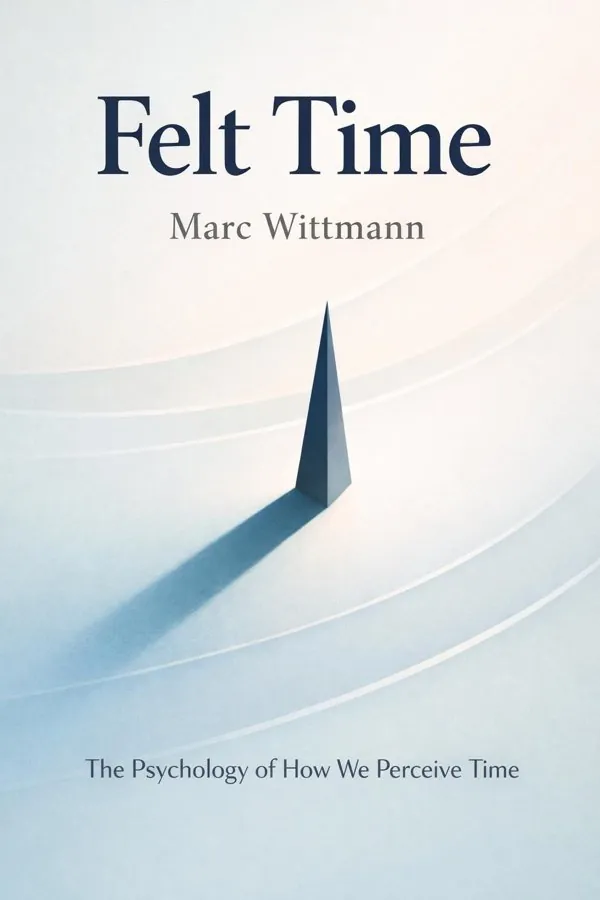
Felt Time: The Psychology of How We Perceive Time: Summary & Key Insights
 10 min10 chaptersAudio available
Key Takeaways from Felt Time: The Psychology of How We Perceive Time
Mechanical time is precise, standardized, and external.
A striking idea at the center of Felt Time is that our sense of time is inseparable from our sense of the body.
Time does not simply pass; it is filtered by where the mind goes.
One of the most relatable themes in the book is that time stretches and shrinks in ordinary life.
We do not live only in the present instant.
What Is Felt Time: The Psychology of How We Perceive Time About?
Felt Time: The Psychology of How We Perceive Time by Marc Wittmann is a cognition book spanning 10 pages. Why does a boring afternoon feel endless while a joyful weekend disappears in a blur? Why do childhood summers seem vast, yet the years of adulthood appear to speed by? In Felt Time, psychologist and neuroscientist Marc Wittmann explores these deceptively simple questions and shows that time is not only something measured by clocks, but something lived through the body, mind, and emotions. The book examines how humans perceive duration, how attention and memory shape the flow of experience, and why our sense of time changes across situations, states of consciousness, and stages of life. Wittmann draws on psychology, neuroscience, phenomenology, and clinical observation to explain subjective time in a way that is both rigorous and accessible. His core insight is that time perception is deeply tied to bodily awareness and self-consciousness: to feel time is, in part, to feel ourselves existing moment by moment. This makes the book valuable not only for readers interested in cognition, but also for anyone who wants to better understand stress, aging, mindfulness, mental health, and the texture of everyday life.
This FizzRead summary covers all 10 key chapters of Felt Time: The Psychology of How We Perceive Time in approximately 10 minutes, distilling the most important ideas, arguments, and takeaways from Marc Wittmann's work. Also available as an audio summary and Key Quotes Podcast.
Felt Time: The Psychology of How We Perceive Time
Why does a boring afternoon feel endless while a joyful weekend disappears in a blur? Why do childhood summers seem vast, yet the years of adulthood appear to speed by? In Felt Time, psychologist and neuroscientist Marc Wittmann explores these deceptively simple questions and shows that time is not only something measured by clocks, but something lived through the body, mind, and emotions. The book examines how humans perceive duration, how attention and memory shape the flow of experience, and why our sense of time changes across situations, states of consciousness, and stages of life. Wittmann draws on psychology, neuroscience, phenomenology, and clinical observation to explain subjective time in a way that is both rigorous and accessible. His core insight is that time perception is deeply tied to bodily awareness and self-consciousness: to feel time is, in part, to feel ourselves existing moment by moment. This makes the book valuable not only for readers interested in cognition, but also for anyone who wants to better understand stress, aging, mindfulness, mental health, and the texture of everyday life.
Who Should Read Felt Time: The Psychology of How We Perceive Time?
This book is perfect for anyone interested in cognition and looking to gain actionable insights in a short read. Whether you're a student, professional, or lifelong learner, the key ideas from Felt Time: The Psychology of How We Perceive Time by Marc Wittmann will help you think differently.
- ✓Readers who enjoy cognition and want practical takeaways
- ✓Professionals looking to apply new ideas to their work and life
- ✓Anyone who wants the core insights of Felt Time: The Psychology of How We Perceive Time in just 10 minutes
Want the full summary?
Get instant access to this book summary and 100K+ more with Fizz Moment.
Get Free SummaryAvailable on App Store • Free to download
Key Chapters
We often speak as if the brain contains a hidden stopwatch, but Wittmann’s research suggests something far more interesting: human time perception emerges from distributed processes rather than one central clock. Mechanical time is precise, standardized, and external. Psychological time is constructed from neural activity, bodily rhythms, attention, and context. Different brain systems help us estimate milliseconds, seconds, or longer stretches in different ways, which is why our sense of duration can be so inconsistent.
This matters because it changes how we think about time errors. If you misjudge how long a meeting lasted, that does not necessarily mean your mind “failed” to track time. It may mean your attention shifted, your emotional state altered your internal pacing, or your memory compressed the event afterward. The brain is not passively recording duration; it is actively generating it from ongoing experience.
A practical example is waiting in line at an airport. If you are anxious, scanning for delays, and hyperaware of every passing minute, the wait feels longer. If you are immersed in conversation or listening to a podcast, the same objective duration may seem shorter. The external clock has not changed, but the systems generating felt time have.
Wittmann’s broader point is that subjective time is not a defect when it differs from clock time. It is a feature of conscious life. Understanding this can make us less frustrated by time’s elasticity and more curious about what our distortions reveal.
Actionable takeaway: When time feels strangely slow or fast, ask what factors are shaping it—attention, emotion, bodily state, or memory—instead of assuming your perception is simply wrong.
A striking idea at the center of Felt Time is that our sense of time is inseparable from our sense of the body. Wittmann emphasizes interoception, the perception of internal bodily signals such as heartbeat, breathing, tension, warmth, and visceral sensations. We do not experience time as detached minds floating above the world. We feel duration through an embodied self that is constantly monitoring internal rhythms.
This means that time consciousness is not just a cognitive calculation. The body provides a living background pulse against which moments unfold. When you become more aware of your breathing during meditation, time may feel fuller, slower, or more detailed. When you are cut off from bodily awareness by stress, overstimulation, or dissociation, time can feel fragmented or unreal.
Think of the difference between scrolling rapidly through social media and taking a quiet walk without headphones. In the first case, your awareness is externally captured and bodily sensations fade into the background. In the second, footsteps, breath, and changing sensations create a richer sense of duration. You are not merely spending time; you are inhabiting it.
Wittmann links this embodied temporality to selfhood itself. To feel the continuity of the body is to feel the continuity of the self through time. This insight helps explain why practices that increase body awareness—mindfulness, breathing exercises, yoga, contemplative movement—can alter one’s temporal experience.
Actionable takeaway: Spend five minutes each day attending to your breath or heartbeat without distraction; strengthening bodily awareness can deepen your sense of presence and change how rushed time feels.
Time does not simply pass; it is filtered by where the mind goes. Wittmann shows that attention is one of the most powerful influences on subjective duration. When we focus directly on time, especially while waiting or anticipating something, moments tend to stretch. When our attention is absorbed in meaningful activity, we often lose track of time altogether.
This principle helps explain familiar experiences. A child in the back seat asking, “Are we there yet?” is attending to time itself, so the journey drags. An artist immersed in painting may look up and discover that hours have vanished. In both cases, objective time is unchanged, but the attentional structure of experience alters felt duration.
Emotion intensifies this effect. Fear, boredom, and discomfort often increase temporal awareness and make time feel slow. Excitement, curiosity, and flow can reduce self-monitoring and create a sense of temporal contraction. That is why public speaking may make five minutes feel like twenty, while a lively dinner with friends can make three hours seem brief.
This has practical implications for work and well-being. If your day feels endlessly fragmented, it may not only be because you have too much to do. Constant task-switching keeps attention unstable and prevents immersion, making time feel both rushed and unsatisfying. Deep focus, by contrast, often creates a more rewarding experience of time.
Wittmann encourages us to see time perception as a window into mental organization. The way time feels tells us something about how our consciousness is distributed.
Actionable takeaway: To make time feel less fractured, reduce multitasking and create blocks of uninterrupted focus where attention can settle into one meaningful activity.
One of the most relatable themes in the book is that time stretches and shrinks in ordinary life. Wittmann distinguishes between prospective time judgment—how long something feels while it is happening—and retrospective time judgment—how long it seems after we look back on it. These can diverge dramatically.
For example, a tedious meeting may feel painfully long in the moment but leave little memory afterward, making it seem brief in retrospect. A vacation packed with novelty may pass quickly while you are enjoying it, yet later feel long and substantial because it contains many vivid memories. This distinction helps explain why people can feel that life is racing by even when individual days sometimes feel slow.
Novelty plays a major role. Repeated routines generate fewer distinctive memory markers, so weeks can blur together. New experiences create richer encoding, making a period seem larger when remembered. That is one reason childhood often feels longer in memory: it contains more firsts, more learning, and more unfamiliarity.
This insight can be applied directly. If you want a month or year to feel fuller, do not only try to “manage your time” more efficiently. Add variation. Visit new places, learn skills, change routines, and pay closer attention to familiar surroundings. Subjective richness depends not just on what happens, but on whether experience is differentiated and encoded.
Wittmann’s point is profound: a meaningful life is not merely long in clock time, but dense in lived time.
Actionable takeaway: Introduce one new activity, place, or ritual each week to increase novelty and make periods of life feel more expansive in memory.
We do not live only in the present instant. Wittmann argues that our experience of time is woven from retention of the just-past, awareness of the now, and anticipation of what comes next. Without memory and expectation, consciousness would fracture into disconnected moments. Felt time is therefore inseparable from the mind’s ability to connect experiences across a temporal arc.
This helps explain why anxiety and rumination can distort time. Anxious anticipation pulls us toward uncertain futures, making waiting feel heavy and prolonged. Depression can trap attention in repetitive memory loops, flattening the future and draining the present of momentum. A healthy temporal life involves flexible movement between remembering, perceiving, and projecting.
In everyday terms, think about preparing for an important interview. The days before it may feel stretched by anticipation. During the interview, concentration narrows awareness. Afterward, memory reorganizes the event, highlighting certain moments and discarding others. Your sense of the total experience is not given all at once; it is continuously reconstructed.
Wittmann also suggests that personal identity depends on this temporal integration. We experience ourselves as enduring beings because we carry the past forward and imagine future possibilities. The self is not outside time; it is built through temporal continuity.
This insight can make us more intentional about memory and expectation. Journaling, reflection, and planning are not just productivity tools. They shape how life hangs together as a meaningful sequence.
Actionable takeaway: End each day by noting one significant event from the past day and one intention for tomorrow; this simple practice strengthens continuity between memory, presence, and anticipation.
Few experiences reveal the constructed nature of time more clearly than altered states. Wittmann examines meditation, flow, drug experiences, trauma, extreme sports, and contemplative absorption to show that time can dramatically change when consciousness changes. In some states, moments become more spacious and detailed. In others, time collapses, accelerates, or loses its usual sequence altogether.
Meditation is especially important in the book because it demonstrates that slowing down is not always about changing the external pace of life. It can arise from changing the quality of awareness. When attention becomes steady and bodily sensations are more clearly perceived, time may feel more present and less pressured. By contrast, in high-adrenaline situations such as accidents or near misses, people often report time slowing down, likely because attention becomes intensely focused and memory encoding increases.
Flow states offer another pattern. During skilled, engaging activity, self-consciousness decreases and action unfolds smoothly. In retrospect, time may seem to have flown, yet the experience itself may feel deeply satisfying rather than merely compressed. This suggests that the best use of time is not always the most self-monitored one.
These altered experiences are not marginal curiosities. They reveal mechanisms at work in everyday life and show that time can be trained, disrupted, or reshaped.
Actionable takeaway: Experiment with practices that alter awareness in healthy ways—such as meditation, focused creative work, or device-free walks—to discover which conditions make time feel more spacious and meaningful for you.
One of Wittmann’s most humane contributions is his examination of how mental disorders affect felt time. Time perception is not an abstract laboratory topic; it is deeply tied to suffering and mental health. Conditions such as depression, anxiety, schizophrenia, ADHD, and trauma-related disorders can all alter temporal experience in distinctive ways.
In depression, time often feels slowed, heavy, and stagnant. The future may seem blocked or empty, and the present can lose vitality. In anxiety, the opposite pressure may occur: time feels urgent, unstable, or dominated by fearful anticipation. In schizophrenia, disturbances in the continuity and ordering of experience may contribute to fragmented temporality. ADHD can involve difficulty estimating duration, planning across time, and maintaining temporal structure in daily life.
These distortions matter because they affect functioning and identity. If time feels stuck, motivation suffers. If time feels chaotic, planning becomes difficult. If present experience does not connect smoothly with memory and expectation, the self can feel unstable.
Wittmann’s perspective encourages empathy. Instead of seeing such difficulties merely as failures of discipline or cognition, we can understand them as disruptions in how a person inhabits time. Clinical care, then, should address not only symptoms but also temporal experience through routines, body-based grounding, therapy, mindfulness, and environmental structure.
For readers without a diagnosed disorder, this chapter offers a powerful reminder: your relationship to time is a signal of psychological well-being. When your time experience changes drastically, it may be telling you something important.
Actionable takeaway: If your sense of time has become persistently oppressive, chaotic, or empty, treat it as meaningful data and consider discussing it with a mental health professional.
To feel time is, in an important sense, to feel oneself existing. Wittmann argues that self-awareness and temporal awareness are deeply intertwined. The continuity of the self depends on the continuity of experience, and this continuity is temporal before it is conceptual. We do not first become selves and then move through time; rather, our sense of self arises through ongoing temporal integration of bodily sensations, perceptions, memories, and expectations.
This idea sheds light on why disruptions of time can feel existential. Jet lag, sleep deprivation, sensory overload, grief, or prolonged stress can make us feel strangely unlike ourselves. It is not only that our schedule has changed; the rhythm that supports self-continuity has been disturbed. Likewise, contemplative practices that stabilize attention can create not just calm, but a stronger sense of coherent presence.
In practical terms, identity is not maintained solely by beliefs such as “I am this kind of person.” It is also maintained by repeated temporal patterns: morning rituals, recurring relationships, bodily habits, and meaningful projects that extend across days and years. These rhythms give the self shape.
Wittmann’s view also challenges the fantasy of total efficiency. A life cut into constant interruptions may not merely feel busy; it may weaken the experience of being fully present as a continuous self. Temporal fragmentation can become personal fragmentation.
Actionable takeaway: Protect at least one daily rhythm—such as a morning routine, exercise session, or evening reflection—that helps anchor your sense of continuity across time.
Subjective time is personal, but it is not purely private. Wittmann shows that age, culture, and social organization shape how time is experienced. One of the most widely recognized examples is the feeling that time speeds up as we get older. Part of this may reflect increased routine and fewer novel experiences, which reduce the richness of memory. A year becomes a smaller proportion of one’s lived life, and repetition compresses retrospective time.
Culture also matters. Some societies emphasize punctuality, schedules, deadlines, and linear progress; others organize life more around events, relationships, or flexible rhythms. These frameworks influence stress, waiting, multitasking, and expectations about how time should be used. Even within the same culture, individuals differ widely in tempo preferences, patience, and sensitivity to interruption.
This perspective is liberating because it reveals that some time pressure is socially constructed. If you constantly feel behind, part of the issue may be the temporal norms surrounding you, not just your personal habits. It also suggests that we can consciously design our environment to create healthier temporal experiences—through slower rituals, reduced notification overload, better work boundaries, and more respect for rest.
Wittmann does not deny objective time; he shows that lived time is mediated by context. How old you are, where you live, and how your community values speed all influence how life feels from the inside.
Actionable takeaway: Audit the social pressures shaping your sense of time and intentionally adopt at least one slower, less efficiency-driven routine each week.
The deepest argument of Felt Time is that neither neuroscience alone nor introspection alone can explain time consciousness. Wittmann calls for an integrated approach that connects brain processes, bodily awareness, subjective reports, and philosophical reflection. Time is both measurable and lived, and any serious account must bridge these levels.
This is important because reductionism can miss the phenomenon. If scientists focus only on neural timing mechanisms, they may explain duration estimation without capturing what it is like for time to drag during grief or expand during meditation. But if we rely only on personal reflection, we risk overlooking the biological systems that make those experiences possible. Wittmann’s achievement is to hold these perspectives together.
For readers, this integration has practical value. It suggests that changing time experience can happen from multiple directions: adjusting attention, improving sleep, treating mental health conditions, engaging the body, reshaping routines, and cultivating awareness. Felt time is not locked in one place; it is an emergent property of whole-person functioning.
The book therefore speaks to psychologists, neuroscientists, philosophers, clinicians, and ordinary readers alike. It treats temporal experience not as a niche topic, but as a central clue to consciousness itself. How we perceive time reveals how mind, brain, body, and world are stitched together.
Actionable takeaway: When trying to improve your experience of time, use a whole-system approach—consider your brain state, body rhythms, attention habits, emotional life, and environment together rather than in isolation.
All Chapters in Felt Time: The Psychology of How We Perceive Time
About the Author
Marc Wittmann is a German psychologist and neuroscientist whose work has made him a leading researcher on time perception and conscious experience. He has been affiliated with the Institute for Frontier Areas of Psychology and Mental Health in Freiburg, where he has explored how humans perceive duration, how bodily awareness shapes the sense of self, and how altered states and psychiatric conditions affect temporal experience. Wittmann is especially known for linking experimental psychology with phenomenology, neuroscience, and contemplative studies, creating a broader understanding of how time is lived from the inside. In his writing, he brings scientific rigor to questions that are deeply personal and universal, such as why time speeds up with age, slows in distress, or becomes richer through mindful attention.
Get This Summary in Your Preferred Format
Read or listen to the Felt Time: The Psychology of How We Perceive Time summary by Marc Wittmann anytime, anywhere. FizzRead offers multiple formats so you can learn on your terms — all free.
Available formats: App · Audio · PDF · EPUB — All included free with FizzRead
Download Felt Time: The Psychology of How We Perceive Time PDF and EPUB Summary
Key Quotes from Felt Time: The Psychology of How We Perceive Time
“Mechanical time is precise, standardized, and external.”
“A striking idea at the center of Felt Time is that our sense of time is inseparable from our sense of the body.”
“Time does not simply pass; it is filtered by where the mind goes.”
“One of the most relatable themes in the book is that time stretches and shrinks in ordinary life.”
“We do not live only in the present instant.”
Frequently Asked Questions about Felt Time: The Psychology of How We Perceive Time
Felt Time: The Psychology of How We Perceive Time by Marc Wittmann is a cognition book that explores key ideas across 10 chapters. Why does a boring afternoon feel endless while a joyful weekend disappears in a blur? Why do childhood summers seem vast, yet the years of adulthood appear to speed by? In Felt Time, psychologist and neuroscientist Marc Wittmann explores these deceptively simple questions and shows that time is not only something measured by clocks, but something lived through the body, mind, and emotions. The book examines how humans perceive duration, how attention and memory shape the flow of experience, and why our sense of time changes across situations, states of consciousness, and stages of life. Wittmann draws on psychology, neuroscience, phenomenology, and clinical observation to explain subjective time in a way that is both rigorous and accessible. His core insight is that time perception is deeply tied to bodily awareness and self-consciousness: to feel time is, in part, to feel ourselves existing moment by moment. This makes the book valuable not only for readers interested in cognition, but also for anyone who wants to better understand stress, aging, mindfulness, mental health, and the texture of everyday life.
You Might Also Like
A Field Guide to Lies: Critical Thinking in the Information Age
Daniel J. Levitin
10 min
A Theory of Cognitive Dissonance
Leon Festinger
10 min
Black-And-White Thinking: The Burden of a Binary Brain in a Complex World
Kevin Dutton
10 min
Born Liars: Why We Can’t Live Without Deceit
Ian Leslie
10 min
Collective Illusions: Conformity, Complicity, and the Science of Why We Make Bad Decisions
Todd Rose
10 min
Concrete Mathematics: A Foundation for Computer Science
Ronald L. Graham, Donald E. Knuth, Oren Patashnik
10 minBrowse by Category
Ready to read Felt Time: The Psychology of How We Perceive Time?
Get the full summary and 100K+ more books with Fizz Moment.