
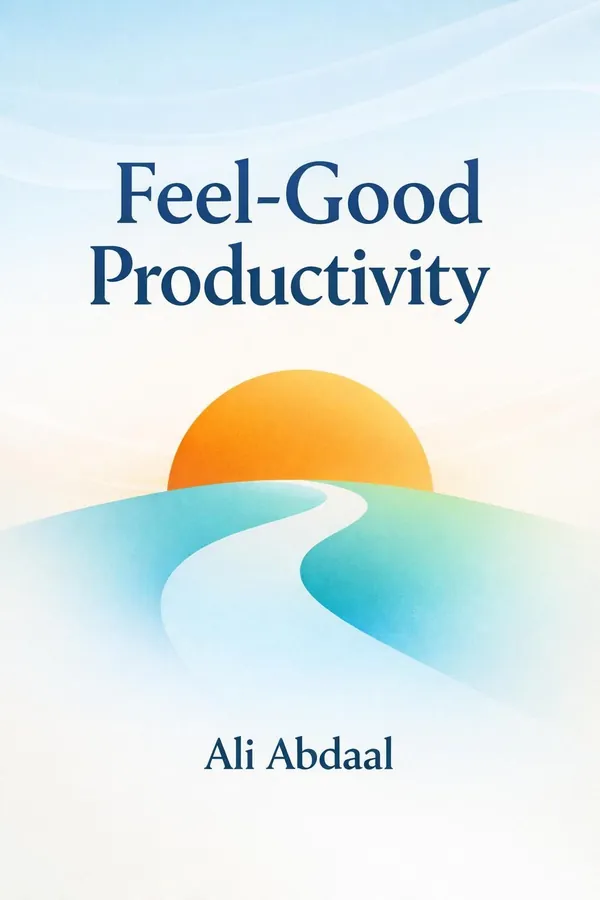
Feel-Good Productivity: How to Do More of What Matters to You: Summary & Key Insights
by Ali Abdaal
 10 min11 chaptersAudio available
What Is Feel-Good Productivity: How to Do More of What Matters to You About?
Feel-Good Productivity: How to Do More of What Matters to You by Ali Abdaal is a productivity book spanning 11 pages. In this book, Dr. Ali Abdaal introduces the Feel-Good Productivity method, a science-based approach to achieving more with less stress. Drawing on psychology and personal experience, he explains how positive emotions, clarity, courage, and alignment can transform productivity into a sustainable and enjoyable process. The book is structured around three key phases—Energize, Unblock, and Sustain—offering practical tools to help readers work and live more effectively.
This FizzRead summary covers all 11 key chapters of Feel-Good Productivity: How to Do More of What Matters to You in approximately 10 minutes, distilling the most important ideas, arguments, and takeaways from Ali Abdaal's work. Also available as an audio summary and Key Quotes Podcast.
Feel-Good Productivity: How to Do More of What Matters to You
In this book, Dr. Ali Abdaal introduces the Feel-Good Productivity method, a science-based approach to achieving more with less stress. Drawing on psychology and personal experience, he explains how positive emotions, clarity, courage, and alignment can transform productivity into a sustainable and enjoyable process. The book is structured around three key phases—Energize, Unblock, and Sustain—offering practical tools to help readers work and live more effectively.
Who Should Read Feel-Good Productivity: How to Do More of What Matters to You?
This book is perfect for anyone interested in productivity and looking to gain actionable insights in a short read. Whether you're a student, professional, or lifelong learner, the key ideas from Feel-Good Productivity: How to Do More of What Matters to You by Ali Abdaal will help you think differently.
- ✓Readers who enjoy productivity and want practical takeaways
- ✓Professionals looking to apply new ideas to their work and life
- ✓Anyone who wants the core insights of Feel-Good Productivity: How to Do More of What Matters to You in just 10 minutes
Want the full summary?
Get instant access to this book summary and 100K+ more with Fizz Moment.
Get Free SummaryAvailable on App Store • Free to download
Key Chapters
The foundation of Feel-Good Productivity lies in the science of positive emotion. The author explains that emotions are not fleeting states but powerful forces that shape cognition, motivation, and physical energy. Through the broaden-and-build theory, positive emotions are shown to expand awareness and foster creativity. When people feel good, they see more possibilities, think more flexibly, and build lasting psychological and social resources. This creates an upward spiral of well-being and achievement.
The author connects these insights to the biology of happiness. Four key hormones—endorphins, serotonin, dopamine, and oxytocin—form the biochemical basis of emotional energy. Endorphins reduce pain and increase motivation; serotonin stabilizes mood and enhances contentment; dopamine drives focus and reward; and oxytocin strengthens social bonds. Together, they create a virtuous cycle: feeling good generates energy, which fuels productivity, which in turn reinforces positive emotion.
The book also explores how positive emotions counteract stress. Barbara Fredrickson’s “undoing hypothesis” shows that positive feelings can reverse the physiological effects of anxiety, lowering heart rate and blood pressure. This means that joy is not merely pleasant—it is restorative. By cultivating positivity, people can recover faster from stress and maintain resilience.
Finally, the author presents evidence that happiness leads to success, not the other way around. Studies involving hundreds of thousands of participants reveal that individuals who frequently experience positive emotions are more creative, sociable, and effective. They earn higher incomes, enjoy better relationships, and perform better at work. The conclusion is clear: success does not produce happiness; happiness produces success. This scientific understanding becomes the cornerstone of the Feel-Good Productivity method, proving that emotional well-being is the most powerful form of human energy.
The first energizer, Play, is introduced through the story of physicist Richard Feynman, who rediscovered his love for science by treating it as a game rather than a duty. After years of grief and exhaustion, Feynman regained his curiosity by playing with ideas—literally modeling the motion of spinning plates. This playful approach led to breakthroughs that earned him the Nobel Prize. The lesson is simple: play restores energy and creativity.
The author expands this idea by showing that play is not childish but essential. It brings adventure, curiosity, and fun into daily life. Research confirms that play rejuvenates the mind and body, reducing fatigue and increasing motivation. Adults often lose their sense of play because they equate seriousness with maturity. Yet, as psychologist Stuart Brown’s studies reveal, playfulness is vital for fulfillment. Brown identifies eight play personalities—from the Collector to the Creator—and encourages readers to find their own.
The author shares personal experiences, from gaming in adolescence to rediscovering joy in work through playful experimentation. He introduces practical methods: choosing a character that embodies one’s playful side, embracing curiosity through “side quests,” and finding fun in mundane tasks. The “post-it question”—How would this be if it were fun?—becomes a guiding principle. By reframing work as a game, even tedious tasks become engaging.
Play also requires lowering stress. Experiments with animals and humans show that stress suppresses playfulness. The author advises reframing failure as data, not defeat, and approaching life with sincerity rather than excessive seriousness. Quoting philosopher Alan Watts, he distinguishes between being serious and being sincere: sincerity allows engagement without anxiety. The chapter concludes that play is not a distraction from productivity—it is its spark. When life feels playful, energy flows naturally, and work becomes a source of joy rather than strain.
+ 9 more chapters — available in the FizzRead app
All Chapters in Feel-Good Productivity: How to Do More of What Matters to You
About the Author
Ali Abdaal is a doctor, entrepreneur, and content creator known for his work on productivity and well-being. A graduate of the University of Cambridge, he began his career in the UK’s National Health Service before becoming a full-time educator and YouTuber, sharing evidence-based strategies for living and working happier and more efficiently.
Get This Summary in Your Preferred Format
Read or listen to the Feel-Good Productivity: How to Do More of What Matters to You summary by Ali Abdaal anytime, anywhere. FizzRead offers multiple formats so you can learn on your terms — all free.
Available formats: App · Audio · PDF · EPUB — All included free with FizzRead
Download Feel-Good Productivity: How to Do More of What Matters to You PDF and EPUB Summary
Key Quotes from Feel-Good Productivity: How to Do More of What Matters to You
“The foundation of Feel-Good Productivity lies in the science of positive emotion.”
“The first energizer, Play, is introduced through the story of physicist Richard Feynman, who rediscovered his love for science by treating it as a game rather than a duty.”
Frequently Asked Questions about Feel-Good Productivity: How to Do More of What Matters to You
Feel-Good Productivity: How to Do More of What Matters to You by Ali Abdaal is a productivity book that explores key ideas across 11 chapters. In this book, Dr. Ali Abdaal introduces the Feel-Good Productivity method, a science-based approach to achieving more with less stress. Drawing on psychology and personal experience, he explains how positive emotions, clarity, courage, and alignment can transform productivity into a sustainable and enjoyable process. The book is structured around three key phases—Energize, Unblock, and Sustain—offering practical tools to help readers work and live more effectively.
More by Ali Abdaal
You Might Also Like



Browse by Category
Ready to read Feel-Good Productivity: How to Do More of What Matters to You?
Get the full summary and 100K+ more books with Fizz Moment.