
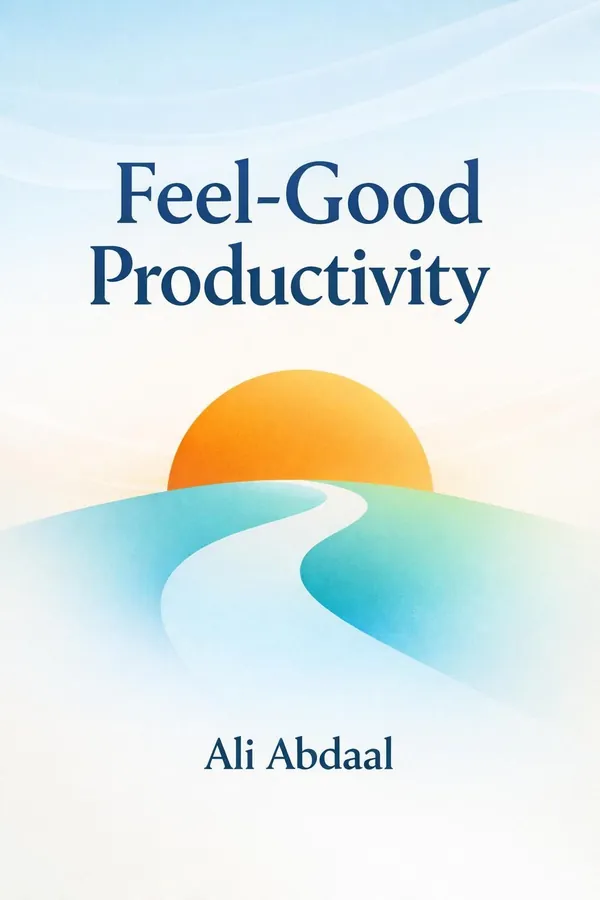
Feel-Good Productivity: Summary & Key Insights
by Ali Abdaal
 10 min9 chaptersAudio available
Key Takeaways from Feel-Good Productivity
Many people assume that exhaustion is evidence of ambition, but Feel-Good Productivity begins by exposing how destructive that idea can be.
We often think of feeling good as a reward for finishing work, but Abdaal makes a compelling case that feeling good is actually what helps us do the work in the first place.
One of the book’s most memorable claims is that play is not a distraction from serious work but a catalyst for it.
A major barrier to productivity is the feeling that our work is happening to us rather than being shaped by us.
Productivity is often presented as a private battle between an individual and a to-do list, but Abdaal argues that our relationships shape our output far more than we realize.
What Is Feel-Good Productivity About?
Feel-Good Productivity by Ali Abdaal is a self-help book. What if the secret to getting more done is not pushing harder, but feeling better? In Feel-Good Productivity, Ali Abdaal challenges the familiar belief that discipline, pressure, and constant hustle are the only paths to high performance. Instead, he argues that sustainable productivity grows from positive emotion, meaningful goals, and a kinder relationship with work. Drawing on psychological research, behavioral science, and his own journey from overworked doctor in the UK’s National Health Service to successful entrepreneur and educator, Abdaal offers a practical system for achieving more without burning out. The book is built around three stages: Energize, Unblock, and Sustain. First, readers learn how to generate energy through play, power, and people. Then they discover how to overcome procrastination, fear, and uncertainty with greater clarity and courage. Finally, Abdaal shows how to maintain momentum by aligning daily actions with long-term purpose and by preventing productivity from becoming joyless self-optimization. The result is a refreshingly humane guide to work and life, one that replaces grind culture with curiosity, resilience, and enjoyment.
This FizzRead summary covers all 9 key chapters of Feel-Good Productivity in approximately 10 minutes, distilling the most important ideas, arguments, and takeaways from Ali Abdaal's work. Also available as an audio summary and Key Quotes Podcast.
Feel-Good Productivity
What if the secret to getting more done is not pushing harder, but feeling better? In Feel-Good Productivity, Ali Abdaal challenges the familiar belief that discipline, pressure, and constant hustle are the only paths to high performance. Instead, he argues that sustainable productivity grows from positive emotion, meaningful goals, and a kinder relationship with work. Drawing on psychological research, behavioral science, and his own journey from overworked doctor in the UK’s National Health Service to successful entrepreneur and educator, Abdaal offers a practical system for achieving more without burning out.
The book is built around three stages: Energize, Unblock, and Sustain. First, readers learn how to generate energy through play, power, and people. Then they discover how to overcome procrastination, fear, and uncertainty with greater clarity and courage. Finally, Abdaal shows how to maintain momentum by aligning daily actions with long-term purpose and by preventing productivity from becoming joyless self-optimization. The result is a refreshingly humane guide to work and life, one that replaces grind culture with curiosity, resilience, and enjoyment.
Who Should Read Feel-Good Productivity?
This book is perfect for anyone interested in self-help and looking to gain actionable insights in a short read. Whether you're a student, professional, or lifelong learner, the key ideas from Feel-Good Productivity by Ali Abdaal will help you think differently.
- ✓Readers who enjoy self-help and want practical takeaways
- ✓Professionals looking to apply new ideas to their work and life
- ✓Anyone who wants the core insights of Feel-Good Productivity in just 10 minutes
Want the full summary?
Get instant access to this book summary and 100K+ more with Fizz Moment.
Get Free SummaryAvailable on App Store • Free to download
Key Chapters
Many people assume that exhaustion is evidence of ambition, but Feel-Good Productivity begins by exposing how destructive that idea can be. Ali Abdaal opens with a powerful memory from his time as a junior doctor, working a Christmas shift under immense pressure, physically depleted and emotionally overwhelmed. That experience captures a broader modern problem: we have built a culture that praises busyness while ignoring the human cost. We often treat productivity as a measure of how much strain we can endure rather than how effectively and sustainably we can contribute.
Abdaal argues that this model is broken. When we rely on stress, guilt, and self-criticism to force ourselves through the day, we may produce short bursts of output, but we also drain motivation, creativity, and long-term well-being. The more work becomes associated with dread, the harder it is to show up fully. This creates a vicious cycle: we fall behind, judge ourselves for it, and then try to compensate with even more pressure.
The book’s core insight is that productivity should not feel like a constant fight against ourselves. Instead of asking, “How can I squeeze more out of my day?” Abdaal invites readers to ask, “How can I make work feel more energizing, meaningful, and enjoyable?” This shift changes everything. It moves productivity from a punishment model to a partnership model, where your emotions are not obstacles to overcome but conditions to cultivate.
A practical application is to audit your current productivity habits. Notice which tools depend on fear, shame, or urgency and which ones create clarity and momentum. Replace one pressure-based habit this week with a more supportive alternative, such as planning with curiosity instead of criticism.
We often think of feeling good as a reward for finishing work, but Abdaal makes a compelling case that feeling good is actually what helps us do the work in the first place. Drawing on research from positive psychology and neuroscience, he explains that positive emotions broaden attention, improve cognitive flexibility, increase motivation, and strengthen resilience. In other words, happiness is not the opposite of productivity; it is one of its drivers.
This idea challenges a deeply rooted assumption. Many of us worry that if we become too relaxed or too satisfied, we will lose our edge. Yet the evidence suggests the reverse. When people feel optimistic, connected, and energized, they are better at solving problems, exploring new ideas, and persisting through setbacks. Positive emotion makes effort feel lighter and progress feel more possible.
Abdaal does not suggest pretending everything is fine or avoiding difficult feelings. Instead, he shows that small doses of joy, curiosity, gratitude, and satisfaction can dramatically improve how we work. Something as simple as starting the day with a task you enjoy, celebrating a small win, working in a pleasant environment, or pausing to appreciate progress can shift your emotional state and unlock better focus.
This is especially useful during mentally demanding work. If a task feels heavy, ask what emotional ingredient is missing. Do you need more variety, more connection, more visible progress, or more meaning? By adjusting the emotional experience of the task, you often improve performance without relying on brute force.
Actionable takeaway: before beginning an important piece of work, spend five minutes creating a positive emotional state. Play energizing music, review recent wins, or write down why the task matters. Treat mood as part of your productivity setup, not an afterthought.
One of the book’s most memorable claims is that play is not a distraction from serious work but a catalyst for it. Abdaal illustrates this through the story of physicist Richard Feynman, who rediscovered his love for science when he stopped treating it as a grim obligation and began following what amused and intrigued him. That playful spirit led not to lower standards, but to deeper engagement and better ideas.
In adulthood, play is often dismissed as childish or unproductive. We imagine that professionalism means seriousness, and that enjoyable work somehow counts less. Abdaal argues the opposite. Play introduces experimentation, curiosity, and lightness into our efforts. It lowers the emotional stakes, making it easier to begin, easier to persist, and easier to recover from mistakes. When work feels like exploration rather than judgment, creativity expands.
Play can take many forms. It might mean turning a repetitive task into a challenge, setting a timer and trying to beat your previous record, brainstorming wild solutions before narrowing them down, or choosing a more enjoyable medium for your work. A writer might draft messy first ideas just for fun. A student might invent quiz games. A manager might frame a difficult planning session as a design experiment rather than a performance test.
The point is not to trivialize important work. It is to make the process more engaging so that effort becomes sustainable. Play also reduces perfectionism, because it encourages action before certainty. You are more willing to try when the task feels less like a final exam.
Actionable takeaway: identify one task you have been avoiding and ask, “How can I make this 10 percent more playful?” Add a timer, a game, a creative constraint, or an element of curiosity, then use that to get started.
A major barrier to productivity is the feeling that our work is happening to us rather than being shaped by us. Abdaal calls attention to the energizing effect of power, not in the sense of dominance over others, but in the sense of personal agency. When we feel that our actions matter and that we have some control over our environment, motivation rises. When we feel trapped, motivation collapses.
This matters because many people lose energy not from the volume of work alone but from the experience of helplessness around it. Endless meetings, unclear expectations, and reactive schedules make us feel like passengers in our own lives. Abdaal suggests reclaiming energy by deliberately increasing autonomy wherever possible. Even small choices can restore a sense of power: deciding when to tackle deep work, setting boundaries around interruptions, choosing your next concrete step, or reframing obligations as commitments you are actively making.
He also emphasizes the importance of competence. We feel more energized when we can see ourselves improving. Tracking progress, building skills, and breaking hard goals into achievable subgoals all reinforce the belief that effort leads somewhere. This creates a positive feedback loop: action produces evidence of capability, which increases confidence, which makes further action easier.
In practical terms, this could mean redesigning your task list around verbs you control. Instead of “deal with taxes,” write “collect receipts for 15 minutes.” Instead of “fix my career,” write “schedule one informational call.” Clarity creates agency, and agency creates momentum.
Actionable takeaway: whenever you feel stuck or drained, ask, “What is one part of this situation I can influence right now?” Then take a small, visible action that restores a sense of control.
Productivity is often presented as a private battle between an individual and a to-do list, but Abdaal argues that our relationships shape our output far more than we realize. Human beings are social creatures, and energy is contagious. Encouragement, accountability, collaboration, and belonging can all increase motivation, while isolation and friction can quietly drain it.
The book highlights how positive social connection supports consistent effort. When we feel seen and supported, difficult work becomes more manageable. A colleague’s enthusiasm can make a dull project feel important. A friend’s check-in can help us follow through. A study partner, mastermind group, or coach can create structure that we struggle to build alone. Even working silently alongside others, as in coworking or body doubling, can reduce resistance.
Abdaal also notes that the quality of our interactions matters. Some people leave us more energized, hopeful, and focused; others leave us depleted. Being intentional about who we spend time with, and how we structure collaborative environments, is therefore a productivity decision as much as a social one. He encourages readers to seek relationships that combine warmth with challenge: people who support your growth while expecting your best.
This idea applies beyond work teams. Families, partners, and friends influence whether your goals feel possible and worthwhile. Productivity improves when your environment contains more encouragement than judgment.
A simple application is to stop tackling every important project in isolation. Share goals with someone, create regular check-ins, or work in parallel with a partner. Social energy can reduce procrastination and make progress feel more enjoyable.
Actionable takeaway: choose one meaningful goal and add a human system to it this week, such as an accountability partner, coworking session, or weekly progress message to a friend.
One of the most useful ideas in Feel-Good Productivity is that procrastination is often not a character flaw but a signal of friction. We delay tasks not simply because we are lazy, but because something about the task feels unclear, emotionally heavy, or cognitively overwhelming. Abdaal argues that the answer is usually not more self-criticism. It is more clarity.
Vague intentions create resistance. A task like “work on presentation” is too broad for the brain to engage with easily. It hides dozens of decisions: where to begin, what good looks like, how long it will take, and what to do first. That uncertainty triggers avoidance. By contrast, a clearly defined next step lowers the activation energy. “Open slides and write three possible headlines” is specific enough to begin.
Abdaal encourages readers to break work into what he elsewhere describes as manageable actions. The goal is not to oversimplify important projects, but to translate them into visible, concrete moves. This is especially effective when paired with time boundaries. You may resist the thought of finishing a report, but you can usually tolerate 10 focused minutes gathering notes.
Clarity also involves understanding why a task matters. Motivation increases when we can connect an action to a meaningful outcome, whether that is helping a client, reducing future stress, learning a skill, or honoring a commitment. The brain is more willing to engage when the path and purpose are both visible.
Actionable takeaway: take your most avoided task and rewrite it as the smallest possible next action. Then schedule just 10 to 15 minutes to begin. Do not aim to finish; aim to reduce uncertainty.
A hidden message in many productivity systems is that if you set things up correctly, work will feel easy. Abdaal offers a more realistic and ultimately more empowering view: even with the best systems, meaningful work will sometimes feel uncomfortable. Fear of failure, fear of judgment, and fear of not being good enough can all block progress. In those moments, what matters is not waiting for confidence to appear but practicing courage.
Courage, in this context, means acting despite discomfort. It means sending the draft before it feels polished, starting the business idea before every detail is certain, speaking up in a meeting despite nerves, or revisiting a difficult project after a setback. Abdaal reframes productivity as an emotional skill as much as a planning skill. The challenge is not only managing time but learning to move through fear without becoming immobilized by it.
This is where self-compassion becomes crucial. If every imperfect attempt becomes evidence that you are inadequate, fear grows. But if mistakes are treated as part of learning, action becomes safer. Abdaal encourages a more experimental mindset: treat efforts as iterations rather than verdicts on your worth. That perspective lowers the emotional cost of trying.
Practical strategies include making tasks smaller, lowering the stakes of the first version, and defining success as showing up rather than performing flawlessly. A creator might aim to publish a “good enough” piece rather than a masterpiece. A job seeker might focus on sending one application rather than solving their whole future at once.
Actionable takeaway: identify one task you have delayed because it feels emotionally risky. Reduce the stakes, create a first tiny version, and complete that version today. Let courage mean movement, not fearlessness.
Doing more is not automatically better. One of Abdaal’s most important contributions is his insistence that productivity must be connected to what actually matters. Without alignment, efficiency simply helps us run faster in the wrong direction. You can optimize your calendar, automate your workflow, and build strong habits, yet still feel empty if your daily actions are disconnected from your values.
Abdaal encourages readers to think beyond output and ask deeper questions: What kind of life am I trying to build? What activities make me feel useful, alive, and proud? Which goals come from genuine desire, and which come from social comparison or external pressure? These questions protect productivity from becoming a sterile exercise in self-management.
Alignment works on both a strategic and daily level. Strategically, it means choosing projects and commitments that support your broader sense of purpose. Daily, it means finding ways to connect routine tasks to something meaningful. An accountant may not love every spreadsheet, but they may care deeply about helping clients feel secure. A student may not enjoy every assignment, but may value the opportunities education creates. Meaning transforms effort from empty obligation into chosen contribution.
This idea also supports resilience. When motivation dips, alignment helps you continue because the work is tethered to something larger than mood. It becomes easier to sustain effort when you know why the effort matters.
Actionable takeaway: review your current major goals and write one sentence explaining how each connects to a value you care about. If you cannot make that connection for a goal, reconsider whether it deserves your energy.
The final lesson of Feel-Good Productivity is that success depends less on short heroic bursts and more on repeatable patterns that do not break you. Abdaal argues that the best productivity system is not the most intense one. It is the one you can sustain with reasonable energy, changing circumstances, and ordinary human emotions. This requires designing routines that are flexible, forgiving, and enjoyable enough to last.
Many people fail not because they lack ambition but because they adopt systems built for ideal days only. They create unrealistic schedules, demand constant deep work, or expect themselves to perform at maximum intensity every day. When life inevitably interferes, the system collapses, and they interpret that collapse as personal failure. Abdaal recommends a gentler approach: lower the friction of good habits, build in recovery, and make consistency easier than perfection.
This can include planning a small daily minimum, using weekly reviews to recalibrate, protecting time for rest, and designing environments that support focus automatically. It also means noticing what genuinely gives you energy over time. Some people work best in focused morning blocks. Others need more variation and movement. Sustainability improves when your system reflects your actual psychology rather than an aspirational fantasy.
A useful example is replacing an all-or-nothing reading goal with a 10-minute daily reading ritual, or replacing a rigid exercise plan with a menu of possible workouts. The key is to maintain identity and momentum even on imperfect days.
Actionable takeaway: choose one area of your life where your current system feels too brittle. Simplify it into a version you could realistically maintain during a busy or stressful week, then commit to that baseline for the next month.
All Chapters in Feel-Good Productivity
About the Author
Ali Abdaal is a British doctor turned entrepreneur, educator, and author best known for his work on productivity, learning, and well-being. He studied medicine at the University of Cambridge and spent several years working in the UK’s National Health Service, where firsthand experience with stress, overwork, and performance pressure helped shape his later ideas. After building a large global audience through YouTube and other platforms, he transitioned into full-time content creation and business, sharing practical, research-informed strategies for living and working more effectively. Abdaal is widely respected for combining scientific evidence with relatable storytelling and clear frameworks. In Feel-Good Productivity, he brings together his medical background, personal journey, and years of teaching to offer a more sustainable and enjoyable approach to achievement.
Get This Summary in Your Preferred Format
Read or listen to the Feel-Good Productivity summary by Ali Abdaal anytime, anywhere. FizzRead offers multiple formats so you can learn on your terms — all free.
Available formats: App · Audio · PDF · EPUB — All included free with FizzRead
Download Feel-Good Productivity PDF and EPUB Summary
Key Quotes from Feel-Good Productivity
“Many people assume that exhaustion is evidence of ambition, but Feel-Good Productivity begins by exposing how destructive that idea can be.”
“We often think of feeling good as a reward for finishing work, but Abdaal makes a compelling case that feeling good is actually what helps us do the work in the first place.”
“One of the book’s most memorable claims is that play is not a distraction from serious work but a catalyst for it.”
“A major barrier to productivity is the feeling that our work is happening to us rather than being shaped by us.”
“Productivity is often presented as a private battle between an individual and a to-do list, but Abdaal argues that our relationships shape our output far more than we realize.”
Frequently Asked Questions about Feel-Good Productivity
Feel-Good Productivity by Ali Abdaal is a self-help book that explores key ideas across 9 chapters. What if the secret to getting more done is not pushing harder, but feeling better? In Feel-Good Productivity, Ali Abdaal challenges the familiar belief that discipline, pressure, and constant hustle are the only paths to high performance. Instead, he argues that sustainable productivity grows from positive emotion, meaningful goals, and a kinder relationship with work. Drawing on psychological research, behavioral science, and his own journey from overworked doctor in the UK’s National Health Service to successful entrepreneur and educator, Abdaal offers a practical system for achieving more without burning out. The book is built around three stages: Energize, Unblock, and Sustain. First, readers learn how to generate energy through play, power, and people. Then they discover how to overcome procrastination, fear, and uncertainty with greater clarity and courage. Finally, Abdaal shows how to maintain momentum by aligning daily actions with long-term purpose and by preventing productivity from becoming joyless self-optimization. The result is a refreshingly humane guide to work and life, one that replaces grind culture with curiosity, resilience, and enjoyment.
More by Ali Abdaal
You Might Also Like



Browse by Category
Ready to read Feel-Good Productivity?
Get the full summary and 100K+ more books with Fizz Moment.