
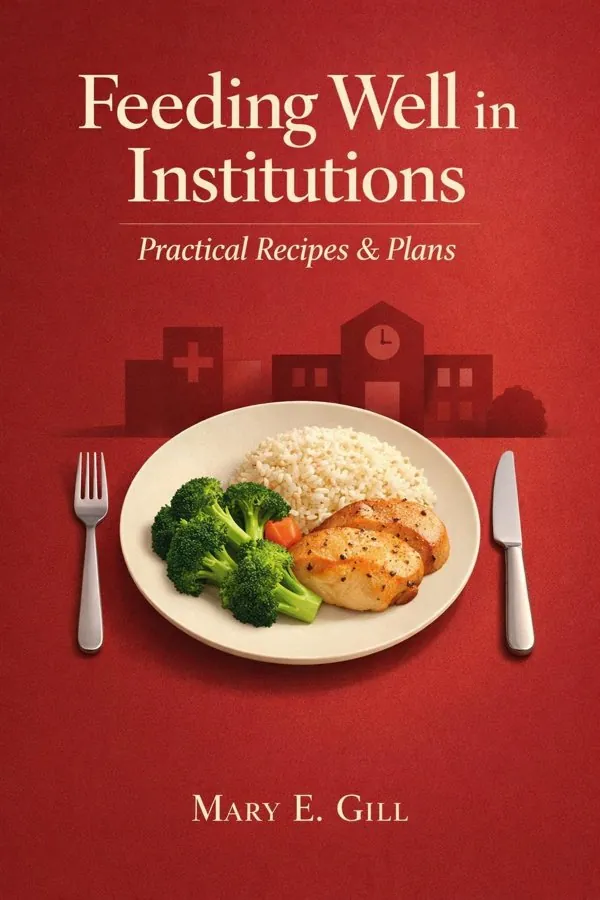
Feeding Well in Institutions: Practical Recipes & Plans: Summary & Key Insights
by Mary E. Gill
 10 min9 chaptersAudio available
Key Takeaways from Feeding Well in Institutions: Practical Recipes & Plans
The first mistake in institutional catering is assuming that a crowd is nutritionally uniform.
A menu is never just a list of dishes; it is a long-term strategy for health, economy, and morale.
Good food service depends as much on systems as on skill.
Scaling a recipe is not the same as multiplying ingredients.
The cheapest meal is often the most expensive if nobody eats it.
What Is Feeding Well in Institutions: Practical Recipes & Plans About?
Feeding Well in Institutions: Practical Recipes & Plans by Mary E. Gill is a nutrition book spanning 5 pages. Feeding large groups well is one of the least glamorous and most essential forms of care. In Feeding Well in Institutions: Practical Recipes & Plans, Mary E. Gill shows that institutional catering is not just a logistical challenge but a public health responsibility. Writing from the perspective of a trained dietitian and food service expert, Gill addresses the real-world demands of hospitals, schools, residential homes, and other communal settings where meals must be nutritious, affordable, appealing, and consistently delivered at scale. What makes this book valuable is its practical intelligence. Gill does not treat nutrition as an abstract science or cooking as a purely domestic art. Instead, she bridges both worlds, explaining how menu planning, purchasing, preparation methods, kitchen organization, and individual dietary needs all shape the quality of institutional life. A poorly planned meal service can waste money and undermine health; a thoughtful one can support recovery, growth, morale, and dignity. Though rooted in an earlier era of dietetics, the book remains strikingly relevant. Anyone responsible for feeding groups efficiently and humanely will find in Gill’s work a disciplined, compassionate guide to doing it well.
This FizzRead summary covers all 9 key chapters of Feeding Well in Institutions: Practical Recipes & Plans in approximately 10 minutes, distilling the most important ideas, arguments, and takeaways from Mary E. Gill's work. Also available as an audio summary and Key Quotes Podcast.
Feeding Well in Institutions: Practical Recipes & Plans
Feeding large groups well is one of the least glamorous and most essential forms of care. In Feeding Well in Institutions: Practical Recipes & Plans, Mary E. Gill shows that institutional catering is not just a logistical challenge but a public health responsibility. Writing from the perspective of a trained dietitian and food service expert, Gill addresses the real-world demands of hospitals, schools, residential homes, and other communal settings where meals must be nutritious, affordable, appealing, and consistently delivered at scale.
What makes this book valuable is its practical intelligence. Gill does not treat nutrition as an abstract science or cooking as a purely domestic art. Instead, she bridges both worlds, explaining how menu planning, purchasing, preparation methods, kitchen organization, and individual dietary needs all shape the quality of institutional life. A poorly planned meal service can waste money and undermine health; a thoughtful one can support recovery, growth, morale, and dignity.
Though rooted in an earlier era of dietetics, the book remains strikingly relevant. Anyone responsible for feeding groups efficiently and humanely will find in Gill’s work a disciplined, compassionate guide to doing it well.
Who Should Read Feeding Well in Institutions: Practical Recipes & Plans?
This book is perfect for anyone interested in nutrition and looking to gain actionable insights in a short read. Whether you're a student, professional, or lifelong learner, the key ideas from Feeding Well in Institutions: Practical Recipes & Plans by Mary E. Gill will help you think differently.
- ✓Readers who enjoy nutrition and want practical takeaways
- ✓Professionals looking to apply new ideas to their work and life
- ✓Anyone who wants the core insights of Feeding Well in Institutions: Practical Recipes & Plans in just 10 minutes
Want the full summary?
Get instant access to this book summary and 100K+ more with Fizz Moment.
Get Free SummaryAvailable on App Store • Free to download
Key Chapters
The first mistake in institutional catering is assuming that a crowd is nutritionally uniform. Gill insists that every institution gathers a distinct population, and that good feeding begins not with recipes but with people. Children in schools need energy, protein, calcium, and regular meal structure to support growth and concentration. Hospital patients may need soft diets, higher protein intake, lighter meals, or carefully controlled feeding during recovery. Elderly residents in care homes often require food that is easy to chew, digest, and enjoy, while still being rich in nutrients that support strength and resilience.
This principle transforms catering from mass production into responsive service. Gill argues that planners must consider age, health condition, activity level, appetite, and even emotional state. A convalescent patient with little appetite will not benefit from an ideal meal left untouched. A school lunch may meet calorie targets on paper yet fail if children find it unappealing. Nutritional adequacy therefore includes suitability, acceptability, and accessibility.
In practice, this means gathering information before planning menus. Institutions should note common medical restrictions, typical levels of physical activity, meal timing needs, and preferences shaped by local habits. A school menu might prioritize hearty midday meals and simple puddings; a care home may need softer vegetables, nourishing soups, and smaller portions served more attractively. Even texture, seasoning, and serving temperature matter when appetite is fragile.
Gill’s larger point is humane as well as technical: feeding people well starts by seeing them clearly. The institution that understands its diners can nourish them more effectively, reduce waste, and improve wellbeing. Actionable takeaway: begin menu planning with a profile of your population’s nutritional, medical, and practical needs rather than with standard recipes alone.
Good food service depends as much on systems as on skill. Gill makes clear that institutional catering fails when kitchens rely on improvisation instead of organized routines. In large-scale settings, inefficiency multiplies quickly: poor workflow delays service, inconsistent portioning wastes food, badly timed preparation reduces quality, and unclear staff roles create avoidable confusion. A successful institutional kitchen is a planned operation in which time, labor, space, and equipment are used intelligently.
Gill’s practical approach begins with sequencing. Ingredients must be ordered, stored, prepared, cooked, and served in a logical flow that reduces unnecessary movement and duplication of effort. Standardized recipes help kitchens produce reliable results regardless of who is on duty. Timetables ensure that soups, roasts, vegetables, and desserts are ready together rather than at cross-purposes. Portion control protects both the budget and fairness, especially in schools and residential institutions where consistency matters.
She also stresses that efficiency should never mean mechanical indifference. The point of organization is to free staff to produce better meals with less strain. For example, preparing vegetables in batches, using stock bases wisely, and planning leftover use can save hours over a week. Separating tasks between early preparation and final cooking can make service calmer and more accurate. In a hospital kitchen, where diets may differ by ward or patient, labeling and communication become especially important.
Modern readers will recognize these ideas in today’s terms: workflow design, standard operating procedures, labor optimization, and quality control. Gill presents them in accessible, kitchen-centered language. Her insight is timeless: when operations are orderly, food is more dependable, staff morale improves, and diners are better served.
Actionable takeaway: map your kitchen workflow from delivery to service, standardize key recipes and portions, and assign responsibilities clearly so quality does not depend on last-minute improvisation.
Scaling a recipe is not the same as multiplying ingredients. Gill understands that food behaves differently in quantity, and that institutional recipes must be designed for both nutrition and practicality. A dish that works beautifully for a family may lose flavor, texture, or consistency when prepared for fifty or five hundred people. The institutional cook therefore needs formulas that account for bulk preparation, holding time, portioning, and dependable nourishment.
Gill’s recipe philosophy is grounded in usefulness. She favors dishes that can be prepared efficiently, served attractively, and trusted to deliver real nutritional value. Soups enriched with milk or pulses, stews that combine meat and vegetables economically, baked dishes that hold their quality during service, and puddings that provide both energy and satisfaction all have a place. These are not luxury recipes but working recipes: practical enough for daily use, yet capable of supporting recovery, growth, and comfort.
An important theme is nutrient density. In many institutions, especially where appetite is low or budgets are tight, meals must do substantial nutritional work. A plain-looking dish may be wisely constructed to provide protein, minerals, and calories in digestible form. For example, adding cheese or milk to mashed potatoes, enriching soups, or using eggs in savory and sweet preparations can improve nourishment without greatly increasing complexity. At the same time, Gill is sensitive to texture and ease of service. Foods should be stable enough for large-batch cooking and portioning, not fussy or fragile.
Her recipes also imply discipline in measuring, testing, and recording. A successful institutional kitchen does not rely on guesswork. It refines recipes through repeated use, adjusting seasoning, yields, and timings to fit actual conditions.
Actionable takeaway: use standardized, tested recipes built specifically for large-scale preparation, and favor dishes that combine ease, consistency, and strong nutritional return per portion.
The cheapest meal is often the most expensive if nobody eats it. Gill’s treatment of economy is notably sophisticated: thrift matters, but only when joined to nutritional adequacy, operational efficiency, and human satisfaction. Institutions work under financial limits, yet cost-cutting that reduces quality, appetite, or morale can lead to greater waste and poorer health outcomes. True economy means getting the greatest nourishing value from available resources.
Gill encourages careful purchasing, intelligent use of seasonal produce, and thoughtful substitution when prices fluctuate. Less expensive cuts, pulses, grains, milk, and eggs can all contribute to excellent meals when planned well. Leftovers should be used creatively but safely, becoming soups, pies, hashes, or puddings rather than waste. Portion control prevents over-serving, while menu cycles help distribute expensive items strategically. However, Gill does not reduce feeding to arithmetic. She repeatedly returns to the emotional and social importance of meals in institutional life.
For many residents or patients, meals are among the day’s few predictable pleasures. The manner of service, friendliness of staff, and appearance of the plate or tray can shape appetite as much as the menu itself. Evaluation therefore must include more than accounts. Were meals eaten? Which dishes were repeatedly refused? Did patients improve? Were children satisfied through the school day? Did staff find the system manageable? These are signs of a functioning food service operation.
Gill’s humane realism is one of the book’s enduring strengths. She shows that economy and dignity are compatible when managers look beyond raw ingredient costs and observe the full feeding experience.
Actionable takeaway: judge food service by a combined measure of cost, waste, nutritional value, and diner response, and treat meals as part of care rather than mere institutional routine.
It is easy in institutional settings for convenience to become the hidden menu planner. Gill pushes firmly in the opposite direction: nutrition must be the organizing principle behind purchasing, menu design, preparation, and service. This does not mean every meal must be complicated or medically rigid. It means that food should be chosen and prepared with a clear understanding of what the body needs and how those needs change across populations.
Gill writes in a period when dietetics was increasingly shaping public health, and her perspective reflects that seriousness. Protein, energy, vitamins, minerals, digestibility, and meal balance are not optional refinements; they are central to the success of institutional feeding. In schools, nourishment supports attention, growth, and resilience. In hospitals, diet can aid recovery and prevent decline. In residential settings, steady, balanced meals sustain comfort and long-term wellbeing.
This principle has direct operational consequences. A menu heavy in starch but weak in protein may be cheap and filling yet nutritionally poor. Overcooked vegetables may satisfy tradition while losing some of their value and appeal. Skipping variety can result in gaps across a weekly cycle. Gill therefore favors planned combinations: protein foods paired with vegetables, milk or dairy used strategically, and desserts that contribute more than empty sweetness. Even modest meals can be improved through wise composition.
Her method also anticipates modern food service standards. Nutritional intent should be visible in procurement lists, recipe formats, and staff training. Cooks need not be laboratory scientists, but they should understand why ingredients matter and how preparation affects value.
Actionable takeaway: review every menu and recipe through a nutritional lens, asking not only whether it is affordable and practical, but whether it truly supports the health of the people being served.
An institution proves its competence not when serving the average diner, but when meeting the needs of those who cannot eat the average meal. Gill recognizes that hospitals, care homes, and even schools often include people who need modified diets: soft foods, light diets, high-protein meals, restricted items, or therapeutic adjustments linked to illness and recovery. These needs cannot be treated as afterthoughts. They require planning, communication, and disciplined execution.
The challenge is practical as much as nutritional. A special diet may fail not because the prescription is wrong, but because the kitchen is disorganized. If trays are mislabeled, textures are inconsistent, or substitutions are made casually, vulnerable diners may receive food they cannot manage or should not consume. Gill therefore places importance on cooperation between dietetic guidance, kitchen staff, and service personnel. Everyone involved must understand the purpose of the diet and the importance of accuracy.
She also implies that special diets should remain as appetizing as possible. A soft or restricted diet should not become a punishment of bland, shapeless meals. Even simple modifications can preserve dignity: pureed soups with good flavor, soft puddings with nourishment, minced dishes seasoned thoughtfully, or smaller portions arranged attractively. In long-term institutions especially, monotony can erode intake and morale.
For managers, this means developing systems rather than relying on memory. Standard modified recipes, tray checks, labeling routines, and close communication with nursing or supervisory staff can reduce error. The more routine these procedures become, the safer and more humane the service will be.
Actionable takeaway: create clear protocols for special diets, including standardized recipes, accurate labeling, and staff communication, so dietary modifications are safe, consistent, and still appetizing.
People do not eat nutrients; they eat meals, and meals are experienced through the senses. One of Gill’s most perceptive themes is that presentation matters in institutional feeding, especially where appetite is weak or morale is low. A meal may be perfectly balanced on paper and still fail if it looks dull, arrives lukewarm, or is served without care. Appearance, color, texture contrast, and service style all affect whether food is welcomed or rejected.
This matters intensely in hospitals and care settings. Patients recovering from illness may have little desire to eat, so small details become decisive: neatly arranged portions, a clean tray, a bright garnish, or a well-chosen pudding can encourage intake. For children, familiar and cheerful presentation can make wholesome meals more acceptable. For elderly residents, manageable portions and visible distinction between foods can make dining less frustrating and more pleasurable.
Gill’s point is not about elaborate decoration. It is about respecting diners through thoughtful service. Overfilled plates can overwhelm. Uniform beige meals can suppress appetite. Foods with similar textures may feel monotonous even when nutritionally sound. By contrast, a simple plate of stew, green vegetable, and attractive dessert can feel complete and inviting. Timing matters too. Good food deteriorates when it waits too long before serving.
Institutions often underestimate these details because they seem secondary to bulk production. Gill shows they are not secondary at all; they are part of effective nourishment. Food that is better presented is more likely to be eaten, and food that is more fully eaten delivers the nourishment intended.
Actionable takeaway: improve meal acceptance by focusing on temperature, portion size, color contrast, cleanliness, and simple presentation touches that make institutional food feel more inviting and respectful.
Behind every kitchen system lies a moral question: what does this institution believe people deserve? Gill’s book quietly argues that food service is a reflection of institutional character. Feeding well requires budgets, recipes, and procedures, but it also requires an attitude that sees meals as part of care, education, recovery, and daily dignity. When institutions treat food as a minor housekeeping task, standards slip. When they treat it as central to wellbeing, the entire operation improves.
This idea helps explain why Gill spends so much time linking nutrition with management and human response. A school that takes meals seriously invests in children’s concentration and health. A hospital that organizes diets carefully reinforces medical treatment. A residential home that serves pleasant, nourishing food fosters comfort, routine, and social connection. Even the staff experience matters: kitchens run with clarity and respect are more likely to deliver consistent quality than those driven by chaos or neglect.
The practical implication is leadership. Administrators must support the kitchen with adequate planning, sensible staffing, and clear nutritional priorities. Food service managers must collect feedback, train staff, and defend quality even under financial pressure. Cooks and servers must understand that their work affects more than hunger; it affects strength, mood, trust, and quality of life.
Gill’s wider contribution is to elevate institutional catering from mere subsistence to purposeful service. The meal becomes a daily expression of competence and care. That perspective remains strikingly relevant in any setting where people depend on others for regular food.
Actionable takeaway: treat institutional meals as a core function of care and leadership, and align budgeting, staffing, and supervision with the belief that good feeding is a fundamental responsibility.
All Chapters in Feeding Well in Institutions: Practical Recipes & Plans
About the Author
Mary E. Gill was a British dietitian and food service specialist associated with the practical side of nutrition education and institutional catering in the mid-20th century. Her work focused on the challenge of feeding large groups in settings such as hospitals, schools, and residential homes, where meals had to be nutritious, economical, and efficiently produced. Gill wrote with the authority of someone who understood both dietetic science and the day-to-day realities of kitchen management. She belonged to a generation of professionals who helped formalize standards in communal feeding, linking nutrition with public health and administration. Her writing remains useful because it combines technical clarity with a humane concern for the wellbeing of those who depend on institutional meals.
Get This Summary in Your Preferred Format
Read or listen to the Feeding Well in Institutions: Practical Recipes & Plans summary by Mary E. Gill anytime, anywhere. FizzRead offers multiple formats so you can learn on your terms — all free.
Available formats: App · Audio · PDF · EPUB — All included free with FizzRead
Download Feeding Well in Institutions: Practical Recipes & Plans PDF and EPUB Summary
Key Quotes from Feeding Well in Institutions: Practical Recipes & Plans
“The first mistake in institutional catering is assuming that a crowd is nutritionally uniform.”
“A menu is never just a list of dishes; it is a long-term strategy for health, economy, and morale.”
“Good food service depends as much on systems as on skill.”
“Scaling a recipe is not the same as multiplying ingredients.”
“The cheapest meal is often the most expensive if nobody eats it.”
Frequently Asked Questions about Feeding Well in Institutions: Practical Recipes & Plans
Feeding Well in Institutions: Practical Recipes & Plans by Mary E. Gill is a nutrition book that explores key ideas across 9 chapters. Feeding large groups well is one of the least glamorous and most essential forms of care. In Feeding Well in Institutions: Practical Recipes & Plans, Mary E. Gill shows that institutional catering is not just a logistical challenge but a public health responsibility. Writing from the perspective of a trained dietitian and food service expert, Gill addresses the real-world demands of hospitals, schools, residential homes, and other communal settings where meals must be nutritious, affordable, appealing, and consistently delivered at scale. What makes this book valuable is its practical intelligence. Gill does not treat nutrition as an abstract science or cooking as a purely domestic art. Instead, she bridges both worlds, explaining how menu planning, purchasing, preparation methods, kitchen organization, and individual dietary needs all shape the quality of institutional life. A poorly planned meal service can waste money and undermine health; a thoughtful one can support recovery, growth, morale, and dignity. Though rooted in an earlier era of dietetics, the book remains strikingly relevant. Anyone responsible for feeding groups efficiently and humanely will find in Gill’s work a disciplined, compassionate guide to doing it well.
You Might Also Like

Eating by the Seasons Cookbook: Seasonal Produce-Focused Recipes
Clare Foster
10 min
From Crook to Cook: Platinum Recipes from Tha Boss Dogg's Kitchen
Snoop Dogg with Ryan Ford
10 min
Juicing for Beginners: The Essential Guide to Juicing Recipes and Juicing for Weight Loss
Rockridge Press
10 min
The Food Therapist: Break Bad Habits, Eat with Intention, and Indulge Without Worry
Shira Lenchewski
10 min
The Mediterranean Diet Meal Plan: A 4-Week Meal Plan for Optimal Health and Weight Loss
Various Contributors
10 min
The Well Plated Cookbook: Simple, Wholesome Recipes for Everyday Meals
Erin Clarke
10 minBrowse by Category
Ready to read Feeding Well in Institutions: Practical Recipes & Plans?
Get the full summary and 100K+ more books with Fizz Moment.