
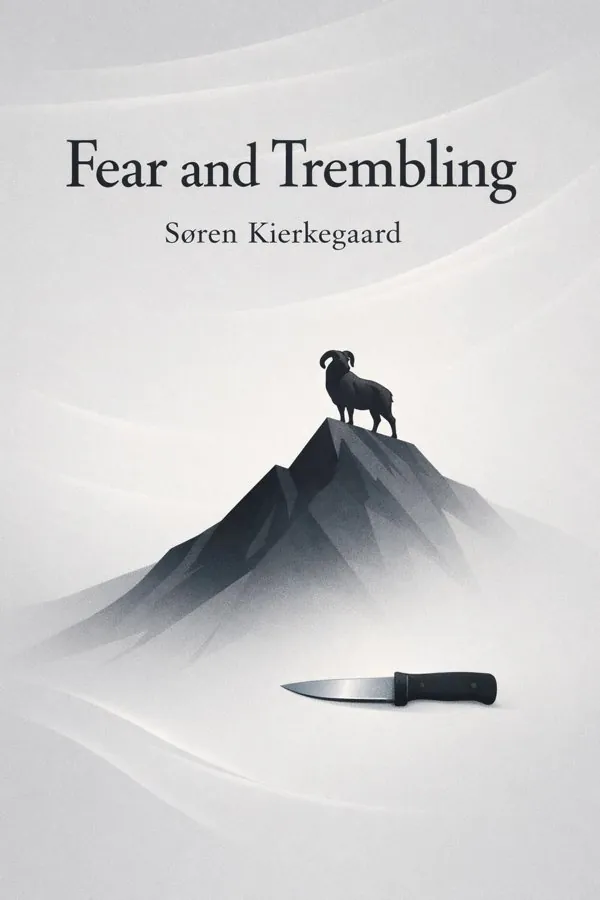
Fear and Trembling: Summary & Key Insights
 10 min8 chaptersAudio available
Key Takeaways from Fear and Trembling
The most disturbing truths are often the ones that cannot be made comfortable.
Admiration becomes shallow when it forgets the cost of greatness.
The hardest moral questions arise when our highest values collide.
Not every profound sacrifice is faith.
A person can live successfully and still remain inwardly unfinished.
What Is Fear and Trembling About?
Fear and Trembling by Søren Kierkegaard is a western_phil book spanning 6 pages. What if true faith begins where reason, ethics, and social approval all fail? In Fear and Trembling, Søren Kierkegaard, writing under the pseudonym Johannes de Silentio, confronts that unsettling question through one of the Bible’s most disturbing stories: Abraham’s willingness to sacrifice Isaac. Rather than treating the tale as a simple lesson in obedience, Kierkegaard turns it into a profound meditation on what faith really demands from an individual. He asks how Abraham can be honored as the “father of faith” when his act appears ethically monstrous, and in doing so he exposes a deep conflict between universal moral norms and a solitary relationship with God. The result is a work that is psychologically intense, philosophically daring, and spiritually unnerving. Kierkegaard’s authority lies not in system-building but in his unmatched ability to describe inward struggle, anxiety, paradox, and commitment. Fear and Trembling remains essential because it challenges modern readers to examine whether faith is merely agreement with ideas, or a lived risk that can never be fully justified to others.
This FizzRead summary covers all 8 key chapters of Fear and Trembling in approximately 10 minutes, distilling the most important ideas, arguments, and takeaways from Søren Kierkegaard's work. Also available as an audio summary and Key Quotes Podcast.
Fear and Trembling
What if true faith begins where reason, ethics, and social approval all fail? In Fear and Trembling, Søren Kierkegaard, writing under the pseudonym Johannes de Silentio, confronts that unsettling question through one of the Bible’s most disturbing stories: Abraham’s willingness to sacrifice Isaac. Rather than treating the tale as a simple lesson in obedience, Kierkegaard turns it into a profound meditation on what faith really demands from an individual. He asks how Abraham can be honored as the “father of faith” when his act appears ethically monstrous, and in doing so he exposes a deep conflict between universal moral norms and a solitary relationship with God. The result is a work that is psychologically intense, philosophically daring, and spiritually unnerving. Kierkegaard’s authority lies not in system-building but in his unmatched ability to describe inward struggle, anxiety, paradox, and commitment. Fear and Trembling remains essential because it challenges modern readers to examine whether faith is merely agreement with ideas, or a lived risk that can never be fully justified to others.
Who Should Read Fear and Trembling?
This book is perfect for anyone interested in western_phil and looking to gain actionable insights in a short read. Whether you're a student, professional, or lifelong learner, the key ideas from Fear and Trembling by Søren Kierkegaard will help you think differently.
- ✓Readers who enjoy western_phil and want practical takeaways
- ✓Professionals looking to apply new ideas to their work and life
- ✓Anyone who wants the core insights of Fear and Trembling in just 10 minutes
Want the full summary?
Get instant access to this book summary and 100K+ more with Fizz Moment.
Get Free SummaryAvailable on App Store • Free to download
Key Chapters
The most disturbing truths are often the ones that cannot be made comfortable. Fear and Trembling begins by placing us before Abraham, who receives God’s command to sacrifice Isaac and proceeds without public explanation, moral defense, or emotional relief. Kierkegaard insists that this story should not be domesticated into a simple example of piety. If Abraham were merely obeying a difficult duty that could be explained in ethical terms, he would be tragic but understandable. Instead, he acts on a divine command that places him beyond ordinary moral categories. This is the paradox of faith: Abraham is both a loving father and someone prepared to kill his son because of his absolute relation to God.
Kierkegaard’s point is not that religion excuses violence or that any private impulse can override ethics. His point is that genuine faith cannot always be translated into universal language. The individual of faith may stand in a position of terrifying isolation, unable to justify himself to the crowd. Abraham does not become admirable because his action is reasonable; he becomes incomprehensible because faith asks more than reason can hold.
In modern life, this paradox appears whenever a person must act from a deep conviction that others cannot fully understand: leaving a secure career for a calling, forgiving someone when justice seems to demand retaliation, or remaining loyal to a duty that brings no public reward. These cases are not equivalent to Abraham’s ordeal, but they reveal how serious commitment can exceed social approval.
Actionable takeaway: When facing a profound commitment, ask whether you are acting from convenience, from public expectation, or from a conviction you are genuinely willing to bear alone.
Admiration becomes shallow when it forgets the cost of greatness. In the Eulogy on Abraham, Kierkegaard praises Abraham not by softening his ordeal but by intensifying it. Abraham waited decades for Isaac, the child of promise, and then faced the command to surrender the very future God had promised through that child. Kierkegaard lingers over this contradiction to show that Abraham’s faith is not naïve certainty or cheerful optimism. It is anguish held together with trust.
Abraham is not great because he felt no fear. He is great because he believed while trembling. That distinction matters. Many people imagine faith as emotional calm, but Kierkegaard portrays it as inward struggle. Abraham climbs Mount Moriah without receiving reassurance that would make his action easy. He neither rebels against God nor dissolves into despair. He continues in obedience while still loving Isaac with his whole soul. His greatness lies in preserving both realities: total devotion to God and total human affection.
This helps explain why Kierkegaard distinguishes Abraham from heroes of ordinary sacrifice. A political leader may give up a child for the nation, or a warrior may die for a cause, and such sacrifices can be honored because they fit the ethical order. Abraham’s ordeal does not. He cannot appeal to the greater good. He can only believe that, absurdly, he will still receive Isaac back.
Today, we often celebrate resilience without acknowledging suffering. Kierkegaard corrects that impulse by reminding us that true inward strength includes vulnerability, fear, and loss. Spiritual maturity does not eliminate trembling; it endures it without surrendering the essential commitment.
Actionable takeaway: Stop measuring conviction by outward confidence alone; instead, examine whether you can remain faithful to what matters most even when fear does not disappear.
The hardest moral questions arise when our highest values collide. In the Problemata, Kierkegaard asks whether there can be a “teleological suspension of the ethical,” meaning whether the universal moral law can ever be set aside for a higher end in one’s relation to God. This is the explosive center of Fear and Trembling. Ethics, for Kierkegaard, is the universal: it applies to everyone and can be publicly justified. Abraham’s intended act, however, cannot be justified this way. Ethically speaking, he appears to be a murderer.
Kierkegaard does not casually dismiss ethics. On the contrary, he takes it with utmost seriousness. That is precisely why Abraham’s situation is so terrifying. If ethics were weak, the dilemma would vanish. But because ethics is powerful and universally binding, Abraham’s obedience to God becomes a genuine paradox. Kierkegaard wants us to feel the scandal: either Abraham is a faithful servant of God, or he is lost.
This creates a sharp challenge to the assumption that religion is simply morality plus inspiration. For Kierkegaard, religion may demand something more radical than ethical decency. Yet he also warns that this is an extraordinary condition, not an everyday excuse for private certainty. The singular relation to God is dangerous because it cannot be verified by the public. That danger is part of what makes faith fear and trembling rather than self-congratulation.
In practical life, most of us do not face Abraham’s situation, but we do encounter tensions between public norms and personal conscience. A whistleblower may break loyalty to an institution in obedience to truth. A caregiver may refuse socially approved success in order to serve a vulnerable loved one. Such decisions remain ethically discussable, unlike Abraham’s case, but they illustrate the strain between universal expectations and higher obligation.
Actionable takeaway: Before claiming that a personal conviction overrides accepted norms, test it ruthlessly for humility, responsibility, and willingness to bear the consequences rather than seeking moral exemption.
Not every profound sacrifice is faith. Kierkegaard distinguishes between the knight of infinite resignation and the knight of faith to show that spiritual depth comes in different forms. The knight of infinite resignation gives up what is most precious and finds peace in that loss. This person renounces finite fulfillment but preserves the beloved inwardly, transforming disappointment into spiritual dignity. Kierkegaard admires this figure because resignation requires honesty, discipline, and courage.
But the knight of faith goes further. After making the movement of resignation, the knight of faith believes, by virtue of the absurd, that the finite will somehow be restored. Abraham does not merely resign himself to losing Isaac forever. He believes that he will receive Isaac back, though reason cannot explain how. That second movement is what makes faith so strange. It is not stoic surrender; it is trust in impossibility.
Kierkegaard uses this distinction to expose how often people confuse religious language with real faith. Many can accept noble loss. Far fewer can relinquish control and still believe in joyful restoration. The knight of faith appears outwardly ordinary, perhaps even banal, because genuine faith does not always look dramatic. It shops, works, laughs, and lives in the finite world while inwardly resting in God.
A practical example is someone who loses a cherished plan, relationship, or identity. Resignation says, “I release it and carry the pain with dignity.” Faith says, “I release it and still remain open to receiving life anew, in ways I cannot calculate.” Both movements matter, but only the second expresses confidence in God’s impossible generosity.
Actionable takeaway: Practice both honesty about loss and openness to unexpected restoration; do not confuse mature resignation with the fuller daring of faith.
A person can live successfully and still remain inwardly unfinished. Although Fear and Trembling is focused on Abraham, it also fits into Kierkegaard’s broader vision of human existence unfolding through aesthetic, ethical, and religious modes of life. The aesthetic life seeks pleasure, stimulation, and avoidance of boredom. The ethical life values duty, consistency, and responsibility within the universal moral order. The religious life goes deeper still, centering on the individual’s absolute relation to God.
Abraham cannot be understood from the aesthetic standpoint, because his action is not driven by desire, excitement, or personal advantage. He also cannot be fully understood from the ethical standpoint, because his task suspends the universal in obedience to God. He belongs to the religious sphere, where the individual stands alone before the divine. This does not mean ethics is discarded in daily life. Rather, it means ethics is not the highest possible category for understanding human existence.
Kierkegaard’s stages are useful because they reveal how people can talk past one another. Someone living aesthetically asks, “What do I feel like doing?” Someone living ethically asks, “What is the right thing for anyone to do?” Someone living religiously asks, “What does God require of me here and now?” These perspectives overlap, but they are not identical.
In modern terms, consider career decisions. The aesthetic person chooses whatever seems exciting. The ethical person chooses what is responsible and socially meaningful. The religious person may choose a path that appears irrational to others because it answers a deeper calling. The challenge is that higher stages are not visible from lower ones.
Actionable takeaway: Reflect on whether your major decisions are guided mainly by pleasure, by duty, or by a deeper spiritual vocation, and identify one area where you need to mature to the next level.
The deepest commitments are often the hardest to explain. One of the most haunting features of Fear and Trembling is Abraham’s silence. He cannot tell Sarah, Eliezer, or Isaac what he is doing in any ethically intelligible way. If he speaks, he is either misunderstood or forced to translate faith into categories that falsify it. Kierkegaard uses this silence to show that religious truth is radically subjective—not meaning arbitrary or invented, but inwardly appropriated in a way that no external system can replace.
Johannes de Silentio, the book’s pseudonymous narrator, underscores this by confessing that he can admire Abraham but cannot fully understand or imitate him. This distance matters. It keeps the reader from pretending too quickly that Abraham’s faith is easy, normal, or philosophically solvable. Subjectivity here means that the truth of faith must be lived, suffered, and chosen by the individual. It cannot be mastered like a concept.
This is why Kierkegaard is often seen as a precursor to existentialism. He shifts attention from abstract definitions to lived existence. A person may be able to defend moral theories brilliantly and still fail when confronted by a personal crisis. Conversely, someone with little theoretical sophistication may possess profound inward seriousness. What counts is not merely what one knows, but how one exists in relation to what one knows.
In practical terms, silence can become a discipline. Not every serious decision benefits from endless explanation or social validation. Some commitments are weakened when prematurely exposed to the demand for public approval. That does not justify secrecy in ordinary moral matters, but it does suggest that inward formation sometimes requires privacy.
Actionable takeaway: Identify one important conviction in your life that needs deeper inward grounding before more outward discussion, and give it the silence necessary to mature.
There is a crucial difference between being admirable and being incomprehensible. Kierkegaard repeatedly compares Abraham to the tragic hero in order to sharpen what faith is not. A tragic hero sacrifices the particular for the universal. Agamemnon gives up his daughter for the sake of the state; Jephthah and Brutus are similarly framed within public, ethical narratives. Their pain is terrible, but it can be understood and even justified within shared moral language.
Abraham is different because he sacrifices the universal itself. He does not act for society, law, or history. He acts as a single individual in absolute relation to God. That makes him not just tragic but paradoxical. If we reduce Abraham to a tragic hero, we protect ourselves from the true scandal of faith. We preserve admiration while avoiding the terrifying possibility that God may summon the individual beyond what the crowd can comprehend.
This distinction helps us understand why Kierkegaard thinks modern people too quickly sentimentalize biblical stories. We want religious figures to confirm what we already accept. But Abraham refuses to serve as a moral illustration. He confronts us with the possibility that faith is not a public performance of virtue but a solitary ordeal.
In contemporary life, we often praise sacrifice when it is legible: serving one’s country, supporting one’s family, or giving up comfort for a cause. Such sacrifices matter. Yet Kierkegaard asks whether there is also a kind of obedience that cannot be translated into public honor. The point is not to glorify obscurity for its own sake, but to recognize that ultimate commitments may not earn applause.
Actionable takeaway: Notice whether you are pursuing sacrifice that remains visible and affirmable to others, or whether you are also willing to be faithful in ways that receive no public understanding.
Faith begins not where life makes sense, but where certainty runs out. Kierkegaard’s famous language of the absurd does not mean nonsense for its own sake. It means that faith believes what reason cannot mediate: Abraham will sacrifice Isaac, and yet somehow Isaac will still be given back. This impossible conjunction is what produces anxiety. Faith is not the elimination of contradiction but the courage to live within it.
That is why Fear and Trembling remains so psychologically powerful. Kierkegaard refuses all cheap resolutions. Abraham does not receive a philosophical proof. He receives a command and continues in trust. The absurd marks the limit of human calculation. At that limit, one either collapses into despair, retreats into mere resignation, or leaps into faith.
Modern readers encounter absurdity less in overtly biblical forms than in life’s unresolved tensions: loving people we cannot protect, pursuing justice in a broken system, hoping after devastating loss, or committing to meaning in a world that often feels indifferent. Kierkegaard’s insight is that belief worthy of the name is not agreement with what is already probable. It is trust when outcomes cannot be guaranteed.
This does not authorize irrationality in everyday decisions. We should still weigh evidence, seek counsel, and use judgment. But Kierkegaard reminds us that the most decisive human commitments—love, vocation, forgiveness, trust in God—always contain an element that surpasses proof. Anxiety is not always a sign that something is wrong. Sometimes it is the atmosphere of freedom and seriousness.
Actionable takeaway: The next time uncertainty unsettles you, ask not only, “How can I remove this anxiety?” but also, “What commitment might this anxiety be asking me to make despite the lack of guarantees?”
All Chapters in Fear and Trembling
About the Author
Søren Kierkegaard (1813–1855) was a Danish philosopher, theologian, and literary stylist whose work laid crucial foundations for existentialism. Writing in reaction to both abstract philosophy and complacent Christianity, he focused on the individual’s lived experience of faith, anxiety, despair, choice, and responsibility. Kierkegaard often published under pseudonyms, each representing a distinct voice or perspective, allowing him to explore different ways of existing rather than presenting a single closed system. His major works include Either/Or, Fear and Trembling, The Concept of Anxiety, and The Sickness Unto Death. Though not widely celebrated during his lifetime, he later became one of the most influential thinkers in modern philosophy and theology. His writing continues to resonate because of its psychological insight, spiritual seriousness, and insistence that truth must be personally appropriated.
Get This Summary in Your Preferred Format
Read or listen to the Fear and Trembling summary by Søren Kierkegaard anytime, anywhere. FizzRead offers multiple formats so you can learn on your terms — all free.
Available formats: App · Audio · PDF · EPUB — All included free with FizzRead
Download Fear and Trembling PDF and EPUB Summary
Key Quotes from Fear and Trembling
“The most disturbing truths are often the ones that cannot be made comfortable.”
“Admiration becomes shallow when it forgets the cost of greatness.”
“The hardest moral questions arise when our highest values collide.”
“Kierkegaard distinguishes between the knight of infinite resignation and the knight of faith to show that spiritual depth comes in different forms.”
“A person can live successfully and still remain inwardly unfinished.”
Frequently Asked Questions about Fear and Trembling
Fear and Trembling by Søren Kierkegaard is a western_phil book that explores key ideas across 8 chapters. What if true faith begins where reason, ethics, and social approval all fail? In Fear and Trembling, Søren Kierkegaard, writing under the pseudonym Johannes de Silentio, confronts that unsettling question through one of the Bible’s most disturbing stories: Abraham’s willingness to sacrifice Isaac. Rather than treating the tale as a simple lesson in obedience, Kierkegaard turns it into a profound meditation on what faith really demands from an individual. He asks how Abraham can be honored as the “father of faith” when his act appears ethically monstrous, and in doing so he exposes a deep conflict between universal moral norms and a solitary relationship with God. The result is a work that is psychologically intense, philosophically daring, and spiritually unnerving. Kierkegaard’s authority lies not in system-building but in his unmatched ability to describe inward struggle, anxiety, paradox, and commitment. Fear and Trembling remains essential because it challenges modern readers to examine whether faith is merely agreement with ideas, or a lived risk that can never be fully justified to others.
More by Søren Kierkegaard
You Might Also Like
A Little History of Philosophy
Nigel Warburton
10 min
Areopagitica
John Milton
10 min
How To Think Like A Philosopher: Essential Principles For Clear Thinking
Peter Cave
10 min
Language, Truth and Logic
A. J. Ayer
10 min
The Age of Reason
Thomas Paine
10 min
The Essays
Michel De Montaigne
10 minBrowse by Category
Ready to read Fear and Trembling?
Get the full summary and 100K+ more books with Fizz Moment.