
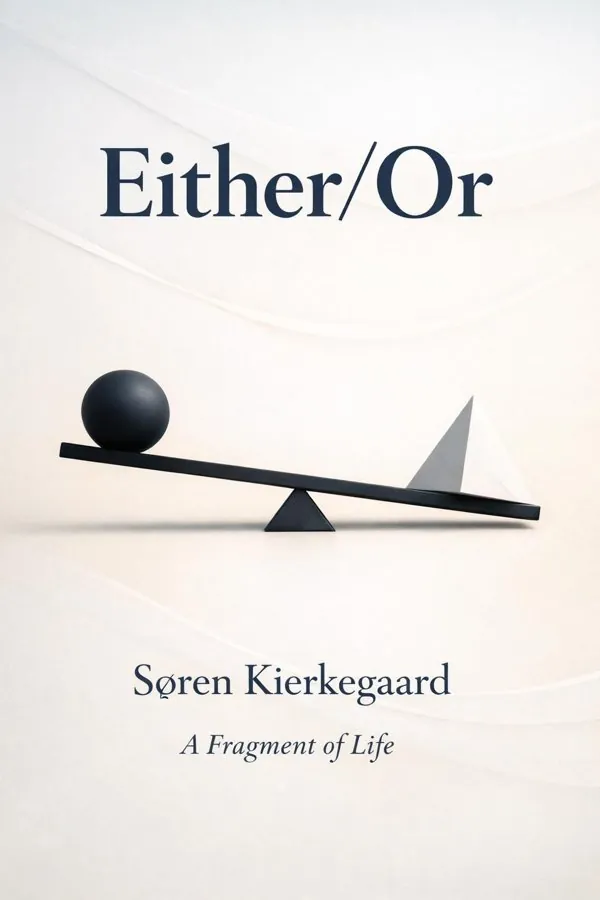
Either/Or: A Fragment of Life: Summary & Key Insights
 10 min9 chaptersAudio available
Key Takeaways from Either/Or: A Fragment of Life
A life devoted to enjoyment can look dazzling from the outside, yet Kierkegaard shows how quickly it can become hollow from within.
Boredom, in Kierkegaard’s aesthetic universe, is not a minor inconvenience but a spiritual threat.
Seduction is often imagined as passion, but Kierkegaard exposes it as a form of control.
Art can reveal truths that argument alone cannot reach, and Kierkegaard uses aesthetics to show both the grandeur and limitation of immediate experience.
A self is not discovered by accident; it is built through commitment.
What Is Either/Or: A Fragment of Life About?
Either/Or: A Fragment of Life by Søren Kierkegaard is a western_phil book spanning 9 pages. First published in 1843, Either/Or is the book in which Søren Kierkegaard announces himself as one of the most original minds in modern philosophy. Presented through pseudonymous voices rather than direct authorial instruction, the work stages a dramatic confrontation between two ways of living: the aesthetic life, devoted to pleasure, novelty, mood, and personal experience; and the ethical life, grounded in commitment, responsibility, and continuity. Through the writings of the aesthete “A” and the letters of Judge Wilhelm, Kierkegaard turns philosophy into lived conflict. He is not merely asking what people should believe, but how they should exist from day to day. The book matters because its central question has never become outdated. Should we seek intensity or stability, freedom or duty, possibility or form? Kierkegaard shows that this is not an abstract puzzle but the structure of every human life. His exploration of boredom, seduction, choice, marriage, inwardness, and selfhood laid crucial groundwork for existentialism, while also remaining deeply psychological and spiritually searching. Either/Or endures because it reveals that the deepest decisions are not only about what we do, but about who we become.
This FizzRead summary covers all 9 key chapters of Either/Or: A Fragment of Life in approximately 10 minutes, distilling the most important ideas, arguments, and takeaways from Søren Kierkegaard's work. Also available as an audio summary and Key Quotes Podcast.
Either/Or: A Fragment of Life
First published in 1843, Either/Or is the book in which Søren Kierkegaard announces himself as one of the most original minds in modern philosophy. Presented through pseudonymous voices rather than direct authorial instruction, the work stages a dramatic confrontation between two ways of living: the aesthetic life, devoted to pleasure, novelty, mood, and personal experience; and the ethical life, grounded in commitment, responsibility, and continuity. Through the writings of the aesthete “A” and the letters of Judge Wilhelm, Kierkegaard turns philosophy into lived conflict. He is not merely asking what people should believe, but how they should exist from day to day.
The book matters because its central question has never become outdated. Should we seek intensity or stability, freedom or duty, possibility or form? Kierkegaard shows that this is not an abstract puzzle but the structure of every human life. His exploration of boredom, seduction, choice, marriage, inwardness, and selfhood laid crucial groundwork for existentialism, while also remaining deeply psychological and spiritually searching. Either/Or endures because it reveals that the deepest decisions are not only about what we do, but about who we become.
Who Should Read Either/Or: A Fragment of Life?
This book is perfect for anyone interested in western_phil and looking to gain actionable insights in a short read. Whether you're a student, professional, or lifelong learner, the key ideas from Either/Or: A Fragment of Life by Søren Kierkegaard will help you think differently.
- ✓Readers who enjoy western_phil and want practical takeaways
- ✓Professionals looking to apply new ideas to their work and life
- ✓Anyone who wants the core insights of Either/Or: A Fragment of Life in just 10 minutes
Want the full summary?
Get instant access to this book summary and 100K+ more with Fizz Moment.
Get Free SummaryAvailable on App Store • Free to download
Key Chapters
A life devoted to enjoyment can look dazzling from the outside, yet Kierkegaard shows how quickly it can become hollow from within. In the first volume of Either/Or, the writer known as “A” represents the aesthetic mode of existence. He is not simply a hedonist chasing crude pleasure. He is refined, intelligent, ironic, and exquisitely sensitive to moods, impressions, and possibilities. For him, life is something to be tasted rather than pledged, admired rather than inhabited. He resists fixed identity because commitment feels like limitation. To remain free, he prefers to keep all doors open.
Kierkegaard’s insight is that the aesthetic life is organized around immediacy. The aesthete wants experience without burden, emotion without permanence, and beauty without obligation. He may pursue art, conversation, romance, or wit, but he avoids the repetitive tasks through which a stable self is formed. This gives him intensity, but not continuity. He lives brilliantly in moments, yet lacks a unifying center.
This idea remains strikingly relevant. Today, the aesthetic life appears in endless scrolling, curated identities, casual relationships, and the constant search for the next stimulating experience. A person may become highly skilled at sampling life while remaining afraid to choose any one direction deeply.
Kierkegaard does not deny the value of sensibility, imagination, or pleasure. He shows instead that when possibility becomes an end in itself, the self begins to disperse. Without commitments that shape character over time, freedom starts to feel less like liberation and more like drift.
Actionable takeaway: Examine one area of your life where you keep options open to avoid commitment, and ask whether that freedom is truly enriching you or quietly preventing you from becoming someone definite.
Boredom, in Kierkegaard’s aesthetic universe, is not a minor inconvenience but a spiritual threat. In one of the most memorable sections of Either/Or, “A” proposes the “rotation method” as a strategy for avoiding boredom. Instead of exhausting life by changing outer circumstances too dramatically, he recommends changing one’s mode of attention. The idea is to rotate ways of seeing, framing, and experiencing reality so that ordinary life remains entertaining. This is not productive discipline; it is clever self-stimulation.
The deeper point is that the aesthete experiences boredom as revelation. When novelty fades, emptiness appears. Pleasure depends on freshness, so one must constantly devise new interpretations, diversions, or intrigues. A dinner party, a landscape, or a love affair is valuable not because it is good in itself, but because it can be made interesting. This turns existence into a performance of perpetual re-enchantment.
Modern life has made the rotation method almost effortless. We can shift attention from platform to platform, hobby to hobby, relationship to relationship, consuming stimulation without ever being forced to confront ourselves. The problem is that distraction can become a way of postponing seriousness. If we always need a new angle, we may never ask whether our lives have substance.
Kierkegaard’s critique is subtle. He understands the ingenuity of aesthetic consciousness; he even admires its brilliance. But he also sees its trap: the more one depends on novelty, the less one can endure repetition, and yet repetition is precisely where ethical and meaningful life unfolds. Love, work, friendship, and vocation all require us to remain present after excitement recedes.
Actionable takeaway: The next time you feel bored, resist the impulse to instantly distract yourself. Stay with the discomfort for a few minutes and ask what it reveals about the structure of your desires.
Seduction is often imagined as passion, but Kierkegaard exposes it as a form of control. In The Seducer’s Diary, one of the most famous sections of Either/Or, Johannes records his calculated effort to win Cordelia. What makes the diary disturbing is not simply that he deceives her, but that he treats the entire relationship as an aesthetic project. He is less interested in loving another person than in composing an exquisite emotional drama in which he is both artist and spectator.
Johannes carefully engineers timing, mood, distance, and disclosure. He wants not possession in the ordinary sense, but the pleasure of shaping another person’s inner life. His satisfaction comes from possibility, suspense, and the elegance of the process. Once the relationship would require genuine continuity, his interest fades. The beloved is not encountered as an equal subject but arranged as material for experience.
This section dramatizes the moral danger of the aesthetic life at its sharpest. When people become means for one’s own inward entertainment, intimacy is replaced by manipulation. The seducer avoids vulnerability by controlling the script. He can appear attentive, romantic, and profound while remaining fundamentally detached.
The pattern is familiar today in more modern forms: breadcrumbing, emotional games, strategic ambiguity, and relationships maintained for ego, excitement, or image rather than care. Kierkegaard shows that such behavior is not merely unkind; it reveals a fractured self incapable of true reciprocity.
The diary also warns that intelligence and sensitivity do not automatically lead to depth. In fact, they can become tools of evasion if they are used to aestheticize rather than inhabit life. Genuine love requires risk, honesty, and duration, none of which the seducer can tolerate.
Actionable takeaway: In your closest relationships, ask whether you are seeking mutual truth or merely preserving a flattering role for yourself. Choose one conversation this week in which you replace performance with honest presence.
Art can reveal truths that argument alone cannot reach, and Kierkegaard uses aesthetics to show both the grandeur and limitation of immediate experience. In the first volume, “A” reflects on music, erotic desire, and artistic expression, especially through his famous discussion of Mozart’s Don Giovanni. For him, music is uniquely suited to express immediacy because it unfolds in time, bypasses rigid conceptual structure, and captures desire in motion. Where ethical life depends on continuity and decision, music embodies impulse, energy, and seduction.
This analysis is not merely a theory of art. It forms part of Kierkegaard’s map of human existence. The aesthetic stage experiences life as mood, resonance, and intensity. Art becomes its privileged language because art can preserve transient feeling and make it meaningful without demanding commitment. A symphony can deepen desire without resolving it; a poem can glorify longing without asking what one ought to do.
Kierkegaard’s brilliance lies in refusing to dismiss this realm. He grants that art can disclose profound dimensions of human life. We often understand ourselves through music, literature, and drama before we can name our condition conceptually. A person grieving a breakup may learn more from a song than from a lecture on emotional attachment.
Yet art also has limits. If one remains only within aesthetic appreciation, one can admire passion without assuming responsibility for one’s life. It is possible to become an expert interpreter of feelings while remaining unwilling to act decisively. The aesthetic attitude can turn even suffering into something one curates.
Kierkegaard therefore honors art without allowing it to become a substitute for existence. Beauty can awaken the self, but it cannot complete the self.
Actionable takeaway: Use art as a mirror rather than a refuge. After a book, film, or piece of music moves you deeply, write down one concrete life decision or conversation it is calling you toward.
A self is not discovered by accident; it is built through commitment. That is the essential argument of Judge Wilhelm, the author of the second volume of Either/Or. Writing in the form of letters to the aesthete, Wilhelm presents the ethical life as superior not because it is dull, conventional, or externally respectable, but because it provides a coherent way of becoming a person. The ethical individual does not merely react to moods. He chooses himself and accepts responsibility for sustaining that choice over time.
For Wilhelm, ethics is not first about obeying social rules. It is about inward appropriation of duty. To live ethically is to stand in continuity with one’s promises, roles, and actions. Marriage, work, friendship, and civic responsibility are not obstacles to freedom; they are the contexts in which freedom becomes real. A person who never binds himself may imagine he is free, but in fact he remains unformed.
This view challenges the assumption that authenticity means spontaneous self-expression. Kierkegaard suggests the opposite: authenticity often requires discipline, repetition, and fidelity. A parent waking at night to care for a child, a doctor honoring professional obligations, or a spouse staying truthful during conflict all exemplify freedom as sustained commitment rather than impulse.
Wilhelm also insists that ethical life deepens rather than destroys individuality. The aesthete fears becoming trapped in sameness, but the judge argues that character emerges precisely by inhabiting responsibilities meaningfully. To choose oneself ethically is not to submit mechanically to convention; it is to make one’s life intelligible through accountable action.
Actionable takeaway: Identify one role you already occupy—partner, friend, worker, parent, citizen—and ask what it would mean to inhabit it more deliberately for the next thirty days through one repeated, concrete act of responsibility.
Romantic intensity often receives more cultural praise than faithful companionship, but Kierkegaard uses marriage to reverse that hierarchy. In Judge Wilhelm’s reflections, marriage becomes the clearest image of ethical existence because it joins love to decision, feeling to obligation, and desire to continuity. Unlike the aesthete, who values romance primarily for excitement and possibility, Wilhelm argues that the deepest form of love is not the thrilling beginning but the ongoing task of choosing the same person within ordinary time.
This does not mean marriage is treated as mere social convention. On the contrary, Wilhelm sees it as a profound spiritual and ethical practice. Marriage asks two people to remain truthful, patient, and responsible even when moods change. It transforms love from a passing passion into a shared world of duties, habits, forgiveness, and mutual formation. Through this repetition, feeling is not destroyed; it is purified and deepened.
The insight extends beyond marriage itself. Any serious commitment—long-term friendship, collaborative vocation, care for family, or dedication to a cause—requires enduring what the aesthetic life avoids: repetition. Repetition is often mistaken for stagnation, yet Kierkegaard suggests it can be the medium of meaning. The daily return to what one has chosen is what gives a life shape.
In a culture fascinated by endless options, this is a radical claim. Many people fear that commitment closes possibilities. Kierkegaard replies that it also opens a new depth impossible to the uncommitted. You can only know certain forms of joy, trust, and selfhood by staying.
Actionable takeaway: Choose one important relationship and strengthen it through a simple repeated practice—weekly check-ins, honest gratitude, or a kept promise—so that affection becomes embodied in dependable action.
The most important choices in life are not always between good and bad options; often they are choices about the kind of self one is willing to become. This is one of the central philosophical achievements of Either/Or. Kierkegaard shifts attention away from isolated decisions and toward the existential significance of choosing. Judge Wilhelm argues that by choosing seriously, a person does not merely select an external path. He chooses himself.
This means that indecision is not neutral. To postpone commitment indefinitely is itself a mode of existence, one that leaves the self fragmented among competing possibilities. The aesthete imagines that keeping options open preserves freedom, but Kierkegaard shows that refusing to choose can become a subtle form of despair. One remains unrealized, suspended between imagined futures and never fully entering any of them.
The ethical person, by contrast, accepts that choice involves loss. To choose one vocation means renouncing countless alternatives. To marry one person is not to marry many others. To commit to honesty may cost approval or convenience. Yet this renunciation is not tragic in a merely negative sense. It is the condition under which a life becomes actual.
This idea has practical force in careers, relationships, and identity. Someone who endlessly researches possible paths but never begins may be protecting himself from failure, but he is also refusing the only terrain on which growth occurs. Clarity often comes after action, not before it.
Kierkegaard’s point is not to choose recklessly, but to recognize that mature existence requires decisive inwardness. A self is shaped in the act of standing behind a chosen direction despite uncertainty.
Actionable takeaway: Pick one lingering decision you have postponed, set a clear deadline, and define one concrete first step. Let action, not endless rumination, become the means by which your identity takes form.
A person can appear successful in both aesthetic and ethical terms and still remain inwardly lost. Although Either/Or is framed as a contrast between pleasure and duty, Kierkegaard hints at a deeper problem beneath both: despair. The aesthete’s despair is easier to see. He is restless, dependent on stimulation, unable to endure silence, and haunted by emptiness when novelty fades. But Kierkegaard also suggests that merely ethical respectability is not the final answer. One can fulfill obligations, maintain appearances, and still avoid the deepest confrontation with selfhood.
Despair in Kierkegaard’s sense is not simply sadness. It is a misrelation in the self, a failure to become transparently grounded in what one truly is. The aesthete tries to lose himself in possibilities; the merely ethical person may lose himself in roles. In both cases, one may avoid the deeper inward task of existing truthfully.
This is why Either/Or ultimately points beyond itself. The conflict between aesthetic and ethical life is decisive, but not exhaustive. Ethical seriousness is a major advancement because it gives structure, accountability, and continuity. Yet Kierkegaard intimates that even the ethical self may need a further transformation if it is to escape despair fully.
This matters today because many people alternate between distraction and productivity, pleasure and duty, without ever examining whether either mode is connected to genuine inward conviction. A life can be busy, admirable, and efficient while remaining spiritually unanchored.
Actionable takeaway: Beyond asking whether your life is enjoyable or responsible, ask a deeper question in writing: where do I feel inwardly divided, and what truth about myself have I been avoiding beneath my routines or entertainments?
The final movement of Either/Or suggests that ethical life, though necessary, does not exhaust human existence. Kierkegaard does not fully develop the religious stage here as he would in later works, but he clearly gestures toward it. Judge Wilhelm defends ethical commitment with power and dignity, yet the book leaves readers with the sense that human beings require more than morality alone. The self must relate not only to social duty and personal consistency, but ultimately to God.
Why is the ethical not enough? Because ethics can tell us that we ought to become responsible, truthful, and committed, but it cannot by itself heal the deepest fractures of guilt, finitude, and inward contradiction. The religious dimension introduces a relation that is not reducible to public norms or self-mastery. It concerns repentance, grace, dependence, and the individual standing before the absolute.
This is where Kierkegaard departs from a purely secular account of maturity. For him, the highest form of existence is not simply becoming a well-ordered citizen or devoted spouse, though those matter greatly. It is becoming a self before God. The ethical life prepares a person for this by teaching seriousness, choice, and accountability. But the religious life transforms seriousness into humility.
Even readers who do not share Kierkegaard’s theology can recognize the underlying insight: human beings often hunger for meaning beyond success, pleasure, and social duty. We want our lives to answer to something ultimate. Without that horizon, even noble commitments can feel incomplete.
Actionable takeaway: Set aside time to reflect on what ultimate reality, principle, or sacred commitment your life is oriented toward. Ask whether your daily choices actually express that highest allegiance, or merely your immediate responsibilities and desires.
All Chapters in Either/Or: A Fragment of Life
About the Author
Søren Kierkegaard (1813–1855) was a Danish philosopher, theologian, and literary writer whose work laid the foundations for existentialism. Writing in nineteenth-century Copenhagen, he challenged the abstract systems of his age by focusing on the individual person, inwardness, and the lived reality of choice. Kierkegaard explored themes such as anxiety, despair, faith, responsibility, and the tension between aesthetic pleasure and ethical commitment. He often wrote under pseudonyms, using multiple voices to present conflicting perspectives rather than simple conclusions. This unusual method made his books intellectually demanding but psychologically rich. Among his most influential works are Either/Or, Fear and Trembling, Philosophical Fragments, and The Sickness Unto Death. Though rooted in Christian thought, his insights have shaped modern philosophy, theology, psychology, and literature far beyond religious contexts.
Get This Summary in Your Preferred Format
Read or listen to the Either/Or: A Fragment of Life summary by Søren Kierkegaard anytime, anywhere. FizzRead offers multiple formats so you can learn on your terms — all free.
Available formats: App · Audio · PDF · EPUB — All included free with FizzRead
Download Either/Or: A Fragment of Life PDF and EPUB Summary
Key Quotes from Either/Or: A Fragment of Life
“A life devoted to enjoyment can look dazzling from the outside, yet Kierkegaard shows how quickly it can become hollow from within.”
“Boredom, in Kierkegaard’s aesthetic universe, is not a minor inconvenience but a spiritual threat.”
“Seduction is often imagined as passion, but Kierkegaard exposes it as a form of control.”
“Art can reveal truths that argument alone cannot reach, and Kierkegaard uses aesthetics to show both the grandeur and limitation of immediate experience.”
“A self is not discovered by accident; it is built through commitment.”
Frequently Asked Questions about Either/Or: A Fragment of Life
Either/Or: A Fragment of Life by Søren Kierkegaard is a western_phil book that explores key ideas across 9 chapters. First published in 1843, Either/Or is the book in which Søren Kierkegaard announces himself as one of the most original minds in modern philosophy. Presented through pseudonymous voices rather than direct authorial instruction, the work stages a dramatic confrontation between two ways of living: the aesthetic life, devoted to pleasure, novelty, mood, and personal experience; and the ethical life, grounded in commitment, responsibility, and continuity. Through the writings of the aesthete “A” and the letters of Judge Wilhelm, Kierkegaard turns philosophy into lived conflict. He is not merely asking what people should believe, but how they should exist from day to day. The book matters because its central question has never become outdated. Should we seek intensity or stability, freedom or duty, possibility or form? Kierkegaard shows that this is not an abstract puzzle but the structure of every human life. His exploration of boredom, seduction, choice, marriage, inwardness, and selfhood laid crucial groundwork for existentialism, while also remaining deeply psychological and spiritually searching. Either/Or endures because it reveals that the deepest decisions are not only about what we do, but about who we become.
More by Søren Kierkegaard
You Might Also Like
A Little History of Philosophy
Nigel Warburton
10 min
Areopagitica
John Milton
10 min
How To Think Like A Philosopher: Essential Principles For Clear Thinking
Peter Cave
10 min
Language, Truth and Logic
A. J. Ayer
10 min
The Age of Reason
Thomas Paine
10 min
The Essays
Michel De Montaigne
10 minBrowse by Category
Ready to read Either/Or: A Fragment of Life?
Get the full summary and 100K+ more books with Fizz Moment.