
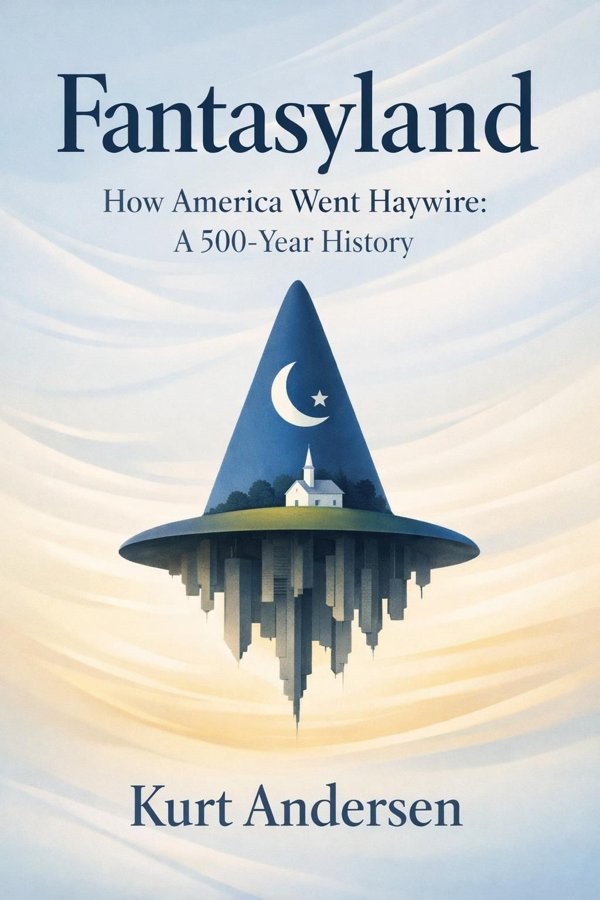
Fantasyland: How America Went Haywire: A 500-Year History: Summary & Key Insights
 10 min8 chaptersAudio available
What Is Fantasyland: How America Went Haywire: A 500-Year History About?
Fantasyland: How America Went Haywire: A 500-Year History by Kurt Andersen is a civilization book spanning 8 pages. A sweeping cultural history that explores how the United States has blended reality and fantasy for centuries, tracing the roots of America's current post-truth era back to its earliest settlers. Andersen argues that the nation's embrace of magical thinking, religious fervor, and individualism has culminated in a society where fact and fiction blur, shaping politics, religion, and popular culture alike.
This FizzRead summary covers all 8 key chapters of Fantasyland: How America Went Haywire: A 500-Year History in approximately 10 minutes, distilling the most important ideas, arguments, and takeaways from Kurt Andersen's work. Also available as an audio summary and Key Quotes Podcast.
Fantasyland: How America Went Haywire: A 500-Year History
A sweeping cultural history that explores how the United States has blended reality and fantasy for centuries, tracing the roots of America's current post-truth era back to its earliest settlers. Andersen argues that the nation's embrace of magical thinking, religious fervor, and individualism has culminated in a society where fact and fiction blur, shaping politics, religion, and popular culture alike.
Who Should Read Fantasyland: How America Went Haywire: A 500-Year History?
This book is perfect for anyone interested in civilization and looking to gain actionable insights in a short read. Whether you're a student, professional, or lifelong learner, the key ideas from Fantasyland: How America Went Haywire: A 500-Year History by Kurt Andersen will help you think differently.
- ✓Readers who enjoy civilization and want practical takeaways
- ✓Professionals looking to apply new ideas to their work and life
- ✓Anyone who wants the core insights of Fantasyland: How America Went Haywire: A 500-Year History in just 10 minutes
Want the full summary?
Get instant access to this book summary and 100K+ more with Fizz Moment.
Get Free SummaryAvailable on App Store • Free to download
Key Chapters
To understand Fantasyland, we must begin with those seventeenth-century settlers — the Puritans and their kin — who sailed to America not simply for land or wealth but to live inside a divine story of their own making. The new world was, in their eyes, God's garden awaiting cultivation, a stage for prophecy and perfection. They carried in their minds tales of the miraculous and the mystical, believing themselves chosen to build heaven on earth.
Religious zeal shaped early American consciousness. Sermons were not mere moral exhortations; they were narratives of cosmic struggle and divine favor. Every natural occurrence could be interpreted as a sign of God’s will. In this environment, personal belief gained a kind of absolute authority. If one felt the Spirit move within, that inner conviction carried as much weight as external evidence.
This primacy of belief — the idea that what I feel is what is true — was America’s first seed of fantasy. While Europe slowly embraced rational inquiry and secular institutions, the colonies doubled down on faith as proof of reality. That self-assured religiosity gave the settlers courage and resilience, but it also began to blur one key distinction: between what is revealed and what is imagined.
From witch trials to visionary sermons, the colonial era established the repeated pattern that still echoes in American life: an inclination to treat sincerity as sufficient validation. The settlers were creating not just a nation but a mythology, and that mythology taught generations of Americans that conviction can defeat fact.
The eighteenth and nineteenth centuries complicated that early religious fantasy. On one hand came the Enlightenment — reason, science, logic — a worldview that promised clarity and truth through evidence. On the other hand, America was expanding westward, and the frontier itself became the perfect canvas for reinvention. The wilderness offered escape from old constraints, a place where stories of discovery and self-making replaced inherited reality.
The frontier spirit was half rational, half romantic. It embraced progress while cherishing myths of the rugged individual who could shape destiny simply through willpower. That contradiction — empirical science coexisting with pure wishfulness — became endemic. America built universities and industries, yet also bought into preposterous schemes of gold cities and mystical healing.
I show how these dual forces, Enlightenment and frontier individualism, didn’t cancel each other; they fused into a hybrid mindset: the American genius and the American dreamer living side by side. Benjamin Franklin could be both inventor and eccentric moral philosopher; pioneers could embrace democracy yet depend on self-proclaimed prophets. The rational and the irrational became equally American virtues. This synthesis made us inventive — and also made us susceptible. Because when freedom is absolute, facts can begin to look like limits on imagination.
+ 6 more chapters — available in the FizzRead app
All Chapters in Fantasyland: How America Went Haywire: A 500-Year History
About the Author
Kurt Andersen is an American writer, journalist, and radio host. He co-founded Spy magazine, has written for The New Yorker and Time, and hosted the public radio program Studio 360. Andersen is known for his insightful commentary on American culture and politics.
Get This Summary in Your Preferred Format
Read or listen to the Fantasyland: How America Went Haywire: A 500-Year History summary by Kurt Andersen anytime, anywhere. FizzRead offers multiple formats so you can learn on your terms — all free.
Available formats: App · Audio · PDF · EPUB — All included free with FizzRead
Download Fantasyland: How America Went Haywire: A 500-Year History PDF and EPUB Summary
Key Quotes from Fantasyland: How America Went Haywire: A 500-Year History
“The new world was, in their eyes, God's garden awaiting cultivation, a stage for prophecy and perfection.”
“The eighteenth and nineteenth centuries complicated that early religious fantasy.”
Frequently Asked Questions about Fantasyland: How America Went Haywire: A 500-Year History
Fantasyland: How America Went Haywire: A 500-Year History by Kurt Andersen is a civilization book that explores key ideas across 8 chapters. A sweeping cultural history that explores how the United States has blended reality and fantasy for centuries, tracing the roots of America's current post-truth era back to its earliest settlers. Andersen argues that the nation's embrace of magical thinking, religious fervor, and individualism has culminated in a society where fact and fiction blur, shaping politics, religion, and popular culture alike.
More by Kurt Andersen

You Might Also Like

The Structure of Scientific Revolutions
Thomas S. Kuhn
10 min
Genius
Harold Bloom
10 min
A Cultural History of the Medieval Age
Various Editors
10 min
A History of God: The 4,000-Year Quest of Judaism, Christianity and Islam
Karen Armstrong
10 min
A History of the World in 10½ Chapters
Julian Barnes
10 min
A Short History of Progress
Ronald Wright
10 minBrowse by Category
Ready to read Fantasyland: How America Went Haywire: A 500-Year History?
Get the full summary and 100K+ more books with Fizz Moment.