
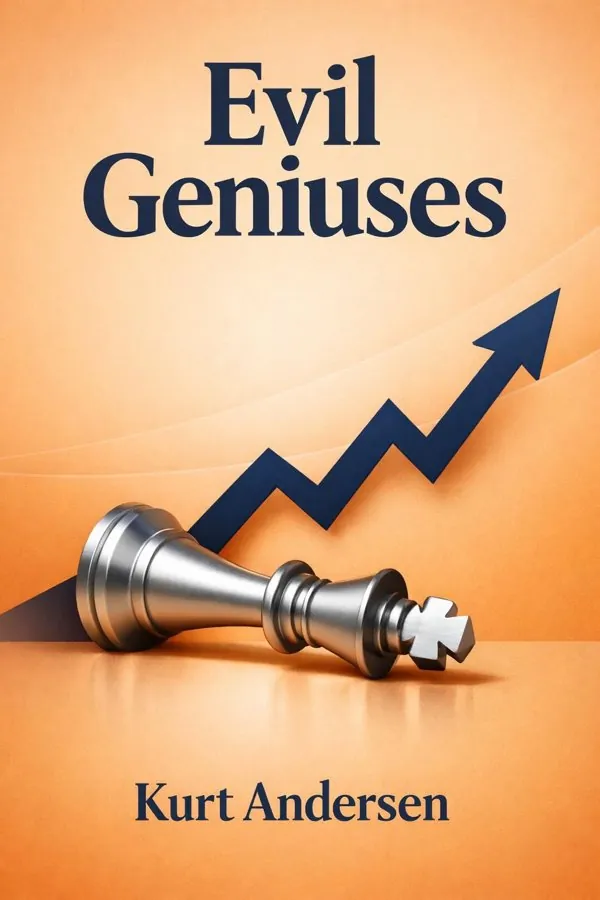
Evil Geniuses: The Unmaking of America: A Recent History: Summary & Key Insights
 10 min11 chaptersAudio available
What Is Evil Geniuses: The Unmaking of America: A Recent History About?
Evil Geniuses: The Unmaking of America: A Recent History by Kurt Andersen is a economics book spanning 11 pages. Evil Geniuses: The Unmaking of America is a nonfiction book by Kurt Andersen that examines how economic and political elites reshaped American society from the late 20th century onward. Andersen argues that a coalition of corporate leaders, conservative thinkers, and political strategists systematically reversed the egalitarian progress of the mid-century, creating a system that favors wealth concentration and undermines social mobility. The book blends historical analysis, cultural critique, and investigative journalism to trace how ideology and policy combined to produce today’s inequality and disillusionment.
This FizzRead summary covers all 11 key chapters of Evil Geniuses: The Unmaking of America: A Recent History in approximately 10 minutes, distilling the most important ideas, arguments, and takeaways from Kurt Andersen's work. Also available as an audio summary and Key Quotes Podcast.
Evil Geniuses: The Unmaking of America: A Recent History
Evil Geniuses: The Unmaking of America is a nonfiction book by Kurt Andersen that examines how economic and political elites reshaped American society from the late 20th century onward. Andersen argues that a coalition of corporate leaders, conservative thinkers, and political strategists systematically reversed the egalitarian progress of the mid-century, creating a system that favors wealth concentration and undermines social mobility. The book blends historical analysis, cultural critique, and investigative journalism to trace how ideology and policy combined to produce today’s inequality and disillusionment.
Who Should Read Evil Geniuses: The Unmaking of America: A Recent History?
This book is perfect for anyone interested in economics and looking to gain actionable insights in a short read. Whether you're a student, professional, or lifelong learner, the key ideas from Evil Geniuses: The Unmaking of America: A Recent History by Kurt Andersen will help you think differently.
- ✓Readers who enjoy economics and want practical takeaways
- ✓Professionals looking to apply new ideas to their work and life
- ✓Anyone who wants the core insights of Evil Geniuses: The Unmaking of America: A Recent History in just 10 minutes
Want the full summary?
Get instant access to this book summary and 100K+ more with Fizz Moment.
Get Free SummaryAvailable on App Store • Free to download
Key Chapters
In the years following World War II, America experienced something nearly miraculous: an economic and social consensus that, for the first time in its history, offered prosperity to the majority rather than the few. Politicians from both parties accepted that the federal government had a responsibility to ensure economic stability and social welfare. Corporations paid their workers well, unions were strong, and marginal tax rates on the wealthiest citizens were sky-high—sometimes over 90 percent. Yet business still boomed. The middle class expanded, homeownership surged, and even college education became attainable for millions.
From my vantage point, this was the high-water mark of the American experiment in shared prosperity. Corporate leaders talked not just about shareholder returns, but about their obligations to employees, communities, and the nation. The term 'stakeholder' actually meant something. There was broad bipartisan acceptance that the New Deal’s reforms—Social Security, labor rights, financial regulation—were not socialist detours but pragmatic guarantees of stability in a capitalist democracy.
What’s most remarkable in retrospect is how unquestioned this consensus seemed. Eisenhower Republicans accepted it, Kennedy Democrats expanded it, and the nation’s cultural imagination revolved around the idea that progress was collective. Yet beneath the surface, certain factions—businessmen bristling under regulation, libertarian economists resentful of government’s reach—were quietly preparing their counterrevolution. When the turbulence of the 1970s arrived, they would be ready to exploit it.
The 1970s broke the spell. Inflation surged, oil shocks rattled the economy, and the American industrial miracle stumbled under global competition. For ordinary citizens, it felt as though the old formula had stopped working. Stagnation replaced growth, trust in institutions eroded, and radical cultural liberation challenged traditional norms. Amid this chaos, the old consensus seemed not just outdated but naïve.
This was the opportunity the 'evil geniuses' had been waiting for. Corporate leaders, right-wing intellectuals, and conservative politicians coalesced around a new story about what went wrong and how to fix it. The villain, they said, was government overreach—the taxes, regulations, and unions that had supposedly strangled innovation. The solution? Free markets, individual freedom, and corporate deregulation. It sounded refreshingly bold in a time of drift. Milton Friedman and his disciples reframed economic management as a moral crusade for liberty, while political strategists like Lewis Powell urged business to fight back through media, academia, and law.
I see this period as the hinge upon which American history swung. The liberal order wasn’t defeated in open battle; it was slowly out-thought, out-communicated, and out-funded. The genius of these architects lay not in brute force but in persuasion. They made their ideology seem like common sense.
+ 9 more chapters — available in the FizzRead app
All Chapters in Evil Geniuses: The Unmaking of America: A Recent History
About the Author
Kurt Andersen is an American writer, journalist, and radio host known for his cultural commentary and historical analysis. He co-founded Spy magazine and has written several bestselling books, including Fantasyland and Evil Geniuses. Andersen’s work often explores the intersection of politics, economics, and American culture.
Get This Summary in Your Preferred Format
Read or listen to the Evil Geniuses: The Unmaking of America: A Recent History summary by Kurt Andersen anytime, anywhere. FizzRead offers multiple formats so you can learn on your terms — all free.
Available formats: App · Audio · PDF · EPUB — All included free with FizzRead
Download Evil Geniuses: The Unmaking of America: A Recent History PDF and EPUB Summary
Key Quotes from Evil Geniuses: The Unmaking of America: A Recent History
“Politicians from both parties accepted that the federal government had a responsibility to ensure economic stability and social welfare.”
“Inflation surged, oil shocks rattled the economy, and the American industrial miracle stumbled under global competition.”
Frequently Asked Questions about Evil Geniuses: The Unmaking of America: A Recent History
Evil Geniuses: The Unmaking of America: A Recent History by Kurt Andersen is a economics book that explores key ideas across 11 chapters. Evil Geniuses: The Unmaking of America is a nonfiction book by Kurt Andersen that examines how economic and political elites reshaped American society from the late 20th century onward. Andersen argues that a coalition of corporate leaders, conservative thinkers, and political strategists systematically reversed the egalitarian progress of the mid-century, creating a system that favors wealth concentration and undermines social mobility. The book blends historical analysis, cultural critique, and investigative journalism to trace how ideology and policy combined to produce today’s inequality and disillusionment.
More by Kurt Andersen
You Might Also Like
Business Adventures
John Brooks
10 min
Nudge
Richard H. Thaler, Cass R. Sunstein
10 min
The Hitchhiker"s Guide to the Galaxy
Douglas Adams
10 minThe Muqaddimah
Ibn Khaldun
10 minThe Outsiders
William N. Thorndike
10 min
A Little History of Economics
Niall Kishtainy
10 minBrowse by Category
Ready to read Evil Geniuses: The Unmaking of America: A Recent History?
Get the full summary and 100K+ more books with Fizz Moment.