
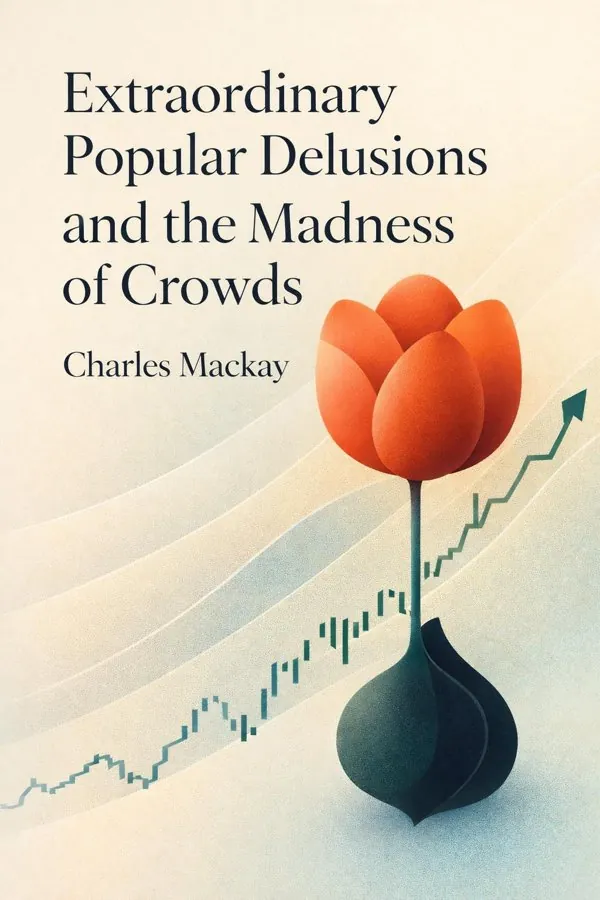
Extraordinary Popular Delusions: Summary & Key Insights
 10 min10 chaptersAudio available
Key Takeaways from Extraordinary Popular Delusions
One of Mackay’s most unsettling insights is that ordinary people do not become wise simply because they gather in large numbers; often, they become less reasonable.
A powerful story can make paper seem richer than reality.
People are especially vulnerable to deception when greed is endorsed by respectability.
The most revealing bubbles are often built around trivial objects, because they expose how little prices sometimes have to do with usefulness.
When life feels uncertain, prediction becomes a seductive form of emotional relief.
What Is Extraordinary Popular Delusions About?
Extraordinary Popular Delusions by Charles Mackay is a non-fiction book published in 1995 spanning 12 pages. Originally published in 1841, Extraordinary Popular Delusions and the Madness of Crowds is Charles Mackay’s sweeping study of the strange moments when entire societies stop thinking clearly and begin believing together. Rather than treating folly as a private weakness, Mackay shows how error can become fashionable, profitable, moralized, and even sacred once it is shared by enough people. His subjects range from financial bubbles such as the Mississippi Scheme, the South Sea Bubble, and Dutch Tulipomania to witch hunts, prophecy, alchemy, dueling, and social crazes that captured the imagination of whole populations. The result is not merely a catalog of old absurdities, but a durable guide to the psychology of contagion, imitation, greed, fear, and prestige. Mackay wrote as a journalist, historian, and gifted storyteller, combining vivid narrative with sharp social observation. That is why the book still matters: in every era, markets overheat, rumors spread, experts are ignored, and crowds reward confidence over truth. Mackay’s warning is timeless—people rarely go mad alone, but they often recover one by one.
This FizzRead summary covers all 10 key chapters of Extraordinary Popular Delusions in approximately 10 minutes, distilling the most important ideas, arguments, and takeaways from Charles Mackay's work. Also available as an audio summary and Key Quotes Podcast.
Extraordinary Popular Delusions
Originally published in 1841, Extraordinary Popular Delusions and the Madness of Crowds is Charles Mackay’s sweeping study of the strange moments when entire societies stop thinking clearly and begin believing together. Rather than treating folly as a private weakness, Mackay shows how error can become fashionable, profitable, moralized, and even sacred once it is shared by enough people. His subjects range from financial bubbles such as the Mississippi Scheme, the South Sea Bubble, and Dutch Tulipomania to witch hunts, prophecy, alchemy, dueling, and social crazes that captured the imagination of whole populations. The result is not merely a catalog of old absurdities, but a durable guide to the psychology of contagion, imitation, greed, fear, and prestige. Mackay wrote as a journalist, historian, and gifted storyteller, combining vivid narrative with sharp social observation. That is why the book still matters: in every era, markets overheat, rumors spread, experts are ignored, and crowds reward confidence over truth. Mackay’s warning is timeless—people rarely go mad alone, but they often recover one by one.
Who Should Read Extraordinary Popular Delusions?
This book is perfect for anyone interested in non-fiction and looking to gain actionable insights in a short read. Whether you're a student, professional, or lifelong learner, the key ideas from Extraordinary Popular Delusions by Charles Mackay will help you think differently.
- ✓Readers who enjoy non-fiction and want practical takeaways
- ✓Professionals looking to apply new ideas to their work and life
- ✓Anyone who wants the core insights of Extraordinary Popular Delusions in just 10 minutes
Want the full summary?
Get instant access to this book summary and 100K+ more with Fizz Moment.
Get Free SummaryAvailable on App Store • Free to download
Key Chapters
One of Mackay’s most unsettling insights is that ordinary people do not become wise simply because they gather in large numbers; often, they become less reasonable. A crowd gives emotional force to beliefs that would seem doubtful in private. Once a claim is repeated by friends, newspapers, authorities, or admired figures, skepticism begins to feel antisocial. The individual stops asking, “Is this true?” and starts asking, “Why is everyone else so certain?” That shift is the engine of collective delusion.
Mackay’s broader argument is that mass folly is rarely produced by ignorance alone. It grows from familiar motives: greed, fear, vanity, hope, resentment, and the desire to belong. These motives are not unusual; they are universal. What makes a mania dangerous is social reinforcement. When rewards appear to go to believers and ridicule falls on doubters, entire communities can normalize absurd behavior.
The pattern is easy to recognize today. Investors chase overhyped assets because everyone on social media seems to be getting rich. Parents spread health rumors because other parents sound passionate and sincere. Consumers rush into trends because scarcity and status create pressure to join early. In each case, the belief becomes stronger not because the evidence improves, but because repetition creates confidence.
Mackay teaches that the first defense against collective error is psychological humility. If many people agree, that may signal truth, but it may also signal contagion. Ask what incentives are at work, who benefits from enthusiasm, what evidence would change your mind, and whether you would still believe the claim if nobody around you did. Actionable takeaway: whenever you feel urgent pressure to join a crowd, pause and write down the evidence for and against the idea before acting.
A powerful story can make paper seem richer than reality. Mackay’s account of the Mississippi Scheme shows how John Law transformed financial fantasy into national fever in early eighteenth-century France. By linking a banking system, government debt, colonial dreams, and a torrent of speculation, Law convinced people that immense prosperity was on the horizon. Shares in his company rose not simply because of actual profits, but because rising prices themselves created excitement, and excitement attracted more buyers.
Mackay highlights a recurring truth about bubbles: they often begin with something plausible. France did need financial repair. Colonies did inspire visions of future wealth. New monetary methods did appear modern and ingenious. But when hope outruns underlying value, the market becomes a theater in which imagination prices assets more aggressively than facts can justify. The public then mistakes motion for substance.
This episode is deeply relevant in modern finance. A startup may have a promising technology, a nation may promote a strategic sector, or a new market may genuinely emerge. Yet valid beginnings can still be wrapped in inflated narratives, unrealistic valuations, and easy-money conditions. The presence of some truth does not protect an idea from becoming delusional.
Mackay also shows the social consequences of speculative mania: corruption, distorted incentives, sudden class mobility, public envy, and eventual collapse. When fortunes rise too quickly, institutions bend around the promise of easy wealth. When confidence breaks, trust in leaders, markets, and the future breaks with it.
Actionable takeaway: when evaluating any booming opportunity, separate the real underlying asset from the story being sold around it, and never treat rising prices as proof that the story is true.
People are especially vulnerable to deception when greed is endorsed by respectability. Mackay’s chapter on the South Sea Bubble shows how England’s political class, financial insiders, and ambitious public all became entangled in a scheme inflated by authority and reputation. The South Sea Company promised spectacular gains from trade and debt conversion, and its rising share price drew in everyone from aristocrats to ordinary savers. As wealth appeared to multiply, imitation replaced judgment.
What made this bubble so potent was not only the dream of profit, but the social legitimacy attached to it. If parliamentarians, courtiers, and wealthy merchants participated, many assumed the enterprise must be safe. Mackay exposes the fatal shortcut in that reasoning. High-status involvement often suppresses skepticism because people confuse access with wisdom. Yet elites can be vain, conflicted, self-interested, or simply wrong.
He also captures a familiar feature of speculative cycles: once one scheme succeeds, countless absurd imitations appear. During the South Sea frenzy, dubious ventures were launched with laughable promises, and investors still subscribed. This is how bubbles spread beyond one asset into a culture of indiscriminate belief. The original mania lowers standards everywhere.
The modern parallel is obvious in celebrity-backed investments, prestigious venture rounds, and market trends that attract buyers mainly because important names are attached. A respected brand, institution, or influencer can make an unsound idea feel safe. But prestige is not due diligence.
Mackay’s deeper lesson is that social proof becomes most dangerous when combined with envy. People do not merely want profit; they do not want to be the ones left behind while others become rich. That fear weakens discipline and accelerates bad decisions.
Actionable takeaway: before trusting an opportunity endorsed by powerful or fashionable people, evaluate the business model, incentives, and risks as if no famous name were attached.
The most revealing bubbles are often built around trivial objects, because they expose how little prices sometimes have to do with usefulness. Mackay’s account of Dutch Tulipomania illustrates a moment when rare bulbs became symbols of wealth, status, and speculative opportunity. Tulips were beautiful and scarcity made them desirable, but the astonishing prices people paid had drifted far beyond any practical or aesthetic measure. The bulbs had become tokens in a social game powered by expectation.
Mackay uses Tulipomania to show that speculative markets can detach from reality when buyers stop caring about what something is worth to them and start caring only about what someone else may pay tomorrow. At that point, value is replaced by momentum. The object being traded matters less than the belief that demand will continue. This is why bubbles can form around flowers, real estate, collectibles, digital assets, or any item capable of carrying prestige and scarcity.
The episode also demonstrates how financialization spreads. Once people begin trading contracts and promises tied to an asset rather than the asset itself, participation broadens, leverage grows, and risk becomes harder to see. More people can join the craze, but fewer understand its fragility. A small change in sentiment can then trigger a violent reversal.
In everyday life, Tulipomania offers a warning beyond markets. People overpay for brands, trends, and status goods not because they improve life proportionately, but because they signal taste, access, or belonging. The social meaning inflates the price.
Mackay’s point is not that beauty or rarity have no value, but that markets become dangerous when future resale eclipses present worth. Actionable takeaway: before buying any hot asset or luxury item, ask whether you want it for its actual utility or mainly because you expect others to admire or buy it later.
When life feels uncertain, prediction becomes a seductive form of emotional relief. Mackay’s treatment of fortune-telling and astrology is not merely a mockery of superstition; it is an examination of why people repeatedly seek systems that promise hidden knowledge of fate. In unstable times, the desire to know what comes next can overpower the discipline required to distinguish evidence from wishful pattern-making.
Astrology persists because it offers several psychological rewards at once. It organizes chaos into narrative, gives personal struggles cosmic significance, and provides a language of identity that feels intimate and flattering. Fortune-tellers extend this effect by converting vague probabilities into dramatic personal guidance. Mackay shows that such systems thrive not because they are rigorously true, but because they are emotionally useful. They reduce anxiety, externalize responsibility, and make random events feel meaningful.
This pattern appears in modern forms as well. Market forecasters promise certainty about stocks, gurus claim to predict social collapse, and online personality systems are treated as if they reveal destiny. The packaging has changed, but the craving is the same: people want confidence in an unpredictable world.
Mackay’s lesson is not that planning is foolish. Sound forecasting based on evidence, probabilities, and clear limits is valuable. The danger begins when a predictive system becomes unfalsifiable, flattering, and vague enough to fit anything. Then the believer stops testing it and starts interpreting life to preserve faith in it.
Practical wisdom here means becoming aware of your own appetite for certainty. Be especially skeptical of predictions that are dramatic, personalized, and impossible to verify in advance. Actionable takeaway: whenever a forecast strongly appeals to your fears or hopes, ask what specific evidence supports it and what outcome would prove it wrong.
Many delusions survive because they promise not just success, but miraculous shortcut. Mackay’s chapter on alchemy captures humanity’s enduring attraction to the idea that base materials can become precious and ordinary lives can be suddenly transfigured. The philosopher’s stone was more than a chemical fantasy; it symbolized the ancient hope that nature’s limits could be bypassed by secret knowledge.
Mackay does not deny that alchemy played a role in the history of science. Experimentation, observation, and curiosity sometimes emerged from these pursuits. But he focuses on the more dangerous side: the exploitation, obsession, and misdirected labor created when people chase hidden formulas for unlimited gain. Alchemists and their patrons often confused mystery with depth and complexity with truth. When results failed, believers blamed their own insufficiency or imagined that success was still just one revelation away.
That pattern is everywhere today. There are modern alchemies in get-rich-quick systems, miracle productivity hacks, secret investment methods, anti-aging cures, and business gurus who claim to have cracked the code of effortless success. The language may be scientific, entrepreneurial, or spiritual, but the structure is familiar: ordinary constraints are dismissed, complexity is mystified, and buyers are invited to believe that one hidden key changes everything.
Mackay reminds us that the search for mastery becomes irrational when it detaches from transparent method, tested evidence, and incremental progress. Real improvement is usually slower and less glamorous than charlatans promise.
Actionable takeaway: whenever a person or system offers extraordinary rewards through secret methods, ask whether the process is independently testable, reproducible, and understandable without relying on mystique.
Fear becomes most destructive when it believes itself righteous. In Mackay’s discussions of the Crusades, witch mania, haunted beliefs, and other episodes of social terror, he shows how communities can convert anxiety into moral certainty and then into persecution. Once a threat is defined as evil rather than merely mistaken, ordinary restraints weaken. Doubt looks like betrayal, mercy looks like weakness, and punishment becomes a public virtue.
Witch hunts are among Mackay’s most chilling examples because they reveal how evidence standards collapse under panic. Rumor, confession under pressure, coincidence, and personal grievance were treated as proof. Social tensions that had little to do with sorcery—envy, local feuds, misogyny, economic frustration, religious conflict—were funneled into a single explanatory story. The accusation itself became contagious.
The same structure appears in modern moral panics. A society becomes convinced that hidden enemies are everywhere. Ambiguous signals are reinterpreted as proof of conspiracy. Authorities respond performatively. The public rewards certainty over caution. In workplaces, online communities, politics, and media cycles, people still rush to condemn before facts are clear because participation in outrage signals virtue and belonging.
Mackay’s great contribution here is to connect superstition with social psychology. Delusion is not always about greed; it can arise from fear, zeal, and the pleasure of collective righteousness. The more noble people think their motives are, the less carefully they may examine their methods.
Actionable takeaway: when a community becomes morally heated and eager to punish, slow down, demand verifiable evidence, and resist joining accusations simply because silence feels socially dangerous.
Human beings do not need proof to spread fear; they need a story that feels plausible enough to repeat. Mackay’s treatment of poison panics, haunted houses, and sensational rumors shows how quickly societies can fill gaps in knowledge with dramatic explanations. Invisible threats are especially potent because they cannot be easily checked. When causes are hidden, imagination rushes in.
The fear of secret poisoning, for example, combines several powerful elements: bodily vulnerability, hidden malice, social distrust, and the thrill of scandal. A community primed to suspect unseen enemies will reinterpret illness, conflict, and coincidence as evidence of conspiracy. Mackay shows how rumor gains force through repetition and emotional resonance rather than verification. The more shocking the claim, the more attention it attracts, and attention itself creates an illusion of credibility.
This dynamic is unmistakably modern. Viral misinformation about crimes, health threats, political plots, or technological dangers spreads because it is memorable and emotionally activating. People forward stories that fit existing anxieties, and each repetition increases perceived legitimacy. The problem is not simply falsehood; it is the erosion of epistemic discipline.
Mackay’s larger lesson is that suspicion can become a self-sealing worldview. Once people decide hidden actors are manipulating events, contrary evidence is easily dismissed as cover-up. At that point, belief becomes resistant to correction.
The antidote is not naive trust but patient verification. Distinguish the possibility of a threat from the proof of a threat. Be wary of narratives built on anonymous claims, extraordinary hidden motives, and emotional urgency. Actionable takeaway: before sharing a sensational claim, pause long enough to trace it to a reliable source and verify whether independent evidence actually supports it.
The most enduring value of Mackay’s book is his insistence that folly evolves in costume but not in structure. Tulips become tech stocks, prophecy becomes punditry, witch hunts become online pile-ons, and alchemy becomes miracle self-optimization. The objects change, yet the underlying mechanisms remain strikingly stable: imitation, status-seeking, fear of exclusion, greed, moral excitement, and the tendency to infer truth from popularity.
Mackay’s historical range allows readers to see patterns that are otherwise hidden by novelty. Every generation believes its tools, institutions, and intelligence make it less gullible than those who came before. But new media, financial instruments, and political movements often amplify old vulnerabilities rather than remove them. In fact, sophistication can make delusion more persuasive because complex language and technical systems obscure simple weaknesses.
This insight is valuable for investors, leaders, educators, and ordinary citizens. In finance, it encourages discipline during speculative booms. In public life, it encourages caution during rumor waves and ideological crusades. In personal decision-making, it encourages reflection on how much our beliefs are chosen versus socially inherited.
Mackay does not suggest cynicism toward all enthusiasm. Progress requires imagination, collective action, and risk-taking. His warning is narrower and wiser: enthusiasm becomes dangerous when detached from evidence, accountability, and proportion. The goal is not to stand apart from every crowd, but to know when a crowd is thinking for you.
Actionable takeaway: build personal safeguards against collective error—seek dissenting views, define your decision criteria in advance, and revisit your strongest beliefs periodically to test whether they rest on evidence or merely on repetition.
All Chapters in Extraordinary Popular Delusions
About the Author
Charles Mackay (1814–1889) was a Scottish journalist, poet, editor, and social commentator whose writing ranged across history, politics, literature, and public life. He worked for major newspapers and became known for his sharp eye for social behavior and his ability to turn complex events into vivid narrative. Mackay wrote songs and poetry as well, but his lasting reputation rests on Extraordinary Popular Delusions and the Madness of Crowds, his influential study of financial bubbles, superstition, and collective folly. In that book, he combined historical storytelling with psychological insight, showing how easily societies can be swept into error. Though he wrote in the nineteenth century, his observations remain relevant to modern discussions of markets, misinformation, and crowd behavior.
Get This Summary in Your Preferred Format
Read or listen to the Extraordinary Popular Delusions summary by Charles Mackay anytime, anywhere. FizzRead offers multiple formats so you can learn on your terms — all free.
Available formats: App · Audio · PDF · EPUB — All included free with FizzRead
Download Extraordinary Popular Delusions PDF and EPUB Summary
Key Quotes from Extraordinary Popular Delusions
“One of Mackay’s most unsettling insights is that ordinary people do not become wise simply because they gather in large numbers; often, they become less reasonable.”
“A powerful story can make paper seem richer than reality.”
“People are especially vulnerable to deception when greed is endorsed by respectability.”
“The most revealing bubbles are often built around trivial objects, because they expose how little prices sometimes have to do with usefulness.”
“When life feels uncertain, prediction becomes a seductive form of emotional relief.”
Frequently Asked Questions about Extraordinary Popular Delusions
Extraordinary Popular Delusions by Charles Mackay is a non-fiction book that explores key ideas across 10 chapters. Originally published in 1841, Extraordinary Popular Delusions and the Madness of Crowds is Charles Mackay’s sweeping study of the strange moments when entire societies stop thinking clearly and begin believing together. Rather than treating folly as a private weakness, Mackay shows how error can become fashionable, profitable, moralized, and even sacred once it is shared by enough people. His subjects range from financial bubbles such as the Mississippi Scheme, the South Sea Bubble, and Dutch Tulipomania to witch hunts, prophecy, alchemy, dueling, and social crazes that captured the imagination of whole populations. The result is not merely a catalog of old absurdities, but a durable guide to the psychology of contagion, imitation, greed, fear, and prestige. Mackay wrote as a journalist, historian, and gifted storyteller, combining vivid narrative with sharp social observation. That is why the book still matters: in every era, markets overheat, rumors spread, experts are ignored, and crowds reward confidence over truth. Mackay’s warning is timeless—people rarely go mad alone, but they often recover one by one.
You Might Also Like


Browse by Category
Ready to read Extraordinary Popular Delusions?
Get the full summary and 100K+ more books with Fizz Moment.