
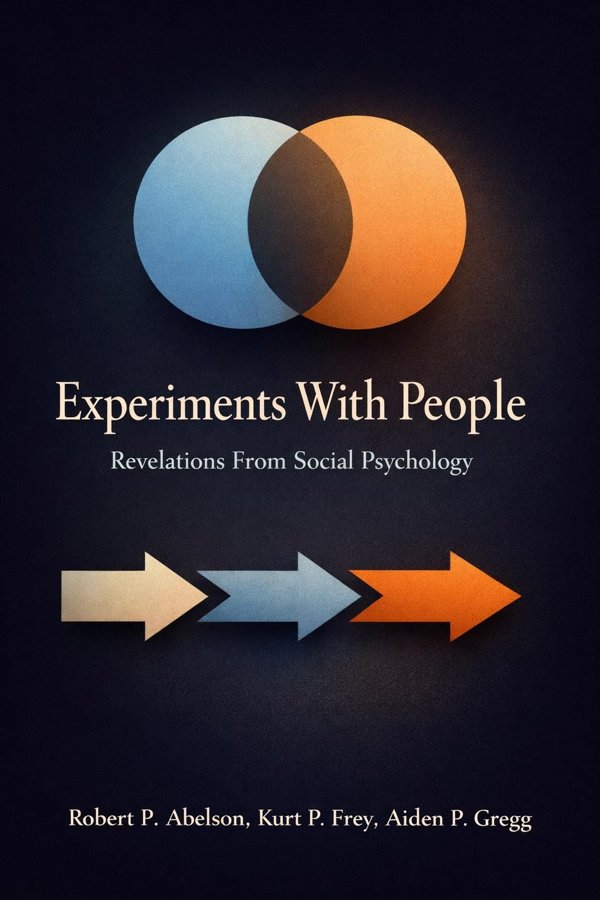
Experiments With People: Revelations From Social Psychology: Summary & Key Insights
by Robert P. Abelson, Kurt P. Frey, Aiden P. Gregg
 10 min12 chaptersAudio available
What Is Experiments With People: Revelations From Social Psychology About?
Experiments With People: Revelations From Social Psychology by Robert P. Abelson, Kurt P. Frey, Aiden P. Gregg is a cognition book spanning 12 pages. This book presents a collection of classic and contemporary experiments in social psychology, illustrating how human behavior is shaped by social influence, group dynamics, and cognitive processes. Each experiment is described in accessible language, highlighting its design, findings, and implications for understanding everyday social interactions.
This FizzRead summary covers all 12 key chapters of Experiments With People: Revelations From Social Psychology in approximately 10 minutes, distilling the most important ideas, arguments, and takeaways from Robert P. Abelson, Kurt P. Frey, Aiden P. Gregg's work. Also available as an audio summary and Key Quotes Podcast.
Experiments With People: Revelations From Social Psychology
This book presents a collection of classic and contemporary experiments in social psychology, illustrating how human behavior is shaped by social influence, group dynamics, and cognitive processes. Each experiment is described in accessible language, highlighting its design, findings, and implications for understanding everyday social interactions.
Who Should Read Experiments With People: Revelations From Social Psychology?
This book is perfect for anyone interested in cognition and looking to gain actionable insights in a short read. Whether you're a student, professional, or lifelong learner, the key ideas from Experiments With People: Revelations From Social Psychology by Robert P. Abelson, Kurt P. Frey, Aiden P. Gregg will help you think differently.
- ✓Readers who enjoy cognition and want practical takeaways
- ✓Professionals looking to apply new ideas to their work and life
- ✓Anyone who wants the core insights of Experiments With People: Revelations From Social Psychology in just 10 minutes
Want the full summary?
Get instant access to this book summary and 100K+ more with Fizz Moment.
Get Free SummaryAvailable on App Store • Free to download
Key Chapters
Few findings capture the tension between independence and social pressure like Solomon Asch’s conformity experiments. We recount how Asch gathered participants around a task that seemed trivially simple—comparing line lengths—and then orchestrated an invisible drama of influence. When confederates unanimously gave incorrect answers, the real participant faced a quiet moral crisis: to trust their eyes or trust the group. Again and again, many chose the group.
We walk the reader through the emotional logic underlying this result. People are social beings wired for belonging; disagreement feels risky, even when the stakes seem small. Conformity does not mean weak will—rather, it reflects the deep evolutionary need for cohesion. Yet we also explore the individuals who resisted the group, demonstrating that social influence is never absolute. One dissenting ally, we show, can dramatically reduce conformity pressures, an insight with profound implications for moral courage and innovation alike.
Through Asch’s work, we reveal how subtle social cues shape perception itself. Conformity is not mere compliance; it is often an internal alignment of one’s own judgments with communal reality. Everyday life is full of such micro-Asch moments—at meetings, in classrooms, within friend circles—where truth and social harmony quietly negotiate their uneasy truce.
+ 10 more chapters — available in the FizzRead app
All Chapters in Experiments With People: Revelations From Social Psychology
About the Authors
Robert P. Abelson (1928–2005) was an American social psychologist known for his work on belief systems and statistical reasoning. Kurt P. Frey and Aiden P. Gregg are social psychologists who have contributed to research on persuasion, self-concept, and social cognition.
Get This Summary in Your Preferred Format
Read or listen to the Experiments With People: Revelations From Social Psychology summary by Robert P. Abelson, Kurt P. Frey, Aiden P. Gregg anytime, anywhere. FizzRead offers multiple formats so you can learn on your terms — all free.
Available formats: App · Audio · PDF · EPUB — All included free with FizzRead
Download Experiments With People: Revelations From Social Psychology PDF and EPUB Summary
Key Quotes from Experiments With People: Revelations From Social Psychology
“In our field, the experiment is more than a tool—it is the language of discovery.”
“Few findings capture the tension between independence and social pressure like Solomon Asch’s conformity experiments.”
Frequently Asked Questions about Experiments With People: Revelations From Social Psychology
Experiments With People: Revelations From Social Psychology by Robert P. Abelson, Kurt P. Frey, Aiden P. Gregg is a cognition book that explores key ideas across 12 chapters. This book presents a collection of classic and contemporary experiments in social psychology, illustrating how human behavior is shaped by social influence, group dynamics, and cognitive processes. Each experiment is described in accessible language, highlighting its design, findings, and implications for understanding everyday social interactions.
You Might Also Like

A Field Guide to Lies: Critical Thinking in the Information Age
Daniel J. Levitin
10 min
A Theory of Cognitive Dissonance
Leon Festinger
10 min
Black-And-White Thinking: The Burden of a Binary Brain in a Complex World
Kevin Dutton
10 min
Born Liars: Why We Can’t Live Without Deceit
Ian Leslie
10 min
Collective Illusions: Conformity, Complicity, and the Science of Why We Make Bad Decisions
Todd Rose
10 min
Concrete Mathematics: A Foundation for Computer Science
Ronald L. Graham, Donald E. Knuth, Oren Patashnik
10 minBrowse by Category
Ready to read Experiments With People: Revelations From Social Psychology?
Get the full summary and 100K+ more books with Fizz Moment.