
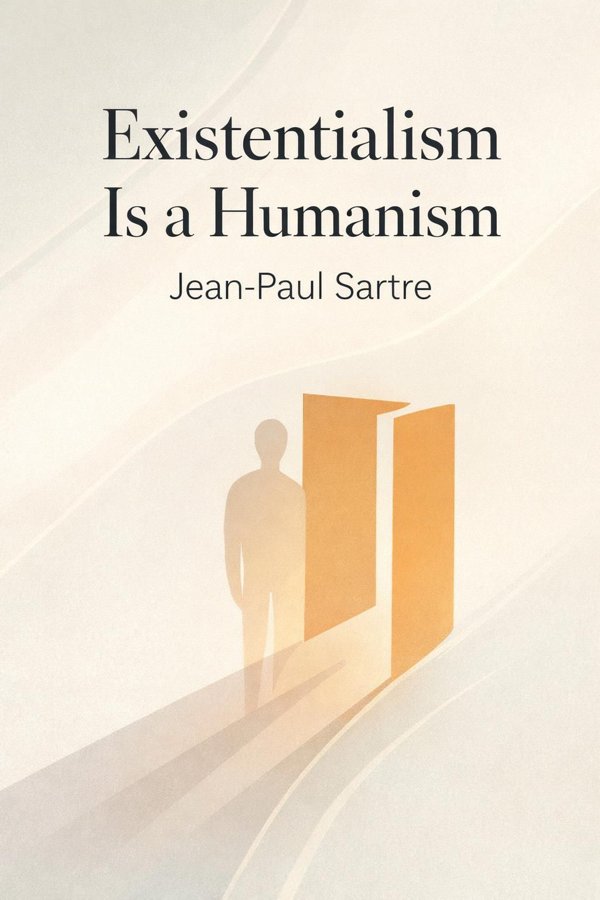
Existentialism Is a Humanism: Summary & Key Insights
 10 min8 chaptersAudio available
What Is Existentialism Is a Humanism About?
Existentialism Is a Humanism by Jean-Paul Sartre is a western_phil book spanning 8 pages. In this 1945 lecture, Jean-Paul Sartre presents the core principles of existentialism, asserting that humans are free and responsible for their choices, and that existence precedes essence. He defends existentialist philosophy against its critics, emphasizing its humanistic and moral dimensions.
This FizzRead summary covers all 8 key chapters of Existentialism Is a Humanism in approximately 10 minutes, distilling the most important ideas, arguments, and takeaways from Jean-Paul Sartre's work. Also available as an audio summary and Key Quotes Podcast.
Existentialism Is a Humanism
In this 1945 lecture, Jean-Paul Sartre presents the core principles of existentialism, asserting that humans are free and responsible for their choices, and that existence precedes essence. He defends existentialist philosophy against its critics, emphasizing its humanistic and moral dimensions.
Who Should Read Existentialism Is a Humanism?
This book is perfect for anyone interested in western_phil and looking to gain actionable insights in a short read. Whether you're a student, professional, or lifelong learner, the key ideas from Existentialism Is a Humanism by Jean-Paul Sartre will help you think differently.
- ✓Readers who enjoy western_phil and want practical takeaways
- ✓Professionals looking to apply new ideas to their work and life
- ✓Anyone who wants the core insights of Existentialism Is a Humanism in just 10 minutes
Want the full summary?
Get instant access to this book summary and 100K+ more with Fizz Moment.
Get Free SummaryAvailable on App Store • Free to download
Key Chapters
The phrase 'existence precedes essence' has become almost a slogan of existentialism, but it bears careful interpretation. When I say this, I mean that there is no predefined nature, no divine blueprint, that determines what a human being is. Unlike a manufactured object—a paper cutter, for example—that is designed with a specific purpose before it exists, human beings appear in the world first, then must define themselves afterward through action.
This reversal of traditional metaphysics is the foundation of existential thought. Philosophers before me, from Aristotle to Descartes, assumed that essence—the set of defining characteristics—comes first. Man was defined by a rational soul, by a moral purpose, or by a place in the cosmic order. Existentialism overturns this by insisting that humans simply find themselves existing, and only afterward construct a self through choice. In a universe emptied of divine instruction, the responsibility of self-definition rests entirely on our shoulders.
This idea terrifies many because it abolishes excuses and external authorities. If there is no God, no inherent nature, we cannot say, 'I was born to this,' or, 'That was my destiny.' It means that at every moment, we are choosing—and through those choices, we declare what we believe a human being should be. When I act, I am at once defining myself and shaping the model of humanity as a whole.
This is why existentialism refuses the comfort of essentialist thinking. It forces us to confront an unstructured life, a blank canvas, and asks us to paint upon it with our own decisions. That is not despair—it is liberation. It is an affirmation that life’s meaning, if it exists at all, must be made, not found.
Determinism is a seductive doctrine—it suggests that everything is written, that human beings are products of circumstance, biology, or divine will. But existentialism rejects such notions outright. I argue that man is radically free, because the absence of any predetermined essence implies that nothing constrains our capacity to choose, save for the physical limits of our situation.
This freedom is not metaphysical license but lived reality. Even in the most constrained conditions, even under oppression or imprisonment, man remains free to interpret, to decide, to act. Freedom is not the ability to get what one wants but the responsibility to choose one’s response to what is. Once we remove determinism, accountability returns. You cannot hide behind 'nature' or 'fate'; you are responsible for your own acts and, by extension, for the shape of humanity those acts express.
Of course, this rejection of determinism makes life difficult. Many would prefer a God who commands, a nature that dictates, a society that molds us. To be free is to stand naked before a silent universe, to realize there is no external justification for your existence. But precisely here lies the source of human dignity. You become the author of your being.
When critics accuse existentialism of being cold and individualistic, they misunderstand its moral heart. By affirming freedom, I am not isolating man—I am reminding him that every choice ripples outward, touching others and shaping the shared world. Freedom is therefore never private; it is a universal condition of human existence. To act freely is to accept the weight of humanity in one’s hands.
+ 6 more chapters — available in the FizzRead app
All Chapters in Existentialism Is a Humanism
About the Author
Jean-Paul Sartre (1905–1980) was a French philosopher, novelist, playwright, and critic, a major figure in existentialism and humanist Marxism. Awarded the Nobel Prize in Literature in 1964, which he declined, Sartre profoundly influenced twentieth-century thought.
Get This Summary in Your Preferred Format
Read or listen to the Existentialism Is a Humanism summary by Jean-Paul Sartre anytime, anywhere. FizzRead offers multiple formats so you can learn on your terms — all free.
Available formats: App · Audio · PDF · EPUB — All included free with FizzRead
Download Existentialism Is a Humanism PDF and EPUB Summary
Key Quotes from Existentialism Is a Humanism
“The phrase 'existence precedes essence' has become almost a slogan of existentialism, but it bears careful interpretation.”
“Determinism is a seductive doctrine—it suggests that everything is written, that human beings are products of circumstance, biology, or divine will.”
Frequently Asked Questions about Existentialism Is a Humanism
Existentialism Is a Humanism by Jean-Paul Sartre is a western_phil book that explores key ideas across 8 chapters. In this 1945 lecture, Jean-Paul Sartre presents the core principles of existentialism, asserting that humans are free and responsible for their choices, and that existence precedes essence. He defends existentialist philosophy against its critics, emphasizing its humanistic and moral dimensions.
More by Jean-Paul Sartre
You Might Also Like
A Little History of Philosophy
Nigel Warburton
10 min
Areopagitica
John Milton
10 min
How To Think Like A Philosopher: Essential Principles For Clear Thinking
Peter Cave
10 min
Language, Truth and Logic
A. J. Ayer
10 min
The Age of Reason
Thomas Paine
10 min
The Essays
Michel De Montaigne
10 minBrowse by Category
Ready to read Existentialism Is a Humanism?
Get the full summary and 100K+ more books with Fizz Moment.