
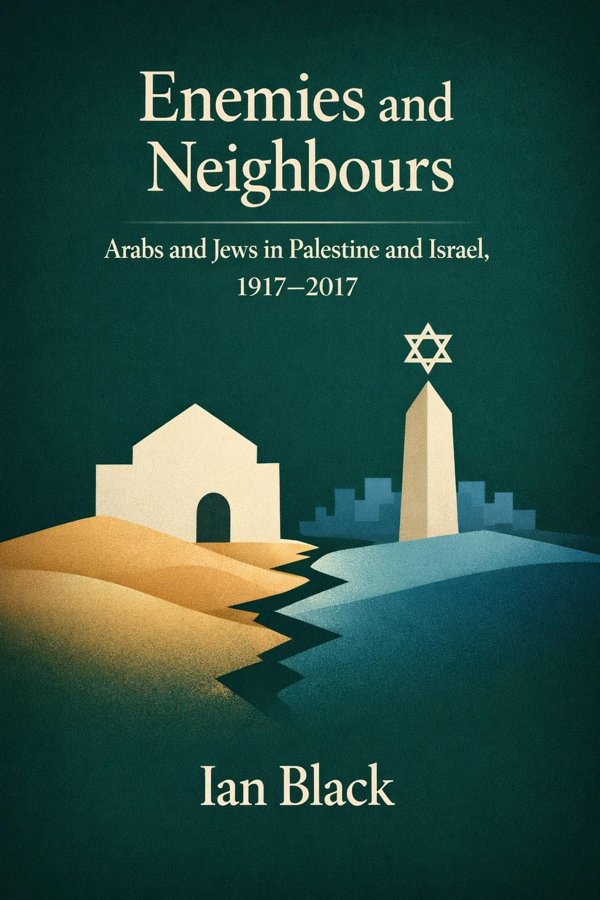
Enemies and Neighbours: Arabs and Jews in Palestine and Israel, 1917–2017: Summary & Key Insights
by Ian Black
 10 min12 chaptersAudio available
What Is Enemies and Neighbours: Arabs and Jews in Palestine and Israel, 1917–2017 About?
Enemies and Neighbours: Arabs and Jews in Palestine and Israel, 1917–2017 by Ian Black is a world_history book spanning 12 pages. Enemies and Neighbours is a comprehensive historical work that examines a century of conflict between Arabs and Jews in Palestine and Israel, from 1917 to 2017. Ian Black, a veteran journalist and Middle East correspondent, offers a balanced and well-documented narrative that combines political analysis with human stories, showing how everyday lives are shaped by the prolonged struggle over land and identity.
This FizzRead summary covers all 12 key chapters of Enemies and Neighbours: Arabs and Jews in Palestine and Israel, 1917–2017 in approximately 10 minutes, distilling the most important ideas, arguments, and takeaways from Ian Black's work. Also available as an audio summary and Key Quotes Podcast.
Enemies and Neighbours: Arabs and Jews in Palestine and Israel, 1917–2017
Enemies and Neighbours is a comprehensive historical work that examines a century of conflict between Arabs and Jews in Palestine and Israel, from 1917 to 2017. Ian Black, a veteran journalist and Middle East correspondent, offers a balanced and well-documented narrative that combines political analysis with human stories, showing how everyday lives are shaped by the prolonged struggle over land and identity.
Who Should Read Enemies and Neighbours: Arabs and Jews in Palestine and Israel, 1917–2017?
This book is perfect for anyone interested in world_history and looking to gain actionable insights in a short read. Whether you're a student, professional, or lifelong learner, the key ideas from Enemies and Neighbours: Arabs and Jews in Palestine and Israel, 1917–2017 by Ian Black will help you think differently.
- ✓Readers who enjoy world_history and want practical takeaways
- ✓Professionals looking to apply new ideas to their work and life
- ✓Anyone who wants the core insights of Enemies and Neighbours: Arabs and Jews in Palestine and Israel, 1917–2017 in just 10 minutes
Want the full summary?
Get instant access to this book summary and 100K+ more with Fizz Moment.
Get Free SummaryAvailable on App Store • Free to download
Key Chapters
The story begins with a single letter — the Balfour Declaration — issued by Britain in 1917, promising a national home for the Jewish people in Palestine. This was a moment charged with idealism and imperial ambition. As I retrace its impact, I show how it embodied the contradictions of empire: a commitment to one people that ignored the existence of another. British officials viewed the declaration as a strategic move in wartime diplomacy, yet for Palestine’s Arab population, it marked the beginning of dispossession.
In the book, I portray the declaration not as an isolated statement but as a seed of future conflict. The Zionist movement saw it as moral validation; Palestinian Arabs received it as betrayal. The British government’s vague wording — pledging to protect “civil and religious rights” of non‑Jewish communities without recognizing their political aspirations — engineered a permanent imbalance. What followed was not simply a clash over land, but over legitimacy and memory. Many of the Arab testimonies I weave into this chapter evoke the feeling of invisibility — a whole society unacknowledged by the power that ruled it and the movement that sought to transform it.
This opening chapter carries the rhythm of unfolding tension. I wanted the reader to grasp how a short diplomatic gesture, drafted in London’s corridors of power, could set in motion generations of struggle. The Balfour Declaration created overlapping promises to Jews and Arabs; it introduced a moral question that still reverberates: can justice for one people coexist with justice denied to another?
The British Mandate emerged from the ashes of the First World War and lasted nearly three decades. In this period, I examine the interplay between imperial administration and competing national projects. Britain was tasked with preparing Palestine for self‑government, but in reality, it had accepted incompatible obligations. Jewish immigration accelerated, driven by European fear and Zionist ambition; Palestinian Arabs resisted, sensing the erosion of their homeland.
As the Mandate evolved, Palestinian society fragmented. Economic disparities widened, and the British policy of divide and rule intensified mistrust. Throughout the book, I draw on archival records and eyewitness accounts to convey how ordinary life in towns like Jaffa and Jerusalem became punctuated by violence — riots in 1920, 1921, and the great revolt of 1936–39. To one community, these years symbolized progress and revival; to the other, loss and rebellion.
By 1947, the British had lost control. The Mandate’s contradictions were exposed for all to see: promises could not reconcile peoples with incompatible visions. I invite readers to experience the collapse of colonial authority not as a distant political event, but as an intimate transformation of daily existence. Streets once shared became boundaries; faith turned into identity, and identity hardened into ideology. The seed planted in 1917 was now flowering into conflict that even Britain could not contain.
+ 10 more chapters — available in the FizzRead app
All Chapters in Enemies and Neighbours: Arabs and Jews in Palestine and Israel, 1917–2017
About the Author
Get This Summary in Your Preferred Format
Read or listen to the Enemies and Neighbours: Arabs and Jews in Palestine and Israel, 1917–2017 summary by Ian Black anytime, anywhere. FizzRead offers multiple formats so you can learn on your terms — all free.
Available formats: App · Audio · PDF · EPUB — All included free with FizzRead
Download Enemies and Neighbours: Arabs and Jews in Palestine and Israel, 1917–2017 PDF and EPUB Summary
Key Quotes from Enemies and Neighbours: Arabs and Jews in Palestine and Israel, 1917–2017
“The story begins with a single letter — the Balfour Declaration — issued by Britain in 1917, promising a national home for the Jewish people in Palestine.”
“The British Mandate emerged from the ashes of the First World War and lasted nearly three decades.”
Frequently Asked Questions about Enemies and Neighbours: Arabs and Jews in Palestine and Israel, 1917–2017
Enemies and Neighbours: Arabs and Jews in Palestine and Israel, 1917–2017 by Ian Black is a world_history book that explores key ideas across 12 chapters. Enemies and Neighbours is a comprehensive historical work that examines a century of conflict between Arabs and Jews in Palestine and Israel, from 1917 to 2017. Ian Black, a veteran journalist and Middle East correspondent, offers a balanced and well-documented narrative that combines political analysis with human stories, showing how everyday lives are shaped by the prolonged struggle over land and identity.
More by Ian Black
You Might Also Like
The Age of Capital
Eric Hobsbawm
10 min
The Gulag Archipelago
Aleksandr Solzhenitsyn
10 min
Jerusalem: The Biography
Simon Sebag Montefiore
10 min
The Anglo-Saxons
James Campbell
10 min
The Boer War
Thomas Pakenham
10 min
The Industrial Revolutionaries: The Making of the Modern World 1776–1914
Gavin Weightman
10 minBrowse by Category
Ready to read Enemies and Neighbours: Arabs and Jews in Palestine and Israel, 1917–2017?
Get the full summary and 100K+ more books with Fizz Moment.