
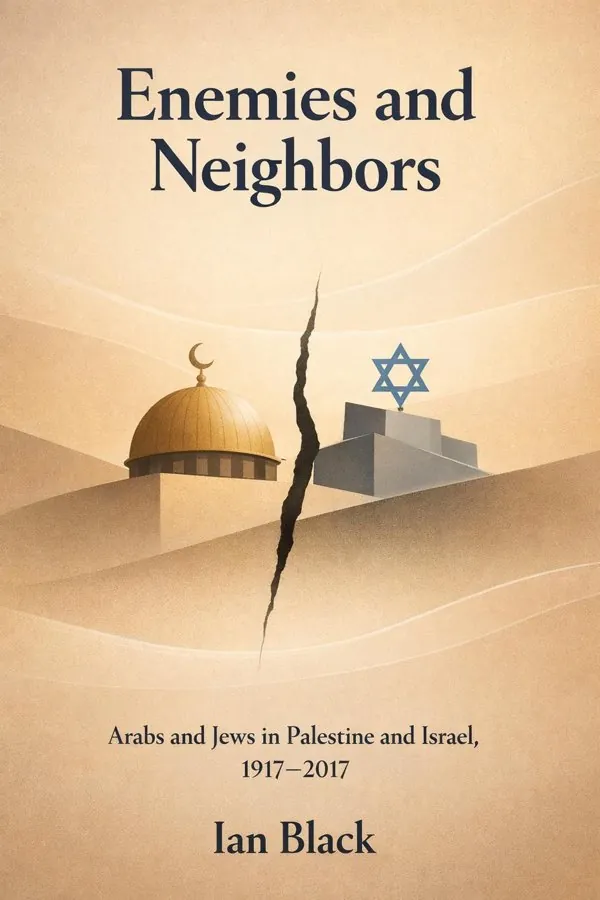
Enemies and Neighbors: Arabs and Jews in Palestine and Israel, 1917–2017: Summary & Key Insights
by Ian Black
 10 min9 chaptersAudio available
Key Takeaways from Enemies and Neighbors: Arabs and Jews in Palestine and Israel, 1917–2017
Some conflicts do not begin with a single battle but with a sentence written far away.
People often imagine the conflict as an eruption of ancient hatred, but Black makes clear that it was also built through institutions.
The year 1948 is not one story but two, and Black insists that any honest account must hold both at once.
Israel absorbed huge numbers of Jewish immigrants, built state institutions, developed agriculture and industry, and created a democratic political system for its Jewish majority.
Sometimes six days can redefine fifty years.
What Is Enemies and Neighbors: Arabs and Jews in Palestine and Israel, 1917–2017 About?
Enemies and Neighbors: Arabs and Jews in Palestine and Israel, 1917–2017 by Ian Black is a world_history book spanning 11 pages. Ian Black’s Enemies and Neighbors is a sweeping, deeply human history of Arabs and Jews in Palestine and Israel across one turbulent century, from the Balfour Declaration in 1917 to the political realities of 2017. Rather than reducing the conflict to a sequence of wars, failed negotiations, and competing claims, Black shows how it has been lived: in cities divided by checkpoints, in villages erased or repopulated, in family memories of exile, and in everyday encounters shaped by fear, pragmatism, and stubborn attachment to land. The book matters because it resists simple moral binaries. It takes seriously both Jewish historical trauma and Palestinian dispossession, while tracing how imperial decisions, nationalism, military power, and regional politics hardened a conflict that was never only local. Black writes with unusual authority. As a longtime Middle East correspondent and editor for The Guardian, he combines archival research, political analysis, and decades of firsthand reporting. The result is an informed, balanced account that helps readers understand not only how this conflict began, but why it has proved so enduring and emotionally charged.
This FizzRead summary covers all 9 key chapters of Enemies and Neighbors: Arabs and Jews in Palestine and Israel, 1917–2017 in approximately 10 minutes, distilling the most important ideas, arguments, and takeaways from Ian Black's work. Also available as an audio summary and Key Quotes Podcast.
Enemies and Neighbors: Arabs and Jews in Palestine and Israel, 1917–2017
Ian Black’s Enemies and Neighbors is a sweeping, deeply human history of Arabs and Jews in Palestine and Israel across one turbulent century, from the Balfour Declaration in 1917 to the political realities of 2017. Rather than reducing the conflict to a sequence of wars, failed negotiations, and competing claims, Black shows how it has been lived: in cities divided by checkpoints, in villages erased or repopulated, in family memories of exile, and in everyday encounters shaped by fear, pragmatism, and stubborn attachment to land. The book matters because it resists simple moral binaries. It takes seriously both Jewish historical trauma and Palestinian dispossession, while tracing how imperial decisions, nationalism, military power, and regional politics hardened a conflict that was never only local. Black writes with unusual authority. As a longtime Middle East correspondent and editor for The Guardian, he combines archival research, political analysis, and decades of firsthand reporting. The result is an informed, balanced account that helps readers understand not only how this conflict began, but why it has proved so enduring and emotionally charged.
Who Should Read Enemies and Neighbors: Arabs and Jews in Palestine and Israel, 1917–2017?
This book is perfect for anyone interested in world_history and looking to gain actionable insights in a short read. Whether you're a student, professional, or lifelong learner, the key ideas from Enemies and Neighbors: Arabs and Jews in Palestine and Israel, 1917–2017 by Ian Black will help you think differently.
- ✓Readers who enjoy world_history and want practical takeaways
- ✓Professionals looking to apply new ideas to their work and life
- ✓Anyone who wants the core insights of Enemies and Neighbors: Arabs and Jews in Palestine and Israel, 1917–2017 in just 10 minutes
Want the full summary?
Get instant access to this book summary and 100K+ more with Fizz Moment.
Get Free SummaryAvailable on App Store • Free to download
Key Chapters
Some conflicts do not begin with a single battle but with a sentence written far away. Black shows that the Balfour Declaration of 1917 was one such sentence: Britain promised support for a “national home for the Jewish people” in Palestine while also claiming it would not prejudice the rights of the existing non-Jewish communities. That ambiguity was not a technical flaw. It became the foundation of a century of competing expectations.
For many Jews, especially in Europe, Zionism offered rescue, dignity, and self-determination after generations of persecution. For Palestinian Arabs, who formed the overwhelming majority in the land at the time, the declaration signaled that an outside empire was endorsing a political project that threatened their future without consulting them. Black emphasizes that both national movements were real, deeply felt, and increasingly incompatible under British rule.
The British Mandate turned these tensions into a governing problem Britain never truly solved. London tried to manage immigration, land disputes, and communal violence while speaking in different registers to different audiences. Jewish institutions grew stronger and more organized; Palestinian leadership remained fragmented and often weakened by repression, exile, and internal rivalry. The result was not balance but asymmetry.
A practical lesson runs through this early history: unresolved ambiguity in statecraft can become combustible when tied to identity, land, and demographic change. Policymakers today still confront the legacy of formulas that sounded flexible but proved politically explosive.
Actionable takeaway: whenever you assess this conflict, start by asking not only what was promised, but to whom, by whom, and with what power to enforce those promises.
People often imagine the conflict as an eruption of ancient hatred, but Black makes clear that it was also built through institutions. During the British Mandate period from 1918 to 1947, Arabs and Jews did not simply live together or apart; they developed increasingly separate political, educational, economic, and military structures. That institutional separation mattered because it turned communal fears into durable realities.
Jewish communities, backed by international networks and motivated by urgency, built representative bodies, labor systems, agricultural settlements, and self-defense organizations. Immigration increased, especially as antisemitism intensified in Europe. Palestinian Arabs saw these developments not as neutral modernization but as the construction of a rival national society within their homeland. Their own political mobilization grew in response, expressed through protests, strikes, and eventually revolt.
Black pays particular attention to the Arab Revolt of 1936–1939, a major turning point. It reflected genuine nationalist resistance to British rule and Jewish immigration, but it was crushed with great force. Palestinian society emerged weakened; many leaders were jailed, exiled, or discredited. Meanwhile, Jewish institutions became more militarily and administratively capable. By the end of the Mandate, the two communities were no longer merely neighbors under one imperial roof. They were rival nations with unequal capacity, preparing for partition or war.
This history is useful beyond the Middle East. It shows how state weakness and unequal institution-building can shape future outcomes long before sovereignty is formally decided. Conflicts often harden not only because of ideology, but because one side acquires functioning structures while the other loses them.
Actionable takeaway: to understand later wars and failed diplomacy, study the institutional imbalance created before 1948, not just the events after independence.
The year 1948 is not one story but two, and Black insists that any honest account must hold both at once. For Jews, the creation of Israel represented statehood, refuge, and the culmination of a nationalist dream sharpened by the Holocaust. For Palestinians, the same events constituted the Nakba, or catastrophe: mass displacement, social collapse, and the loss of homes, land, and political center.
The UN partition plan of 1947 proposed dividing the land into Jewish and Arab states, but it satisfied neither side and quickly gave way to civil war, followed by a broader Arab-Israeli war after Israel declared independence in May 1948. Israel survived and expanded beyond the partition borders. More than 700,000 Palestinians became refugees, many expecting to return within weeks or months. Most did not.
Black is careful not to flatten the debate over causes, expulsions, fear, and battlefield dynamics, but his central point is unmistakable: 1948 established the emotional and political vocabulary of the conflict. Israeli independence and Palestinian dispossession are inseparable historical facts. Refugee camps across the region became living archives of loss. Israeli society, forged under siege, developed a powerful security ethos and a justified sense of vulnerability. These memories became national identities.
In practical terms, 1948 explains why later negotiations have been so difficult. Borders, recognition, sovereignty, refugees, and historical legitimacy all trace back to this founding rupture. It also explains why language matters. Calling 1948 only liberation or only catastrophe erases half the lived reality.
Actionable takeaway: when discussing the conflict, treat 1948 as a dual historical trauma. Any serious analysis or peace proposal must acknowledge both independence and dispossession.
Nations often present their early years as heroic and unifying, but Black shows that Israel’s formative decades from 1948 to 1967 combined impressive state-building with unresolved exclusion. Israel absorbed huge numbers of Jewish immigrants, built state institutions, developed agriculture and industry, and created a democratic political system for its Jewish majority. Yet Palestinian Arabs who remained within Israel lived under military rule until 1966, facing restrictions on movement, land expropriation, and political marginalization.
This period also reshaped the broader map. The West Bank came under Jordanian control and Gaza under Egyptian administration, leaving Palestinians without a sovereign state of their own. Arab regimes championed the Palestinian cause rhetorically, but often subordinated it to their own interests. Cross-border fedayeen raids and Israeli retaliatory operations deepened insecurity. The conflict did not disappear after 1948; it was reorganized.
Black’s account helps readers see the complexity inside Israel as well. Jewish immigrants did not arrive as a single unified group. Holocaust survivors, Jews from Arab countries, secular socialists, religious communities, and others all carried different expectations into a new state under permanent military pressure. The promise of refuge coexisted with hierarchy, austerity, and the challenge of integrating diverse populations.
The broader insight is that successful state-building does not automatically resolve questions of justice. A country can create strong institutions while leaving a foundational minority problem unaddressed. That unresolved issue can then return more forcefully in later decades.
Actionable takeaway: when evaluating any nation’s “founding success,” ask who gained citizenship, who gained power, and who remained present but unequal. In the Israeli-Palestinian case, that question is essential.
Sometimes six days can redefine fifty years. Black treats the 1967 war as the hinge of the modern conflict. Israel’s rapid victory over Egypt, Jordan, and Syria brought East Jerusalem, the West Bank, Gaza, the Sinai Peninsula, and the Golan Heights under Israeli control. For many Israelis, the war confirmed military vulnerability and then produced euphoria, deterrence, and access to places of historic and religious significance. For Palestinians, it marked the start of a new era of direct Israeli occupation.
The consequences were vast. The territorial question became central, and so did the settlement project. What began as strategic and ideological outposts evolved into a sprawling system that changed facts on the ground and complicated any future partition. East Jerusalem was annexed by Israel, though not internationally recognized as such. Palestinians in the occupied territories lived under military administration without sovereignty or equal rights.
Black shows that 1967 also revitalized Palestinian politics. The Arab states had failed to prevent defeat, and Palestinians increasingly turned to their own national movement. At the same time, Israeli society began debating whether the newly occupied territories were bargaining chips, security buffers, or part of a redeemed homeland. Those debates still shape politics today.
A practical insight from this chapter is that occupations rarely remain temporary in political or psychological terms. Bureaucracies grow around them, vested interests emerge, ideologies harden, and international diplomacy becomes more abstract as reality on the ground becomes more entrenched.
Actionable takeaway: if you want to understand current disputes over settlements, Jerusalem, borders, and rights, treat 1967 not as a sequel to 1948, but as the event that created the contemporary structure of conflict.
A people denied statehood often become more politically visible, not less. Black traces how Palestinian nationalism came into its own in the 1970s and 1980s, moving from fragmentation and dependence on Arab regimes toward a clearer independent identity. Organizations like the Palestine Liberation Organization, and especially Yasser Arafat’s Fatah movement, made the Palestinian issue impossible to ignore internationally.
This shift happened through both diplomacy and violence. Guerrilla attacks, hijackings, and armed struggle gave the movement visibility but also damaged its legitimacy in many eyes. At the same time, Palestinians built institutions in exile, developed a national discourse, and gradually won recognition as a distinct political people rather than a refugee problem. The first Intifada, beginning in 1987, was especially important in Black’s account because it brought resistance back inside the occupied territories. Unlike the image of distant fedayeen, this was a mass uprising of communities confronting occupation through strikes, boycotts, demonstrations, and, at times, violence.
The Intifada changed global perceptions. It highlighted the daily mechanics of occupation and made clear that Palestinians were not disappearing into neighboring states. It also pushed Israeli society to confront the costs of ruling another population indefinitely.
One of Black’s most valuable contributions here is nuance: nationalism can empower a people while also dividing it. The rise of Islamist alternatives such as Hamas showed that Palestinian politics was never monolithic. Strategies differed sharply over armed struggle, diplomacy, religion, and compromise.
Actionable takeaway: when analyzing Palestinian politics, do not reduce it to leadership personalities alone. Look at how grassroots mobilization, exile politics, occupation, and ideological competition shaped a national movement over time.
Peace processes often succeed symbolically before they succeed structurally. Black presents the Oslo years of the 1990s as a moment of real breakthrough and fatal incompleteness. Mutual recognition between Israel and the PLO, the famous handshake on the White House lawn, and the creation of the Palestinian Authority generated worldwide optimism. For the first time, Israelis and Palestinians formally accepted each other as negotiating partners.
Yet Oslo deferred the hardest issues: Jerusalem, refugees, borders, settlements, and final sovereignty. Interim arrangements were supposed to build confidence, but instead they often deepened suspicion. Palestinians gained limited self-rule in fragmented areas while Israeli settlement expansion continued. Many Israelis hoped the process would bring security and normalize relations; instead they faced suicide bombings and political backlash. Trust deteriorated on both sides.
Black explains that Oslo’s architecture contained a serious weakness: it relied on asymmetrical parties to voluntarily convert a conflict-management framework into a just final settlement. One side remained an occupying power with greater military, economic, and territorial control; the other gained administrative responsibility without full sovereignty. This mismatch made every delay meaningful.
The lesson extends beyond this case. Diplomatic symbolism matters, but if the incentives on the ground reward delay, expansion, or unilateral action, ceremony cannot carry the process. Institutions built under occupation can become both necessary and compromised.
For readers trying to understand why “peace process” became a phrase of disillusionment, Black offers a sober answer: hope was real, but the structure was too weak to withstand spoilers, assassinations, violence, and unresolved core grievances.
Actionable takeaway: judge peace efforts not only by agreements signed, but by whether daily realities improve fast enough to sustain public belief in compromise.
When peace collapses, people do not simply return to the previous status quo; they often emerge more fearful and less able to imagine the other side. Black’s treatment of the Second Intifada and the early 21st century shows how violence transformed the conflict from a damaged negotiation into a more entrenched regime of separation. The uprising that began in 2000 brought suicide bombings, Israeli military incursions, targeted killings, widespread destruction, and a profound collapse of trust.
For Israelis, buses, cafes, and public spaces became sites of terror, reinforcing the conviction that concessions invited bloodshed. For Palestinians, reoccupation, checkpoints, closures, arrests, and economic devastation made the language of peace sound hollow. The construction of Israel’s separation barrier reduced attacks in many areas, but it also cut through Palestinian land and symbolized a future of unilateral partition without agreement.
Black also explores Gaza as a concentrated expression of the conflict’s contradictions. Israel withdrew settlers and soldiers in 2005, but Gaza did not become free in any meaningful sense. After Hamas took control in 2007, blockade, repeated wars, rocket fire, and humanitarian decline created a cycle in which military superiority did not deliver political resolution, and resistance did not deliver liberation.
At the social level, separation became normalized. Fewer shared spaces meant fewer ordinary encounters. Each side increasingly consumed the conflict through its own media, memories, and trauma. That narrowed the political imagination.
Actionable takeaway: if you want to assess whether a conflict is moving toward peace, measure not only formal negotiations but also whether everyday life is producing more contact, dignity, and trust—or more walls, distance, and dehumanization.
The most striking insight in Black’s book may be that total separation has never truly been achieved, even when both sides act as if it has. Alongside war, occupation, and political rupture, he highlights the dense social and cultural entanglement of Arabs and Jews: shared markets, labor ties, mixed cities, legal struggles, language overlap, medical cooperation, intellectual exchange, and the intimate geography of neighboring communities.
This does not mean coexistence is easy or equal. Black is careful to distinguish genuine civic interdependence from coexistence under domination. Palestinians in Israel, residents of Jerusalem, West Bank workers, activists, lawyers, journalists, and families across borders experience proximity very differently. Yet the idea of complete separation is partly a political myth. The two peoples remain bound by land, infrastructure, economy, memory, and demography.
That is why the book resists simplistic end-state formulas. Whether one prefers two states, one state, confederation, or some other arrangement, the practical question is the same: how can rights, security, movement, identity, and political belonging be organized in a space already deeply interconnected but radically unequal?
Black’s contemporary chapters suggest that by 2017 the conflict had not been solved so much as managed in increasingly lopsided ways. Settlement growth, Palestinian division, rightward shifts in Israeli politics, and regional upheaval all made old frameworks less convincing. Yet human interdependence remained.
Actionable takeaway: do not think only in terms of diplomatic maps. Also ask how millions of people who are already neighbors might live with equal dignity, legal clarity, and physical security in the same contested space.
All Chapters in Enemies and Neighbors: Arabs and Jews in Palestine and Israel, 1917–2017
About the Author
Ian Black is a British journalist and author known for his extensive reporting on the Middle East. He served as Middle East editor and correspondent for The Guardian, covering regional politics, diplomacy, war, and social change over many years. His work is distinguished by a combination of firsthand observation, historical depth, and careful attention to competing narratives. In Enemies and Neighbors, Black draws on decades of engagement with Israel, Palestine, and the wider Arab world to produce a history that is both authoritative and accessible. Rather than writing as a distant commentator, he brings the perspective of a seasoned reporter who has followed leaders, uprisings, negotiations, and ordinary lives across the region. His expertise makes him a trusted guide to one of modern history’s most complex and emotionally charged conflicts.
Get This Summary in Your Preferred Format
Read or listen to the Enemies and Neighbors: Arabs and Jews in Palestine and Israel, 1917–2017 summary by Ian Black anytime, anywhere. FizzRead offers multiple formats so you can learn on your terms — all free.
Available formats: App · Audio · PDF · EPUB — All included free with FizzRead
Download Enemies and Neighbors: Arabs and Jews in Palestine and Israel, 1917–2017 PDF and EPUB Summary
Key Quotes from Enemies and Neighbors: Arabs and Jews in Palestine and Israel, 1917–2017
“Some conflicts do not begin with a single battle but with a sentence written far away.”
“People often imagine the conflict as an eruption of ancient hatred, but Black makes clear that it was also built through institutions.”
“The year 1948 is not one story but two, and Black insists that any honest account must hold both at once.”
“Nations often present their early years as heroic and unifying, but Black shows that Israel’s formative decades from 1948 to 1967 combined impressive state-building with unresolved exclusion.”
“Sometimes six days can redefine fifty years.”
Frequently Asked Questions about Enemies and Neighbors: Arabs and Jews in Palestine and Israel, 1917–2017
Enemies and Neighbors: Arabs and Jews in Palestine and Israel, 1917–2017 by Ian Black is a world_history book that explores key ideas across 9 chapters. Ian Black’s Enemies and Neighbors is a sweeping, deeply human history of Arabs and Jews in Palestine and Israel across one turbulent century, from the Balfour Declaration in 1917 to the political realities of 2017. Rather than reducing the conflict to a sequence of wars, failed negotiations, and competing claims, Black shows how it has been lived: in cities divided by checkpoints, in villages erased or repopulated, in family memories of exile, and in everyday encounters shaped by fear, pragmatism, and stubborn attachment to land. The book matters because it resists simple moral binaries. It takes seriously both Jewish historical trauma and Palestinian dispossession, while tracing how imperial decisions, nationalism, military power, and regional politics hardened a conflict that was never only local. Black writes with unusual authority. As a longtime Middle East correspondent and editor for The Guardian, he combines archival research, political analysis, and decades of firsthand reporting. The result is an informed, balanced account that helps readers understand not only how this conflict began, but why it has proved so enduring and emotionally charged.
More by Ian Black
You Might Also Like
The Age of Capital
Eric Hobsbawm
10 min
The Gulag Archipelago
Aleksandr Solzhenitsyn
10 min
Jerusalem: The Biography
Simon Sebag Montefiore
10 min
The Anglo-Saxons
James Campbell
10 min
The Boer War
Thomas Pakenham
10 min
The Industrial Revolutionaries: The Making of the Modern World 1776–1914
Gavin Weightman
10 minBrowse by Category
Ready to read Enemies and Neighbors: Arabs and Jews in Palestine and Israel, 1917–2017?
Get the full summary and 100K+ more books with Fizz Moment.