
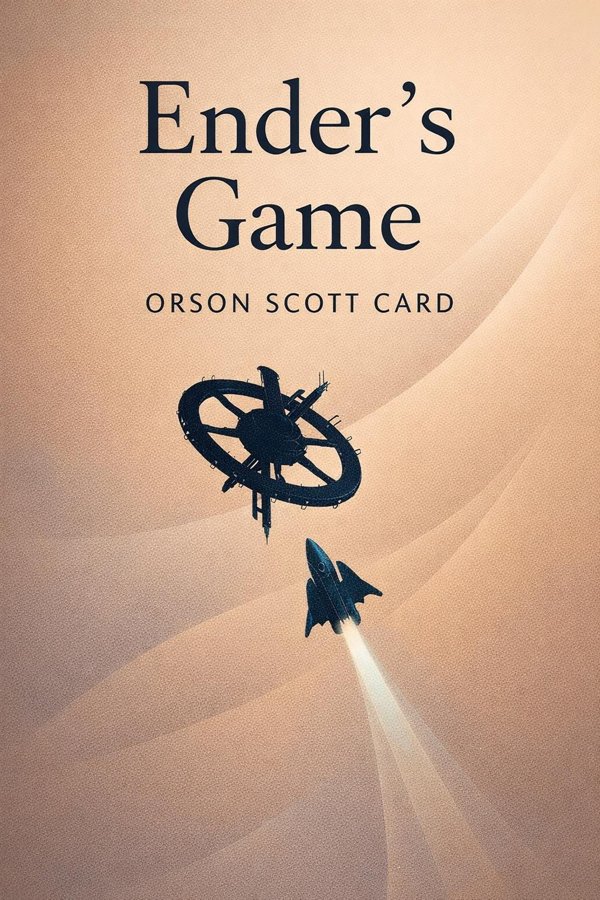
Ender’s Game: Summary & Key Insights
 10 min9 chapters
Key Takeaways from Ender’s Game
Great institutions often claim they are searching for excellence, but what they usually seek is usefulness.
The people closest to us often become the voices we carry inside our own minds.
People are easier to shape when they are cut off from support.
Games feel safe because they seem separate from reality, yet they often teach us how reality works.
The strongest leaders are often the ones most capable of imagining another person’s mind.
What Is Ender’s Game About?
Ender’s Game by Orson Scott Card is a scifi_fantasy book spanning 6 pages. Ender’s Game is a gripping science fiction novel about war, childhood, power, and the terrible cost of brilliance. Set in a future where Earth fears another attack from the insect-like Formics, the story follows Andrew “Ender” Wiggin, a gifted boy recruited into Battle School, an elite military academy in orbit. There, children are pushed through increasingly brutal simulations designed to identify the one commander capable of saving humanity. What begins as a tale of tactical genius quickly becomes something deeper: a study of manipulation, empathy, loneliness, and the moral damage caused by turning children into weapons. The novel matters because it does more than imagine advanced warfare. It asks how leaders are made, what institutions justify in the name of survival, and whether victory can still be called triumph when it is built on deception. Orson Scott Card brings unusual authority to these questions through a story that combines psychological realism, strategic conflict, and ethical tension. Widely regarded as a landmark of modern science fiction, Ender’s Game remains powerful because its central dilemmas feel as urgent now as ever.
This FizzRead summary covers all 9 key chapters of Ender’s Game in approximately 10 minutes, distilling the most important ideas, arguments, and takeaways from Orson Scott Card's work.
Ender’s Game
Ender’s Game is a gripping science fiction novel about war, childhood, power, and the terrible cost of brilliance. Set in a future where Earth fears another attack from the insect-like Formics, the story follows Andrew “Ender” Wiggin, a gifted boy recruited into Battle School, an elite military academy in orbit. There, children are pushed through increasingly brutal simulations designed to identify the one commander capable of saving humanity. What begins as a tale of tactical genius quickly becomes something deeper: a study of manipulation, empathy, loneliness, and the moral damage caused by turning children into weapons. The novel matters because it does more than imagine advanced warfare. It asks how leaders are made, what institutions justify in the name of survival, and whether victory can still be called triumph when it is built on deception. Orson Scott Card brings unusual authority to these questions through a story that combines psychological realism, strategic conflict, and ethical tension. Widely regarded as a landmark of modern science fiction, Ender’s Game remains powerful because its central dilemmas feel as urgent now as ever.
Who Should Read Ender’s Game?
This book is perfect for anyone interested in scifi_fantasy and looking to gain actionable insights in a short read. Whether you're a student, professional, or lifelong learner, the key ideas from Ender’s Game by Orson Scott Card will help you think differently.
- ✓Readers who enjoy scifi_fantasy and want practical takeaways
- ✓Professionals looking to apply new ideas to their work and life
- ✓Anyone who wants the core insights of Ender’s Game in just 10 minutes
Want the full summary?
Get instant access to this book summary and 100K+ more with Fizz Moment.
Get Free SummaryAvailable on App Store • Free to download
Key Chapters
Great institutions often claim they are searching for excellence, but what they usually seek is usefulness. In Ender’s Game, the International Fleet watches children with extraordinary intensity, testing not only intelligence but temperament, imagination, aggression, and emotional control. Ender is not chosen simply because he is smart. He is chosen because he combines traits that rarely coexist: he can understand other people deeply, outthink them creatively, and still act decisively under pressure. To the adults around him, that makes him humanity’s best chance. It also makes him dangerous.
The novel shows that selection systems are never neutral. Ender’s recruitment is framed as a noble necessity, yet it begins with surveillance, pressure, and engineered social conflict. The Fleet believes the right leader can be produced if enough stress is applied. This raises a question that extends far beyond science fiction: when organizations identify “high potential” people, are they investing in them or exploiting them? Schools, workplaces, sports programs, and military structures often celebrate talent while quietly demanding emotional sacrifice.
What makes Ender compelling is that he never fully fits the role others assign him. He resists cruelty even as he becomes increasingly capable of using force. That tension is the point. Real leadership is not just raw ability; it is the struggle between competence and conscience.
In practical terms, this idea invites readers to examine how talent is recognized in their own world. Do we reward only performance under pressure? Do we confuse empathy with weakness when it may actually be a strategic advantage? When choosing leaders, character matters as much as brilliance.
Actionable takeaway: When evaluating talent in yourself or others, look beyond visible achievement and ask whether empathy, judgment, and integrity are being developed alongside skill.
The people closest to us often become the voices we carry inside our own minds. Before Ender ever enters Battle School, his life is shaped by his siblings, Peter and Valentine, who represent two powerful and opposing forces. Peter is ruthless, ambitious, and hungry for domination. Valentine is compassionate, intelligent, and emotionally generous. Ender fears he is like Peter, yet longs to remain worthy of Valentine’s love. This conflict becomes the emotional engine of the novel.
Peter and Valentine are not just side characters; they are moral poles that define Ender’s self-understanding. Peter reveals what intelligence can become when detached from empathy. Valentine reveals what empathy looks like when joined with insight and restraint. Ender contains elements of both, and that is what terrifies him. He does not fear weakness. He fears becoming someone who understands others so well that he can destroy them completely.
The novel suggests that identity is often formed through contrast. We learn who we are partly by seeing what we reject and what we admire. Ender’s brilliance is inseparable from his emotional sensitivity, but that same sensitivity makes him vulnerable to guilt and manipulation. His siblings therefore function as mirrors: one reflects his darkest possibility, the other his best self.
This dynamic applies in everyday life. Many people know what it is like to be shaped by strong personalities in a family, workplace, or community. We absorb habits of aggression, kindness, fear, and ambition from those around us. The challenge is not to deny these influences but to choose consciously which ones will govern our actions.
Actionable takeaway: Identify the people or influences that bring out your worst and your best, then deliberately strengthen the habits that align with the person you want to become.
People are easier to shape when they are cut off from support. One of the most chilling insights in Ender’s Game is that Ender’s isolation is not accidental; it is policy. Colonel Graff and the other adults believe Ender must be separated from friendship, comfort, and solidarity so that he will become self-reliant enough to lead. He is advanced early, denied stable alliances, and placed under constant pressure. The result is extraordinary growth, but also profound damage.
This part of the novel exposes how systems justify cruelty by naming it preparation. Battle School presents itself as a meritocratic training ground, yet its design depends on social engineering. Ender is repeatedly put in unwinnable situations because the adults want to see how he adapts. He does adapt, but by paying a steep personal price. He learns that trust is fragile, rest is temporary, and belonging may be deliberately taken away.
There is a practical truth here that reaches into many real environments. Competitive institutions sometimes glorify “toughening people up” through exclusion, overwork, or manufactured scarcity. New employees are thrown into chaos to prove themselves. Students are isolated by pressure and ranking. Athletes are tested through emotional exhaustion. Sometimes resilience grows. Sometimes harm does.
Ender’s response is complicated. He does not simply break. He builds new forms of connection through leadership, fairness, and competence. He earns loyalty not by demanding it but by understanding what others need. Even under isolation, he creates community where he can.
Actionable takeaway: When facing a demanding environment, do not confuse unnecessary isolation with strength. Seek or build healthy alliances, because resilience is strongest when supported rather than imposed through loneliness.
Games feel safe because they seem separate from reality, yet they often teach us how reality works. Battle School runs on this paradox. Its zero-gravity battles, shifting rules, and constant competition appear to be training exercises, but they are also lessons in perception, adaptability, and power. Ender succeeds because he refuses to treat the games as fixed systems. He studies the hidden assumptions, asks what the rules truly allow, and then changes the field through creativity.
One of the novel’s central insights is that mastery does not come from obedience alone. It comes from seeing structure more clearly than everyone else. Ender recognizes that accepted methods are often conventions rather than necessities. He rearranges formations, rethinks movement in zero gravity, and invents tactics that seem strange until they win. His genius lies not only in intelligence but in reframing problems.
This has obvious applications beyond military fiction. In business, education, negotiations, and personal decision-making, many people lose because they accept inherited rules without question. They assume a process must remain the way it has always been. The most effective problem-solvers identify leverage points, redefine goals, and use constraints creatively.
Yet the novel also warns that game-based thinking can be morally dangerous. If every conflict becomes a puzzle to solve, people may disappear behind abstractions. Battle School rewards strategic success while numbing children to the emotional reality of combat. Efficiency becomes easier when consequences feel distant.
The challenge, then, is to learn from games without becoming trapped by them. Strategy is valuable, but wisdom requires remembering that real life includes human costs no scoreboard can fully capture.
Actionable takeaway: In any difficult system, ask not only how to play better, but whether the rules, incentives, and human consequences deserve to be challenged as well.
The strongest leaders are often the ones most capable of imagining another person’s mind. Ender’s greatest strength is not aggression but empathy. He understands his enemies, rivals, and subordinates so deeply that he can predict their choices and respond with precision. This makes him a brilliant commander, but it also becomes the source of his deepest suffering. To defeat someone fully, he must first know them intimately.
The novel offers a powerful and unsettling definition of empathy: to understand another person enough to love them, and then to possess the ability to destroy them. Ender does not dominate through fear alone. He notices what motivates others. He adapts to personalities. He teaches in ways his soldiers can absorb. He earns trust because he sees people clearly. His Dragon Army follows him not simply because he is talented, but because he gives them purpose and dignity.
In practical leadership terms, this is highly relevant. Whether managing a team, teaching a classroom, parenting, or resolving conflict, influence grows when people feel accurately seen. Effective leaders communicate differently with different individuals, not out of manipulation but out of awareness. They understand that morale, confidence, and belonging shape performance as much as technical skill.
At the same time, Ender’s experience shows the burden of empathic leadership. Caring deeply can intensify responsibility and guilt. Leaders who understand everyone’s needs may feel crushed by competing demands. Empathy must therefore be paired with boundaries, reflection, and ethical clarity.
The book suggests that compassion and strategic excellence are not opposites. In fact, empathy may be the highest form of intelligence. But unless institutions honor its moral weight, they may exploit empathic people by turning their insight into a weapon.
Actionable takeaway: Strengthen your leadership by listening closely, adapting to others’ perspectives, and using understanding to guide and support rather than merely to control.
People rarely discover their limits in a single dramatic moment; more often, they are pushed there by a system that normalizes escalation. Ender’s Game is relentless in showing how authority figures manipulate Ender under the banner of necessity. Graff and the commanders do not merely train him. They arrange circumstances to exhaust him, isolate him, provoke him, and deny him rest. They believe they are forging the only commander capable of saving humanity.
This raises one of the novel’s hardest ethical questions: can abuse be justified if the stakes are high enough? The adults argue from survival. Another Formic invasion could mean extinction. Ender’s suffering, from their perspective, is tragic but acceptable. The novel never lets that logic feel comfortable. It shows the visible result: a child who grows in skill while losing trust, ease, and innocence.
The concept matters because extreme-pressure cultures exist everywhere. Organizations often tell talented people that hardship is proof of value. If you are overwhelmed, it means you are special. If you are struggling, the mission is bigger than your comfort. Sometimes sacrifice is real and necessary. But the book reminds us that systems are often tempted to spend human beings as if they were resources.
Ender’s psychological strain also reveals that high performance can mask deep harm. Someone may look successful while quietly approaching collapse. Achievement is not the same as well-being.
For readers, this idea offers both warning and self-check. Ambition can make manipulation feel noble. Loyalty can make exploitation seem deserved. Ethical leadership requires asking not only what result is wanted, but what kind of damage is being treated as acceptable along the way.
Actionable takeaway: If a demanding system asks for constant sacrifice, pause and ask where challenge ends and exploitation begins, both for yourself and for others under your influence.
Some of the most consequential decisions in life are made under false assumptions, and that is exactly what gives them their tragedy. At Command School, Ender believes he is completing advanced simulations under the guidance of Mazer Rackham. The exercises are impossibly difficult, forcing him to command fleets across interstellar distances and make devastating choices under pressure. He thinks he is being tested. In reality, he is fighting the real war.
This revelation transforms the novel from a story of military excellence into a profound moral shock. Ender’s final victory, achieved through the annihilation of the Formic home world, is celebrated by humanity as salvation. But for Ender, it is unbearable. He did not knowingly choose genocide. His consent was manufactured through deception. The adults got the result they wanted by keeping him ignorant of the true stakes.
The novel’s insight is brutal: victory can be ethically hollow when the process that produced it stripped away truth and agency. Ender wins in strategic terms and loses in moral terms. This distinction matters in every field. A successful negotiation achieved through dishonesty, a project completed by burning out a team, a public triumph built on concealed costs, all raise the same question: what kind of success is this?
The book also shows the danger of distancing decision-makers from consequences. The war feels game-like until the truth arrives. Modern systems often do something similar when they turn human outcomes into metrics, screens, or abstractions.
Ender’s horror is the beginning of his maturity. He can no longer hide inside performance. He must confront what was done in his name and by his hand.
Actionable takeaway: Before pursuing any major success, ask what information is missing, who bears the cost, and whether the outcome would still feel like victory if every consequence were made visible.
Control over events matters, but control over interpretation often matters even more. While Ender is being shaped in orbit, Peter and Valentine are shaping opinion back on Earth under the identities Locke and Demosthenes. Through essays and political commentary, they influence global debate, public fear, and the future balance of power. This subplot expands the novel’s scope beyond military training and shows that wars are fought not only with fleets, but with narratives.
Peter understands that people do not respond to facts alone. They respond to framing, emotion, authority, and repetition. Valentine, though more ethical, helps create persuasive arguments that move masses. Together they demonstrate how intelligence can steer societies when it learns the language of legitimacy. Their work anticipates the modern reality of media influence, digital persuasion, and reputation management.
This idea is especially relevant now. In politics, business, and social life, whoever defines the story often shapes the outcome. A leader who explains a crisis well may gain public trust even before solving it. A company can survive failure if it controls the narrative around accountability. A harmful idea can spread if it is packaged as moral urgency.
The novel does not say persuasion is inherently corrupt. Clear communication is necessary for collective action. But it warns that rhetoric can blur the line between insight and manipulation. Peter’s rise shows how dangerous a brilliant strategist becomes when power itself is the goal.
Readers can apply this lesson by becoming more attentive to how arguments are constructed. Who is speaking? What emotions are being activated? What assumptions are hidden beneath confident language? Critical literacy is one of the book’s quiet but essential themes.
Actionable takeaway: When encountering persuasive messages, slow down and evaluate not just what is being said, but how, why, and to whose advantage the narrative is being shaped.
A person is not defined only by what was done to them or even by what they did under pressure, but by how they respond after the truth is known. The final movement of Ender’s Game turns away from conquest and toward redemption. After learning that he destroyed the Formics, Ender is consumed by grief. Yet the novel refuses to leave him in guilt alone. Instead, it gives him a new moral task: to understand, to testify, and to repair what can still be repaired.
Ender discovers that the Formics were not the mindless monsters humanity imagined. Misunderstanding, fear, and the impossibility of communication shaped the war as much as aggression did. In finding the surviving Formic queen and committing himself to help her people live again, Ender becomes something greater than a commander. He becomes a witness and an interpreter, someone dedicated to telling the truth of another species’ life with compassion and accuracy.
This is the seed of the later role known as Speaker for the Dead, but its significance is already clear in this novel. Real maturity is not just accepting blame. It is using pain as a source of deeper honesty and moral responsibility. Redemption does not erase harm. It creates a path for meaning after harm.
In everyday life, this lesson matters wherever relationships, communities, or institutions have been damaged. Repair begins with truthful understanding. It requires resisting easy villain stories and listening for what was unseen or misread. Accountability is strongest when joined with empathy and action.
Actionable takeaway: When you discover that a conflict was shaped by misunderstanding or harm, do more than feel regret; seek the fuller truth, take responsibility for your part, and look for concrete ways to restore what can still be healed.
All Chapters in Ender’s Game
About the Author
Orson Scott Card is an American writer celebrated for his contributions to science fiction and fantasy. Born in 1951, he gained international recognition with Ender’s Game, a novel that won both the Hugo and Nebula Awards and later became the foundation of the acclaimed Ender Saga. Card is known for combining speculative premises with intense psychological insight and moral complexity. His fiction frequently explores leadership, identity, family, belief, and the ethical consequences of power. In addition to novels, he has written short stories, plays, essays, and works in other genres, building a broad literary career. Whatever the setting, his most distinctive strength is his ability to turn imaginative worlds into arenas for serious questions about human nature, responsibility, and compassion.
Get This Summary in Your Preferred Format
Read or listen to the Ender’s Game summary by Orson Scott Card anytime, anywhere. FizzRead offers multiple formats so you can learn on your terms — all free.
Available formats: App · Audio · PDF · EPUB — All included free with FizzRead
Download Ender’s Game PDF and EPUB Summary
Key Quotes from Ender’s Game
“Great institutions often claim they are searching for excellence, but what they usually seek is usefulness.”
“The people closest to us often become the voices we carry inside our own minds.”
“People are easier to shape when they are cut off from support.”
“Games feel safe because they seem separate from reality, yet they often teach us how reality works.”
“The strongest leaders are often the ones most capable of imagining another person’s mind.”
Frequently Asked Questions about Ender’s Game
Ender’s Game by Orson Scott Card is a scifi_fantasy book that explores key ideas across 9 chapters. Ender’s Game is a gripping science fiction novel about war, childhood, power, and the terrible cost of brilliance. Set in a future where Earth fears another attack from the insect-like Formics, the story follows Andrew “Ender” Wiggin, a gifted boy recruited into Battle School, an elite military academy in orbit. There, children are pushed through increasingly brutal simulations designed to identify the one commander capable of saving humanity. What begins as a tale of tactical genius quickly becomes something deeper: a study of manipulation, empathy, loneliness, and the moral damage caused by turning children into weapons. The novel matters because it does more than imagine advanced warfare. It asks how leaders are made, what institutions justify in the name of survival, and whether victory can still be called triumph when it is built on deception. Orson Scott Card brings unusual authority to these questions through a story that combines psychological realism, strategic conflict, and ethical tension. Widely regarded as a landmark of modern science fiction, Ender’s Game remains powerful because its central dilemmas feel as urgent now as ever.
More by Orson Scott Card

You Might Also Like
Red Rising
Pierce Brown
10 min
Stranger in a Strange Land
Robert A. Heinlein
10 min
AI Valley
Chen Qiufan
10 min
Bloodchild
Octavia E. Butler
10 min
Do Androids Dream of Electric Sheep?
Philip K. Dick
10 min
Jujutsu Kaisen, Vol. 24
Gege Akutami
10 minBrowse by Category
Ready to read Ender’s Game?
Get the full summary and 100K+ more books with Fizz Moment.