
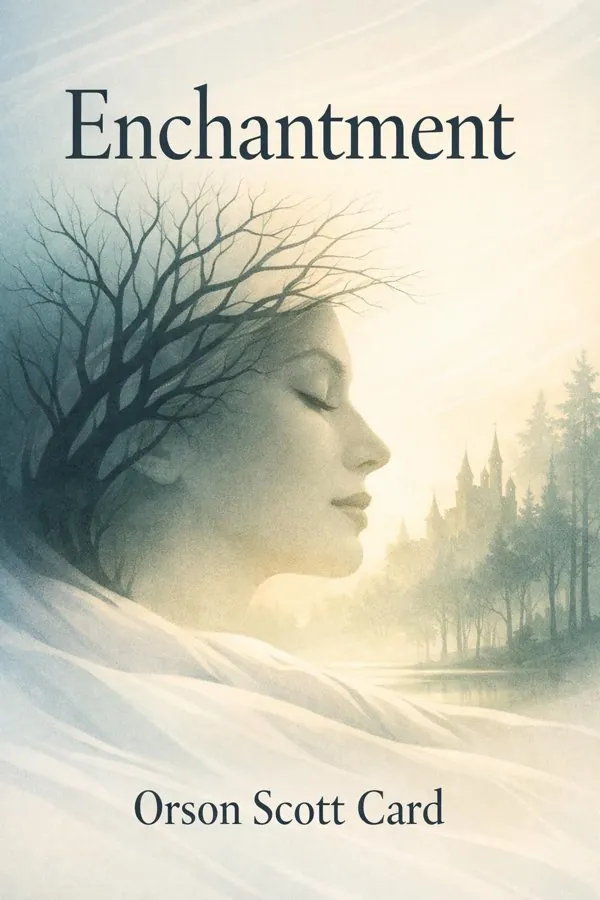
Enchantment: Summary & Key Insights
 10 min4 chaptersAudio available
What Is Enchantment About?
Enchantment by Orson Scott Card is a scifi_fantasy book spanning 4 pages. Enchantment es una novela de fantasía del escritor estadounidense Orson Scott Card, publicada por primera vez en 1999. La historia reinterpreta el cuento clásico de la Bella Durmiente, combinando elementos de la mitología eslava y la historia moderna. El protagonista, Ivan Smetski, un joven académico de origen ucraniano, descubre un misterioso claro en un bosque que lo transporta a un mundo antiguo donde una princesa duerme bajo un hechizo. A través de su viaje entre los siglos, la novela explora temas de amor, destino, fe y el choque entre culturas y tiempos.
This FizzRead summary covers all 4 key chapters of Enchantment in approximately 10 minutes, distilling the most important ideas, arguments, and takeaways from Orson Scott Card's work. Also available as an audio summary and Key Quotes Podcast.
Enchantment
Enchantment es una novela de fantasía del escritor estadounidense Orson Scott Card, publicada por primera vez en 1999. La historia reinterpreta el cuento clásico de la Bella Durmiente, combinando elementos de la mitología eslava y la historia moderna. El protagonista, Ivan Smetski, un joven académico de origen ucraniano, descubre un misterioso claro en un bosque que lo transporta a un mundo antiguo donde una princesa duerme bajo un hechizo. A través de su viaje entre los siglos, la novela explora temas de amor, destino, fe y el choque entre culturas y tiempos.
Who Should Read Enchantment?
This book is perfect for anyone interested in scifi_fantasy and looking to gain actionable insights in a short read. Whether you're a student, professional, or lifelong learner, the key ideas from Enchantment by Orson Scott Card will help you think differently.
- ✓Readers who enjoy scifi_fantasy and want practical takeaways
- ✓Professionals looking to apply new ideas to their work and life
- ✓Anyone who wants the core insights of Enchantment in just 10 minutes
Want the full summary?
Get instant access to this book summary and 100K+ more with Fizz Moment.
Get Free SummaryAvailable on App Store • Free to download
Key Chapters
Ivan Smetski’s earliest memory haunts him — a clearing deep in a Ukrainian forest, a pedestal, and upon it, a sleeping woman. This memory, half-dream, half-revelation, is the thread that ties his scholarly adulthood to the mysteries of his childhood. As a linguist studying ancient Slavic languages, Ivan prides himself on his rational mind, trained to categorize and interpret myths rather than live them. Yet he cannot ignore the pull of that forgotten clearing.
When he returns decades later, armed with modern skepticism, research tools, and linguistic precision, he discovers that time itself bends in places saturated with old belief. The air in the clearing hums with presence. There, he confronts the impossible — the same woman, unchanged, asleep beneath a curse spanning centuries. His academic detachment shatters. In the face of beauty and wonder beyond logic, Ivan makes a choice that sends him spiraling centuries backward, into the heart of medieval Russia — a world where myth and reality are indistinguishable.
Writing this, I wanted to dramatize the tension between modern intellect and ancestral faith. Ivan embodies our age — trained to study myth as artifact, never as truth. Yet the forest reminds us that all knowledge begins in wonder, and wonder begins in belief. The sleeping woman represents unacknowledged faith — dormant until awakened by curiosity and courage. The forest itself, timeless and alive, is the meeting place of epochs, the space where human consciousness expands beyond its temporal limits.
In awakening the princess, Ivan also awakens his own suppressed longing for meaning beyond data, beyond reason. The forest scene thus functions as both literal and symbolic initiation — into love, into danger, and into the enigma of enchantment that intellectual arrogance alone cannot unravel.
Katerina’s medieval kingdom is as alien to Ivan as his twentieth-century sensibilities are to her. When he wakes her, he disrupts not only her sleep but also the social order that kept her imprisoned by myth. The two stand opposite each other, not merely as man and woman, but as embodiments of epochal forces: reason and faith, modernity and tradition.
Katerina is no passive fairy-tale princess. She is proud, fierce, and shaped by a world that values action and devotion to divine order. Her language alone breathes another rhythm of reality, one where God, witchcraft, and destiny coexist without contradiction. Through their shared confusion — their inability to understand each other’s words, customs, and assumptions — the story exposes how progress can both illuminate and diminish us.
When Ivan travels with her back to her kingdom, he finds himself tested on every front. The values he assumed immutable — equality, rationality, skepticism — dissolve in a culture defined by fealty, faith, and the palpable presence of magic. He must learn humility, and in doing so, discovers a strength deeper than intellect: faith as an act of courage, not superstition.
In these chapters, I wanted to bring medieval belief systems into direct dialogue with the secular modern world. Too often, we dismiss the past as ignorant because it is religious, mystical, or governed by divine causality. Yet beneath that worldview lies a coherence modernity lacks — a sense that life, though dangerous, has purpose. As Ivan learns, rationality cannot replace purpose; it can only describe structure. Katerina’s world restores to him the language of significance that his own world has forfeited. And in turn, Ivan offers Katerina knowledge — a means to reimagine her world without surrendering its soul.
Their partnership, born out of mistrust and necessity, becomes the axis around which both worlds turn. By the time love begins to emerge, it is clear that enchantment is not a curse to dispel, but a bridge to walk — uniting the seen and the unseen, the ancient and the modern.
+ 2 more chapters — available in the FizzRead app
All Chapters in Enchantment
About the Author
Orson Scott Card es un novelista estadounidense conocido principalmente por su obra de ciencia ficción 'Ender's Game'. Nació en 1951 en Richland, Washington. Además de ciencia ficción, ha escrito novelas de fantasía, teatro y ensayos. Su estilo combina la exploración moral y filosófica con narrativas de gran profundidad emocional.
Get This Summary in Your Preferred Format
Read or listen to the Enchantment summary by Orson Scott Card anytime, anywhere. FizzRead offers multiple formats so you can learn on your terms — all free.
Available formats: App · Audio · PDF · EPUB — All included free with FizzRead
Download Enchantment PDF and EPUB Summary
Key Quotes from Enchantment
“Ivan Smetski’s earliest memory haunts him — a clearing deep in a Ukrainian forest, a pedestal, and upon it, a sleeping woman.”
“Katerina’s medieval kingdom is as alien to Ivan as his twentieth-century sensibilities are to her.”
Frequently Asked Questions about Enchantment
Enchantment by Orson Scott Card is a scifi_fantasy book that explores key ideas across 4 chapters. Enchantment es una novela de fantasía del escritor estadounidense Orson Scott Card, publicada por primera vez en 1999. La historia reinterpreta el cuento clásico de la Bella Durmiente, combinando elementos de la mitología eslava y la historia moderna. El protagonista, Ivan Smetski, un joven académico de origen ucraniano, descubre un misterioso claro en un bosque que lo transporta a un mundo antiguo donde una princesa duerme bajo un hechizo. A través de su viaje entre los siglos, la novela explora temas de amor, destino, fe y el choque entre culturas y tiempos.
More by Orson Scott Card
You Might Also Like
Red Rising
Pierce Brown
10 min
Stranger in a Strange Land
Robert A. Heinlein
10 min
AI Valley
Chen Qiufan
10 min
Bloodchild
Octavia E. Butler
10 min
Do Androids Dream of Electric Sheep?
Philip K. Dick
10 min
Jujutsu Kaisen, Vol. 24
Gege Akutami
10 minBrowse by Category
Ready to read Enchantment?
Get the full summary and 100K+ more books with Fizz Moment.