
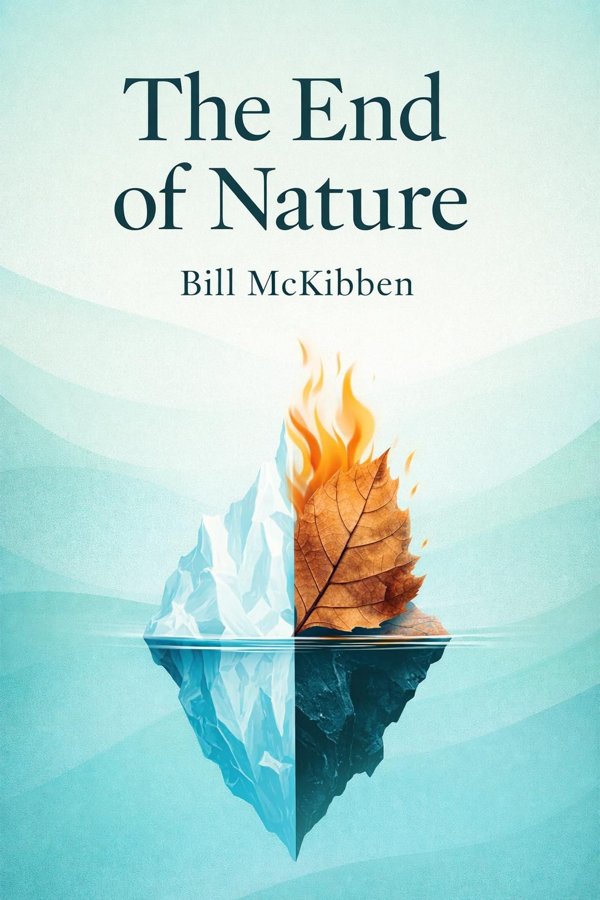
The End of Nature: Summary & Key Insights
 10 min10 chaptersAudio available
Key Takeaways from The End of Nature
The most unsettling environmental change is not always the one we can see.
Nothing demonstrates humanity’s reach more clearly than a changed sky.
A place can be remote and still not be untouched.
The ecological crisis is not only about damaged landscapes; it is about damaged meaning.
People often fail to protect what they no longer truly notice.
What Is The End of Nature About?
The End of Nature by Bill McKibben is a environment book spanning 10 pages. The End of Nature is one of the earliest and most influential books to argue that climate change is not just an environmental problem but a civilizational turning point. In this landmark work, Bill McKibben contends that human activity—especially the burning of fossil fuels—has altered the atmosphere so profoundly that nature can no longer be understood as separate from us. Forests, oceans, weather systems, and seasons may still look familiar, but they now operate under conditions shaped by human industry. That, for McKibben, marks the "end" of nature as an independent force. What makes the book powerful is its unusual blend of science, moral philosophy, cultural criticism, and personal reflection. McKibben does not simply list ecological facts; he asks what it means for human beings to live on a planet where even the sky bears our fingerprints. His argument helped define modern climate thinking long before the issue entered mainstream politics. As an environmental journalist, activist, and founder of 350.org, McKibben writes with both authority and urgency, making this a foundational book for anyone seeking to understand the deeper meaning of ecological crisis.
This FizzRead summary covers all 10 key chapters of The End of Nature in approximately 10 minutes, distilling the most important ideas, arguments, and takeaways from Bill McKibben's work. Also available as an audio summary and Key Quotes Podcast.
The End of Nature
The End of Nature is one of the earliest and most influential books to argue that climate change is not just an environmental problem but a civilizational turning point. In this landmark work, Bill McKibben contends that human activity—especially the burning of fossil fuels—has altered the atmosphere so profoundly that nature can no longer be understood as separate from us. Forests, oceans, weather systems, and seasons may still look familiar, but they now operate under conditions shaped by human industry. That, for McKibben, marks the "end" of nature as an independent force.
What makes the book powerful is its unusual blend of science, moral philosophy, cultural criticism, and personal reflection. McKibben does not simply list ecological facts; he asks what it means for human beings to live on a planet where even the sky bears our fingerprints. His argument helped define modern climate thinking long before the issue entered mainstream politics. As an environmental journalist, activist, and founder of 350.org, McKibben writes with both authority and urgency, making this a foundational book for anyone seeking to understand the deeper meaning of ecological crisis.
Who Should Read The End of Nature?
This book is perfect for anyone interested in environment and looking to gain actionable insights in a short read. Whether you're a student, professional, or lifelong learner, the key ideas from The End of Nature by Bill McKibben will help you think differently.
- ✓Readers who enjoy environment and want practical takeaways
- ✓Professionals looking to apply new ideas to their work and life
- ✓Anyone who wants the core insights of The End of Nature in just 10 minutes
Want the full summary?
Get instant access to this book summary and 100K+ more with Fizz Moment.
Get Free SummaryAvailable on App Store • Free to download
Key Chapters
The most unsettling environmental change is not always the one we can see. McKibben’s central claim is that nature has “ended” not because mountains have vanished or rivers have stopped flowing, but because the natural world is no longer fully independent of human influence. For most of history, people experienced nature as something beyond human control: weather arrived on its own terms, seasons followed their own rhythms, and ecosystems evolved without being designed by us. That autonomy gave nature both its mystery and its authority.
McKibben argues that industrial society has broken that separation. By changing the atmosphere, humans have changed the conditions under which every natural system operates. Even remote places now exist within a climate altered by emissions from factories, cars, and power plants. Wilderness remains in appearance, but not in the old philosophical sense. The key loss is not scenery; it is independence.
This idea changes how we think about conservation. Protecting a forest is no longer just about preserving a place from logging or roads. It also means recognizing that the forest’s rainfall, temperature, pests, and fire patterns may now be shaped by global human activity. A national park cannot be fully protected if the atmosphere above it is destabilized.
In everyday life, this insight invites a broader environmental awareness. Recycling, energy choices, transportation habits, and food systems are not marginal behaviors; they participate in planetary systems. McKibben’s point is not that humans should withdraw from the world entirely, but that we must stop pretending our actions remain local and isolated.
Actionable takeaway: Start seeing environmental responsibility at the systems level. Ask not only whether a place looks natural, but whether your daily choices help preserve or further erode the planet’s ecological independence.
Nothing demonstrates humanity’s reach more clearly than a changed sky. McKibben treats climate change as the most powerful evidence that nature’s autonomy has ended because the atmosphere once symbolized the ultimate beyond—vast, untouchable, and indifferent to human affairs. Yet by burning coal, oil, and gas, modern civilization has loaded that atmosphere with heat-trapping gases, changing temperature, rainfall, storms, and seasonality across the globe.
What makes climate change distinct from other forms of pollution is its scale. A toxic waste dump harms a place; greenhouse gases alter the operating system of the planet. A car trip in one country contributes, however slightly, to melting glaciers in another. This means environmental ethics can no longer be confined to local damage. The consequences of modern life are dispersed, delayed, and global.
McKibben wrote before climate change became common public vocabulary, which makes his argument especially striking. He recognized early that the issue was not simply warmer weather but a transformed relationship between humans and Earth. If we can alter the chemistry of the air itself, then human power has crossed a threshold. We have become geological agents without fully developing the wisdom to manage that role.
Today, practical examples are everywhere: crop failures linked to shifting rainfall, stronger heat waves in cities, coral bleaching from warming seas, and insurance systems strained by extreme weather. These effects show that climate change is not abstract science; it is a structural condition shaping economics, health, migration, and security.
Actionable takeaway: Treat climate change as a central framework for personal and civic decision-making. Support clean energy, reduce fossil-fuel dependence, and vote for policies that cut emissions at the scale the problem requires.
A place can be remote and still not be untouched. One of McKibben’s most moving insights is that wilderness has been altered even where roads, cities, and machines are absent. We often imagine wild places as escapes from human influence—mountain ranges, polar regions, old-growth forests, deserts. But if global emissions change temperatures, precipitation, and ecological cycles everywhere, then no place remains wholly outside human reach.
This does not mean wilderness has lost its beauty or value. McKibben is not saying that wild landscapes are fake. He is saying their status has changed. They are no longer realms that exist independently of us. A glacier in Alaska, a forest in the Amazon, or a coral reef in the Pacific may still inspire awe, but each now exists within a climate system altered by industrial society.
That idea carries both emotional and policy implications. Emotionally, it means our relationship to wilderness becomes more tragic and more responsible. We cannot simply admire nature from a distance while assuming it will endure on its own. Politically, it means conservation must expand beyond land protection. Setting aside parks matters, but it is not enough if planetary warming destabilizes the ecosystems inside them.
A useful modern example is wildfire. Protecting a forest boundary does little if rising heat and prolonged drought increase fire intensity across an entire region. Similarly, marine reserves cannot fully shield ocean life from warming and acidification. Ecological protection now requires atmospheric protection.
Actionable takeaway: Support conservation approaches that connect local land protection with global climate action. Preserve wild spaces, but also back policies that address emissions, biodiversity loss, and ecological resilience together.
The ecological crisis is not only about damaged landscapes; it is about damaged meaning. McKibben insists that the end of nature is a philosophical event as much as a scientific one. For centuries, people found in nature a source of humility, transcendence, and moral perspective. Nature reminded us that we were not the measure of all things. It set limits, inspired reverence, and offered a reality larger than human desire.
If human beings now shape even the climate, that older experience becomes harder to sustain. We no longer encounter a fully separate world; we encounter a world partly remade by ourselves. This can deepen arrogance, as if everything is manageable through technology, or deepen despair, as if nothing remains sacred. McKibben warns against both. His point is not that meaning disappears, but that we must rebuild an ethical relationship with the natural world under new conditions.
This philosophical shift affects everyday life more than it first appears. When people view nature merely as a resource, they make consumer decisions differently than when they see it as a living order deserving restraint. Urban planning, agriculture, energy use, and even recreation all reflect hidden beliefs about whether the world exists for extraction or for relationship.
McKibben asks readers to recover humility. Scientific knowledge does not erase mystery; it should sharpen our awareness of complexity and interdependence. The more power we have, the more urgently we need moral limits.
Actionable takeaway: Examine the worldview behind your habits. In work, consumption, and politics, choose practices that reflect humility and stewardship rather than domination and endless control.
People often fail to protect what they no longer truly notice. McKibben explores how modern life dulls our perception of the natural world, making environmental destruction easier to ignore. Many of us encounter nature through windows, screens, forecasts, and managed landscapes rather than through direct dependence on seasons, soils, or local ecosystems. As that intimacy fades, environmental damage becomes conceptually distant—even when its causes are woven into our daily routines.
This numbness is reinforced by normalization. Each generation tends to accept the environmental conditions it grows up with as ordinary, even if those conditions are already degraded. A child who never sees abundant birdlife, stable winters, or clear rivers may not recognize what has been lost. This “shifting baseline” allows decline to continue without producing proportional alarm.
McKibben’s insight matters because environmental action begins with attention. People are more likely to care for places they know directly and patterns they can perceive over time. A community that notices shorter winters, hotter summers, fewer pollinators, or more frequent flooding gains a more grounded understanding of climate and ecological stress than one that treats nature as background scenery.
Practical applications are simple but powerful: spending regular time outdoors in the same place, keeping seasonal notes, learning local species, gardening, joining community science projects, or following regional water and air data. These habits rebuild perception and convert abstract concern into lived awareness.
McKibben suggests that ecological responsibility starts not with grand ideology but with recovering our powers of observation. We protect what we learn to see, and we learn to see what we treat as worthy of attention.
Actionable takeaway: Develop one regular practice that reconnects you with local nature—such as weekly walks, a seasonal journal, or volunteering with a restoration group—to sharpen awareness and deepen care.
Environmental destruction is not only produced in smokestacks; it is also produced in values. McKibben links ecological decline to industrial society’s deeper commitment to growth, consumption, and convenience. Modern economies often measure success by how much is extracted, manufactured, purchased, and discarded. That logic treats the natural world as raw material and encourages people to seek identity through acquisition rather than through restraint, community, or sufficiency.
This matters because climate change is not caused by a single bad invention. It emerges from a whole way of life built around constant energy use and rising material expectations. Bigger homes demand more heating and cooling. Car-centered infrastructure locks in fossil-fuel dependence. Fast fashion, disposable products, industrial agriculture, and energy-intensive food systems turn everyday consumption into ecological pressure.
McKibben does not argue that comfort or technology are inherently wrong. His criticism is aimed at a culture that confuses more with better. When consumption becomes the default answer to human needs—status, boredom, security, pleasure—the environment becomes collateral damage. The result is a society rich in goods yet increasingly poor in ecological stability.
The practical relevance is immediate. People can reduce harm by buying less, repairing more, choosing public transit, eating lower on the food chain, insulating homes, supporting local production, and resisting needless upgrades. But McKibben’s argument also points beyond personal virtue to structural change: public transit, efficient housing, renewable energy, circular manufacturing, and economic models that prioritize well-being over throughput.
Actionable takeaway: Pick one area of overconsumption—transportation, clothing, food, or home energy—and redesign it around sufficiency rather than convenience. Small shifts reveal how cultural values translate into environmental impact.
The same ingenuity that creates power can also create dangerous illusions. McKibben is skeptical of the belief that technology alone will solve ecological problems without requiring changes in behavior, values, or social systems. Science is indispensable for understanding climate change, measuring atmospheric carbon, and developing cleaner tools. But when technology becomes a substitute for moral reflection, it encourages the fantasy that every damage can be engineered away.
This is one of the book’s sharpest warnings. A society that caused planetary instability through industrial expansion may be tempted to answer with even more control—geoengineering schemes, endless extraction offset by future fixes, or efficiency gains that reduce guilt without reducing total consumption. McKibben does not reject innovation; he rejects technological arrogance. The problem is not knowledge itself, but the assumption that human cleverness removes the need for limits.
In practice, this distinction matters greatly. Solar panels, heat pumps, battery storage, and better grids are essential. So are climate models, crop science, and building design. But none of these eliminate the need to ask harder questions: How much energy is enough? What forms of growth are actually beneficial? Which desires should societies cultivate, and which should they restrain?
A good example is efficiency. More efficient cars or appliances can reduce emissions, but if those gains are offset by larger vehicles, longer commutes, and greater total use, the deeper problem remains. Technology works best when guided by an ethic of sufficiency and care.
Actionable takeaway: Embrace clean technology, but pair it with conscious limits. When adopting a “green” solution, also ask what habits, expectations, or systems need to change so the solution truly reduces harm.
One of McKibben’s most enduring contributions is to frame environmental harm as a moral failure, not just a technical challenge. Climate change is often discussed in terms of parts per million, temperature targets, and policy mechanisms. Those are essential, but McKibben insists they do not capture the whole issue. At its core, the crisis raises ethical questions about responsibility, justice, and the kind of people we choose to be.
If the wealth and convenience of some are purchased through the destabilization of the global climate, then environmental degradation becomes a question of fairness. Those who contribute least to emissions often face the harshest consequences: farmers vulnerable to drought, coastal communities exposed to storms, poorer nations with fewer resources for adaptation, and future generations who inherit altered ecosystems they did not choose. This asymmetry gives climate change a deeply moral character.
McKibben also broadens responsibility beyond direct intent. A person may not wish to harm forests, oceans, or vulnerable communities, yet still participate in systems that do. Moral maturity, in this view, means acknowledging indirect consequences and acting accordingly. Ethical life in the modern world includes understanding supply chains, energy systems, and the long-term effects of everyday convenience.
This perspective can reshape institutions as well. Businesses can evaluate profit alongside ecological cost. Schools can teach environmental literacy as civic ethics. Faith communities can frame stewardship as a moral calling. Families can discuss lifestyle choices not only in terms of price, but in terms of impact.
Actionable takeaway: Add an ethical question to major decisions: “Who or what bears the hidden cost of this choice?” Using that lens can guide more responsible behavior at home, at work, and in public life.
No one lives outside the systems causing environmental damage, which means meaningful change must happen at more than one level. McKibben avoids the false choice between personal responsibility and political action. Individual habits matter because they express values, reduce harm, and build credibility. But private virtue alone cannot solve a crisis embedded in energy grids, transportation systems, agricultural models, and economic incentives.
This dual focus is one reason the book remains relevant. Personal change without structural reform can become symbolic. Structural demands without personal commitment can become hollow. McKibben argues, implicitly and explicitly, for alignment: live differently, and also organize differently.
In practice, personal change may include driving less, cutting household energy use, eating more sustainably, reducing waste, and spending time in ways less tied to consumption. These choices matter, especially when they help normalize lower-carbon ways of living. Yet large-scale outcomes also depend on civic engagement: supporting climate legislation, backing renewable infrastructure, pushing institutions to divest from fossil fuels, and joining community efforts around transit, resilience, and conservation.
This idea also protects against despair. People often feel either guilty because their personal actions seem too small or powerless because only governments and corporations appear large enough to matter. McKibben’s framework suggests both are necessary. Individual conduct shapes culture; culture shapes politics; politics shapes systems.
The path forward is not purity but participation. People do not need perfect lifestyles before advocating change. They need seriousness, honesty, and willingness to act where they can while demanding more from larger actors.
Actionable takeaway: Pair one personal sustainability habit with one civic action this month—for example, reduce home energy use and contact local leaders about clean-energy policy—so your concern becomes both lived and public.
Real hope is not optimism without evidence; it is commitment without denial. Although The End of Nature is famous for its stark warning, McKibben does not end in nihilism. He believes renewal remains possible, but only if people first confront the truth of what has happened. False reassurance is dangerous because it delays action. Honest recognition, by contrast, can become the basis for courage, solidarity, and meaningful change.
This form of hope is disciplined rather than sentimental. It does not promise a return to some untouched past, because McKibben’s point is precisely that the old relationship with nature has been irreversibly altered. Instead, hope lies in building a wiser civilization within that new reality—one less arrogant, less wasteful, and more attentive to limits. The goal is not to recover innocence, but to cultivate responsibility.
Examples of such hope can be seen in community adaptation projects, indigenous stewardship practices, youth climate movements, regenerative farming, ecosystem restoration, and the rapid expansion of renewable energy. None of these erases the problem, but together they show that human societies can still choose different directions.
McKibben’s hope is also relational. People are more resilient when they act together. Shared projects—planting urban trees, protecting watersheds, improving public transit, strengthening local food systems—transform environmental concern from private anxiety into public purpose. Hope grows when action becomes collective and concrete.
Actionable takeaway: Replace passive worry with one recurring act of engagement. Join or support a local climate, conservation, or resilience effort so hope becomes something you practice, not something you wait to feel.
All Chapters in The End of Nature
About the Author
Bill McKibben is an American environmental writer, journalist, and activist widely recognized as one of the earliest public intellectuals to warn about climate change. Born in 1960, he became known for combining clear scientific explanation with moral and philosophical reflection on humanity’s relationship with the Earth. His 1989 book The End of Nature was among the first major works written for a general audience about global warming. Beyond his writing, McKibben is the founder of 350.org, an international grassroots climate campaign named after a safe upper limit for atmospheric carbon dioxide. He has written numerous books on ecology, sustainability, community, and energy, and has long been a leading voice calling for climate action, civic responsibility, and a more restrained, humane relationship with the natural world.
Get This Summary in Your Preferred Format
Read or listen to the The End of Nature summary by Bill McKibben anytime, anywhere. FizzRead offers multiple formats so you can learn on your terms — all free.
Available formats: App · Audio · PDF · EPUB — All included free with FizzRead
Download The End of Nature PDF and EPUB Summary
Key Quotes from The End of Nature
“The most unsettling environmental change is not always the one we can see.”
“Nothing demonstrates humanity’s reach more clearly than a changed sky.”
“A place can be remote and still not be untouched.”
“The ecological crisis is not only about damaged landscapes; it is about damaged meaning.”
“People often fail to protect what they no longer truly notice.”
Frequently Asked Questions about The End of Nature
The End of Nature by Bill McKibben is a environment book that explores key ideas across 10 chapters. The End of Nature is one of the earliest and most influential books to argue that climate change is not just an environmental problem but a civilizational turning point. In this landmark work, Bill McKibben contends that human activity—especially the burning of fossil fuels—has altered the atmosphere so profoundly that nature can no longer be understood as separate from us. Forests, oceans, weather systems, and seasons may still look familiar, but they now operate under conditions shaped by human industry. That, for McKibben, marks the "end" of nature as an independent force. What makes the book powerful is its unusual blend of science, moral philosophy, cultural criticism, and personal reflection. McKibben does not simply list ecological facts; he asks what it means for human beings to live on a planet where even the sky bears our fingerprints. His argument helped define modern climate thinking long before the issue entered mainstream politics. As an environmental journalist, activist, and founder of 350.org, McKibben writes with both authority and urgency, making this a foundational book for anyone seeking to understand the deeper meaning of ecological crisis.
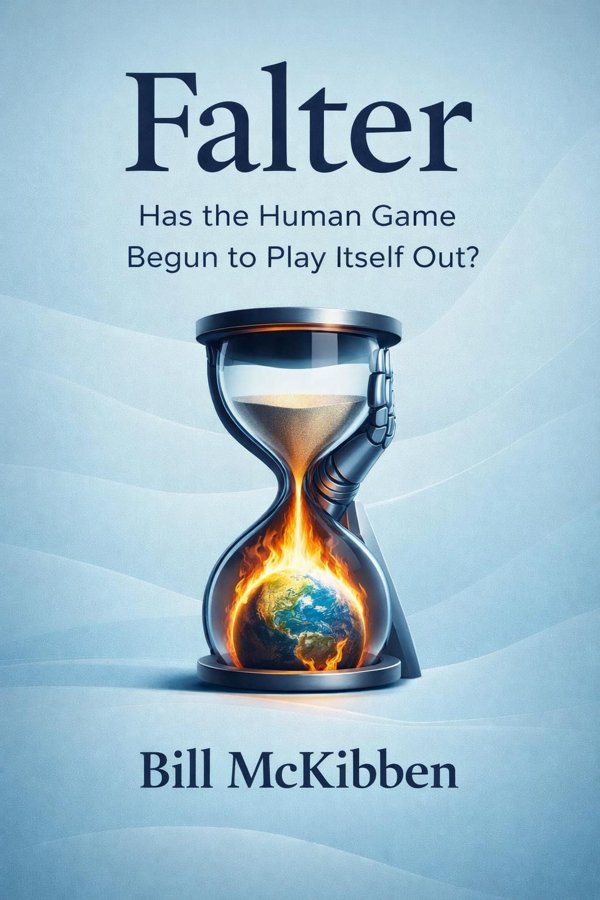
More by Bill McKibben
You Might Also Like
A Life on Our Planet: My Witness Statement and a Vision for the Future
David Attenborough
10 min
A Sky Full Of Birds
Matt Merritt
10 min
Carbon Zero: Imagining Cities That Can Save the Planet
Alex Steffen
10 min
Eaarth: Making a Life on a Tough New Planet
Bill McKibben
10 min
The Social Contract and Environmental Governance
Various Editors
10 min
The Wild Places
Robert Macfarlane
10 minBrowse by Category
Ready to read The End of Nature?
Get the full summary and 100K+ more books with Fizz Moment.