
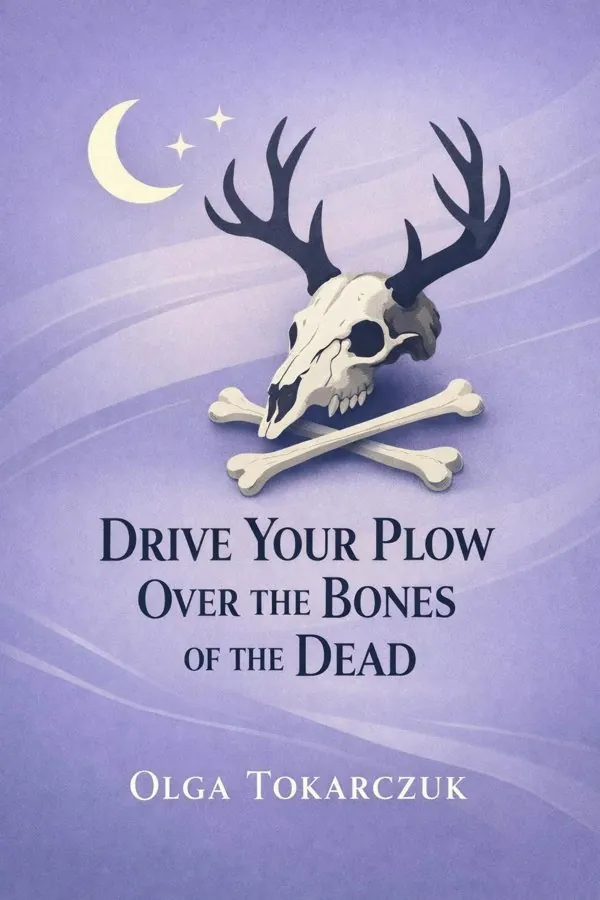
Drive Your Plow Over the Bones of the Dead: Summary & Key Insights
 10 min9 chaptersAudio available
Key Takeaways from Drive Your Plow Over the Bones of the Dead
Sometimes the person everyone dismisses is the only one paying attention.
A society reveals its deepest values by what it excuses as normal.
Even in a novel full of death and alienation, small friendships become acts of resistance.
The most unsettling truths are the ones that force us to question our own moral comfort.
One of the novel’s boldest moves is insisting that animals are not scenery in human drama.
What Is Drive Your Plow Over the Bones of the Dead About?
Drive Your Plow Over the Bones of the Dead by Olga Tokarczuk is a bestsellers book spanning 4 pages. What begins as a strange murder story in a remote Polish hamlet becomes something far more unsettling, witty, and profound in Olga Tokarczuk’s Drive Your Plow Over the Bones of the Dead. The novel follows Janina Duszejko, an aging, sharp-tongued, deeply eccentric woman who lives near the Czech border, studies astrology, translates William Blake, and cares more for animals than for most of the people around her. When several local men connected to hunting and authority die under mysterious circumstances, Janina becomes convinced that the natural world is answering back. Part detective novel, part ecological fable, and part philosophical monologue, the book questions who gets called rational, who gets dismissed as mad, and what justice looks like when human law protects cruelty. Tokarczuk, winner of the Nobel Prize in Literature, brings unusual authority to these questions through her psychological insight, moral seriousness, and talent for blending realism with mythic intensity. This is a novel that entertains as a literary mystery while quietly forcing readers to reconsider violence, power, and the boundaries of compassion.
This FizzRead summary covers all 9 key chapters of Drive Your Plow Over the Bones of the Dead in approximately 10 minutes, distilling the most important ideas, arguments, and takeaways from Olga Tokarczuk's work. Also available as an audio summary and Key Quotes Podcast.
Drive Your Plow Over the Bones of the Dead
What begins as a strange murder story in a remote Polish hamlet becomes something far more unsettling, witty, and profound in Olga Tokarczuk’s Drive Your Plow Over the Bones of the Dead. The novel follows Janina Duszejko, an aging, sharp-tongued, deeply eccentric woman who lives near the Czech border, studies astrology, translates William Blake, and cares more for animals than for most of the people around her. When several local men connected to hunting and authority die under mysterious circumstances, Janina becomes convinced that the natural world is answering back. Part detective novel, part ecological fable, and part philosophical monologue, the book questions who gets called rational, who gets dismissed as mad, and what justice looks like when human law protects cruelty. Tokarczuk, winner of the Nobel Prize in Literature, brings unusual authority to these questions through her psychological insight, moral seriousness, and talent for blending realism with mythic intensity. This is a novel that entertains as a literary mystery while quietly forcing readers to reconsider violence, power, and the boundaries of compassion.
Who Should Read Drive Your Plow Over the Bones of the Dead?
This book is perfect for anyone interested in bestsellers and looking to gain actionable insights in a short read. Whether you're a student, professional, or lifelong learner, the key ideas from Drive Your Plow Over the Bones of the Dead by Olga Tokarczuk will help you think differently.
- ✓Readers who enjoy bestsellers and want practical takeaways
- ✓Professionals looking to apply new ideas to their work and life
- ✓Anyone who wants the core insights of Drive Your Plow Over the Bones of the Dead in just 10 minutes
Want the full summary?
Get instant access to this book summary and 100K+ more with Fizz Moment.
Get Free SummaryAvailable on App Store • Free to download
Key Chapters
Sometimes the person everyone dismisses is the only one paying attention. Janina Duszejko lives in an isolated settlement near the Polish-Czech border, where winter empties the landscape and human life seems reduced to routines of maintenance, weather, and survival. She looks after summer houses, cares for animals, studies horoscopes, and resists the assumptions of a society that sees old women as irrelevant. Her solitude is not just a social condition; it becomes a way of perceiving the world differently. Because she stands slightly outside the community, she notices patterns others ignore—changes in animal behavior, shifts in mood, and the moral rot hidden beneath ordinary customs.
The novel’s first death introduces its method. A local poacher dies under bizarre circumstances, and Janina immediately interprets the event through a framework others consider absurd: astrology, cosmic order, and animal vengeance. Whether readers agree with her conclusions is almost beside the point. Tokarczuk uses Janina’s voice to show how dominant culture labels some forms of knowing as reasonable and others as ridiculous, often for political rather than intellectual reasons. The authorities rely on procedure and hierarchy; Janina relies on intuition, symbolism, and attention to neglected life.
This dynamic has practical resonance beyond the novel. In organizations, families, and communities, unconventional observers often detect problems before official systems do. The colleague others call eccentric may be the first to notice ethical risk. The neighbor who speaks emotionally may still be right about harm no one wants to name.
Actionable takeaway: Pay closer attention to the perspectives you instinctively dismiss. Ask what outsiders, loners, or nonconformists might be seeing that accepted authorities are failing to recognize.
A society reveals its deepest values by what it excuses as normal. In Drive Your Plow Over the Bones of the Dead, the men who dominate local life—hunters, police, clergy, and landowners—represent a world in which violence against animals is not merely tolerated but ritualized, celebrated, and morally sanitized. Hunting is framed as tradition, masculinity, and order. Yet as Janina sees it, this language hides cruelty, vanity, and a profound failure of empathy. When one by one several of these men die under mysterious conditions, the novel turns into a dark moral inquiry: why is killing animals for pleasure socially acceptable, while violence against humans is treated as unthinkable?
Tokarczuk does not offer a simplistic inversion, but she relentlessly exposes the hypocrisy of human law. The same institutions that lecture about morality often ignore suffering when it falls outside the human sphere. The priest blesses hunting. Officials dismiss Janina’s complaints about animal cruelty. Bureaucratic systems protect status more readily than vulnerability. In this world, legality becomes a poor guide to justice.
This idea applies widely. Many modern institutions defend harmful practices by calling them customary, profitable, or necessary. Environmental destruction, exploitative labor, and casual dehumanization often survive not because they are ethically sound, but because they are embedded in respectable systems. The novel asks readers to separate legitimacy from morality.
The recurring deaths intensify this challenge. Each unexplained event forces the community to confront the possibility that the order it trusts may be built on denial. Janina’s outrage sounds excessive only because everyone else has normalized cruelty.
Actionable takeaway: When evaluating a law, policy, or tradition, ask not only whether it is accepted, but whom it harms and whose suffering has been conveniently excluded from consideration.
Even in a novel full of death and alienation, small friendships become acts of resistance. Janina may appear misanthropic, but Tokarczuk carefully shows that she is not against human connection itself; she is against numbness, domination, and moral laziness. Her life is sustained by a few fragile but meaningful relationships, especially with figures such as Dizzy, Oddball, and her student and translator companion. These bonds matter because they offer mutual recognition in a world that otherwise treats vulnerable people as disposable.
Isolation in the novel is social, generational, and epistemic. Janina is old, female, unconventional, and outspoken, which means she is persistently patronized. Yet friendship creates temporary zones in which language, imagination, and care can flourish. Working together on William Blake translations, sharing conversations, helping one another through bureaucratic absurdity—these moments soften the bleakness of the setting and remind readers that solidarity does not require large movements to be real. It can begin with one person taking another seriously.
This has practical force in contemporary life. Many people who care deeply about animals, climate, justice, or spiritual questions feel isolated by mainstream culture. The novel suggests that sustaining moral clarity often depends on finding even a few companions who can bear witness with you. Support groups, reading circles, local activism, or simply one trustworthy friendship can prevent ethical exhaustion.
Tokarczuk also shows that understanding often arrives indirectly. Janina is not fully understood even by her friends, and she does not fully understand them. Yet imperfect connection still matters. Human community does not need total agreement to be nourishing; it needs attention, kindness, and shared vulnerability.
Actionable takeaway: If you feel morally or intellectually isolated, invest in one or two sincere relationships built on curiosity and care. Small circles of understanding can make difficult convictions livable.
The most unsettling truths are the ones that force us to question our own moral comfort. As the mystery unfolds, Drive Your Plow Over the Bones of the Dead moves toward revelation—not only about the deaths themselves, but about Janina, justice, and the reader’s complicity. Tokarczuk refuses the clean payoff of conventional crime fiction. Instead of restoring order, the novel destabilizes it. What seems at first like eccentric speculation gradually intersects with shocking reality, leaving readers to confront a troubling question: what do we do when legal systems fail so completely that private vengeance starts to resemble moral protest?
The book’s power lies in its refusal to simplify. Janina is sympathetic, perceptive, and ethically alive, yet she is also obsessive, unreliable, and capable of radical transgression. Tokarczuk does not excuse violence, but neither does she let institutions off the hook for the conditions that make such violence imaginable. The result is moral ambiguity of a serious kind—not ambiguity for style, but ambiguity born from real ethical fracture.
In everyday life, people often crave clear heroes and villains because certainty feels safe. But many of the hardest issues—ecological collapse, systemic cruelty, institutional neglect—do not produce emotionally tidy answers. The novel trains readers to remain alert inside discomfort rather than rushing toward easy judgment.
This matters especially in debates about protest, resistance, and civil disobedience. When is breaking a rule an act of conscience? When does moral outrage become self-authorization? Tokarczuk leaves space for these questions to remain unresolved, which is exactly why they linger.
Actionable takeaway: Resist the urge to force complex moral situations into simple categories. When something disturbs you, stay with the discomfort long enough to examine the failures, motives, and costs on every side.
One of the novel’s boldest moves is insisting that animals are not scenery in human drama. From Janina’s perspective, animals are beings with their own value, suffering, and possibly even agency. The dominant culture around her treats them as resources, pests, trophies, or sentimental distractions. Janina rejects all of this. Her outrage is rooted in a radical moral claim: animals are not lesser lives existing for human use, and any ethics that ignores their pain is fundamentally corrupt.
Tokarczuk pushes this idea beyond sentimentality. The novel is not simply saying that animals are cute and should be protected. It is asking readers to reconsider the architecture of moral concern itself. Why do people react with horror to certain forms of human violence while accepting industrial slaughter, sport hunting, and environmental destruction as ordinary? The title, drawn from William Blake, points to a world in which the dead—human and animal alike—testify against the living.
In practical terms, this theme invites readers to scrutinize daily habits. Food choices, entertainment, consumer products, pest control, land use, and political priorities all involve assumptions about what kinds of life matter. One need not adopt Janina’s worldview wholesale to feel the force of the challenge. Even small decisions—reducing meat consumption, supporting wildlife protections, avoiding exploitative products, teaching children respect for animals—can reflect a shift from domination to stewardship.
What makes the novel memorable is that it treats empathy for animals not as softness but as moral seriousness. Janina may be mocked, yet the book continually suggests that her capacity for identification with nonhuman life is a form of ethical intelligence the wider society lacks.
Actionable takeaway: Pick one area of your life—diet, purchasing, recreation, or voting—and make a concrete change that reduces unnecessary harm to animals.
Modern people often behave as if nature were a backdrop, but Tokarczuk writes as if it were an active presence with memory and consequence. The remote landscape of the novel is not passive scenery; weather, darkness, animal tracks, forests, and borders all shape what characters can know and how they behave. Janina experiences the natural world as charged with meaning. Others treat it as territory to control. The murders, whether interpreted realistically or symbolically, create the sensation that human arrogance is encountering resistance.
This is one reason the novel feels eerily contemporary. Ecological crisis has made it increasingly difficult to maintain the fantasy that humans stand outside the systems they damage. Fires, floods, extinctions, and climate instability are reminders that domination has costs. Tokarczuk does not write a policy tract, yet the novel resonates as an environmental warning: when people normalize extraction and cruelty, they also invite forms of disorder they cannot predict or manage.
Janina’s worldview can seem mystical, but it captures something modern rationality often misses—the emotional and ethical consequences of severing ourselves from the more-than-human world. A community that mocks animals, ignores ecological signs, and worships control becomes spiritually impoverished as well as environmentally reckless.
Readers can apply this insight by rethinking what counts as intelligence in relation to place. Paying attention to seasonal rhythms, local species, land degradation, water quality, and disappearing habitats is not quaint; it is a way of becoming less abstract and more responsible.
Actionable takeaway: Build one regular practice of ecological attention into your life, such as walking the same route weekly to notice seasonal change or learning the names and needs of species in your local environment.
Who gets believed is never just a matter of evidence. Janina is repeatedly ignored not only because her theories are unusual, but because she occupies a socially disempowered position. She is an older woman, physically vulnerable, unmarried, economically marginal, and intellectually independent. In many cultural settings, that combination invites condescension. Men in authority treat her as troublesome, comic, irrational, or unstable long before they seriously consider what she is saying. Tokarczuk uses this pattern to reveal how power filters credibility.
Janina’s eccentricity is real, but the novel makes an important distinction between unconventionality and unreliability. She notices hypocrisy others tolerate. She asks questions others prefer to avoid. She refuses the polite performances expected of women who are supposed to stay agreeable, quiet, and grateful. Her anger is coded as pathology because it disrupts male institutions built on entitlement.
This theme extends beyond gender alone. Across workplaces, medical systems, courts, and media, certain voices are discounted because they sound emotional, obsessive, overly intense, or socially awkward. Yet these very voices are often closest to the harm. Survivors, whistleblowers, caregivers, and marginalized observers are frequently required to perform calmness before anyone will listen.
The novel therefore becomes a study in testimonial injustice: the wrong done when someone’s word is devalued because of who they are. Tokarczuk does not idealize Janina, but she demands that readers recognize how dismissal itself can become a mechanism of injustice.
Actionable takeaway: In conversations and decisions, notice whether you are evaluating ideas based on their substance or on your assumptions about the speaker’s age, gender, status, tone, or social polish.
A mystery novel usually promises answers, but Tokarczuk uses the crime genre to ask better questions. On the surface, Drive Your Plow Over the Bones of the Dead contains all the recognizable elements of a thriller: suspicious deaths, local secrets, eccentric suspects, police investigation, and growing tension. Yet the real engine of the book is not puzzle-solving. It is moral reframing. Instead of asking only who committed the crimes, the novel asks which kinds of violence count as crimes in the first place.
This shift transforms the reader’s role. We are drawn in by suspense, then gradually confronted with our own habits of judgment. Why do we focus on spectacular deaths while overlooking routine brutality? Why does institutional violence feel normal and personal retaliation feel shocking? Tokarczuk exploits the conventions of genre fiction in order to destabilize the reader’s ethical hierarchy.
That strategy helps explain the novel’s wide appeal. Readers who come for atmosphere and suspense find themselves engaged in philosophical reflection without being lectured. The story remains gripping because its ideas are dramatized through character, place, and escalating unease rather than abstract argument.
There is a useful lesson here for how complex issues are communicated. People often absorb challenging ideas more effectively through narrative than through direct instruction. Stories lower resistance, create identification, and reveal contradictions emotionally as well as intellectually. Whether in education, leadership, or advocacy, form matters.
Actionable takeaway: If you want to persuade others about a difficult ethical issue, consider using narrative, examples, and human stakes instead of relying only on abstract claims or data.
All Chapters in Drive Your Plow Over the Bones of the Dead
About the Author
Olga Tokarczuk is a Polish novelist, essayist, and former psychologist whose work is celebrated for its intellectual daring, moral depth, and imaginative range. Born in 1962, she emerged as one of the most important voices in contemporary European literature through novels that combine myth, history, spirituality, psychology, and political reflection. She was awarded the Nobel Prize in Literature for 2018, recognizing her boundary-crossing storytelling and unique narrative vision. Tokarczuk’s major books include Flights, which won the International Booker Prize, The Books of Jacob, Primeval and Other Times, and Drive Your Plow Over the Bones of the Dead. Her writing often explores identity, movement, ecology, and the hidden assumptions shaping modern life. She is widely admired for fiction that is both formally inventive and ethically searching.
Get This Summary in Your Preferred Format
Read or listen to the Drive Your Plow Over the Bones of the Dead summary by Olga Tokarczuk anytime, anywhere. FizzRead offers multiple formats so you can learn on your terms — all free.
Available formats: App · Audio · PDF · EPUB — All included free with FizzRead
Download Drive Your Plow Over the Bones of the Dead PDF and EPUB Summary
Key Quotes from Drive Your Plow Over the Bones of the Dead
“Sometimes the person everyone dismisses is the only one paying attention.”
“A society reveals its deepest values by what it excuses as normal.”
“Even in a novel full of death and alienation, small friendships become acts of resistance.”
“The most unsettling truths are the ones that force us to question our own moral comfort.”
“One of the novel’s boldest moves is insisting that animals are not scenery in human drama.”
Frequently Asked Questions about Drive Your Plow Over the Bones of the Dead
Drive Your Plow Over the Bones of the Dead by Olga Tokarczuk is a bestsellers book that explores key ideas across 9 chapters. What begins as a strange murder story in a remote Polish hamlet becomes something far more unsettling, witty, and profound in Olga Tokarczuk’s Drive Your Plow Over the Bones of the Dead. The novel follows Janina Duszejko, an aging, sharp-tongued, deeply eccentric woman who lives near the Czech border, studies astrology, translates William Blake, and cares more for animals than for most of the people around her. When several local men connected to hunting and authority die under mysterious circumstances, Janina becomes convinced that the natural world is answering back. Part detective novel, part ecological fable, and part philosophical monologue, the book questions who gets called rational, who gets dismissed as mad, and what justice looks like when human law protects cruelty. Tokarczuk, winner of the Nobel Prize in Literature, brings unusual authority to these questions through her psychological insight, moral seriousness, and talent for blending realism with mythic intensity. This is a novel that entertains as a literary mystery while quietly forcing readers to reconsider violence, power, and the boundaries of compassion.
More by Olga Tokarczuk

You Might Also Like
The Godfather
Mario Puzo
10 min
The Handmaid's Tale
Margaret Atwood
10 min
The Hunger Games
Suzanne Collins
10 min
The Nightingale
Kristin Hannah
10 min
The Seven Husbands of Evelyn Hugo
Taylor Jenkins Reid
10 min
Backwater Justice
Fern Michaels
10 minBrowse by Category
Ready to read Drive Your Plow Over the Bones of the Dead?
Get the full summary and 100K+ more books with Fizz Moment.