
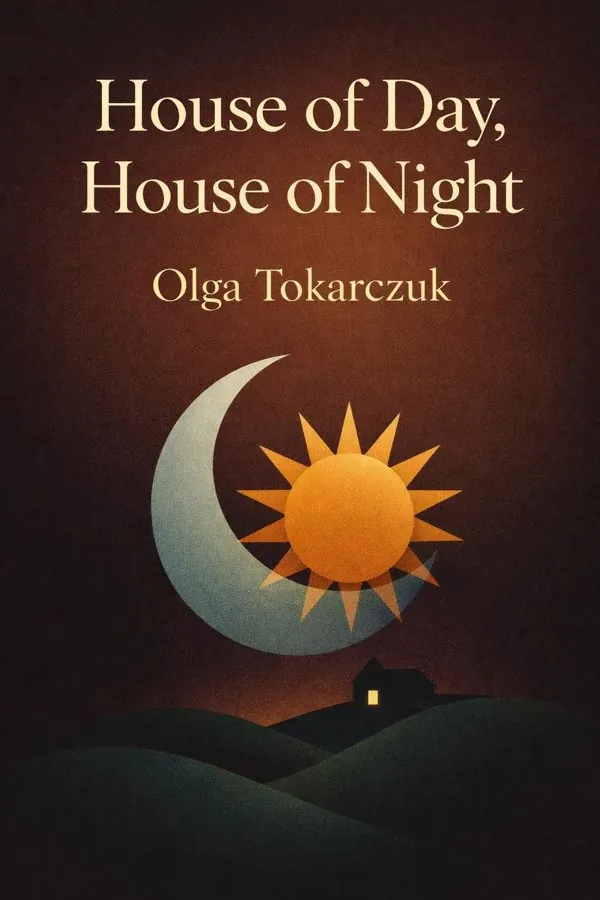
House of Day, House of Night: Summary & Key Insights
 10 min8 chaptersAudio available
Key Takeaways from House of Day, House of Night
A place is never only geography; it is also a storage vessel for memory.
Every human life contains more mystery than appearances suggest.
The sacred is never pure, and the profane is never empty.
People do not live by facts alone; they live by the stories that make facts bearable.
Nature in Tokarczuk’s fiction is never a passive backdrop; it is a presence with its own rhythms, intelligence, and moral force.
What Is House of Day, House of Night About?
House of Day, House of Night by Olga Tokarczuk is a classics book spanning 7 pages. House of Day, House of Night is one of Olga Tokarczuk’s most distinctive novels: a mosaic of stories, dreams, local legends, memories, and philosophical reflections set in a small town near the Polish-Czech border. Rather than following a conventional plot, the book unfolds as a living archive of voices and impressions, where ordinary neighbors, forgotten saints, animals, landscapes, and the dead all seem to share the same fragile world. Tokarczuk turns a borderland town into a spiritual map, showing how personal history, collective memory, and myth are woven together. What makes the book matter is its radical vision of reality. It suggests that life cannot be understood through facts alone; we also need symbols, stories, dreams, and intuition. In an age obsessed with speed and certainty, Tokarczuk offers a more patient and porous way of seeing. Her background in psychology deepens the novel’s sensitivity to inner life, while her literary imagination transforms everyday details into something sacred and mysterious. Awarded the Nobel Prize in Literature, Tokarczuk is celebrated for precisely this gift: revealing how the visible world is always haunted by hidden meanings.
This FizzRead summary covers all 8 key chapters of House of Day, House of Night in approximately 10 minutes, distilling the most important ideas, arguments, and takeaways from Olga Tokarczuk's work. Also available as an audio summary and Key Quotes Podcast.
House of Day, House of Night
House of Day, House of Night is one of Olga Tokarczuk’s most distinctive novels: a mosaic of stories, dreams, local legends, memories, and philosophical reflections set in a small town near the Polish-Czech border. Rather than following a conventional plot, the book unfolds as a living archive of voices and impressions, where ordinary neighbors, forgotten saints, animals, landscapes, and the dead all seem to share the same fragile world. Tokarczuk turns a borderland town into a spiritual map, showing how personal history, collective memory, and myth are woven together.
What makes the book matter is its radical vision of reality. It suggests that life cannot be understood through facts alone; we also need symbols, stories, dreams, and intuition. In an age obsessed with speed and certainty, Tokarczuk offers a more patient and porous way of seeing. Her background in psychology deepens the novel’s sensitivity to inner life, while her literary imagination transforms everyday details into something sacred and mysterious. Awarded the Nobel Prize in Literature, Tokarczuk is celebrated for precisely this gift: revealing how the visible world is always haunted by hidden meanings.
Who Should Read House of Day, House of Night?
This book is perfect for anyone interested in classics and looking to gain actionable insights in a short read. Whether you're a student, professional, or lifelong learner, the key ideas from House of Day, House of Night by Olga Tokarczuk will help you think differently.
- ✓Readers who enjoy classics and want practical takeaways
- ✓Professionals looking to apply new ideas to their work and life
- ✓Anyone who wants the core insights of House of Day, House of Night in just 10 minutes
Want the full summary?
Get instant access to this book summary and 100K+ more with Fizz Moment.
Get Free SummaryAvailable on App Store • Free to download
Key Chapters
A place is never only geography; it is also a storage vessel for memory. In House of Day, House of Night, the town of Nowa Ruda is not merely a setting but a living participant in the novel. Situated in the Kłodzko Valley on the Polish-Czech border, it carries layers of Polish, Czech, and German history. The land remembers political shifts, vanished communities, inherited trauma, and the ordinary repetitions of domestic life. Tokarczuk shows that a town can hold what people forget, preserving traces in architecture, habits, names, and silences.
This idea matters because modern life often treats places as interchangeable backdrops. Tokarczuk resists that flattening. She invites us to see streets, houses, gardens, and hills as bearers of human experience. In her telling, borderlands are especially rich because they expose the instability of identity. National belonging is not fixed; it is sedimented, contested, and haunted by what came before.
You can apply this insight by looking differently at your own environment. A train station may carry stories of migration. A neighborhood bakery may embody continuity across generations. Even a neglected building may preserve the emotional residue of those who lived there before. The novel encourages historical imagination: asking what happened here, who was erased, and what still lingers.
The practical value is profound. When we see place as memory, we become more attentive, humble, and rooted. We stop consuming landscapes and start reading them. Actionable takeaway: choose one familiar place this week and investigate its hidden past through observation, conversation, or research, treating it as a text rather than a backdrop.
Every human life contains more mystery than appearances suggest. One of Tokarczuk’s most beautiful achievements is her treatment of ordinary townspeople as figures of mythic significance. Neighbors are never just neighbors; they become guardians of stories, vessels of longing, and embodiments of half-hidden truths. Characters such as Marta are grounded in everyday routines, yet the narration grants them symbolic depth, as if sainthood and strangeness are always close to the surface of daily life.
This transforms the reader’s understanding of community. Rather than dividing life into the meaningful and the mundane, Tokarczuk reveals the sacred inside repetition: cooking, gossiping, tending gardens, grieving, aging, remembering. What appears insignificant becomes rich when attended to properly. In that sense, the novel democratizes wonder. Mystery is not reserved for exceptional heroes but distributed among ordinary people.
This perspective has practical application in how we relate to others. We often reduce people to functions: the cashier, the landlord, the retired neighbor, the difficult relative. Tokarczuk suggests that every person is an archive of stories we cannot fully see. A lonely woman may carry generations of family history. An eccentric neighbor may preserve local folklore. A seemingly trivial anecdote may reveal a worldview.
By reading everyday life mythically, we become more patient and less judgmental. We learn to listen for significance instead of waiting for spectacle. This does not mean romanticizing people; it means recognizing complexity beneath habit.
Actionable takeaway: in one conversation this week, ask someone about a memory, superstition, family custom, or local story. Treat that exchange as meaningful. You may discover that ordinary lives become extraordinary when truly heard.
The sacred is never pure, and the profane is never empty. In the sections involving the convent, Tokarczuk explores one of the novel’s central tensions: the uneasy coexistence of spiritual aspiration and bodily reality. Religious institutions are not portrayed as simple vessels of holiness. Instead, they are inhabited by desire, fear, discipline, secrecy, ritual, and power. The convent becomes a place where transcendence and human limitation constantly collide.
This complexity is essential to Tokarczuk’s worldview. She refuses easy oppositions between spirit and body, holiness and corruption, devotion and repression. The spiritual life is shown as deeply human, shaped by flesh, emotion, and social structures. Rather than exposing religion cynically or praising it sentimentally, she presents it as one of the many systems through which people try to give form to mystery.
The broader lesson is that institutions often contain both wisdom and contradiction. Whether we are dealing with religion, family, academia, or politics, systems built to preserve values also generate distortions. Tokarczuk’s insight helps readers examine their own inherited frameworks with honesty. We can honor the longing for meaning while also noticing the ways authority, shame, or rigidity can distort it.
In practical terms, this encourages more mature reflection on beliefs and traditions. Instead of accepting or rejecting them wholesale, we can ask: what human need does this practice serve? Where does it nourish life, and where does it deny it? That approach creates room for nuance rather than dogma.
Actionable takeaway: identify one tradition or institution in your life that you usually see in black-and-white terms. Write down one way it offers meaning and one way it limits freedom. Hold both truths together before deciding what to keep.
People do not live by facts alone; they live by the stories that make facts bearable. House of Day, House of Night is saturated with legends, visions, hearsay, saints’ lives, and local tales. These are not decorative additions to reality but active forces that shape how people interpret births, deaths, illnesses, landscapes, and coincidence. Tokarczuk shows that legend is not opposed to truth. It is another way communities organize what would otherwise feel chaotic or mute.
In the novel, the miraculous does not erupt as a dramatic break from reality. Instead, it seeps into ordinary life. A story passed from one person to another changes the emotional atmosphere of a place. A remembered tale turns a hill, church, or house into a site of significance. The result is a world where myth and daily experience constantly illuminate each other.
This idea is useful because contemporary culture often demands literal proof for everything that matters. Yet people still rely on narratives to understand suffering, love, luck, memory, and identity. Family stories shape self-image. National myths shape politics. Personal narratives shape resilience. Tokarczuk invites readers to become conscious of the stories governing their own perceptions.
A practical example: if a family repeatedly tells the story that it survives hardship through humor, that legend influences future behavior. If a town celebrates itself as industrious or cursed, people may unconsciously inhabit that script. The key is not to stop telling stories, but to examine which ones enlarge life and which ones trap it.
Actionable takeaway: write down one recurring story your family, workplace, or community tells about itself. Ask whether that story opens possibilities or limits them. If needed, begin crafting a better one.
Nature in Tokarczuk’s fiction is never a passive backdrop; it is a presence with its own rhythms, intelligence, and moral force. In House of Day, House of Night, animals, seasons, weather, plants, and the terrain of the borderland are woven into human consciousness. The natural world does not simply surround the characters; it influences memory, mood, ritual, and perception. Human life appears smaller, more fragile, and more interconnected when seen against these cycles.
This matters because the novel challenges the illusion that humans stand apart from nature. Tokarczuk consistently suggests that our categories, schedules, and ambitions are temporary arrangements inside a much larger web of life. The hills and forests outlast political systems. Seasonal changes reshape the emotional landscape of the town. Animals and plants carry meanings that human language only partly captures.
For readers, this can become a corrective to modern alienation. Many people live according to screens, deadlines, and artificial environments, losing touch with embodied time. Tokarczuk’s attention to nature restores sensitivity to slowness, recurrence, and interdependence. This is not vague pastoral nostalgia; it is a reminder that mental and spiritual life are affected by ecological awareness.
A practical application is simple but powerful. Notice how weather changes your thoughts. Pay attention to recurring seasonal rituals in your household. Observe how a garden, park, or even a single tree structures memory over time. Such practices reconnect abstract life to lived reality.
Actionable takeaway: establish one small ritual of ecological attention this week—walk the same route at the same time for several days, noting changes in light, sound, temperature, and growth. Let the natural world become a conversation rather than scenery.
Time is rarely as linear as clocks pretend. One of the most distinctive qualities of House of Day, House of Night is its dreamlike structure, where memory, fantasy, anecdote, history, and present observation flow into one another. Dreams are not presented as escapist interruptions but as valid forms of knowledge. They reveal emotional truths, submerged fears, and hidden continuities between the living and the dead, the past and the present.
Tokarczuk undermines the modern obsession with chronological order. Human experience does not unfold neatly. A smell can summon childhood. A rumor can revive the dead. A dream can expose what waking reason suppresses. By embracing this fluidity, the novel reflects the actual texture of consciousness more faithfully than a purely linear narrative could.
This insight helps readers rethink their own relationship to memory and identity. We often tell our lives as organized stories with causes and outcomes, but lived reality is more fragmented. Unexpected associations shape us. Unfinished experiences continue acting in the present. Dreams and intuitions may point toward unresolved tensions we need to face.
Practically speaking, this does not require mystical belief. It means respecting non-linear forms of understanding. Journaling, dream notes, and reflective pauses can reveal patterns that rational planning misses. For example, recurring dreams during stress may point to needs for rest, grief, or change. A memory triggered repeatedly may signal unfinished emotional work.
Tokarczuk’s lesson is that meaning often arrives sideways. We do not always think our way into truth; sometimes we must notice what returns.
Actionable takeaway: keep a notebook by your bed for one week and record dreams, fragments, or morning feelings. At the end of the week, look for repeated images or emotions. Treat them as clues, not noise.
Identity becomes most visible where its edges blur. By placing the novel in a Polish-Czech border region marked by German absence and historical displacement, Tokarczuk explores belonging as something layered rather than singular. People inherit languages, customs, myths, and silences that do not align neatly. A borderland exposes the fiction of purity. Every culture carries mixtures, borrowings, losses, and unresolved ghosts.
This is one of the book’s major intellectual contributions. Tokarczuk treats geography as a philosophical condition. To live near a border is to become aware that categories like nation, home, origin, and self are unstable. That instability can produce anxiety, but it can also generate openness. The border is not only a line of division; it is a space of contact, translation, and hybrid imagination.
In today’s world, this feels especially relevant. Many people live with multiple affiliations: linguistic, ethnic, regional, professional, digital, familial. Yet public discourse often pressures them to simplify who they are. Tokarczuk offers a counter-model in which complexity is not a problem to solve but a truth to inhabit.
A practical application is to examine where your own sense of self has been shaped by crossings. Perhaps your family migrated. Perhaps your class background differs from your current environment. Perhaps your inner life is divided between inherited faith and modern skepticism. Recognizing these borders can make you less defensive and more articulate.
The novel ultimately proposes that identity is strongest not when it is pure, but when it is conscious of its layers.
Actionable takeaway: map three influences that shaped who you are from different worlds—such as family, region, education, religion, or migration. Notice how your identity is formed at crossings, not just within categories.
All Chapters in House of Day, House of Night
About the Author
Olga Tokarczuk is a Polish novelist, essayist, and public intellectual widely regarded as one of the most important writers of contemporary world literature. Born in 1962, she studied psychology at the University of Warsaw and later worked as a therapist, an experience that sharpened her insight into memory, dreams, and the hidden layers of human behavior. Her fiction is known for blending mythology, history, spirituality, ecology, and philosophical inquiry in innovative narrative forms. Tokarczuk received the Nobel Prize in Literature for her imaginative scope and her ability to cross boundaries between cultures, genres, and perspectives. Her notable works include Flights, Drive Your Plow Over the Bones of the Dead, Primeval and Other Times, and The Books of Jacob. Across her writing, she consistently explores movement, interconnectedness, and the mystery embedded in ordinary life.
Get This Summary in Your Preferred Format
Read or listen to the House of Day, House of Night summary by Olga Tokarczuk anytime, anywhere. FizzRead offers multiple formats so you can learn on your terms — all free.
Available formats: App · Audio · PDF · EPUB — All included free with FizzRead
Download House of Day, House of Night PDF and EPUB Summary
Key Quotes from House of Day, House of Night
“A place is never only geography; it is also a storage vessel for memory.”
“Every human life contains more mystery than appearances suggest.”
“The sacred is never pure, and the profane is never empty.”
“People do not live by facts alone; they live by the stories that make facts bearable.”
“Nature in Tokarczuk’s fiction is never a passive backdrop; it is a presence with its own rhythms, intelligence, and moral force.”
Frequently Asked Questions about House of Day, House of Night
House of Day, House of Night by Olga Tokarczuk is a classics book that explores key ideas across 8 chapters. House of Day, House of Night is one of Olga Tokarczuk’s most distinctive novels: a mosaic of stories, dreams, local legends, memories, and philosophical reflections set in a small town near the Polish-Czech border. Rather than following a conventional plot, the book unfolds as a living archive of voices and impressions, where ordinary neighbors, forgotten saints, animals, landscapes, and the dead all seem to share the same fragile world. Tokarczuk turns a borderland town into a spiritual map, showing how personal history, collective memory, and myth are woven together. What makes the book matter is its radical vision of reality. It suggests that life cannot be understood through facts alone; we also need symbols, stories, dreams, and intuition. In an age obsessed with speed and certainty, Tokarczuk offers a more patient and porous way of seeing. Her background in psychology deepens the novel’s sensitivity to inner life, while her literary imagination transforms everyday details into something sacred and mysterious. Awarded the Nobel Prize in Literature, Tokarczuk is celebrated for precisely this gift: revealing how the visible world is always haunted by hidden meanings.
More by Olga Tokarczuk



You Might Also Like

Browse by Category
Ready to read House of Day, House of Night?
Get the full summary and 100K+ more books with Fizz Moment.