
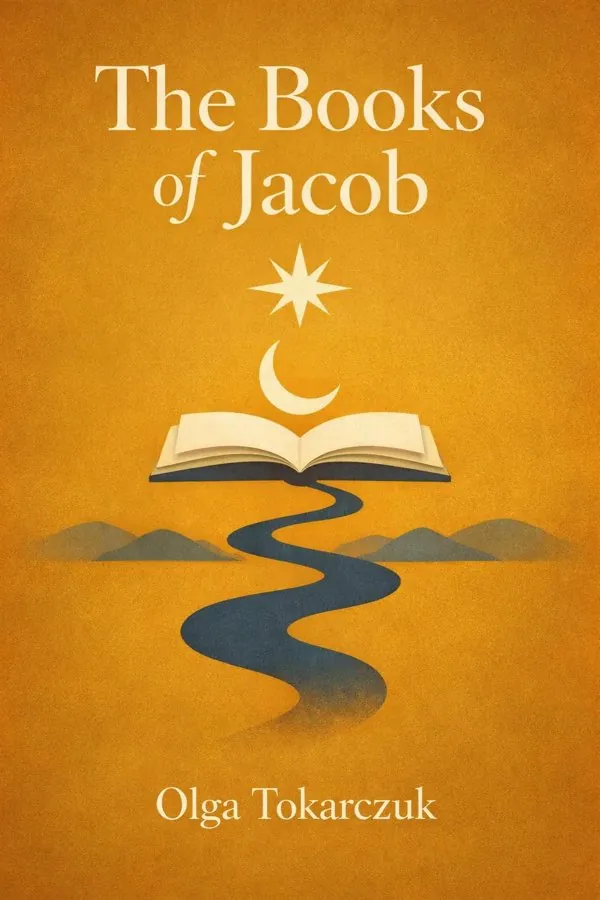
The Books of Jacob: Summary & Key Insights
 10 min9 chaptersAudio available
Key Takeaways from The Books of Jacob
Before Jacob Frank becomes the center of the story, Tokarczuk asks us to understand the unstable world that makes his rise possible.
Power often begins not with facts but with atmosphere, and Tokarczuk introduces Jacob Frank as a rumor before she presents him as a man.
Ideas rarely stay pure when they travel, and The Books of Jacob treats movement across borders as a force that changes theology itself.
Revolutionary movements often promise spiritual liberation while quietly reorganizing social power, and Tokarczuk captures that process with extraordinary precision.
Few acts appear more intimate than conversion, yet Tokarczuk shows that religious change is often entangled with politics, survival, and public performance.
What Is The Books of Jacob About?
The Books of Jacob by Olga Tokarczuk is a classics book spanning 8 pages. Olga Tokarczuk’s The Books of Jacob is not simply a historical novel; it is an immense literary reconstruction of a world in crisis. Set in the eighteenth-century Polish–Lithuanian Commonwealth and stretching across the Ottoman Empire and Habsburg lands, the book follows the rise of Jacob Frank, a charismatic and deeply controversial religious leader who gathered followers by promising spiritual renewal, social reversal, and freedom from inherited boundaries. Around him, Tokarczuk assembles a vast chorus of nobles, rabbis, priests, mystics, women, converts, skeptics, and wanderers, creating a portrait of Europe at the fault line between tradition and modernity. What makes this novel matter is its refusal to reduce history to heroes or villains. Instead, it examines how belief is formed, how communities fracture, and how marginalized people become vulnerable to grand promises. Tokarczuk, winner of the Nobel Prize in Literature, brings extraordinary authority to this task through her blend of archival depth, philosophical imagination, and narrative daring. The result is a demanding but unforgettable classic: a book about faith, power, identity, and the dangerous human longing to be transformed.
This FizzRead summary covers all 9 key chapters of The Books of Jacob in approximately 10 minutes, distilling the most important ideas, arguments, and takeaways from Olga Tokarczuk's work. Also available as an audio summary and Key Quotes Podcast.
The Books of Jacob
Olga Tokarczuk’s The Books of Jacob is not simply a historical novel; it is an immense literary reconstruction of a world in crisis. Set in the eighteenth-century Polish–Lithuanian Commonwealth and stretching across the Ottoman Empire and Habsburg lands, the book follows the rise of Jacob Frank, a charismatic and deeply controversial religious leader who gathered followers by promising spiritual renewal, social reversal, and freedom from inherited boundaries. Around him, Tokarczuk assembles a vast chorus of nobles, rabbis, priests, mystics, women, converts, skeptics, and wanderers, creating a portrait of Europe at the fault line between tradition and modernity.
What makes this novel matter is its refusal to reduce history to heroes or villains. Instead, it examines how belief is formed, how communities fracture, and how marginalized people become vulnerable to grand promises. Tokarczuk, winner of the Nobel Prize in Literature, brings extraordinary authority to this task through her blend of archival depth, philosophical imagination, and narrative daring. The result is a demanding but unforgettable classic: a book about faith, power, identity, and the dangerous human longing to be transformed.
Who Should Read The Books of Jacob?
This book is perfect for anyone interested in classics and looking to gain actionable insights in a short read. Whether you're a student, professional, or lifelong learner, the key ideas from The Books of Jacob by Olga Tokarczuk will help you think differently.
- ✓Readers who enjoy classics and want practical takeaways
- ✓Professionals looking to apply new ideas to their work and life
- ✓Anyone who wants the core insights of The Books of Jacob in just 10 minutes
Want the full summary?
Get instant access to this book summary and 100K+ more with Fizz Moment.
Get Free SummaryAvailable on App Store • Free to download
Key Chapters
Before Jacob Frank becomes the center of the story, Tokarczuk asks us to understand the unstable world that makes his rise possible. The eighteenth-century Polish–Lithuanian Commonwealth is shown as politically weakened, socially fragmented, and spiritually restless. Nobles defend their privileges, clerics fight over orthodoxy, peasants endure the weight of hierarchy, and Jewish communities live within a tense balance of autonomy and vulnerability. In such a landscape, old institutions still command obedience, yet they no longer inspire trust. That contradiction creates the novel’s true opening drama.
Tokarczuk’s achievement is to show that religious upheaval never appears in a vacuum. Jacob Frank’s movement emerges because the existing order has failed to satisfy many of the people living inside it. The Commonwealth becomes a laboratory of competing identities: Polish, Jewish, Ottoman, Catholic, Orthodox, and more. Borders are porous, but loyalties remain rigid. That tension generates both opportunity and danger.
A practical way to read this section is to see it as a case study in how social collapse invites charismatic solutions. When political systems seem exhausted and moral authorities lose legitimacy, people often become drawn to radical figures who claim to offer wholeness. That pattern is not limited to eighteenth-century Europe; it recurs in modern politics, religion, and even corporate culture.
Tokarczuk also reminds us that historical complexity matters. Communities are not monoliths, and crisis does not affect everyone in the same way. Some experience breakdown as terror, others as liberation. By mapping that complexity, she prepares us to see Jacob Frank neither as an isolated fraud nor as a miraculous exception, but as a product of a wider unraveling.
Actionable takeaway: when trying to understand any disruptive leader or movement, begin by studying the conditions that made people ready to believe.
Power often begins not with facts but with atmosphere, and Tokarczuk introduces Jacob Frank as a rumor before she presents him as a man. This is one of the novel’s sharpest insights: charisma is frequently built in advance through stories, whispers, projections, and the desires of others. By the time Frank fully appears, he already carries the charge of mystery. He is trader, traveler, outsider, initiate, and possible fraud all at once. His ambiguity is not a weakness; it is the source of his force.
Frank’s background matters because he belongs nowhere neatly. He moves through Ottoman lands, absorbs multiple traditions, and returns marked by distance. That position lets him speak to people dissatisfied with inherited categories. He can present himself as one who has seen beyond conventional limits. Tokarczuk understands that such figures become compelling precisely because they seem to stand both inside and outside the social order.
This has clear relevance beyond the novel. In many fields, from religion to business to media, influential personalities gain followers by appearing difficult to classify. Their appeal rests on the suggestion that they possess hidden knowledge unavailable to ordinary institutions. The less stable the surrounding environment, the more powerful that suggestion becomes.
Tokarczuk does not ask readers simply to admire or condemn Frank. Instead, she asks us to study the mechanics of attraction. Why do people find uncertainty magnetic when it is wrapped in confidence? Why do contradictions sometimes increase a leader’s appeal instead of weakening it? Frank can seem visionary to one observer and manipulator to another, and the novel insists that both perceptions may coexist.
Actionable takeaway: when someone’s influence seems to rest on mystery, pause and separate what is known from what followers desperately want to be true.
Ideas rarely stay pure when they travel, and The Books of Jacob treats movement across borders as a force that changes theology itself. Frank’s time in Ottoman territories is not a decorative subplot; it is central to the formation of his syncretic imagination. In these regions, religious life appears more visibly plural, with Islam, Judaism, Christianity, and heterodox practices existing in uneasy proximity. Exposure to this world expands Frank’s repertoire of symbols and gives him the language of crossing boundaries.
Tokarczuk uses this journey to challenge the fantasy that belief systems develop in isolation. Frankism emerges from contact, borrowing, translation, and deliberate transgression. Mystical Jewish currents, messianic expectation, antinomian impulses, and the performative aspects of conversion all mix together. Frank’s authority partly comes from turning complexity into revelation. He does not simply repeat inherited doctrine; he rearranges fragments from different worlds into a new promise.
This matters because syncretism often appears whenever people live at crossroads. Modern readers can recognize the pattern in hybrid spiritual movements, self-help cultures that combine science and mysticism, or political identities built from multiple traditions. Cross-cultural exchange can create genuine insight, but it can also produce unstable systems held together more by charisma than coherence.
Tokarczuk is especially attentive to the ethical risk of selective borrowing. Frank transforms traditions, but he also instrumentalizes them. He treats spiritual forms as materials that can be recombined to support his own exceptional status. Readers are invited to ask not only whether a belief is new, but who benefits from its novelty.
Actionable takeaway: when encountering a movement that blends traditions, look closely at whether it fosters deeper understanding or merely repackages difference to increase one person’s authority.
Revolutionary movements often promise spiritual liberation while quietly reorganizing social power, and Tokarczuk captures that process with extraordinary precision. As Frankism takes shape, it attracts those who feel constrained by existing religious and communal structures. Some followers are drawn by messianic hope, some by dissatisfaction with rabbinic authority, some by the thrill of secrecy, and others by a deeper longing to escape humiliation, exclusion, or inherited roles. The movement offers not just doctrine, but emotional reclassification: you are no longer marginal, it says; you are chosen.
This is why the Frankist community becomes so compelling in the novel. It creates belonging through rupture. To join is to participate in a drama of reversal, where what was once forbidden becomes a sign of higher truth and where outsiders can imagine themselves at the center of history. Tokarczuk shows how dangerous and seductive such inversions can be. They generate enormous loyalty because they do more than persuade the mind; they remake identity.
Practical examples of this dynamic are easy to spot in contemporary life. Groups that define themselves against an establishment often gain strength by offering members a narrative of hidden superiority. Whether in political subcultures, extremist communities, or intense ideological networks, people may accept contradiction if the group gives them meaning and status.
Tokarczuk also emphasizes that a movement does not spread through abstract ideas alone. It spreads through meals, conversations, rituals, patronage, travel, and personal ties. Networks matter as much as doctrine. The novel’s social detail reveals how belief becomes organized and how organization hardens belief.
Actionable takeaway: when evaluating any movement, ask not only what it teaches, but what emotional rewards and social identities it offers to those who join.
Few acts appear more intimate than conversion, yet Tokarczuk shows that religious change is often entangled with politics, survival, and public performance. In The Books of Jacob, the movement’s interactions with Catholic authorities culminate in conversions that are spiritually charged, socially explosive, and deeply strategic. For some, conversion appears to promise safety, upward mobility, or recognition from the dominant order. For others, it is a scandal or betrayal. For Frank himself, it becomes an opportunity to transform marginality into leverage.
The novel refuses simplistic definitions of sincerity. A person can convert out of conviction, coercion, fear, ambition, longing, confusion, or several of these at once. Tokarczuk captures this ambiguity with unusual generosity. She understands that when power is unequal, inner motives become difficult to isolate from external pressures. Conversion is never merely private in such a context; it is watched, interpreted, and weaponized by institutions.
This idea remains useful today. People still perform versions of conversion in nonreligious settings: they adopt new ideological languages, professional identities, or cultural affiliations to gain access, protection, or legitimacy. Public declarations may contain both real transformation and strategic calculation. Tokarczuk asks us to resist the urge to label them as purely authentic or purely false.
At the same time, the book warns that theatrical transformation can become addictive. Once identity becomes a public spectacle, leaders may escalate symbolic acts to retain attention and control. Frank thrives in this space, where crossing boundaries keeps followers and opponents equally fascinated.
Actionable takeaway: when someone undergoes a dramatic public transformation, examine the surrounding power structures before deciding what the change truly means.
No movement survives on revelation alone. One of Tokarczuk’s most penetrating themes is that spirituality requires material infrastructure: patrons, hosts, money, legal protection, social access, and symbolic endorsement. As Frank’s influence grows, he enters a world of noble households, clerical interests, and political calculations. His message may sound transcendent, but its continuation depends on very worldly arrangements.
This does not make the movement less real; it makes it more historically credible. Tokarczuk shows that ideas become durable when they attach themselves to institutions and benefactors. Patronage offers visibility, legitimacy, and shelter. It also imposes subtle obligations. A charismatic leader who appears free may, in fact, be sustained by elites who see him as useful. The novel demonstrates how spiritual rebellion can become entangled with status games and factional advantage.
Readers can apply this insight widely. Cultural trends, activist causes, religious organizations, and intellectual fashions all rely on resources. Asking who funds, hosts, promotes, and protects a movement often reveals as much as analyzing its official beliefs. Power frequently hides in logistics.
Tokarczuk is especially good at exposing the inner corrosion that follows success. As Frank gains patrons and influence, the original energy of rupture becomes harder to maintain. Hierarchy reappears inside the anti-hierarchical movement. Dependence grows. Performance intensifies. The closer the movement gets to worldly power, the more it risks becoming what it once opposed.
This is one of the novel’s bleakest and most realistic lessons: access can stabilize a vision, but it can also hollow it out. Movements that claim purity are often transformed first by the systems that sustain them.
Actionable takeaway: whenever a bold movement claims independence, trace its material support and ask how those dependencies shape its message.
When powerful figures fall, their stories often become even more potent. Tokarczuk presents Frank’s imprisonment, decline, and eventual diminishment not as a neat conclusion, but as a transformation of his influence. Confinement reduces his physical reach, yet myth thrives in restriction. Followers reinterpret setbacks as signs, enemies magnify his legend through denunciation, and the distance between the man and his image grows wider. Defeat becomes narratively useful.
This is a crucial insight into charismatic power. A leader’s authority does not depend only on success; it can also feed on persecution, exile, and suffering. Once a movement has built a symbolic framework strong enough to explain every reversal, external defeat may deepen internal belief. Tokarczuk shows how stories protect devotion by converting contradiction into confirmation.
We see modern versions of this dynamic whenever fallen public figures recast accountability as martyrdom, or when communities interpret criticism as proof that they possess dangerous truth. Such reactions are not irrational accidents. They are often built into the movement’s structure from the beginning. If a group teaches that the world will reject the elect, rejection becomes spiritually profitable.
At the same time, the novel does not romanticize decline. It tracks fatigue, disappointment, dependence, and erosion. Real bodies age; financial networks fray; promises become harder to sustain. Myth persists, but it often does so at the cost of reality. The person at the center becomes trapped inside the story he helped create.
Actionable takeaway: when a movement treats every setback as proof of its righteousness, examine whether its belief system has become immune to evidence.
Perhaps the novel’s broadest claim is that identity is less stable than institutions would like us to believe. Across borders, languages, faiths, and generations, Tokarczuk depicts people in continuous transformation. Jews become converts; heretics become symbols; outsiders become courted guests; believers become skeptics; memories become rewritten inheritances. The book resists any comfortable idea that communities remain pure, closed, or unchanged over time.
This fluidity is not presented as simple liberation. It can be exhilarating, but it is also disorienting and dangerous. To cross boundaries may open new possibilities, yet it can also produce profound loss. The novel’s world is full of people who are remade by history without fully choosing their new form. Tokarczuk therefore treats identity as both creation and wound.
Readers can apply this insight to their own lives and societies. Modern debates about religion, nation, culture, and belonging often assume that identities have clear edges. The Books of Jacob suggests the opposite: identities are negotiated, layered, and historically produced. Recognizing that complexity can make us more thoughtful about migration, assimilation, ideological change, and intergenerational conflict.
Tokarczuk also links identity to narrative. We become who we are partly through the stories communities tell about us. Frank understands this and exploits it. But the novel offers a more humane alternative: stories can also enlarge our sense of human possibility by showing how incomplete every fixed label really is.
Actionable takeaway: treat identity less as a permanent essence and more as a historical process shaped by memory, power, and contact with others.
All Chapters in The Books of Jacob
About the Author
Olga Tokarczuk is a Polish novelist, essayist, and trained psychologist widely regarded as one of the most important literary voices of her generation. Born in 1962, she first worked in psychology before turning fully to writing, a background that helped shape her deep interest in memory, identity, myth, and the hidden motives behind human behavior. Her fiction is known for its intellectual range, formal experimentation, and ability to connect intimate lives to vast historical and philosophical questions. Tokarczuk won the 2018 Nobel Prize in Literature and is also a two-time recipient of Poland’s Nike Literary Award. Her major works include Flights, Drive Your Plow Over the Bones of the Dead, and The Books of Jacob, all of which reflect her distinctive blend of narrative imagination and moral inquiry.
Get This Summary in Your Preferred Format
Read or listen to the The Books of Jacob summary by Olga Tokarczuk anytime, anywhere. FizzRead offers multiple formats so you can learn on your terms — all free.
Available formats: App · Audio · PDF · EPUB — All included free with FizzRead
Download The Books of Jacob PDF and EPUB Summary
Key Quotes from The Books of Jacob
“Before Jacob Frank becomes the center of the story, Tokarczuk asks us to understand the unstable world that makes his rise possible.”
“Power often begins not with facts but with atmosphere, and Tokarczuk introduces Jacob Frank as a rumor before she presents him as a man.”
“Ideas rarely stay pure when they travel, and The Books of Jacob treats movement across borders as a force that changes theology itself.”
“Revolutionary movements often promise spiritual liberation while quietly reorganizing social power, and Tokarczuk captures that process with extraordinary precision.”
“Few acts appear more intimate than conversion, yet Tokarczuk shows that religious change is often entangled with politics, survival, and public performance.”
Frequently Asked Questions about The Books of Jacob
The Books of Jacob by Olga Tokarczuk is a classics book that explores key ideas across 9 chapters. Olga Tokarczuk’s The Books of Jacob is not simply a historical novel; it is an immense literary reconstruction of a world in crisis. Set in the eighteenth-century Polish–Lithuanian Commonwealth and stretching across the Ottoman Empire and Habsburg lands, the book follows the rise of Jacob Frank, a charismatic and deeply controversial religious leader who gathered followers by promising spiritual renewal, social reversal, and freedom from inherited boundaries. Around him, Tokarczuk assembles a vast chorus of nobles, rabbis, priests, mystics, women, converts, skeptics, and wanderers, creating a portrait of Europe at the fault line between tradition and modernity. What makes this novel matter is its refusal to reduce history to heroes or villains. Instead, it examines how belief is formed, how communities fracture, and how marginalized people become vulnerable to grand promises. Tokarczuk, winner of the Nobel Prize in Literature, brings extraordinary authority to this task through her blend of archival depth, philosophical imagination, and narrative daring. The result is a demanding but unforgettable classic: a book about faith, power, identity, and the dangerous human longing to be transformed.
More by Olga Tokarczuk


You Might Also Like

Browse by Category
Ready to read The Books of Jacob?
Get the full summary and 100K+ more books with Fizz Moment.