
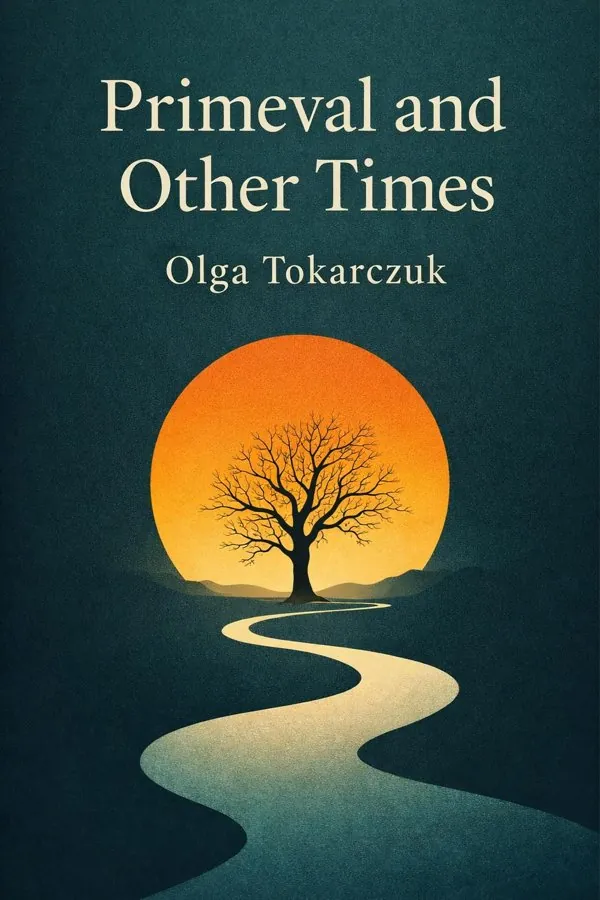
Primeval and Other Times: Summary & Key Insights
 10 min9 chaptersAudio available
Key Takeaways from Primeval and Other Times
A place becomes unforgettable when it means more than its geography.
The most powerful way to understand history is often through the people forced to live through it.
No place is so protected that history cannot reach it.
What disappears physically can continue to exist through memory.
We often imagine time as a straight line, but lived experience rarely feels that simple.
What Is Primeval and Other Times About?
Primeval and Other Times by Olga Tokarczuk is a classics book spanning 4 pages. Some novels describe a place; Olga Tokarczuk creates one so completely that it begins to feel older than history itself. Primeval and Other Times unfolds in the fictional Polish village of Primeval, a small settlement imagined as the spiritual center of the world. Across the twentieth century, Tokarczuk follows generations of villagers as they endure war, love, hunger, faith, boredom, loss, and change. Yet this is far more than a family chronicle or a rural novel. It is a meditation on time itself: cyclical rather than linear, intimate rather than abstract, sacred even in ordinary life. What makes the book enduring is its ability to hold opposites together. The everyday coexists with myth, angels watch over fields and roads, and private suffering mirrors the larger movements of history. Tokarczuk, winner of the Nobel Prize in Literature, brings the insight of a psychologist and the imagination of a mythmaker to every page. Her authority lies not in offering simple answers, but in showing how human lives are shaped by memory, landscape, and forces beyond reason. Primeval and Other Times matters because it turns one village into a map of the human condition.
This FizzRead summary covers all 9 key chapters of Primeval and Other Times in approximately 10 minutes, distilling the most important ideas, arguments, and takeaways from Olga Tokarczuk's work. Also available as an audio summary and Key Quotes Podcast.
Primeval and Other Times
Some novels describe a place; Olga Tokarczuk creates one so completely that it begins to feel older than history itself. Primeval and Other Times unfolds in the fictional Polish village of Primeval, a small settlement imagined as the spiritual center of the world. Across the twentieth century, Tokarczuk follows generations of villagers as they endure war, love, hunger, faith, boredom, loss, and change. Yet this is far more than a family chronicle or a rural novel. It is a meditation on time itself: cyclical rather than linear, intimate rather than abstract, sacred even in ordinary life.
What makes the book enduring is its ability to hold opposites together. The everyday coexists with myth, angels watch over fields and roads, and private suffering mirrors the larger movements of history. Tokarczuk, winner of the Nobel Prize in Literature, brings the insight of a psychologist and the imagination of a mythmaker to every page. Her authority lies not in offering simple answers, but in showing how human lives are shaped by memory, landscape, and forces beyond reason. Primeval and Other Times matters because it turns one village into a map of the human condition.
Who Should Read Primeval and Other Times?
This book is perfect for anyone interested in classics and looking to gain actionable insights in a short read. Whether you're a student, professional, or lifelong learner, the key ideas from Primeval and Other Times by Olga Tokarczuk will help you think differently.
- ✓Readers who enjoy classics and want practical takeaways
- ✓Professionals looking to apply new ideas to their work and life
- ✓Anyone who wants the core insights of Primeval and Other Times in just 10 minutes
Want the full summary?
Get instant access to this book summary and 100K+ more with Fizz Moment.
Get Free SummaryAvailable on App Store • Free to download
Key Chapters
A place becomes unforgettable when it means more than its geography. In Primeval and Other Times, the village of Primeval is not just a rural settlement in Poland; it is a symbolic world, a center where earthly life and cosmic order intersect. Tokarczuk builds the village as though she were retelling creation itself. Primeval is bounded by rivers, forests, roads, and invisible presences, giving it the structure of a myth rather than a mere map. It is watched over by archangels, rooted in local detail, and yet strangely universal.
This mythic geography matters because it changes how we read every event that follows. A marriage, a harvest, a death, or a war is never merely personal. Everything that happens in Primeval echoes something larger: the fall from innocence, the fragility of order, the persistence of renewal. Tokarczuk suggests that human beings do not live in neutral spaces. We create meaningful worlds through stories, rituals, names, and memory. A village is never only a location; it is a way of understanding existence.
This idea has practical resonance beyond literature. People still mythologize their own places: a childhood home becomes sacred, a town square becomes the site of shared identity, a family farm becomes the symbol of continuity. We all organize our lives around emotional geographies. Reflecting on this can deepen our sense of belonging and reveal why certain places feel charged with significance.
Actionable takeaway: Identify one place in your life that feels larger than itself, and ask what story, memory, or belief has made it meaningful.
The most powerful way to understand history is often through the people forced to live through it. At the center of Primeval and Other Times stand Michał and Genowefa Niebieski, whose lives provide continuity in a world repeatedly broken by change. They are not heroic in a grand, conventional sense. Instead, they embody endurance. Through work, marriage, parenthood, disappointment, and aging, they become the human thread that ties the village’s scattered episodes into a lived reality.
Michał carries a quiet solidity, while Genowefa often appears more emotionally attuned to the rhythms of domestic and spiritual life. Together, they show how history enters ordinary households. Political upheavals are experienced not as abstract events, but as altered routines, strained resources, private griefs, and changes in what a family can hope for. Tokarczuk pays close attention to the small acts that hold a life together: preparing food, tending land, raising children, waiting for someone to return.
Their story reveals that continuity is not the absence of disruption, but the ability to keep meaning alive despite it. In practical terms, this is how many people experience their own lives. Family routines, inherited habits, and shared stories become stabilizing forces during uncertain times. Whether facing economic upheaval, migration, illness, or social transformation, people survive by preserving some sense of relational order.
Tokarczuk also resists idealizing family life. Love is mixed with duty, misunderstanding, fatigue, and compromise. Yet this realism makes the bond more convincing. The Niebieskis matter because they show that ordinary devotion is one of the deepest forms of resistance.
Actionable takeaway: Consider which relationships in your life provide continuity, and invest in one small ritual that helps preserve that bond over time.
No place is so protected that history cannot reach it. One of the novel’s central insights is that even a village imagined as the center of the world cannot remain untouched by modernity and war. Primeval may have mythic borders and spiritual guardians, but the twentieth century still arrives with violence, occupation, bureaucracy, displacement, and moral confusion. Tokarczuk shows how large historical forces infiltrate the smallest corners of life.
The world wars do not appear merely as dates or political summaries. They are felt through absence, fear, damaged land, hunger, and the collapse of familiar assumptions. Modernity, too, is not represented as simple progress. Alongside new systems and possibilities come disconnection, acceleration, and the weakening of older communal structures. The village changes not only materially but spiritually. People lose inherited certainties even as they gain new forms of knowledge or mobility.
What makes this portrayal so compelling is its refusal of simplistic nostalgia. Tokarczuk does not suggest that the past was pure and modern life corrupted it completely. Rather, she shows that every era contains both promise and loss. This is a useful lens for contemporary readers. We often discuss technological or social change in extremes, either celebrating innovation or mourning decline. Primeval invites a more nuanced view: change always redistributes power, attention, and meaning.
In everyday life, we see similar tensions when communities confront globalization, digital technology, urbanization, or political instability. The question is not whether change can be stopped, but how people preserve dignity and memory while adapting.
Actionable takeaway: When facing a major change in your own life, ask not only what is being gained, but also what valuable forms of connection or meaning need to be consciously protected.
What disappears physically can continue to exist through memory. As Primeval changes and declines, Tokarczuk turns toward one of the novel’s deepest concerns: the endurance of remembrance. Houses decay, generations die, customs fade, and the village loses some of its old coherence. Yet memory refuses to vanish neatly. It survives in stories, objects, habits, dreams, and the emotional residue of lived experience.
Tokarczuk presents memory as neither fully reliable nor purely sentimental. It is unstable, selective, and often painful. But this very imperfection gives it truth. Human beings do not preserve the past like archivists; they carry it unevenly, through fragments. A smell recalls a childhood room. A phrase repeats what a grandparent used to say. A landscape still bears the shape of events no longer visible. In Primeval, memory becomes a second form of habitation. People continue living in places that no longer exist exactly as they were.
This insight matters because modern culture often treats value as dependent on visibility or utility. If a place has changed, if a person has died, if a tradition is no longer practiced, we may assume it has been lost. Tokarczuk argues otherwise. The past remains active in the present, shaping identity and perception. In practical terms, this helps explain why family history, regional culture, and personal recollection still influence choices long after circumstances have shifted.
Readers can apply this by paying attention to the memories embedded in everyday life. Family recipes, inherited objects, recurring sayings, and repeated routes all contain hidden continuity. Remembering is not passive nostalgia; it is a way of resisting erasure.
Actionable takeaway: Preserve one meaningful memory this week by writing it down, telling it to someone else, or connecting it to a physical object that keeps it alive.
We often imagine time as a straight line, but lived experience rarely feels that simple. One of Tokarczuk’s most striking artistic choices is to portray time as layered, circular, and recursive. In Primeval and Other Times, events unfold across decades, yet the rhythm of the novel resists a purely chronological march. Seasons return, family patterns repeat, desires reappear in new forms, and old griefs echo through later generations.
This cyclical sense of time allows Tokarczuk to challenge the modern belief that history always moves forward toward improvement. Primeval suggests that while circumstances change, many human experiences remain constant: longing, fear, faith, pride, tenderness, envy, wonder. Individuals are unique, yet they inhabit recurring emotional structures. This does not make life meaningless. On the contrary, it gives ordinary existence a mythic dignity. To suffer, hope, age, and remember is to participate in patterns older than oneself.
This perspective can be surprisingly practical. Many people become discouraged when they find themselves repeating struggles they thought they had outgrown: family tensions, self-doubt, grief, relationship dynamics. Tokarczuk’s vision reminds us that repetition is part of being human. Growth does not always mean escape from old patterns; sometimes it means meeting them with greater awareness.
The cyclical model of time also encourages patience. Rural life in the novel is shaped by weather, harvest, and natural recurrence rather than constant productivity. Contemporary readers, caught in calendars and deadlines, may find this especially meaningful. There are forms of wisdom that emerge only through recurrence.
Actionable takeaway: Notice one recurring pattern in your life, and instead of judging it immediately, ask what it is trying to teach you about your values, fears, or unfinished questions.
The extraordinary does not always arrive dramatically; sometimes it is hidden in daily life. A defining quality of Primeval and Other Times is its seamless blending of realism with myth, spirituality, and the uncanny. Angels observe the village, symbolic forces hover over events, and ordinary actions seem connected to invisible meanings. Yet Tokarczuk never turns the novel into pure fantasy. The supernatural elements deepen reality rather than replace it.
This mixture suggests that the world is richer than rational explanation alone can capture. The sacred may be present in fields, kitchens, births, deaths, silences, and repetitive labor. Tokarczuk treats spiritual imagination not as escapism, but as a language for understanding experiences that exceed logic: awe, destiny, grief, coincidence, intuition, and mystery. In this way, the novel challenges modern habits of disenchantment.
The practical relevance of this idea is broad. Even readers who are not religious may recognize that some moments feel charged beyond their visible surface: returning to a childhood place, sitting beside a dying relative, witnessing the first snow after loss, sensing the emotional weight of a family ritual. Such experiences remind us that meaning is not exhausted by facts. Symbolic thinking can help us process what ordinary language cannot fully contain.
Tokarczuk also invites attentiveness. If the sacred is embedded in the everyday, then paying attention becomes an ethical and imaginative act. To notice texture, weather, gestures, stories, and silences is to resist numbness. The village matters not because miraculous things interrupt life, but because life itself is shown to be quietly miraculous.
Actionable takeaway: Choose one ordinary moment each day this week and observe it as if it carried hidden meaning; notice how attention changes your experience.
The more specific a story becomes, the more universal it can feel. Although Primeval and Other Times is rooted in a fictional Polish village, its characters repeatedly transcend their local context. Tokarczuk gives us distinct individuals with private desires and limitations, yet their lives also function as patterns of broader human experience. A failed hope, a family duty, a spiritual hunger, or an act of resentment becomes more than one person’s episode; it becomes recognizable across cultures and eras.
This is one reason the novel travels so well beyond Poland. Tokarczuk does not rely on abstraction to reach universality. She begins with concrete details: land, weather, meals, bodies, generations, local myths. From that specificity emerges a sense that every small community contains the whole drama of human life. Primeval is a village, but it is also a model of the world. Its people are provincial only in the geographic sense; existentially, they face the same mysteries as everyone else.
For readers, this offers a practical lesson in empathy. It reminds us that understanding others does not require identical circumstances. A person from another country, class, or historical moment may still be legible through shared emotions and recurring human dilemmas. Literature becomes a training ground for this kind of attention. By learning to see the universal in the particular, we become less trapped by stereotypes and distance.
This idea also applies to personal storytelling. Many people dismiss their own experiences as too small or ordinary to matter. Tokarczuk shows the opposite. A village life, carefully seen, can illuminate the structure of existence itself.
Actionable takeaway: When listening to someone else’s story, ask not only how their life differs from yours, but what shared human need or fear is being expressed beneath the surface.
People do not merely live in nature; nature forms the texture of their inner lives. In Primeval and Other Times, forests, rivers, fields, animals, and weather are not decorative background. They actively shape how the villagers think, feel, labor, and remember. The natural world provides rhythm, limitation, sustenance, danger, and symbolic meaning. Tokarczuk restores an older understanding that landscape is not external to human identity.
This is especially important in a novel concerned with time. Natural cycles keep recurring even as political systems collapse and generations pass. Seasons create continuity where human institutions fail. At the same time, nature in the book is not sentimentalized. It can nourish, but it can also remain indifferent. Crops fail, bodies weaken, and the earth does not organize itself around human wishes. This tension gives the novel much of its philosophical depth.
Modern readers, especially those shaped by urban or digital life, may find this perspective clarifying. Many contemporary crises, from anxiety to ecological destruction, are intensified by forgetting our dependence on the more-than-human world. Tokarczuk’s village reminds us that attention to land, weather, and nonhuman life is not a luxury; it is a way of recovering proportion. Human dramas are real, but they take place within larger systems.
Practically, this can mean noticing how environment affects mood, energy, and memory. It can mean valuing seasonal rhythms, spending time outdoors, or seeing ecological care as inseparable from cultural and personal survival. In Primeval, damaged relationship to place often signals deeper forms of disorientation.
Actionable takeaway: Reconnect with your environment by observing one recurring natural pattern near you, such as light, temperature, birds, or plants, and reflect on how it quietly shapes your days.
When reality becomes fragmented, storytelling is one of the few ways human beings create coherence. Primeval and Other Times is built from many short, shifting episodes rather than one tightly unified plot, and this structure is part of its meaning. Tokarczuk suggests that life itself comes to us in fragments: remembered scenes, inherited anecdotes, local myths, private symbols, partial explanations. The work of narrative is not to erase this fragmentation, but to hold it in a form that remains meaningful.
This matters because the world of Primeval is repeatedly disrupted by forces no individual can master. War, death, desire, accident, and social change all threaten to reduce life to randomness. Stories counter that threat. They do not make suffering disappear, but they allow people to place events within patterns, however provisional. A family tale, a village legend, a sacred image, or even a personal interpretation becomes a way of saying: this happened, and it belongs somewhere.
In practical life, people do this constantly. We retell breakups, losses, migrations, illnesses, and turning points until they become part of an intelligible self. Communities do the same through commemorations, rituals, and collective memory. Tokarczuk’s novel honors this human need without pretending that all stories are complete or final. Meaning remains open, but narrative gives us something to live with.
This is especially relevant in anxious times, when information overwhelms interpretation. Primeval reminds readers that wisdom requires more than data; it requires forms of telling that connect events to values and identity.
Actionable takeaway: Take one confusing experience from your past and write a short account of it, focusing not just on what happened, but on what story you have been living inside because of it.
All Chapters in Primeval and Other Times
About the Author
Olga Tokarczuk is a Polish novelist, essayist, and former psychologist born in 1962. She is one of the most acclaimed writers of contemporary world literature and received the Nobel Prize in Literature for 2018. Her work is known for blending myth, history, philosophy, ecology, and psychological insight, often through unconventional narrative structures. Tokarczuk first gained major recognition in Poland before becoming internationally celebrated through translations of books such as Primeval and Other Times, Flights, Drive Your Plow Over the Bones of the Dead, House of Day, House of Night, and The Books of Jacob. Across her writing, she explores memory, place, identity, borders, spirituality, and the hidden patterns connecting human lives. Her fiction is admired for its intelligence, moral imagination, and ability to make local stories feel universal.
Get This Summary in Your Preferred Format
Read or listen to the Primeval and Other Times summary by Olga Tokarczuk anytime, anywhere. FizzRead offers multiple formats so you can learn on your terms — all free.
Available formats: App · Audio · PDF · EPUB — All included free with FizzRead
Download Primeval and Other Times PDF and EPUB Summary
Key Quotes from Primeval and Other Times
“A place becomes unforgettable when it means more than its geography.”
“The most powerful way to understand history is often through the people forced to live through it.”
“No place is so protected that history cannot reach it.”
“What disappears physically can continue to exist through memory.”
“We often imagine time as a straight line, but lived experience rarely feels that simple.”
Frequently Asked Questions about Primeval and Other Times
Primeval and Other Times by Olga Tokarczuk is a classics book that explores key ideas across 9 chapters. Some novels describe a place; Olga Tokarczuk creates one so completely that it begins to feel older than history itself. Primeval and Other Times unfolds in the fictional Polish village of Primeval, a small settlement imagined as the spiritual center of the world. Across the twentieth century, Tokarczuk follows generations of villagers as they endure war, love, hunger, faith, boredom, loss, and change. Yet this is far more than a family chronicle or a rural novel. It is a meditation on time itself: cyclical rather than linear, intimate rather than abstract, sacred even in ordinary life. What makes the book enduring is its ability to hold opposites together. The everyday coexists with myth, angels watch over fields and roads, and private suffering mirrors the larger movements of history. Tokarczuk, winner of the Nobel Prize in Literature, brings the insight of a psychologist and the imagination of a mythmaker to every page. Her authority lies not in offering simple answers, but in showing how human lives are shaped by memory, landscape, and forces beyond reason. Primeval and Other Times matters because it turns one village into a map of the human condition.
More by Olga Tokarczuk



You Might Also Like


Browse by Category
Ready to read Primeval and Other Times?
Get the full summary and 100K+ more books with Fizz Moment.