
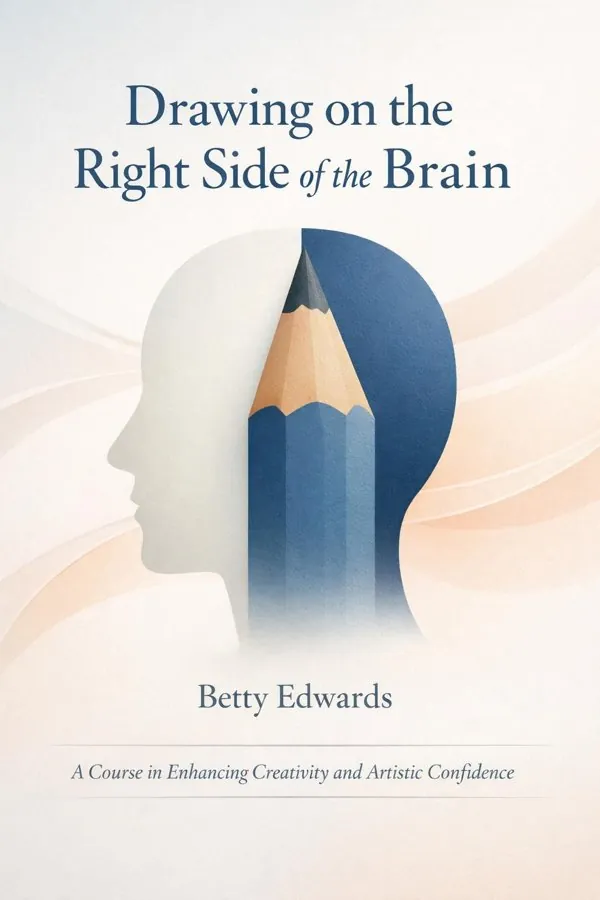
Drawing on the Right Side of the Brain: A Course in Enhancing Creativity and Artistic Confidence: Summary & Key Insights
 10 min9 chaptersAudio available
Key Takeaways from Drawing on the Right Side of the Brain: A Course in Enhancing Creativity and Artistic Confidence
One of the book’s most provocative claims is that drawing problems often begin in the mind before they ever appear on the page.
The biggest obstacle to realistic drawing is not lack of effort but the tyranny of symbols.
Edwards reduces the complexity of drawing to a set of learnable perceptual skills, and that reframing changes everything.
Few exercises in the book are as transformative as contour drawing, because few reveal so clearly how little we usually see.
Sometimes the easiest way to draw an object accurately is to stop drawing the object altogether.
What Is Drawing on the Right Side of the Brain: A Course in Enhancing Creativity and Artistic Confidence About?
Drawing on the Right Side of the Brain: A Course in Enhancing Creativity and Artistic Confidence by Betty Edwards is a creativity book spanning 11 pages. Betty Edwards’ Drawing on the Right Side of the Brain is one of the most influential books ever written on learning to draw, not because it treats drawing as a mysterious gift, but because it turns it into a teachable way of seeing. Edwards argues that most people struggle with drawing not due to a lack of talent, but because they rely on habitual, symbolic thinking instead of direct visual perception. Her method helps readers shift from an analytical, verbal mode of attention to a more spatial, intuitive one, allowing them to notice edges, shapes, relationships, light, and form with far greater accuracy. What makes the book so powerful is its blend of cognitive insight and practical instruction. Edwards, an experienced art educator, developed her approach through years of teaching students who believed they could not draw. Again and again, she found that dramatic improvement could happen quickly when learners were guided to perceive differently. The result is a classic creativity manual that builds technical skill, artistic confidence, and deeper awareness. It matters not only for aspiring artists, but for anyone interested in perception, learning, and unlocking more imaginative ways of thinking.
This FizzRead summary covers all 9 key chapters of Drawing on the Right Side of the Brain: A Course in Enhancing Creativity and Artistic Confidence in approximately 10 minutes, distilling the most important ideas, arguments, and takeaways from Betty Edwards's work. Also available as an audio summary and Key Quotes Podcast.
Drawing on the Right Side of the Brain: A Course in Enhancing Creativity and Artistic Confidence
Betty Edwards’ Drawing on the Right Side of the Brain is one of the most influential books ever written on learning to draw, not because it treats drawing as a mysterious gift, but because it turns it into a teachable way of seeing. Edwards argues that most people struggle with drawing not due to a lack of talent, but because they rely on habitual, symbolic thinking instead of direct visual perception. Her method helps readers shift from an analytical, verbal mode of attention to a more spatial, intuitive one, allowing them to notice edges, shapes, relationships, light, and form with far greater accuracy.
What makes the book so powerful is its blend of cognitive insight and practical instruction. Edwards, an experienced art educator, developed her approach through years of teaching students who believed they could not draw. Again and again, she found that dramatic improvement could happen quickly when learners were guided to perceive differently. The result is a classic creativity manual that builds technical skill, artistic confidence, and deeper awareness. It matters not only for aspiring artists, but for anyone interested in perception, learning, and unlocking more imaginative ways of thinking.
Who Should Read Drawing on the Right Side of the Brain: A Course in Enhancing Creativity and Artistic Confidence?
This book is perfect for anyone interested in creativity and looking to gain actionable insights in a short read. Whether you're a student, professional, or lifelong learner, the key ideas from Drawing on the Right Side of the Brain: A Course in Enhancing Creativity and Artistic Confidence by Betty Edwards will help you think differently.
- ✓Readers who enjoy creativity and want practical takeaways
- ✓Professionals looking to apply new ideas to their work and life
- ✓Anyone who wants the core insights of Drawing on the Right Side of the Brain: A Course in Enhancing Creativity and Artistic Confidence in just 10 minutes
Want the full summary?
Get instant access to this book summary and 100K+ more with Fizz Moment.
Get Free SummaryAvailable on App Store • Free to download
Key Chapters
One of the book’s most provocative claims is that drawing problems often begin in the mind before they ever appear on the page. Betty Edwards explains that people tend to use two distinct modes of thinking. One is verbal, logical, linear, and quick to label things. The other is spatial, intuitive, holistic, and attentive to relationships. Her famous framework describes these as left-brain and right-brain modes, not as a strict neurological doctrine, but as a practical teaching model for understanding why drawing can feel so difficult.
When you try to draw a face, for example, the analytical mode immediately says “eye,” “nose,” “mouth,” and supplies familiar symbols. That mode is useful for language and categorization, but it interferes with accurate drawing because it substitutes concepts for perception. The more visual mode, by contrast, notices the angle of an eyelid, the exact shape of a shadow, and the distance between features. Drawing improves when this mode becomes more dominant.
Edwards uses exercises such as copying an image upside down to disrupt verbal labeling. When the subject becomes unfamiliar, the mind stops saying “this is an eye” and starts seeing lines, spaces, and angles. Many beginners are shocked by how much better they draw under these conditions.
The broader lesson is that artistic skill depends less on hand talent than on mental state. If you can learn to quiet your naming mind, you can access more accurate seeing. Actionable takeaway: before drawing, spend two minutes observing your subject silently without naming anything, focusing only on angles, spaces, edges, and tonal shifts.
The biggest obstacle to realistic drawing is not lack of effort but the tyranny of symbols. From childhood, most people learn to represent the world with shorthand images: almond-shaped eyes, stick-figure bodies, a curved line for a smile, a triangle nose. These symbols are efficient for communication, but they become traps when we want to draw what is actually in front of us.
Edwards shows that when adults claim they “can’t draw,” they are often drawing exactly the way they did as children. The problem is not that their hands never developed; it is that their eyes never learned to override stored visual clichés. We tend to draw what we know rather than what we see. A coffee mug becomes a standard mug icon, even if the actual mug is tilted, partly hidden, or distorted by perspective.
This insight is liberating because it shifts the challenge from talent to perception. Instead of asking, “How do I draw a hand?” Edwards encourages asking, “What shapes, contours, and shadows are present in this particular hand right now?” The moment you move from category to observation, drawing becomes specific and believable.
A practical application is to choose an everyday object, such as your shoe, and draw it as though you have never seen a shoe before. Notice the strange bends, laces, overlaps, and shadow patterns. This exercise reveals how odd and interesting familiar objects truly are.
The key is to distrust your first mental image. Actionable takeaway: whenever you start drawing a familiar subject, pause and list three ways the actual object differs from your mental symbol of it before making your first marks.
Edwards reduces the complexity of drawing to a set of learnable perceptual skills, and that reframing changes everything. Rather than treating drawing as a vague artistic gift, she identifies five core abilities: perceiving edges, spaces, relationships, lights and shadows, and the gestalt, or the whole. This gives beginners a concrete path forward and makes progress measurable.
Perceiving edges means noticing where one shape ends and another begins. Perceiving spaces involves seeing the areas around and between objects, not just the objects themselves. Relationships refer to proportion and perspective, the measurable connections among parts. Lights and shadows involve value, the range from bright to dark that creates form. Finally, gestalt means integrating all of these perceptions into a coherent whole.
This framework is especially useful because it separates seeing from drawing. If your drawing is inaccurate, the error usually comes from misperception in one of these categories, not from some undefined lack of ability. For example, if a chair looks crooked, the issue may be relational: one angle or proportion was misjudged. If a face looks flat, the problem may be insufficient value contrast.
In practice, these skills can be trained one at a time. A beginner might spend one session drawing only contours, another focusing only on negative spaces, and another on shadows. This removes overwhelm and encourages steady improvement. Edwards’ method is effective because it breaks art into visible, trainable acts of attention.
The deeper message is empowering: drawing becomes less about inspiration and more about disciplined perception. Actionable takeaway: evaluate every drawing by asking which of the five perceptual skills needs the most work, then design your next practice session around that single skill.
Few exercises in the book are as transformative as contour drawing, because few reveal so clearly how little we usually see. In contour drawing, you slowly trace the edges of a subject with your eyes while your hand follows on paper, often without looking down. The aim is not a polished picture but intense visual attention.
At first, the exercise feels awkward and even frustrating. The drawing may look distorted or clumsy. But that discomfort is part of the lesson. Edwards uses contour drawing to teach that the hand can only record what the eye truly notices. When people stop rushing to produce a recognizable image and instead follow each subtle bend, angle, and interruption of the edge, they begin to enter a different mental state: quieter, slower, and more absorbed.
Drawing your hand is a classic example. You may think you know what a hand looks like, but once you study it contour by contour, you discover surprising complexities in the knuckles, fingernails, wrinkles, and shifting outlines. The exercise also helps synchronize eye and hand coordination, not through mechanical drilling but through close observation.
Contour drawing has benefits beyond art. It builds patience, concentration, and tolerance for imperfection. Because the goal is process rather than prettiness, it also reduces fear. Many students who feel intimidated by drawing relax once they realize that a useful exercise can look messy.
The lesson is simple but profound: good drawing starts when looking becomes slow and deliberate. Actionable takeaway: spend ten uninterrupted minutes each day doing a blind or modified contour drawing of your hand, a plant, or a household object to strengthen observation and attention.
Drawing becomes believable when parts relate convincingly to one another. Edwards emphasizes that proportion is not guesswork and not a mystical gift; it is the disciplined perception of relationships. Instead of asking whether an eye looks like an eye, the better question is whether it is the right distance from the nose, tilted at the correct angle, and equal in scale to the other eye.
This is where sighting and measuring come in. By using a pencil, thumb, or simple visual comparison, artists estimate lengths, angles, alignments, and relative sizes. A bottle may be twice as tall as it is wide. The top of one ear may align with the eyebrow. The corner of a mouth may fall vertically below the pupil. These observations create structural credibility.
Edwards shows that many drawing errors come from assumptions rather than from observation. We think the eyes sit near the top of the head, when they are actually around the midpoint. We assume one object is straight when it leans slightly. Measurement interrupts these habits and replaces them with evidence.
This skill is practical in nearly every kind of drawing: still life, landscape, figure, portrait, even design sketching. It helps artists place elements correctly before investing time in details. It also reduces frustration because proportions can be checked and corrected early.
Learning relationships changes how you see the world. You stop looking at isolated objects and start noticing systems of comparison. Actionable takeaway: before adding details to any drawing, use simple sighting to check three things first: overall width-to-height ratio, major angle directions, and key alignments between important points.
A line can describe shape, but value gives that shape life. Edwards teaches that one of the most important shifts in drawing is learning to see not just objects, but patterns of light and shadow. What makes an apple look round or a face look dimensional is not the outline alone, but the subtle range of tones across its surface.
Beginners often treat shading as decoration added after the “real drawing” is finished. Edwards reverses that mindset. Value is not cosmetic; it is structural. Highlights, midtones, cast shadows, reflected light, and dark accents tell the viewer how forms turn in space. When these tonal relationships are observed correctly, even a simple drawing can feel solid and atmospheric.
She encourages students to squint at the subject to simplify values into broader masses. Squinting reduces distracting detail and makes the big light-dark pattern easier to see. For example, in a portrait, one side of the face may fall into a single shadow mass, while the lit side contains subtle shifts. If the major pattern is captured first, smaller nuances can follow naturally.
This principle applies outside traditional realism too. Designers, illustrators, and photographers all rely on value structure to guide attention and create mood. Strong value contrast can make a composition dramatic; soft transitions can make it calm.
The central lesson is to stop thinking in terms of named features and start seeing abstract tonal arrangements. Actionable takeaway: choose a simple object under a single light source and make a five-value study, reducing what you see into just five tonal categories before attempting a more detailed drawing.
The most satisfying moments in drawing often arrive when separate skills stop feeling separate. Edwards calls attention to the gestalt, the sense of the whole, which emerges when edges, spaces, relationships, and values work together. At that point, drawing is no longer a checklist of parts but an integrated act of perception.
This integration also explains the altered state many people feel while drawing well. Time seems to pass differently. Self-consciousness fades. Internal chatter quiets down. The artist becomes absorbed in the subject and the evolving image. Edwards interprets this as a shift into the visual, nonverbal mode of mind, and for many readers it is one of the book’s most exciting promises: drawing can become both a skill and a form of deep mental focus.
Portrait drawing is a powerful test of this integration because it requires all five perceptual skills at once. A successful portrait depends on contour accuracy, spatial awareness, proportional relationships, value modeling, and sensitivity to the whole expression. If one element is slightly wrong, likeness suffers. But when all elements support each other, even a simple portrait can feel alive.
The same principle applies beyond portraits. In any creative field, mastery comes when isolated techniques become coordinated perception. A musician no longer thinks only of notes, a writer no longer thinks only of grammar, and a drafter no longer thinks only of lines.
Wholeness cannot be forced, but it can be invited through steady practice. Actionable takeaway: once a week, complete one drawing from start to finish in a single sitting, focusing on the overall unity of the image rather than endlessly correcting isolated details.
Although the book teaches drawing, its deeper appeal lies in what it suggests about creativity itself. Edwards argues that the visual, spatial mode used in drawing is not limited to art class. It can enrich problem-solving, innovation, empathy, and everyday awareness. When we suspend premature labeling and attend more openly to what is actually present, we think differently.
This broader value explains why so many non-artists are drawn to the book. Executives, teachers, therapists, engineers, and students may never aim to become fine artists, yet they benefit from the mental shift the exercises cultivate. The capacity to perceive patterns, tolerate ambiguity, and delay quick conclusions is useful in almost every domain. In that sense, drawing becomes a training ground for more flexible thinking.
Edwards also emphasizes confidence. Many adults carry a quiet wound from childhood: the belief that they are “not creative.” By demonstrating rapid improvement through methodical exercises, she challenges that identity. The transformation is often emotional as much as technical. People who once felt excluded from art discover that creativity is less about rare talent than about attention, practice, and permission.
The final lesson is that seeing can become a daily habit. You can notice negative spaces in architecture, shadow patterns on a sidewalk, proportions in a friend’s face, or abstract shapes in crumpled fabric. The world becomes visually richer when you stop glancing and start observing.
Creativity grows where perception deepens. Actionable takeaway: build a daily seeing practice by spending five minutes observing an ordinary scene and mentally noting edges, negative spaces, proportions, and values, even when you do not have time to draw.
All Chapters in Drawing on the Right Side of the Brain: A Course in Enhancing Creativity and Artistic Confidence
About the Author
Betty Edwards is an American art teacher, researcher, and author best known for her influential work in drawing instruction and creativity education. She taught art for many years and became widely recognized for developing a practical method that helps beginners learn to draw by improving perception rather than relying on assumed talent. Her most famous book, Drawing on the Right Side of the Brain, introduced millions of readers to exercises designed to strengthen visual awareness, spatial reasoning, and artistic confidence. Although the book’s brain-hemisphere language is often interpreted more metaphorically today, Edwards’ teaching approach remains highly respected for its clarity and effectiveness. Her work has had a lasting impact on art education by making drawing more accessible, structured, and psychologically encouraging for learners of all backgrounds.
Get This Summary in Your Preferred Format
Read or listen to the Drawing on the Right Side of the Brain: A Course in Enhancing Creativity and Artistic Confidence summary by Betty Edwards anytime, anywhere. FizzRead offers multiple formats so you can learn on your terms — all free.
Available formats: App · Audio · PDF · EPUB — All included free with FizzRead
Download Drawing on the Right Side of the Brain: A Course in Enhancing Creativity and Artistic Confidence PDF and EPUB Summary
Key Quotes from Drawing on the Right Side of the Brain: A Course in Enhancing Creativity and Artistic Confidence
“One of the book’s most provocative claims is that drawing problems often begin in the mind before they ever appear on the page.”
“The biggest obstacle to realistic drawing is not lack of effort but the tyranny of symbols.”
“Edwards reduces the complexity of drawing to a set of learnable perceptual skills, and that reframing changes everything.”
“Few exercises in the book are as transformative as contour drawing, because few reveal so clearly how little we usually see.”
“Sometimes the easiest way to draw an object accurately is to stop drawing the object altogether.”
Frequently Asked Questions about Drawing on the Right Side of the Brain: A Course in Enhancing Creativity and Artistic Confidence
Drawing on the Right Side of the Brain: A Course in Enhancing Creativity and Artistic Confidence by Betty Edwards is a creativity book that explores key ideas across 9 chapters. Betty Edwards’ Drawing on the Right Side of the Brain is one of the most influential books ever written on learning to draw, not because it treats drawing as a mysterious gift, but because it turns it into a teachable way of seeing. Edwards argues that most people struggle with drawing not due to a lack of talent, but because they rely on habitual, symbolic thinking instead of direct visual perception. Her method helps readers shift from an analytical, verbal mode of attention to a more spatial, intuitive one, allowing them to notice edges, shapes, relationships, light, and form with far greater accuracy. What makes the book so powerful is its blend of cognitive insight and practical instruction. Edwards, an experienced art educator, developed her approach through years of teaching students who believed they could not draw. Again and again, she found that dramatic improvement could happen quickly when learners were guided to perceive differently. The result is a classic creativity manual that builds technical skill, artistic confidence, and deeper awareness. It matters not only for aspiring artists, but for anyone interested in perception, learning, and unlocking more imaginative ways of thinking.
You Might Also Like
Dimensions Of Creativity
Margaret A. Boden
10 min
How to Fly a Horse: The Secret History of Creation, Invention, and Discovery
Kevin Ashton
10 min
Imagine: How Creativity Works
Jonah Lehrer
10 min
The Accidental Creative: How to Be Brilliant at a Moment's Notice
Todd Henry
10 min
The Origins of Creativity
Edward O. Wilson
10 min
Wired to Create: Unraveling the Mysteries of the Creative Mind
Scott Barry Kaufman, Carolyn Gregoire
10 minBrowse by Category
Ready to read Drawing on the Right Side of the Brain: A Course in Enhancing Creativity and Artistic Confidence?
Get the full summary and 100K+ more books with Fizz Moment.