
Betty Edwards Books
Betty Edwards is an American art teacher and author best known for her pioneering work in art education and creativity research. She developed methods to teach drawing based on cognitive psychology and the functions of the brain’s hemispheres.
Known for: Drawing on the Right Side of the Brain: A Course in Enhancing Creativity and Artistic Confidence
Books by Betty Edwards
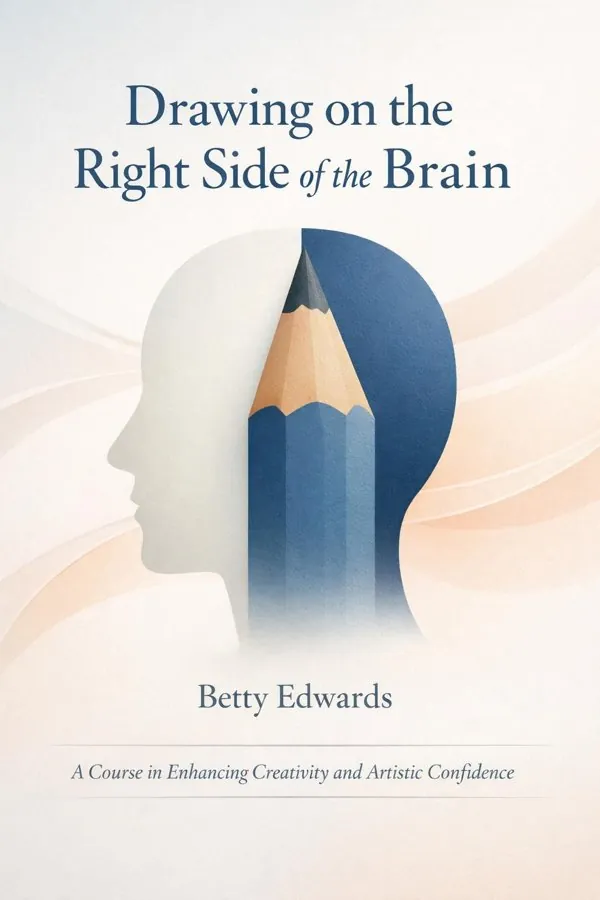
Drawing on the Right Side of the Brain: A Course in Enhancing Creativity and Artistic Confidence
Betty Edwards’ Drawing on the Right Side of the Brain is one of the most influential books ever written on learning to draw, not because it treats drawing as a mysterious gift, but because it turns it into a teachable way of seeing. Edwards argues that most people struggle with drawing not due to a lack of talent, but because they rely on habitual, symbolic thinking instead of direct visual perception. Her method helps readers shift from an analytical, verbal mode of attention to a more spatial, intuitive one, allowing them to notice edges, shapes, relationships, light, and form with far greater accuracy. What makes the book so powerful is its blend of cognitive insight and practical instruction. Edwards, an experienced art educator, developed her approach through years of teaching students who believed they could not draw. Again and again, she found that dramatic improvement could happen quickly when learners were guided to perceive differently. The result is a classic creativity manual that builds technical skill, artistic confidence, and deeper awareness. It matters not only for aspiring artists, but for anyone interested in perception, learning, and unlocking more imaginative ways of thinking.
Read SummaryKey Insights from Betty Edwards
Two Modes of Mind Shape Vision
One of the book’s most provocative claims is that drawing problems often begin in the mind before they ever appear on the page. Betty Edwards explains that people tend to use two distinct modes of thinking. One is verbal, logical, linear, and quick to label things. The other is spatial, intuitive, h...
From Drawing on the Right Side of the Brain: A Course in Enhancing Creativity and Artistic Confidence
Symbols Prevent You From Seeing Clearly
The biggest obstacle to realistic drawing is not lack of effort but the tyranny of symbols. From childhood, most people learn to represent the world with shorthand images: almond-shaped eyes, stick-figure bodies, a curved line for a smile, a triangle nose. These symbols are efficient for communicati...
From Drawing on the Right Side of the Brain: A Course in Enhancing Creativity and Artistic Confidence
Five Perceptual Skills Build Drawing Ability
Edwards reduces the complexity of drawing to a set of learnable perceptual skills, and that reframing changes everything. Rather than treating drawing as a vague artistic gift, she identifies five core abilities: perceiving edges, spaces, relationships, lights and shadows, and the gestalt, or the wh...
From Drawing on the Right Side of the Brain: A Course in Enhancing Creativity and Artistic Confidence
Contour Drawing Trains Deep Attention
Few exercises in the book are as transformative as contour drawing, because few reveal so clearly how little we usually see. In contour drawing, you slowly trace the edges of a subject with your eyes while your hand follows on paper, often without looking down. The aim is not a polished picture but ...
From Drawing on the Right Side of the Brain: A Course in Enhancing Creativity and Artistic Confidence
Negative Space Reveals Hidden Accuracy
Sometimes the easiest way to draw an object accurately is to stop drawing the object altogether. Edwards’ teaching on negative space is one of the most elegant parts of the book because it shows that empty areas are not empty at all. The spaces around and between forms have precise shapes, and drawi...
From Drawing on the Right Side of the Brain: A Course in Enhancing Creativity and Artistic Confidence
Proportion Depends on Measured Relationships
Drawing becomes believable when parts relate convincingly to one another. Edwards emphasizes that proportion is not guesswork and not a mystical gift; it is the disciplined perception of relationships. Instead of asking whether an eye looks like an eye, the better question is whether it is the right...
From Drawing on the Right Side of the Brain: A Course in Enhancing Creativity and Artistic Confidence
About Betty Edwards
Betty Edwards is an American art teacher and author best known for her pioneering work in art education and creativity research. She developed methods to teach drawing based on cognitive psychology and the functions of the brain’s hemispheres.


Frequently Asked Questions
Betty Edwards is an American art teacher and author best known for her pioneering work in art education and creativity research. She developed methods to teach drawing based on cognitive psychology and the functions of the brain’s hemispheres.
Read Betty Edwards's books in 15 minutes
Get AI-powered summaries with key insights from 1 book by Betty Edwards.