
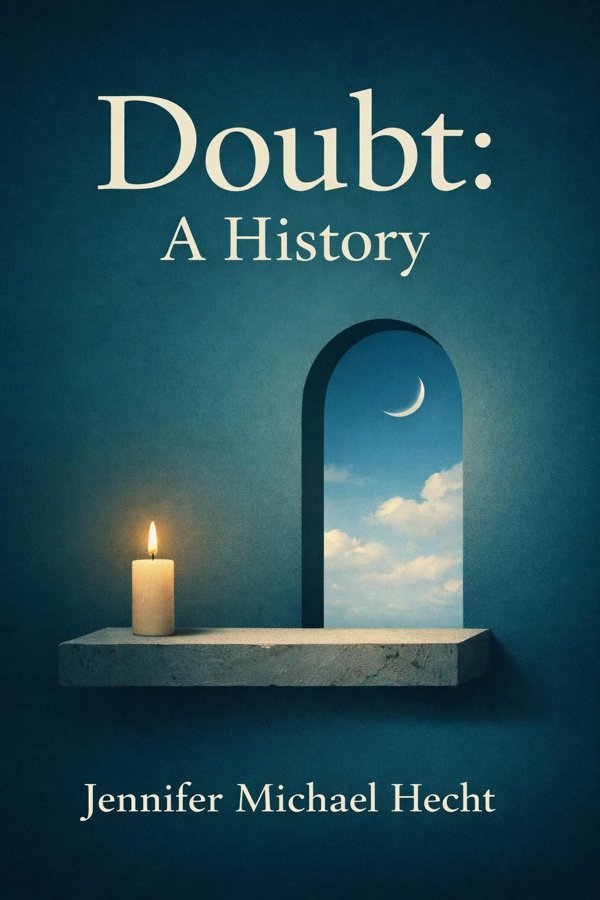
Doubt: A History: The Great Doubters and Their Legacy of Innovation from Socrates and Jesus to Thomas Jefferson and Emily Dickinson: Summary & Key Insights
 10 min9 chaptersAudio available
Key Takeaways from Doubt: A History: The Great Doubters and Their Legacy of Innovation from Socrates and Jesus to Thomas Jefferson and Emily Dickinson
A civilization changes when it stops treating questions as threats and starts treating them as tools.
When old certainties break, people do not stop searching for truth; they search for better ways to live without guarantees.
Religious traditions often define themselves against doubt, yet they are also shaped by it from the beginning.
Doubt does not vanish in religious ages; it learns to speak carefully.
A culture opens when people rediscover that authority can be inherited without being absolute.
What Is Doubt: A History: The Great Doubters and Their Legacy of Innovation from Socrates and Jesus to Thomas Jefferson and Emily Dickinson About?
Doubt: A History: The Great Doubters and Their Legacy of Innovation from Socrates and Jesus to Thomas Jefferson and Emily Dickinson by Jennifer Michael Hecht is a civilization book spanning 9 pages. Jennifer Michael Hecht’s Doubt: A History is a sweeping intellectual history of one of civilization’s most misunderstood forces: doubt. Rather than treating skepticism as a weakness, Hecht argues that questioning authority, inherited belief, and official truth has been one of the main engines of human progress. Moving from ancient Greece and the Hebrew tradition through Christianity, Islam, the Renaissance, the Scientific Revolution, the Enlightenment, and modern secular thought, she shows how doubters preserved intellectual freedom when orthodoxy tried to close debate. The book matters because it reframes cultural history: many of the ideas we now associate with reason, tolerance, science, and individual conscience emerged not from certainty, but from brave uncertainty. Hecht is exceptionally well suited to tell this story. A historian, poet, and philosopher with a Ph.D. in the history of science from Columbia University, she combines scholarly range with a vivid, humane voice. The result is both a history of ideas and a defense of intellectual courage, showing that doubt is not the enemy of meaning, but often its beginning.
This FizzRead summary covers all 9 key chapters of Doubt: A History: The Great Doubters and Their Legacy of Innovation from Socrates and Jesus to Thomas Jefferson and Emily Dickinson in approximately 10 minutes, distilling the most important ideas, arguments, and takeaways from Jennifer Michael Hecht's work. Also available as an audio summary and Key Quotes Podcast.
Doubt: A History: The Great Doubters and Their Legacy of Innovation from Socrates and Jesus to Thomas Jefferson and Emily Dickinson
Jennifer Michael Hecht’s Doubt: A History is a sweeping intellectual history of one of civilization’s most misunderstood forces: doubt. Rather than treating skepticism as a weakness, Hecht argues that questioning authority, inherited belief, and official truth has been one of the main engines of human progress. Moving from ancient Greece and the Hebrew tradition through Christianity, Islam, the Renaissance, the Scientific Revolution, the Enlightenment, and modern secular thought, she shows how doubters preserved intellectual freedom when orthodoxy tried to close debate. The book matters because it reframes cultural history: many of the ideas we now associate with reason, tolerance, science, and individual conscience emerged not from certainty, but from brave uncertainty. Hecht is exceptionally well suited to tell this story. A historian, poet, and philosopher with a Ph.D. in the history of science from Columbia University, she combines scholarly range with a vivid, humane voice. The result is both a history of ideas and a defense of intellectual courage, showing that doubt is not the enemy of meaning, but often its beginning.
Who Should Read Doubt: A History: The Great Doubters and Their Legacy of Innovation from Socrates and Jesus to Thomas Jefferson and Emily Dickinson?
This book is perfect for anyone interested in civilization and looking to gain actionable insights in a short read. Whether you're a student, professional, or lifelong learner, the key ideas from Doubt: A History: The Great Doubters and Their Legacy of Innovation from Socrates and Jesus to Thomas Jefferson and Emily Dickinson by Jennifer Michael Hecht will help you think differently.
- ✓Readers who enjoy civilization and want practical takeaways
- ✓Professionals looking to apply new ideas to their work and life
- ✓Anyone who wants the core insights of Doubt: A History: The Great Doubters and Their Legacy of Innovation from Socrates and Jesus to Thomas Jefferson and Emily Dickinson in just 10 minutes
Want the full summary?
Get instant access to this book summary and 100K+ more with Fizz Moment.
Get Free SummaryAvailable on App Store • Free to download
Key Chapters
A civilization changes when it stops treating questions as threats and starts treating them as tools. Hecht begins in ancient Greece because Athens gave doubt a new cultural visibility. Socrates did not found a religion, write a sacred text, or offer final answers. Instead, he asked unsettling questions about justice, courage, piety, and knowledge. His method, often called elenchus, exposed how often confident people could not actually defend what they claimed to know. That was revolutionary. Doubt became not merely private uncertainty, but a disciplined public practice.
For Hecht, Socrates matters because he made intellectual humility honorable. He showed that admitting confusion can be a deeper form of wisdom than repeating accepted opinions. Yet Athens also reveals the cost of doubt. Socrates was executed in part because relentless questioning can destabilize civic comfort. The same society that celebrated debate also punished a man who embodied it too fully.
This ancient lesson remains surprisingly current. In classrooms, workplaces, and politics, people often reward certainty over accuracy. The Socratic example suggests that better thinking begins when we ask not, “What should I believe?” but “How do I know?” A manager can use this by probing assumptions before launching a project. A student can use it by challenging textbook summaries. A citizen can use it by testing slogans against evidence.
The practical value of this tradition is simple: doubt slows down error. Before accepting a claim, ask at least three clarifying questions about its logic, evidence, and consequences.
When old certainties break, people do not stop searching for truth; they search for better ways to live without guarantees. After the classical Greek era, Hellenistic and Roman philosophers turned doubt into competing life strategies. Epicurus rejected superstition by arguing that the gods, if they exist, do not micromanage human life. Fear of divine punishment, he thought, was one of the great sources of misery. The Stoics, by contrast, emphasized inner discipline and rational order, while Skeptics warned that dogmatic certainty itself is a trap.
Hecht shows that these schools were not simply abstract systems. They were practical responses to political instability, cultural mixing, and existential anxiety. Epicurean thought helped people imagine a world governed by nature rather than constant supernatural interference. Skepticism taught suspension of judgment where evidence was weak. Stoicism offered resilience in the face of chaos. Together, they expanded the space between belief and obedience.
Their arguments still shape modern habits of mind. Scientific naturalism owes something to Epicurean materialism. Cognitive self-management resembles Stoic discipline. Intellectual caution echoes ancient skepticism. If you have ever said, “I need more evidence,” “I can’t control everything,” or “Fear is distorting my judgment,” you are living inside traditions these thinkers helped build.
Hecht’s point is not that one school wins. It is that doubt matured when thinkers learned to turn uncertainty into ethics, psychology, and everyday practice. You do not need total certainty to live thoughtfully.
Actionable takeaway: when faced with confusion, separate what you can know, what you can influence, and what fear is adding to the picture.
Religious traditions often define themselves against doubt, yet they are also shaped by it from the beginning. Hecht’s treatment of early Christianity is especially nuanced because she does not portray belief and doubt as simple opposites. The early Christian world was full of argument: about scripture, authority, the nature of Jesus, the meaning of resurrection, and the boundaries of orthodoxy. Even canonical texts preserve uncertainty, debate, and interpretation. Doubt was present not only in critics of Christianity but also inside Christianity itself.
Hecht pays attention to figures and moments in which questioning coexisted with devotion. Some believers wrestled with divine hiddenness, suffering, and conflicting doctrines. Others emphasized inward conscience over institutional authority. At the same time, church consolidation gradually narrowed acceptable forms of inquiry. Heresy-hunting was not only about theology; it was about power, identity, and social control. Once institutions gained strength, preserving unity often meant disciplining ambiguity.
This historical pattern remains familiar. Communities formed around shared meaning need cohesion, but cohesion can harden into suppression. A religious organization, political movement, or even a startup can begin with passionate searching and end with rigid gatekeeping. Hecht’s insight is that doubt never fully disappears; it gets managed, redirected, or silenced.
For modern readers, this chapter encourages a more mature understanding of belief. Faith without questions is often shallow, while questioning need not automatically destroy commitment. The healthiest traditions can distinguish honest inquiry from bad-faith sabotage.
Actionable takeaway: in any belief-based community you belong to, make room for one serious unresolved question rather than pretending certainty where none exists.
Doubt does not vanish in religious ages; it learns to speak carefully. The medieval period is often caricatured as intellectually frozen, but Hecht shows a more complicated reality. Jewish, Christian, and Islamic thinkers debated revelation, reason, metaphysics, and the limits of language about God. Scholars such as Maimonides, Averroes, and Abelard tested how far rational inquiry could go within inherited frameworks. Their world imposed constraints, yet those constraints did not eliminate philosophical creativity.
What makes this era important is the tension between obedience and analysis. Medieval thinkers often had to frame radical questions in cautious terms, embedding critique inside commentary or scholastic disputation. They asked whether reason and revelation could truly agree, whether scripture should be interpreted literally, and whether human language can describe the divine without distortion. These are not minor questions. They strike at the foundations of authority.
Hecht’s broader contribution here is to remind us that intellectual history rarely moves in a straight line from darkness to enlightenment. Even highly structured cultures contain zones of inquiry. Today, many people work in institutions where direct dissent is costly: universities, corporations, governments, or tight-knit communities. Medieval intellectuals offer a model of strategic questioning. They found ways to preserve thoughtfulness without always inviting immediate punishment.
This is not a romantic endorsement of censorship. Rather, it is a realistic account of how inquiry survives under pressure. Sometimes doubt progresses through bold confrontation; sometimes through careful interpretation, coded debate, and patient scholarship.
Actionable takeaway: if you operate in a restrictive environment, practice asking difficult questions in precise, evidence-based language that invites dialogue rather than immediate defensiveness.
A culture opens when people rediscover that authority can be inherited without being absolute. In Hecht’s account, the Renaissance revives classical learning in ways that unsettle medieval intellectual monopoly. Humanists returned to original texts, compared versions, examined language historically, and treated ancient authors as conversation partners rather than untouchable authorities. That philological discipline had explosive consequences. Once readers noticed textual variation, translation choices, and historical context, certainty about tradition became harder to maintain.
Renaissance humanism also elevated human capacity: judgment, eloquence, creativity, and moral agency. This did not instantly abolish religion, but it shifted the balance. People became more willing to ask whether institutions represented eternal truth or contingent historical arrangements. Artistic innovation, geographic discovery, and exposure to diverse cultures further weakened the assumption that one inherited worldview exhausted reality.
Hecht uses this period to show that doubt often grows from skills, not moods. Close reading, comparison, historical awareness, and linguistic analysis are practical tools that undermine simplistic certainty. The more carefully people read sacred, legal, or political texts, the more they notice complexity and contradiction.
That lesson matters now in an age of viral claims and decontextualized quotations. Humanism suggests that intellectual independence is built through method. Check the source. Compare translations. Ask when and why a document was produced. Look for missing context. In daily life, this can improve how we read news, evaluate policy, or interpret organizational rules.
Actionable takeaway: whenever a text is used to end discussion, go back to the original wording, context, and competing interpretations before accepting the conclusion.
The Scientific Revolution transformed doubt from a philosophical posture into a disciplined way of investigating the world. Hecht traces how figures like Copernicus, Galileo, Bacon, and Descartes challenged inherited authorities by insisting that tradition alone could not settle questions about nature. Observation, experiment, mathematical reasoning, and methodological skepticism offered a new standard. This was not merely disbelief. It was organized doubt aimed at producing more reliable knowledge.
One of Hecht’s key insights is that scientific progress did not arise because people abandoned all beliefs. It arose because they became willing to test beliefs. Galileo’s telescopic observations challenged geocentric assumptions. Bacon argued that the mind is vulnerable to error and needs procedures to correct it. Descartes famously doubted in order to rebuild knowledge on firmer ground. Even when these thinkers retained religious commitments, they expanded the legitimate role of questioning.
The practical significance is enormous. Modern medicine, engineering, and technology depend on institutionalized skepticism: peer review, replication, error correction, and openness to revision. In science, doubt is not paralysis. It is quality control. A researcher asks whether a result can be reproduced. A doctor checks whether symptoms fit multiple diagnoses. A product team runs tests before scaling a feature.
Hecht’s story reminds us that evidence-based thinking is culturally fragile. People still prefer reassuring narratives to uncomfortable facts. The scientific legacy asks us to welcome correction because reality is not obligated to confirm our assumptions.
Actionable takeaway: treat your strongest opinion as a hypothesis—look actively for disconfirming evidence before deciding that you are right.
Doubt becomes historically transformative when it moves from individual courage to public principle. In Hecht’s narrative, the Enlightenment marks that expansion. Thinkers such as Voltaire, Hume, Diderot, Paine, and Jefferson did more than question doctrine; they argued that societies should protect the right to question. Skepticism became tied to civil liberty, religious tolerance, free inquiry, and constitutional limits on power.
This was a major shift. Earlier doubters often survived at the margins or under threat. Enlightenment thinkers tried to redesign the public order so that dissent could be normal rather than heroic. Criticism of miracles, churches, monarchy, and inherited hierarchy was linked to a broader defense of reasoned debate. Hecht shows that the secular state did not emerge from hostility to meaning, but from practical recognition that coercive certainty leads to cruelty.
The period also demonstrates that doubt can be politically productive. Jefferson’s religious heterodoxy did not prevent moral seriousness; it shaped his commitment to liberty of conscience. Hume’s skepticism about causation and religion sharpened standards of evidence. These thinkers were not always consistent, and Hecht does not ignore their blind spots. But she highlights their larger contribution: they made questioning socially generative.
For contemporary readers, the Enlightenment lesson is urgent. Free societies depend on citizens who can disagree without demanding suppression. Universities, courts, journalism, and democratic institutions all function best when criticism is protected rather than pathologized.
Actionable takeaway: defend procedures that allow disagreement—free discussion, transparency, and evidence-based review—even when the views being challenged are your own.
Not all doubt is analytical; some of it is emotional, spiritual, and deeply personal. Hecht’s treatment of Romantic and nineteenth-century thought broadens the history beyond philosophers and scientists. As traditional faith weakened under modern pressures, poets, writers, and intellectuals explored what it feels like to live without settled metaphysical guarantees. Figures such as Emily Dickinson become central because they reveal doubt not as a cold rejection of meaning, but as an intimate mode of attention.
This matters because rational critique alone cannot explain modern secularity. People do not merely change ideas; they also lose certainties, mourn them, resist them, and reinvent forms of hope. Romanticism often reacted against mechanistic reason, yet it also intensified subjective questioning. The self became a site of struggle. Longing, silence, absence, and ambiguity all entered the literature of doubt.
Hecht suggests that this interior dimension is part of the doubter’s legacy. A person may reject dogma and still ache for transcendence. Dickinson’s compressed, searching poetry captures that tension beautifully. She neither surrenders to orthodoxy nor settles into easy dismissal. Instead, she models a disciplined willingness to inhabit uncertainty.
Modern readers can apply this insight in mental and emotional life. Not every unresolved question needs immediate closure. In grief, career transition, or spiritual reevaluation, forcing certainty too quickly can produce false confidence. Journaling, poetry, reflective reading, and honest conversation can make ambiguity bearable without collapsing into despair.
Actionable takeaway: when facing a life question you cannot solve, describe it accurately in writing before trying to resolve it; clarity often begins with naming the uncertainty.
Secularism is often presented as a recent break from history, but Hecht argues that it is better understood as the latest chapter in a very old struggle over authority, evidence, and conscience. Modern secular thought did not arise from nowhere. It inherits the methods of Greek inquiry, the inner wrestling of religious traditions, the textual criticism of humanism, the procedures of science, and the political commitments of the Enlightenment. What changes in modernity is scale: doubt becomes more socially visible, institutionally protected, and culturally normalized.
Yet Hecht is not triumphalist. Secularism solves some problems while creating others. As shared religious frameworks weaken, individuals face new burdens of meaning-making. Freedom increases, but so can alienation. The modern world offers pluralism, but pluralism can feel unstable. Doubt liberates, but it also demands maturity: the ability to live ethically without guaranteed cosmic answers.
That is why this book still resonates. In a world shaped by ideological polarization, conspiracy thinking, and identity-driven certainty, Hecht’s history reminds us that doubt is not the same as cynicism. Cynicism assumes bad faith everywhere and often leads to passivity. Doubt, at its best, remains curious, rigorous, and open to revision. It asks better questions in order to live more honestly.
In practical terms, modern secular citizenship requires habits of epistemic responsibility: checking sources, tolerating complexity, revising beliefs, and respecting freedom of conscience. These habits are not automatic. They must be learned and protected.
Actionable takeaway: build a personal practice of responsible skepticism—verify before sharing, revise when corrected, and separate uncertainty from nihilism.
All Chapters in Doubt: A History: The Great Doubters and Their Legacy of Innovation from Socrates and Jesus to Thomas Jefferson and Emily Dickinson
About the Author
Jennifer Michael Hecht is an American historian, poet, and philosopher whose work explores doubt, secularism, morality, and the search for meaning. She earned her Ph.D. in the history of science from Columbia University and became widely known for bringing complex intellectual history to a broad readership. Her writing combines academic depth with a clear, engaging style, allowing her to move fluently between philosophy, religion, literature, and cultural history. In addition to Doubt: A History, she has written notable books on happiness, mortality, and ethics. Hecht is especially interested in how people build meaningful lives in the absence of certainty, and that theme runs through much of her work. Her voice is both scholarly and humane, making her a distinctive interpreter of civilization’s biggest questions.
Get This Summary in Your Preferred Format
Read or listen to the Doubt: A History: The Great Doubters and Their Legacy of Innovation from Socrates and Jesus to Thomas Jefferson and Emily Dickinson summary by Jennifer Michael Hecht anytime, anywhere. FizzRead offers multiple formats so you can learn on your terms — all free.
Available formats: App · Audio · PDF · EPUB — All included free with FizzRead
Download Doubt: A History: The Great Doubters and Their Legacy of Innovation from Socrates and Jesus to Thomas Jefferson and Emily Dickinson PDF and EPUB Summary
Key Quotes from Doubt: A History: The Great Doubters and Their Legacy of Innovation from Socrates and Jesus to Thomas Jefferson and Emily Dickinson
“A civilization changes when it stops treating questions as threats and starts treating them as tools.”
“When old certainties break, people do not stop searching for truth; they search for better ways to live without guarantees.”
“Religious traditions often define themselves against doubt, yet they are also shaped by it from the beginning.”
“Doubt does not vanish in religious ages; it learns to speak carefully.”
“A culture opens when people rediscover that authority can be inherited without being absolute.”
Frequently Asked Questions about Doubt: A History: The Great Doubters and Their Legacy of Innovation from Socrates and Jesus to Thomas Jefferson and Emily Dickinson
Doubt: A History: The Great Doubters and Their Legacy of Innovation from Socrates and Jesus to Thomas Jefferson and Emily Dickinson by Jennifer Michael Hecht is a civilization book that explores key ideas across 9 chapters. Jennifer Michael Hecht’s Doubt: A History is a sweeping intellectual history of one of civilization’s most misunderstood forces: doubt. Rather than treating skepticism as a weakness, Hecht argues that questioning authority, inherited belief, and official truth has been one of the main engines of human progress. Moving from ancient Greece and the Hebrew tradition through Christianity, Islam, the Renaissance, the Scientific Revolution, the Enlightenment, and modern secular thought, she shows how doubters preserved intellectual freedom when orthodoxy tried to close debate. The book matters because it reframes cultural history: many of the ideas we now associate with reason, tolerance, science, and individual conscience emerged not from certainty, but from brave uncertainty. Hecht is exceptionally well suited to tell this story. A historian, poet, and philosopher with a Ph.D. in the history of science from Columbia University, she combines scholarly range with a vivid, humane voice. The result is both a history of ideas and a defense of intellectual courage, showing that doubt is not the enemy of meaning, but often its beginning.
You Might Also Like
The Structure of Scientific Revolutions
Thomas S. Kuhn
10 min
Genius
Harold Bloom
10 min
A Cultural History of the Medieval Age
Various Editors
10 min
A History of God: The 4,000-Year Quest of Judaism, Christianity and Islam
Karen Armstrong
10 min
A History of the World in 10½ Chapters
Julian Barnes
10 min
A Short History of Progress
Ronald Wright
10 minBrowse by Category
Ready to read Doubt: A History: The Great Doubters and Their Legacy of Innovation from Socrates and Jesus to Thomas Jefferson and Emily Dickinson?
Get the full summary and 100K+ more books with Fizz Moment.