
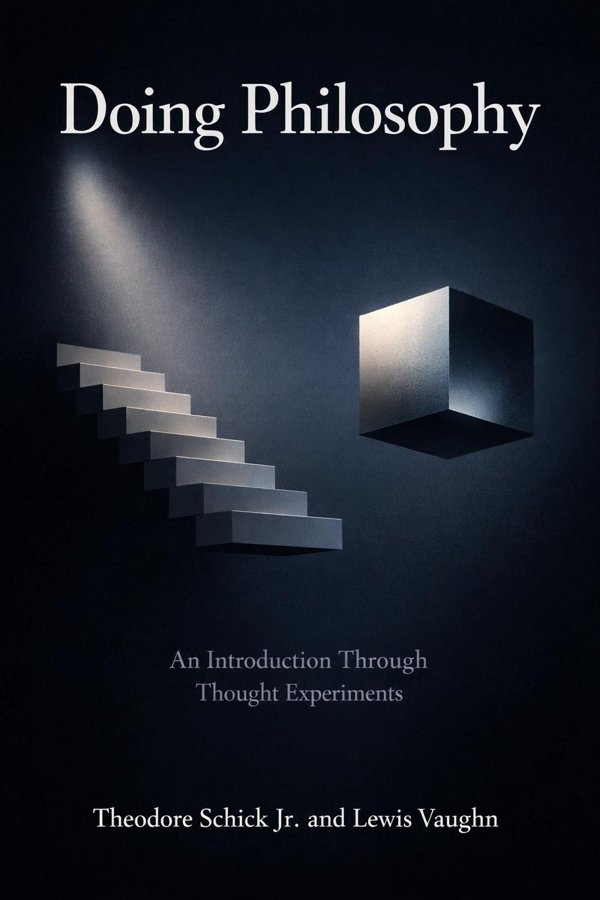
Doing Philosophy: An Introduction Through Thought Experiments: Summary & Key Insights
by Theodore Schick Jr., Lewis Vaughn
 10 min9 chaptersAudio available
What Is Doing Philosophy: An Introduction Through Thought Experiments About?
Doing Philosophy: An Introduction Through Thought Experiments by Theodore Schick Jr. and Lewis Vaughn is a education book spanning 9 pages. Doing Philosophy: An Introduction Through Thought Experiments es una guía introductoria que enseña a los lectores cómo pensar críticamente sobre cuestiones filosóficas. A través de experimentos mentales clásicos y contemporáneos, los autores presentan los métodos y herramientas del razonamiento filosófico, ayudando a los estudiantes a desarrollar habilidades analíticas y argumentativas. El libro cubre temas como ética, metafísica, epistemología y filosofía de la mente, con un enfoque práctico y accesible.
This FizzRead summary covers all 9 key chapters of Doing Philosophy: An Introduction Through Thought Experiments in approximately 10 minutes, distilling the most important ideas, arguments, and takeaways from Theodore Schick Jr. and Lewis Vaughn's work. Also available as an audio summary and Key Quotes Podcast.
Doing Philosophy: An Introduction Through Thought Experiments
Doing Philosophy: An Introduction Through Thought Experiments es una guía introductoria que enseña a los lectores cómo pensar críticamente sobre cuestiones filosóficas. A través de experimentos mentales clásicos y contemporáneos, los autores presentan los métodos y herramientas del razonamiento filosófico, ayudando a los estudiantes a desarrollar habilidades analíticas y argumentativas. El libro cubre temas como ética, metafísica, epistemología y filosofía de la mente, con un enfoque práctico y accesible.
Who Should Read Doing Philosophy: An Introduction Through Thought Experiments?
This book is perfect for anyone interested in education and looking to gain actionable insights in a short read. Whether you're a student, professional, or lifelong learner, the key ideas from Doing Philosophy: An Introduction Through Thought Experiments by Theodore Schick Jr. and Lewis Vaughn will help you think differently.
- ✓Readers who enjoy education and want practical takeaways
- ✓Professionals looking to apply new ideas to their work and life
- ✓Anyone who wants the core insights of Doing Philosophy: An Introduction Through Thought Experiments in just 10 minutes
Want the full summary?
Get instant access to this book summary and 100K+ more with Fizz Moment.
Get Free SummaryAvailable on App Store • Free to download
Key Chapters
Philosophy begins with reasoning. To do philosophy well, one must learn to recognize that an argument is not a quarrel, but a structured set of claims designed to establish a conclusion. In our book, we start by walking students through the difference between assertions and arguments. A philosophical claim has value only when supported by reasons, and those reasons must connect logically to the conclusion. The rigor of philosophy lies in this connection—it is what keeps our thinking disciplined and our conclusions credible.
We teach you how to dissect arguments into their constituent parts: premises and conclusions. Through exercises and examples, you learn to ask whether premises are true, relevant, and sufficient to secure the conclusion. This process, known as analysis, is the heart of philosophical method. But more than checking logical form, philosophers also assess whether arguments are sound—whether they proceed from truths, and not just valid structures.
Importantly, we emphasize that reasoning is not limited to formal logic. Everyday arguments often rely on inductive reasoning, drawing on evidence and probability rather than strict necessity. The key skill is to recognize patterns of inference, see where they hold, and understand when they break down.
A major portion of this section addresses fallacies—those seductive missteps that masquerade as solid arguments. You’ll encounter ad hominems, slippery slopes, false dichotomies, hasty generalizations, and more. But instead of treating them as mere labels, we show why they fail and how they distort thought. Philosophy trains the mind not simply to name errors, but to understand *why* they go wrong.
By developing these analytical habits, you cultivate intellectual honesty. It forces you to examine your own reasoning as carefully as others’. That self-corrective attitude is what defines genuine philosophical inquiry. Argumentation, far from being confrontational, becomes cooperative: a shared search for truth grounded in clarity and respect for reason.
Logic is the grammar of thought. Without it, our ideas remain vague and our arguments uncertain. In *Doing Philosophy*, we treat logic not as a dry mathematical system but as a living language that clarifies what we mean and prevents confusion.
We introduce both deductive and inductive reasoning, explaining how each serves different purposes in philosophical debate. Deductive logic guarantees truth preservation: if your premises are true and your form valid, your conclusion must be true. Inductive logic, by contrast, deals in likelihood—drawing generalizations from specific instances. Most of our reasoning, even in science, is of this kind.
We show how symbolic reasoning complements ordinary language, allowing us to test validity using truth tables and formal notation. Though it may seem technical, symbolic logic ultimately makes arguments clearer, not more arcane. We supplement this with many examples—to show, for instance, how moral reasoning or arguments about God’s existence can be translated into logical form.
At its heart, logic is about intellectual integrity. It demands that we say what we mean and mean what we say. Sloppy reasoning doesn’t just undermine argumentation; it breeds misunderstanding and division. Clear thinking, by contrast, opens the way to genuine insight.
+ 7 more chapters — available in the FizzRead app
All Chapters in Doing Philosophy: An Introduction Through Thought Experiments
About the Authors
Theodore Schick Jr. es profesor de filosofía en la Universidad Estatal de Nueva York en Plattsburgh, especializado en pensamiento crítico y filosofía de la ciencia. Lewis Vaughn es escritor y editor de textos filosóficos y éticos ampliamente utilizados en la educación superior estadounidense.
Get This Summary in Your Preferred Format
Read or listen to the Doing Philosophy: An Introduction Through Thought Experiments summary by Theodore Schick Jr. and Lewis Vaughn anytime, anywhere. FizzRead offers multiple formats so you can learn on your terms — all free.
Available formats: App · Audio · PDF · EPUB — All included free with FizzRead
Download Doing Philosophy: An Introduction Through Thought Experiments PDF and EPUB Summary
Key Quotes from Doing Philosophy: An Introduction Through Thought Experiments
“To do philosophy well, one must learn to recognize that an argument is not a quarrel, but a structured set of claims designed to establish a conclusion.”
“Without it, our ideas remain vague and our arguments uncertain.”
Frequently Asked Questions about Doing Philosophy: An Introduction Through Thought Experiments
Doing Philosophy: An Introduction Through Thought Experiments by Theodore Schick Jr. and Lewis Vaughn is a education book that explores key ideas across 9 chapters. Doing Philosophy: An Introduction Through Thought Experiments es una guía introductoria que enseña a los lectores cómo pensar críticamente sobre cuestiones filosóficas. A través de experimentos mentales clásicos y contemporáneos, los autores presentan los métodos y herramientas del razonamiento filosófico, ayudando a los estudiantes a desarrollar habilidades analíticas y argumentativas. El libro cubre temas como ética, metafísica, epistemología y filosofía de la mente, con un enfoque práctico y accesible.
You Might Also Like

Bedtime Biography: Florence Nightingale
Isabel Thomas
10 min
Introduction To Museum Studies
Howard H. Hoyt
10 min
A Mind for Numbers: How to Excel at Math and Science (Even If You Flunked Algebra)
Barbara Oakley
10 min
AI for Educators: Learning Strategies, Teacher Empowerment, and the Future of Education
Matt Miller
10 min
Animation For Beginners
Morr Meroz
10 min
Artificial Intelligence for Learning
Donald Clark
10 minBrowse by Category
Ready to read Doing Philosophy: An Introduction Through Thought Experiments?
Get the full summary and 100K+ more books with Fizz Moment.