
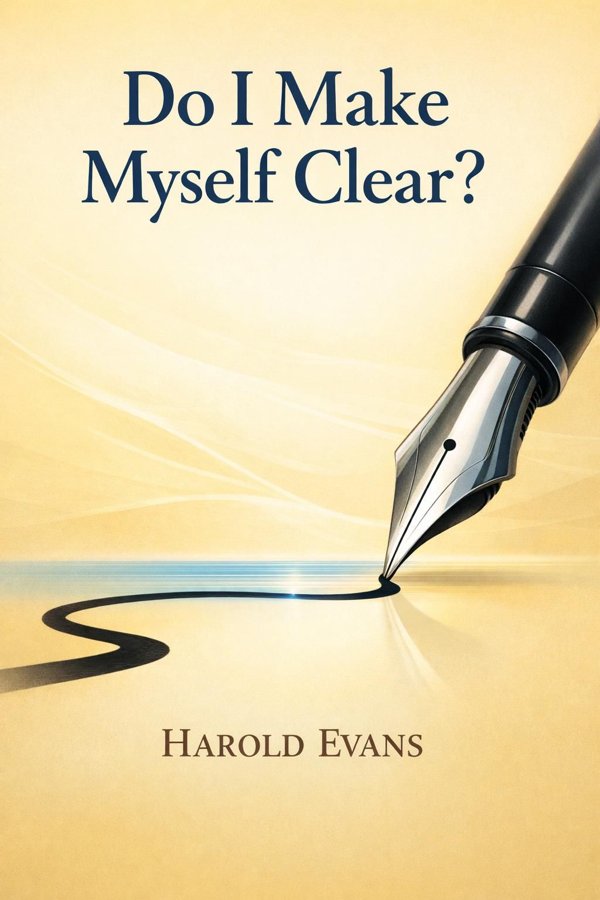
Do I Make Myself Clear?: Why Writing Well Matters: Summary & Key Insights
by Harold Evans
 10 min10 chaptersAudio available
Key Takeaways from Do I Make Myself Clear?: Why Writing Well Matters
Confusion in writing is rarely harmless.
Muddy writing often begins long before the first sentence.
Writing becomes memorable when it uses words that are exact, vivid, and necessary.
Many people either fear grammar or worship it.
Bad writing usually fails in familiar ways.
What Is Do I Make Myself Clear?: Why Writing Well Matters About?
Do I Make Myself Clear?: Why Writing Well Matters by Harold Evans is a writing book spanning 12 pages. Why do so many important messages become harder to understand the moment they are written down? In Do I Make Myself Clear?: Why Writing Well Matters, Harold Evans argues that bad writing is not a minor annoyance but a serious public problem. When governments hide behind jargon, businesses bury meaning in inflated language, and professionals write to impress rather than inform, readers pay the price in confusion, wasted time, and poor decisions. Evans sets out to defend clarity as both a practical skill and a civic duty. Drawing on a remarkable career as a journalist, editor, and publisher, he shows how strong writing depends on clear thinking, concrete language, sound structure, and ruthless revision. The book combines memorable examples, sharp criticism of bloated prose, and encouraging advice for anyone who wants to communicate more effectively. More than a style manual, it is a passionate case for writing that respects the reader. Whether you are a student, manager, journalist, lawyer, public servant, or everyday email writer, Evans offers timeless principles for making your words precise, persuasive, and alive.
This FizzRead summary covers all 10 key chapters of Do I Make Myself Clear?: Why Writing Well Matters in approximately 10 minutes, distilling the most important ideas, arguments, and takeaways from Harold Evans's work. Also available as an audio summary and Key Quotes Podcast.
Do I Make Myself Clear?: Why Writing Well Matters
Why do so many important messages become harder to understand the moment they are written down? In Do I Make Myself Clear?: Why Writing Well Matters, Harold Evans argues that bad writing is not a minor annoyance but a serious public problem. When governments hide behind jargon, businesses bury meaning in inflated language, and professionals write to impress rather than inform, readers pay the price in confusion, wasted time, and poor decisions. Evans sets out to defend clarity as both a practical skill and a civic duty. Drawing on a remarkable career as a journalist, editor, and publisher, he shows how strong writing depends on clear thinking, concrete language, sound structure, and ruthless revision. The book combines memorable examples, sharp criticism of bloated prose, and encouraging advice for anyone who wants to communicate more effectively. More than a style manual, it is a passionate case for writing that respects the reader. Whether you are a student, manager, journalist, lawyer, public servant, or everyday email writer, Evans offers timeless principles for making your words precise, persuasive, and alive.
Who Should Read Do I Make Myself Clear?: Why Writing Well Matters?
This book is perfect for anyone interested in writing and looking to gain actionable insights in a short read. Whether you're a student, professional, or lifelong learner, the key ideas from Do I Make Myself Clear?: Why Writing Well Matters by Harold Evans will help you think differently.
- ✓Readers who enjoy writing and want practical takeaways
- ✓Professionals looking to apply new ideas to their work and life
- ✓Anyone who wants the core insights of Do I Make Myself Clear?: Why Writing Well Matters in just 10 minutes
Want the full summary?
Get instant access to this book summary and 100K+ more with Fizz Moment.
Get Free SummaryAvailable on App Store • Free to download
Key Chapters
Confusion in writing is rarely harmless. Harold Evans insists that unclear language does more than irritate readers; it distorts public life. When official documents, corporate reports, medical instructions, or policy statements are filled with jargon and evasive phrasing, they create distance between institutions and the people they serve. The result is not just awkward prose but diminished trust, weaker accountability, and decisions made without full understanding.
Evans is especially alert to the way bureaucracies use language to disguise reality. Euphemisms can soften hard truths, but they can also hide failure, deny responsibility, or make harmful actions sound routine. A company does not fire workers; it "rightsizes." A government does not make a mistake; it experiences an "implementation challenge." Such phrases blur meaning and reduce emotional honesty. Good writing, by contrast, tells readers plainly what happened, who did it, and why it matters.
This principle extends beyond politics and institutions. In everyday professional life, people often write as though complexity proves intelligence. Evans rejects that habit. If a sentence forces readers to decode what should have been directly stated, the writer has shifted the burden of labor onto the audience. Writing should lighten that burden, not add to it.
A practical example is the difference between "Your request cannot be processed at this time due to procedural irregularities" and "We cannot approve your request because one document is missing." The second version is shorter, kinder, and more useful.
Actionable takeaway: before sending any piece of writing, ask whether it helps the reader understand reality more quickly and truthfully. If not, revise until it does.
Muddy writing often begins long before the first sentence. Evans argues that writers usually become unclear because their thinking is incomplete, disorganized, or evasive. A tangled paragraph is often a symptom of a tangled mind. This is why good writing is not merely about word choice or grammar; it starts with understanding what you actually want to say.
In newsroom culture, where Evans spent much of his life, there is no room for vague comprehension. A reporter who does not grasp the facts cannot explain them. An editor faced with fuzzy copy knows the problem is often conceptual rather than stylistic. Before polishing language, the writer must identify the core point: What happened? Why does it matter? What should the reader know first?
This insight has practical power in every field. Suppose you are writing a project update. If you are unsure whether the main message is delay, progress, risk, or request, your email will likely wander through background details without giving the reader a clear takeaway. But if you first write one sentence to yourself such as, "The project is on schedule, but we need approval by Friday to avoid cost increases," the rest of the message becomes easier to organize.
Evans encourages writers to strip an idea to its essentials before expanding it. Summarize the point in plain speech. If you cannot explain it conversationally, you probably do not understand it well enough to write it well.
Actionable takeaway: before drafting, force yourself to state your main point in one simple sentence. Use that sentence as the compass for everything that follows.
Writing becomes memorable when it uses words that are exact, vivid, and necessary. Evans celebrates the power of language not as ornament but as precision. The right word does not merely decorate a sentence; it sharpens thought, creates rhythm, and helps readers see clearly. Weak writing often relies on abstraction, filler, and fashionable phrases. Strong writing chooses concrete nouns, active verbs, and plain speech.
One of Evans's recurring lessons is that shorter, simpler words often carry more force than longer, more elaborate ones. Compare "utilize" with "use," "commence" with "begin," or "facilitate" with "help." In many contexts, the simpler term is not only easier to read but also more honest. Inflated diction can sound official, but it rarely sounds human.
This does not mean all writing must be plain to the point of dullness. Evans loves energetic prose. He values cadence, personality, and style. But style should grow from accuracy and confidence, not from verbal puffery. A sentence should feel alive because each word earns its place.
In practice, this matters in everything from speeches to product descriptions. Instead of writing, "Our organization is committed to the optimization of customer-centric outcomes," write, "We want to serve customers faster and better." The second version says more because it hides less.
Writers can improve quickly by developing sensitivity to overused terms and dead phrases. Whenever a sentence sounds as though it could have been written by anyone for anything, it probably needs revision.
Actionable takeaway: during editing, circle every abstract or inflated word and ask, "Can I replace this with a simpler, more concrete one?" Do that consistently, and your prose will gain strength.
Many people either fear grammar or worship it. Evans takes a more practical view: grammar matters because it helps meaning travel cleanly from writer to reader. Rules are useful not as badges of superiority but as tools for preventing ambiguity, confusion, and accidental comedy. Good grammar supports clarity, pace, and emphasis.
Evans does not treat grammar as a set of rigid commandments detached from real writing. Instead, he shows how sentence structure affects understanding. A misplaced modifier can distort a fact. A chain of subordinate clauses can bury the point. Passive constructions can hide responsibility. Punctuation can alter rhythm and meaning. In each case, grammar becomes important because it shapes what the reader grasps.
Take a simple example: "After reviewing the case, the policy was changed." Who reviewed the case? The sentence omits the actor. A clearer version would be, "After reviewing the case, the committee changed the policy." The revision identifies responsibility and improves flow. Likewise, compare a bloated sentence with multiple interruptions to one that moves in a straight line toward its point. Readers understand faster when syntax is under control.
Evans also reminds writers that rules are not ends in themselves. Sometimes a fragment can create emphasis. Sometimes a sentence can begin with "And." What matters is whether the choice improves communication. The best writers know the rules well enough to use them intelligently, not timidly.
Actionable takeaway: revise every sentence for one question only: does the structure make the meaning easier or harder to understand? If harder, simplify the grammar until the idea becomes unmistakable.
Bad writing usually fails in familiar ways. Evans identifies recurring habits that make prose dull, confusing, or pompous: clichés, unnecessary adverbs, nominalizations, passive constructions, overlong sentences, and vague abstractions. These habits are dangerous because they often feel normal. Writers imitate the language around them, especially in workplaces where bloated prose has become institutional custom.
Consider nominalizations, the turning of verbs into heavy nouns: instead of "decide," writers produce "make a decision"; instead of "analyze," they write "conduct an analysis." This pattern adds bulk without adding meaning. Likewise, strings of passive verbs can make responsibility vanish: "Mistakes were made" is weaker and less accountable than "We made mistakes."
Clichés are another enemy. Phrases like "at the end of the day," "moving forward," or "think outside the box" save the writer from thinking freshly and force the reader to process dead language. The problem is not just stylistic boredom. Clichés often conceal weak ideas. If the thought were sharper, the wording would likely be fresher.
Long sentences are not always bad, but long unclear sentences are. Evans does not ban complexity; he demands control. A sentence can be extended if each clause adds something and the reader can follow the path.
A useful application is to audit workplace documents for repeated offenders. In memos, reports, and presentations, replace phrases like "undertake an evaluation" with "evaluate," and "provide assistance" with "help." Such edits can dramatically improve readability.
Actionable takeaway: create a personal blacklist of your most common writing crutches, then search for them during revision and replace them with direct alternatives.
First drafts reveal ideas; revision makes them readable. Evans places enormous value on editing, not as cosmetic cleanup but as the central act of writing well. The draft is where you discover what you think. The edit is where you decide what the reader needs. This shift in perspective is crucial. Weak writers stop when they have said something. Strong writers continue until the message lands clearly.
Editors, in Evans's world, are not enemies of style but guardians of sense. They test structure, challenge ambiguity, cut repetition, improve order, and strengthen emphasis. Good editing also protects tone. It removes accidental harshness, unnecessary formality, and self-indulgence. In journalism especially, editing can be the difference between information and impact.
Evans encourages writers to cultivate editorial distance from their own words. That may mean reading aloud, printing the text, setting it aside for a few hours, or asking someone else where they became confused. These methods help expose problems the writer has become blind to. Reading aloud is especially effective because awkward rhythm often signals unclear thinking.
A practical revision process might include four passes: first for structure, second for clarity, third for concision, and fourth for tone and correctness. On the structure pass, ensure the main point comes early. On the clarity pass, remove ambiguity. On the concision pass, cut every unnecessary word. On the tone pass, make sure the writing sounds human and appropriate.
Actionable takeaway: never judge your writing by the first draft. Build a deliberate revision routine and assume that at least one serious edit is necessary before your words are ready for readers.
The most persuasive writing is not the loudest or most elaborate; it is the clearest, best structured, and most trustworthy. Evans shows that persuasion grows from respect for facts and respect for readers. A writer who manipulates language too obviously, hides weaknesses, or relies on grandiose claims may attract attention but rarely earns lasting conviction.
Good persuasive writing begins by understanding the audience's questions and objections. It then answers them plainly. Instead of drowning readers in exaggerated adjectives or abstract mission language, the writer should present evidence, choose strong examples, and arrange the argument logically. Clarity here is not separate from persuasion; it is persuasion. People are more likely to be moved by what they can understand and verify.
This principle works in many settings. In a job application, saying "I increased customer retention by 18% in six months" is more persuasive than saying "I consistently delivered high-impact customer engagement outcomes." In a public campaign, a direct phrase like "clean water for every child" outperforms jargon-heavy policy slogans because it gives readers something concrete to hold onto.
Evans also values tone. Persuasion weakens when writing becomes pompous, hectoring, or self-important. Confidence is useful; swagger is not. The writer's job is to make the case so well that the prose does not need to shout.
Actionable takeaway: when writing to persuade, replace inflated claims with evidence, examples, and plain language. If your argument cannot survive simplification, strengthen the argument rather than dressing it up.
Information alone is not enough. Evans understands that readers grasp facts more readily when those facts are shaped into a coherent narrative. This is especially true in reporting, but the principle applies widely: whether you are writing a case study, a presentation, or a policy brief, people understand better when they can follow a sequence, see stakes, and recognize human consequences.
Journalistic storytelling, in Evans's view, does not mean inventing drama. It means selecting meaningful detail, establishing context, and organizing material so that readers care and remember. A strong piece of reporting identifies what happened, to whom, under what conditions, and with what consequences. It avoids both dry data-dumping and melodrama.
For example, a report on housing shortages could begin with statistics, but it becomes more readable if it opens with a family waiting months for a flat, then broadens to show the larger system behind that struggle. The anecdote creates entry; the evidence provides scope. Together they produce both emotional and intellectual understanding.
This method also improves business and academic writing. A team update becomes clearer when framed as a problem, an action, and a result. A research summary becomes more engaging when it begins with the real-world question that motivated the study.
Evans's deeper point is that readers are human beings, not data processors. To write well is to guide attention and meaning. Facts matter enormously, but how they are presented determines whether they sink in.
Actionable takeaway: when explaining any complex issue, ask yourself what human example, sequence, or consequence can give the facts a shape the reader can easily follow.
Behind much good writing stands an invisible advocate for the reader: the editor. Evans, one of journalism's great editors, makes a compelling case that editing is not secondary labor but a form of leadership. Editors improve more than grammar. They clarify purpose, demand evidence, challenge vagueness, improve emphasis, and ask the most important question of all: what will the reader understand after this?
A healthy editorial culture assumes that writing improves through scrutiny. In weak organizations, people are afraid to question each other's prose, and bad language spreads unchecked. In strong organizations, editing is expected, vigorous, and collaborative. The goal is not to flatten individuality but to prevent self-indulgence and confusion.
Evans also stresses the ethical dimension of editing. Editors can stop misleading phrasing, unsupported claims, and hidden assumptions before they reach the public. They are quality control for truth as much as for style. This matters especially in journalism, law, public policy, and corporate communication, where unclear language can shape real-world outcomes.
Even writers working alone can adopt an editor's mindset. Imagine an impatient but intelligent reader. Where would that reader stumble? What term would need definition? Which sentence dodges responsibility? Which paragraph starts too slowly? Such questions transform revision from mere tidying into service.
The digital age has made self-publishing easier, but it has not made editors less necessary. If anything, the flood of content increases the value of those who can make writing clean, reliable, and readable.
Actionable takeaway: whether or not you have a formal editor, revise as if you are accountable to one. Read with the reader's impatience in mind, and cut anything that wastes or confuses their attention.
Modern communication tools tempt us to write quickly, casually, and constantly. Evans recognizes that email, online publishing, and digital media have changed how words circulate, but he warns that speed does not excuse muddle. In fact, the faster writing moves, the more important clarity becomes. Confusing language can now spread instantly to thousands or millions of readers.
Digital writing introduces special pressures. Attention spans are fragmented. Screens reward brevity. Readers skim before they commit. Yet these realities do not justify carelessness. They demand stronger structure: clear subject lines, informative openings, short paragraphs, precise wording, and visible hierarchy. A message should announce its purpose early because readers may never reach the fourth paragraph.
At the same time, Evans would resist the idea that digital writing must be shallow. Concision is not the same as simplification. A well-written email can be both brief and complete. A strong online article can be accessible without being thin. What matters is discipline. Writers must decide what the reader needs now, what can be omitted, and what must be stated unmistakably.
Consider two versions of an email. One begins, "I hope you're well. I just wanted to circle back regarding the matter we previously discussed." Another begins, "Please send the revised contract by 3 p.m. today so we can submit it before the deadline." The second respects time and purpose.
Digital communication also preserves mistakes. Sloppy wording can be forwarded, screenshot, and misread long after it was written.
Actionable takeaway: for every digital message, put the purpose first, keep the structure visible, and remove any phrase that delays understanding.
All Chapters in Do I Make Myself Clear?: Why Writing Well Matters
About the Author
Harold Evans (1928-2020) was a British-born journalist, editor, author, and publisher whose career made him one of the most respected voices in modern journalism. He rose to prominence as editor of The Sunday Times in London, where he oversaw influential investigative reporting and championed rigorous editorial standards. Later, he moved to the United States and served in major publishing roles, including president and publisher of Random House. Evans was admired for his sharp mind, moral seriousness, and deep belief in the power of language to inform public life. He wrote widely on journalism, history, and writing, and he remained a passionate defender of clarity, truth, and accountability throughout his career. He was knighted for services to journalism and literature.
Get This Summary in Your Preferred Format
Read or listen to the Do I Make Myself Clear?: Why Writing Well Matters summary by Harold Evans anytime, anywhere. FizzRead offers multiple formats so you can learn on your terms — all free.
Available formats: App · Audio · PDF · EPUB — All included free with FizzRead
Download Do I Make Myself Clear?: Why Writing Well Matters PDF and EPUB Summary
Key Quotes from Do I Make Myself Clear?: Why Writing Well Matters
“Confusion in writing is rarely harmless.”
“Muddy writing often begins long before the first sentence.”
“Writing becomes memorable when it uses words that are exact, vivid, and necessary.”
“Many people either fear grammar or worship it.”
“Bad writing usually fails in familiar ways.”
Frequently Asked Questions about Do I Make Myself Clear?: Why Writing Well Matters
Do I Make Myself Clear?: Why Writing Well Matters by Harold Evans is a writing book that explores key ideas across 10 chapters. Why do so many important messages become harder to understand the moment they are written down? In Do I Make Myself Clear?: Why Writing Well Matters, Harold Evans argues that bad writing is not a minor annoyance but a serious public problem. When governments hide behind jargon, businesses bury meaning in inflated language, and professionals write to impress rather than inform, readers pay the price in confusion, wasted time, and poor decisions. Evans sets out to defend clarity as both a practical skill and a civic duty. Drawing on a remarkable career as a journalist, editor, and publisher, he shows how strong writing depends on clear thinking, concrete language, sound structure, and ruthless revision. The book combines memorable examples, sharp criticism of bloated prose, and encouraging advice for anyone who wants to communicate more effectively. More than a style manual, it is a passionate case for writing that respects the reader. Whether you are a student, manager, journalist, lawyer, public servant, or everyday email writer, Evans offers timeless principles for making your words precise, persuasive, and alive.
You Might Also Like
The Art of Perspective
Christopher Castellani
10 min
Making a Point: The Persnickety Story of English Punctuation
David Crystal
10 min
The Elements Of Eloquence: How To Turn The Perfect English Phrase
Mark Forsyth
10 min
The Pocket Muse: Ideas and Inspirations for Writing
Monica Wood
10 min
A Little Book on Form: An Exploration into the Formal Imagination of Poetry
Robert Hass
10 min
Adventures In The Screen Trade: A Personal View Of Hollywood And Screenwriting
William Goldman
10 minBrowse by Category
Ready to read Do I Make Myself Clear?: Why Writing Well Matters?
Get the full summary and 100K+ more books with Fizz Moment.