
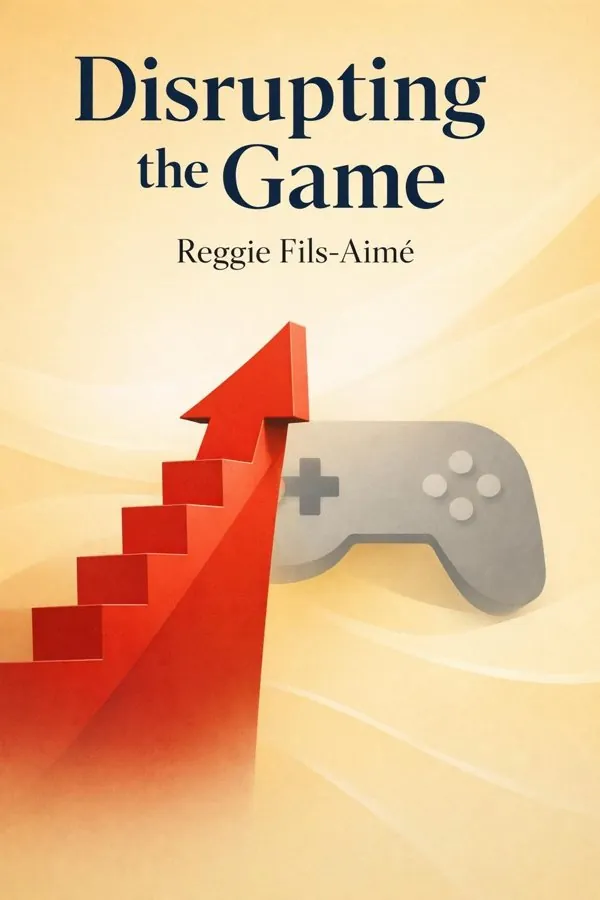
Disrupting the Game: From the Bronx to the Top of Nintendo: Summary & Key Insights
 10 min9 chaptersAudio available
Key Takeaways from Disrupting the Game: From the Bronx to the Top of Nintendo
Ambition often begins long before a career does.
Great leaders are rarely built in one dramatic moment; they are assembled through repeated exposure to demanding systems.
Sometimes disruption starts with how you show up.
The most powerful innovation does not always come from adding complexity; sometimes it comes from removing barriers.
A common mistake in business is to confuse ambition with expansion in every direction.
What Is Disrupting the Game: From the Bronx to the Top of Nintendo About?
Disrupting the Game: From the Bronx to the Top of Nintendo by Reggie Fils-Aimé is a biographies book spanning 6 pages. Disrupting the Game is part memoir, part leadership playbook, and part business case study. In it, Reggie Fils-Aimé traces his path from a modest upbringing in the Bronx as the son of Haitian immigrants to one of the most visible and influential roles in the global video game industry: President and COO of Nintendo of America. But this is not simply a success story about rising through the ranks. It is a book about how values, preparation, resilience, and strategic risk-taking shape a leader over time. What makes the book especially compelling is Fils-Aimé’s unusual combination of warmth, candor, and operational insight. He writes not only about his years at Nintendo, including the Wii era and major platform launches, but also about the formative lessons he learned at Procter & Gamble, Pizza Hut, and VH1. Those experiences taught him how to understand consumers, challenge stale assumptions, and build teams around clear goals. For readers interested in leadership, innovation, career growth, or the business of entertainment, Disrupting the Game matters because it shows that meaningful disruption is rarely reckless. It is disciplined, customer-focused, and rooted in the courage to stand for something.
This FizzRead summary covers all 9 key chapters of Disrupting the Game: From the Bronx to the Top of Nintendo in approximately 10 minutes, distilling the most important ideas, arguments, and takeaways from Reggie Fils-Aimé's work. Also available as an audio summary and Key Quotes Podcast.
Disrupting the Game: From the Bronx to the Top of Nintendo
Disrupting the Game is part memoir, part leadership playbook, and part business case study. In it, Reggie Fils-Aimé traces his path from a modest upbringing in the Bronx as the son of Haitian immigrants to one of the most visible and influential roles in the global video game industry: President and COO of Nintendo of America. But this is not simply a success story about rising through the ranks. It is a book about how values, preparation, resilience, and strategic risk-taking shape a leader over time.
What makes the book especially compelling is Fils-Aimé’s unusual combination of warmth, candor, and operational insight. He writes not only about his years at Nintendo, including the Wii era and major platform launches, but also about the formative lessons he learned at Procter & Gamble, Pizza Hut, and VH1. Those experiences taught him how to understand consumers, challenge stale assumptions, and build teams around clear goals.
For readers interested in leadership, innovation, career growth, or the business of entertainment, Disrupting the Game matters because it shows that meaningful disruption is rarely reckless. It is disciplined, customer-focused, and rooted in the courage to stand for something.
Who Should Read Disrupting the Game: From the Bronx to the Top of Nintendo?
This book is perfect for anyone interested in biographies and looking to gain actionable insights in a short read. Whether you're a student, professional, or lifelong learner, the key ideas from Disrupting the Game: From the Bronx to the Top of Nintendo by Reggie Fils-Aimé will help you think differently.
- ✓Readers who enjoy biographies and want practical takeaways
- ✓Professionals looking to apply new ideas to their work and life
- ✓Anyone who wants the core insights of Disrupting the Game: From the Bronx to the Top of Nintendo in just 10 minutes
Want the full summary?
Get instant access to this book summary and 100K+ more with Fizz Moment.
Get Free SummaryAvailable on App Store • Free to download
Key Chapters
Ambition often begins long before a career does. For Reggie Fils-Aimé, the roots of leadership were planted in the Bronx, where he grew up in a Haitian immigrant family that prized education, discipline, and self-respect. His parents had endured upheaval and sacrifice to create better opportunities for their children, and that family history gave achievement a deeper meaning. Success was not just personal advancement; it was a way of honoring the risks others had taken on his behalf.
The book shows how environment can shape a person without defining their limits. The Bronx exposed Fils-Aimé to challenge, diversity, and toughness, while his family taught him that excellence was expected, not optional. Those early years built the inner framework he would carry into every classroom and boardroom. At Cornell, that framework expanded. College was not simply a credentialing step; it was where he sharpened his curiosity, learned to navigate elite institutions, and discovered the importance of voice. He began to see that talent matters, but confidence, preparation, and the ability to present your ideas matter just as much.
This section is especially useful for readers who underestimate the long arc of personal development. Fils-Aimé’s story suggests that leadership starts with identity: understanding where you come from, what you value, and what standard you hold yourself to when nobody is watching. A practical application is to reflect on the early influences that still shape your decisions today. Which beliefs support your growth, and which ones limit it?
Actionable takeaway: Write a short personal leadership origin story that identifies three formative influences from your early life and one standard you want those experiences to help you uphold in your work.
Great leaders are rarely built in one dramatic moment; they are assembled through repeated exposure to demanding systems. Before Nintendo made him famous, Fils-Aimé developed his managerial instincts inside major corporations such as Procter & Gamble, Pizza Hut, and VH1. These roles gave him a practical education in marketing, operations, consumer psychology, and organizational politics. Each company taught him a different language of business, and together they formed the foundation of his later success.
At Procter & Gamble, he learned rigor. Marketing there was not guesswork or creative intuition alone; it was rooted in disciplined analysis of customer behavior. That lesson would remain central throughout his career: strong decisions start with a deep understanding of what people actually want, not what executives assume they want. At Pizza Hut, he saw how brands live or die based on execution, speed, and responsiveness to shifting consumer expectations. At VH1, he operated closer to media and culture, learning how audience engagement depends on relevance and storytelling.
What makes this chapter valuable is its rejection of the myth that only glamorous jobs matter. Fils-Aimé shows that every role can become leadership training if you pay attention to the underlying lessons. Consumer insight, cross-functional collaboration, and strategic communication are transferable assets. Readers can apply this by treating their current job not as a fixed identity but as a laboratory. Ask: what is this role teaching me about customers, teams, conflict, or execution that I can carry forward?
Actionable takeaway: Make a two-column list of your past jobs or major projects and the leadership skills each one taught you; then identify one overlooked skill you can deliberately strengthen in your current role.
Sometimes disruption starts with how you show up. When Fils-Aimé joined Nintendo, he entered a company with an extraordinary legacy but also a set of market challenges. The gaming industry was fiercely competitive, and Nintendo needed to sharpen how it communicated its value to consumers, retailers, and the broader culture. Fils-Aimé quickly became a visible public face of the brand, but his impact was not merely performative. He helped reposition Nintendo with a clearer, bolder, and more confident voice.
His famous debut line, “My name is Reggie. I’m about kicking ass, I’m about taking names, and we’re about making games,” became iconic because it captured something audiences had not seen before from Nintendo of America: swagger paired with strategic intent. Yet the book makes clear that charisma alone is insufficient. Presence works when it reflects substance. Fils-Aimé had already done the internal work of understanding the company, its products, and its competitive pressures. He used communication as a business tool, not just a branding flourish.
This idea matters for anyone leading change inside an established organization. A new strategy often fails because employees, partners, or customers do not feel its energy or clarity. Leaders must signal direction in ways people can remember. That does not require theatricality; it requires authenticity, confidence, and alignment between message and action. A manager launching a new initiative, for example, can borrow this approach by articulating the mission in a concise, memorable way and then consistently reinforcing it through decisions and behavior.
Actionable takeaway: Create a one-sentence leadership message for your team or project that clearly states what you stand for, then make sure your next three actions visibly support that message.
The most powerful innovation does not always come from adding complexity; sometimes it comes from removing barriers. One of the most important business lessons in Disrupting the Game is the philosophy behind the Nintendo Wii. Rather than competing directly on raw technical power with rivals such as Sony and Microsoft, Nintendo pursued a different path. It focused on accessibility, intuitive play, and broadening the definition of who games were for.
This was a disruptive move because it challenged industry assumptions. Many companies were obsessed with serving core gamers through increasingly sophisticated hardware and graphics. Nintendo asked a more expansive question: what if the future of gaming includes families, older adults, casual players, and people who have never thought of themselves as gamers at all? The Wii’s motion controls and approachable design turned that idea into a global phenomenon. Its success showed that markets can grow dramatically when you stop designing exclusively for insiders.
Fils-Aimé’s account highlights a principle relevant far beyond gaming: inclusive innovation is not charity or simplification; it is strategy. Businesses often miss growth opportunities because they over-serve experts and under-serve everyone else. In practical terms, that might mean redesigning a product interface, simplifying onboarding, reducing jargon, or identifying a customer segment your industry ignores. The key is to understand friction from the user’s perspective rather than your own.
Actionable takeaway: Examine one product, service, or process you use or manage and ask, “What would make this easier for a complete beginner?” Then implement one change that reduces intimidation, confusion, or unnecessary effort.
A common mistake in business is to confuse ambition with expansion in every direction. Fils-Aimé’s career at Nintendo illustrates a more disciplined truth: strategy is as much about deciding what not to pursue as it is about chasing opportunity. Nintendo’s success during key periods came not from copying competitors but from understanding its own strengths and making deliberate trade-offs.
The company did not try to win every technological arms race. Instead, it leaned into distinctive intellectual property, imaginative hardware experiences, and gameplay that emphasized fun and social connection. That required restraint. It is tempting for companies, especially under pressure, to imitate market leaders or stretch themselves thin across trends. But imitation often weakens identity. Fils-Aimé repeatedly emphasizes the importance of aligning decisions with the company’s core capabilities and long-term values.
This idea is useful for entrepreneurs, executives, and individual professionals alike. A team that says yes to every client request may lose focus. A startup that chases every adjacent market may dilute its value proposition. A person who tries to develop ten priorities at once may make little real progress on any. Better strategy starts by identifying the few choices that create meaningful distinction and then protecting them.
In daily work, this can mean setting explicit boundaries: which customers are your priority, which features truly matter, which meetings are essential, or which metrics define success. Saying no becomes easier when it is tied to a clear vision of what you are trying to build.
Actionable takeaway: Identify one current commitment, feature, or goal that does not support your main strategy, and either eliminate it, delegate it, or postpone it to create room for higher-value work.
Many organizations talk about culture as if it were a slogan on a wall, but Fils-Aimé treats it as something more concrete: the repeated behaviors leaders reward, tolerate, and model. During his time at Nintendo of America, he worked to shape a culture that balanced accountability with creativity, candor with respect, and performance with purpose. The book shows that healthy culture does not emerge automatically from good intentions. It is built through systems, expectations, and everyday interactions.
One of Fils-Aimé’s strengths as a leader was his willingness to challenge complacency. He believed teams should be clear about goals, honest about shortcomings, and aligned around measurable outcomes. At the same time, he understood that people perform best when they feel trusted and connected to a meaningful mission. This blend of high standards and human connection is what makes culture durable. Fear may drive short-term compliance, but it rarely creates commitment or innovation.
The lesson applies to organizations of every size. A startup founder shapes culture by how they respond to mistakes. A department head shapes it by whether meetings invite dissent or punish it. A project manager shapes it by whether credit is shared fairly. Culture becomes visible in moments of tension, not just celebration. If you want a more open and effective team, you must model the behaviors you expect from others.
Actionable takeaway: Choose one cultural value you care about, such as accountability, openness, or collaboration, and define one observable behavior that demonstrates it. Then practice and reinforce that behavior consistently over the next month.
In a world of polished executive personas, authenticity can be surprisingly disruptive. Fils-Aimé became memorable not simply because he was articulate or charismatic, but because he projected a genuine, unmistakable personality. He did not try to fit a generic mold of what a gaming executive should look or sound like. That authenticity helped him connect with fans, retailers, media, and employees in ways that felt real rather than scripted.
The deeper lesson is that authenticity is not the same as impulsiveness or overexposure. Fils-Aimé’s public image worked because it was grounded in competence and intention. He understood the role visibility played in building confidence around Nintendo’s direction, and he used his personality to reinforce the company’s message. In that sense, authenticity became strategic: it increased trust, made communication more memorable, and differentiated both the leader and the brand.
For readers, this idea is especially relevant in careers where people feel pressure to become blandly professional. Authenticity does not mean saying everything you think. It means expressing your values, voice, and strengths clearly enough that others understand what makes you distinctive. A teacher, consultant, engineer, or founder can all apply this by communicating with more honesty and consistency instead of hiding behind empty corporate language.
To use authenticity effectively, you need self-awareness. What qualities do people reliably associate with you? Which of those create trust and energy? Which habits undermine your credibility? When you answer those questions honestly, you can lead with more coherence.
Actionable takeaway: Ask three trusted colleagues to describe the qualities that feel most genuine and impactful in your communication, then lean into those strengths more intentionally in your next presentation, meeting, or leadership conversation.
A successful career is not only about climbing; it is also about knowing when and how to transition. In the later part of Disrupting the Game, Fils-Aimé reflects on retirement from Nintendo not as withdrawal, but as reinvention. After years of operating at the center of a major entertainment company, he moved into a new phase that included board service, teaching, mentoring, and broader forms of influence. This shift reveals an important truth: leadership can evolve without losing momentum.
Many professionals treat retirement or career transitions as identity threats because their self-worth has become fused with a title. Fils-Aimé offers a healthier model. He recognizes the satisfaction of his accomplishments while remaining open to new ways of contributing. That mindset requires humility and foresight. It means preparing for life beyond a single role and understanding that the value you bring is larger than your job description.
This lesson is relevant even for readers far from retirement. Career resilience improves when you build portable strengths, diverse relationships, and interests that extend beyond your current position. A person who mentors others, joins boards, teaches, writes, or develops outside expertise is better equipped for future transitions. Instead of waiting until a change is forced upon you, you can shape your next chapter proactively.
Actionable takeaway: Define one way you want to contribute beyond your current formal role, such as mentoring, teaching, advising, or community leadership, and take a concrete first step toward it this month.
The word disruption is often used carelessly, as if breaking norms is automatically valuable. Fils-Aimé’s story offers a more disciplined definition. Real disruption is not rebellion for its own sake. It is the act of challenging assumptions in service of a better outcome, and it succeeds only when paired with preparation, insight, and execution.
Across the book, whether he is discussing his immigrant family background, his corporate training, or Nintendo’s biggest strategic bets, the pattern is consistent. Bold moves matter, but they work because they are built on groundwork. The Wii was disruptive because Nintendo deeply understood underserved consumers. Fils-Aimé’s personal rise was disruptive because he combined confidence with competence. His leadership style stood out because it was rooted in values, not image alone.
This broader message ties the memoir together. Readers are encouraged to question inherited rules, but also to earn the right to challenge them. Before disrupting a process at work, learn how it functions. Before pushing for a new strategy, understand the customer and the numbers. Before demanding a bigger role, prove that you can deliver under pressure. Purpose gives disruption meaning, and preparation gives it force.
This is especially practical in fast-moving industries, where novelty is often rewarded more than substance. Fils-Aimé reminds us that sustainable impact comes from combining vision with discipline. The strongest leaders are not merely contrarian; they are useful.
Actionable takeaway: Before proposing your next big idea, prepare a one-page case that explains the problem, the customer impact, the evidence behind your recommendation, and the trade-offs involved. Make your disruption credible.
All Chapters in Disrupting the Game: From the Bronx to the Top of Nintendo
About the Author
Reggie Fils-Aimé is an American business executive and former President and COO of Nintendo of America, where he served from 2006 to 2019. Born in the United States to Haitian immigrant parents and raised in the Bronx, he built his career through a series of influential roles in consumer products, food service, and media before entering the video game industry. His previous positions at Procter & Gamble, Pizza Hut, and VH1 helped shape his expertise in marketing, operations, and brand strategy. At Nintendo, he became known for his dynamic public appearances, strong leadership during the Wii era, and emphasis on customer-focused innovation. Since retiring, he has remained active through board service, teaching, mentoring, and speaking on business and leadership.
Get This Summary in Your Preferred Format
Read or listen to the Disrupting the Game: From the Bronx to the Top of Nintendo summary by Reggie Fils-Aimé anytime, anywhere. FizzRead offers multiple formats so you can learn on your terms — all free.
Available formats: App · Audio · PDF · EPUB — All included free with FizzRead
Download Disrupting the Game: From the Bronx to the Top of Nintendo PDF and EPUB Summary
Key Quotes from Disrupting the Game: From the Bronx to the Top of Nintendo
“Ambition often begins long before a career does.”
“Great leaders are rarely built in one dramatic moment; they are assembled through repeated exposure to demanding systems.”
“Sometimes disruption starts with how you show up.”
“The most powerful innovation does not always come from adding complexity; sometimes it comes from removing barriers.”
“A common mistake in business is to confuse ambition with expansion in every direction.”
Frequently Asked Questions about Disrupting the Game: From the Bronx to the Top of Nintendo
Disrupting the Game: From the Bronx to the Top of Nintendo by Reggie Fils-Aimé is a biographies book that explores key ideas across 9 chapters. Disrupting the Game is part memoir, part leadership playbook, and part business case study. In it, Reggie Fils-Aimé traces his path from a modest upbringing in the Bronx as the son of Haitian immigrants to one of the most visible and influential roles in the global video game industry: President and COO of Nintendo of America. But this is not simply a success story about rising through the ranks. It is a book about how values, preparation, resilience, and strategic risk-taking shape a leader over time. What makes the book especially compelling is Fils-Aimé’s unusual combination of warmth, candor, and operational insight. He writes not only about his years at Nintendo, including the Wii era and major platform launches, but also about the formative lessons he learned at Procter & Gamble, Pizza Hut, and VH1. Those experiences taught him how to understand consumers, challenge stale assumptions, and build teams around clear goals. For readers interested in leadership, innovation, career growth, or the business of entertainment, Disrupting the Game matters because it shows that meaningful disruption is rarely reckless. It is disciplined, customer-focused, and rooted in the courage to stand for something.
You Might Also Like

An American Marriage
Tayari Jones
10 min
Benjamin Franklin: An American Life
Walter Isaacson
10 min
I Know Why The Caged Bird Sings
Maya Angelou
10 min
Long Walk to Freedom
Nelson Mandela
10 min
Persepolis
Marjane Satrapi
10 min
Surely You're Joking, Mr. Feynman!
Richard P. Feynman
10 minBrowse by Category
Ready to read Disrupting the Game: From the Bronx to the Top of Nintendo?
Get the full summary and 100K+ more books with Fizz Moment.