
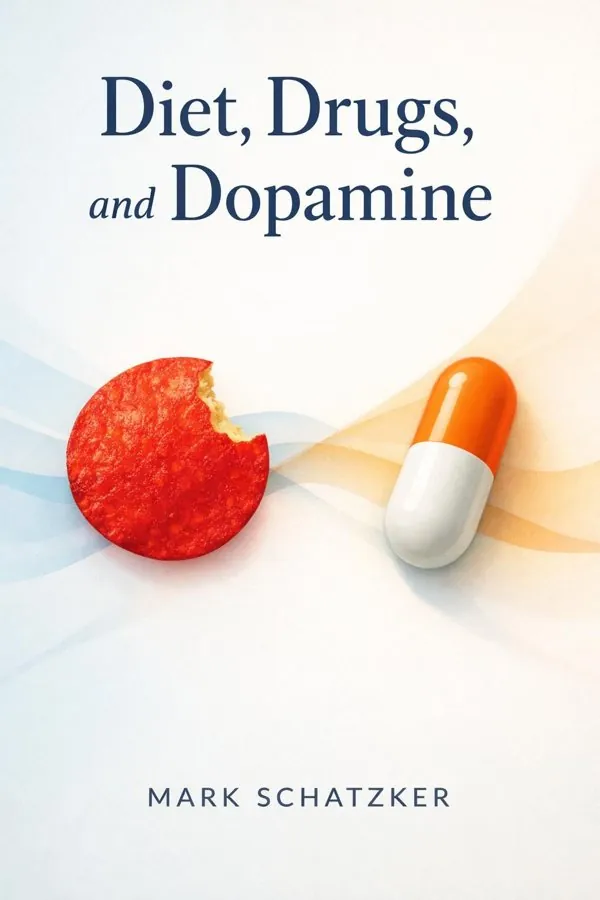
Diet, Drugs, and Dopamine: Summary & Key Insights
 10 min9 chaptersAudio available
Key Takeaways from Diet, Drugs, and Dopamine
Long before calorie counts and ingredient panels, taste was a biological map.
The most important innovation in modern food may not be convenience, shelf life, or price.
Many people think dopamine is the brain’s pleasure chemical, but Schatzker emphasizes a more useful truth: dopamine is deeply involved in wanting, learning, and motivation.
Overeating often looks like a failure of discipline, but Schatzker reframes it as a predictable outcome of highly stimulating food environments.
One of Schatzker’s boldest moves is to place food and drugs on the same conceptual map.
What Is Diet, Drugs, and Dopamine About?
Diet, Drugs, and Dopamine by Mark Schatzker is a nutrition book spanning 5 pages. Diet, Drugs, and Dopamine examines a troubling modern paradox: if we know more about nutrition than any generation before us, why do so many of us still struggle with overeating, cravings, and chronic metabolic disease? In this provocative work, journalist Mark Schatzker argues that the answer lies not only in willpower or bad choices, but in a profound mismatch between ancient biology and modern food design. He explores how ultra-processed foods, synthetic flavors, and even certain drugs manipulate the brain’s reward circuitry, especially dopamine, in ways that can sever pleasure from nourishment. The result is a world where taste no longer reliably signals what the body needs, and appetite becomes increasingly confused. Schatzker is a compelling guide because he blends investigative journalism, nutrition science, neuroscience, and cultural history into a highly readable argument. Rather than offering another simplistic diet plan, he asks a deeper question about why natural appetite has become so unreliable. The book matters because it reframes overeating not as a personal moral failure, but as a predictable response to an engineered environment built to hijack desire.
This FizzRead summary covers all 9 key chapters of Diet, Drugs, and Dopamine in approximately 10 minutes, distilling the most important ideas, arguments, and takeaways from Mark Schatzker's work. Also available as an audio summary and Key Quotes Podcast.
Diet, Drugs, and Dopamine
Diet, Drugs, and Dopamine examines a troubling modern paradox: if we know more about nutrition than any generation before us, why do so many of us still struggle with overeating, cravings, and chronic metabolic disease? In this provocative work, journalist Mark Schatzker argues that the answer lies not only in willpower or bad choices, but in a profound mismatch between ancient biology and modern food design. He explores how ultra-processed foods, synthetic flavors, and even certain drugs manipulate the brain’s reward circuitry, especially dopamine, in ways that can sever pleasure from nourishment. The result is a world where taste no longer reliably signals what the body needs, and appetite becomes increasingly confused. Schatzker is a compelling guide because he blends investigative journalism, nutrition science, neuroscience, and cultural history into a highly readable argument. Rather than offering another simplistic diet plan, he asks a deeper question about why natural appetite has become so unreliable. The book matters because it reframes overeating not as a personal moral failure, but as a predictable response to an engineered environment built to hijack desire.
Who Should Read Diet, Drugs, and Dopamine?
This book is perfect for anyone interested in nutrition and looking to gain actionable insights in a short read. Whether you're a student, professional, or lifelong learner, the key ideas from Diet, Drugs, and Dopamine by Mark Schatzker will help you think differently.
- ✓Readers who enjoy nutrition and want practical takeaways
- ✓Professionals looking to apply new ideas to their work and life
- ✓Anyone who wants the core insights of Diet, Drugs, and Dopamine in just 10 minutes
Want the full summary?
Get instant access to this book summary and 100K+ more with Fizz Moment.
Get Free SummaryAvailable on App Store • Free to download
Key Chapters
Long before calorie counts and ingredient panels, taste was a biological map. Humans evolved in environments where flavor usually told the truth. Sweetness signaled energy-rich fruit or honey, saltiness hinted at essential minerals, bitterness warned of toxins, and umami often pointed toward protein and nutrient density. In that older world, pleasure was not the enemy of health. It was one of nature’s most elegant teaching tools, steering people toward what their bodies needed and away from what could harm them.
Schatzker shows that this ancient arrangement depended on a tight link between sensory pleasure and actual nourishment. A ripe peach tasted good because it contained valuable nutrients and calories. Rich animal foods were satisfying because their flavor reflected real biochemical benefits. Appetite, in this sense, was intelligent. It was not perfect, but it was generally adaptive.
The modern diet has disrupted this relationship. Today, food can taste intensely rewarding without delivering the nutrition that flavor once promised. Strawberry flavor might come from a lab rather than fruit. Cheese flavor may appear in a puffed snack containing little of the protein or micronutrients that traditionally accompanied savory taste. As a result, the brain receives the signal of reward, but the body does not receive the expected payoff.
This idea has practical implications. It helps explain why people can continue eating foods that seem satisfying in the moment yet leave them oddly unfulfilled soon after. If flavor no longer reflects nourishment, appetite loses a reliable guide.
Actionable takeaway: Treat strong flavor as a clue, not proof, of nutrition. Choose foods in which taste and nutrients still travel together, such as fruit, eggs, yogurt, legumes, nuts, fish, and minimally processed meats.
The most important innovation in modern food may not be convenience, shelf life, or price. It may be deception. Schatzker argues that food engineering has steadily uncoupled taste from nutrition, allowing manufacturers to create products that deliver maximum sensory excitement at minimum biological cost. This shift did not happen accidentally. It emerged through advances in flavor chemistry, processing, additives, and texture design that let companies manufacture foods that feel deeply desirable without being naturally whole.
Flavor houses became central players in this transformation. These companies learned how to isolate, amplify, and imitate the molecules associated with pleasure. Vanillin could replicate vanilla’s signature note without the complexity of the vanilla bean. Artificial fruit flavors could mimic the smell of ripeness without any real fruit. Texture experts discovered how crunch, melt, creaminess, and mouthfeel affect reward. Together, these tools made it possible to build foods that stimulate the senses more efficiently than nature does.
The consequence is not just that modern foods taste different. It is that they send false promises to the brain. A cheese-flavored cracker can suggest protein and fat richness while offering mostly refined starch, salt, and engineered flavor. A diet soda can deliver intense sweetness without calories, changing how the brain learns from taste. Over time, this repeated mismatch may distort appetite, increase cravings, and leave people eating more in search of the satisfaction that never quite arrives.
This helps explain why many ultra-processed foods are easy to start and hard to stop. They are designed to create a loop of anticipation and partial reward rather than deep satiety.
Actionable takeaway: Read beyond the front-of-package claims. If a food’s flavor comes mostly from additives, concentrates, and “natural flavors,” assume that taste may be advertising rather than reliable nutritional information.
Many people think dopamine is the brain’s pleasure chemical, but Schatzker emphasizes a more useful truth: dopamine is deeply involved in wanting, learning, and motivation. It helps the brain notice rewards, predict them, and pursue them again. That distinction matters because it explains why something can drive intense craving without delivering lasting satisfaction. We do not chase rewarding foods only because they feel good in the moment. We chase them because dopamine teaches us to expect something important from them.
In a natural food environment, this system worked well. If a food reliably provided calories, nutrients, or survival benefits, the brain learned to value it. Dopamine strengthened attention, memory, and pursuit. But in a world of hyperpalatable foods, the system can be trained by exaggerated stimuli that are novel, concentrated, and omnipresent. Bright packaging, engineered flavors, rapid mouthfeel, and high sugar-fat-salt combinations become powerful teachers.
Schatzker’s argument is not that dopamine is bad. It is that the brain’s learning machinery is vulnerable to manipulation. This is why cravings can feel urgent even when the body does not truly need more energy. It is also why variety packs, limited-edition flavors, delivery apps, and constant food cues can keep desire activated. The brain is always updating what seems worth pursuing.
Practically, this means you cannot solve every food struggle with nutrition knowledge alone. You also have to manage the learning environment. If your pantry, phone, commute, and social routines are packed with cues that trigger pursuit, dopamine will keep doing its job.
Actionable takeaway: Reduce reward cues before relying on self-control. Keep tempting ultra-processed foods out of immediate reach, standardize meals when helpful, and make nutritious options the most visible and convenient choice.
Overeating often looks like a failure of discipline, but Schatzker reframes it as a predictable outcome of highly stimulating food environments. Hyperpalatable foods are engineered to hit multiple reward pathways at once, combining sugar, refined carbohydrates, fat, salt, flavor boosters, and pleasant textures in ratios rarely found in nature. This creates foods that are easy to chew, quick to consume, and unusually hard to stop eating.
What makes these foods especially powerful is that they can generate excitement without producing durable fullness. A bowl of potato chips, a frosted pastry, or a fast-food meal may create a burst of reward, but the body often receives a relatively narrow nutritional profile. If satiety depends not just on calories but also on protein, fiber, micronutrients, and meaningful sensory completion, then many processed foods may leave the brain and body still searching.
Schatzker connects this to the idea of a “reward gap.” The brain is promised something by the flavor intensity, but the nutritional delivery does not fully match the signal. So eating continues. This helps explain familiar experiences: finishing an entire bag of snacks while barely noticing, wanting dessert after a large meal, or feeling drawn to eat again shortly after consuming low-protein processed foods.
A practical application is meal composition. Meals built around protein, fiber, and intact foods tend to produce more stable satiety than meals built around refined starches and flavored products. A breakfast of eggs, fruit, and yogurt usually lands differently than a sweetened cereal bar and latte.
Actionable takeaway: When cravings are frequent, upgrade meal structure before blaming yourself. Anchor meals with protein and minimally processed foods so your brain receives not just stimulation, but meaningful satiety.
One of Schatzker’s boldest moves is to place food and drugs on the same conceptual map. He does not claim that eating a cookie is identical to taking a narcotic. Instead, he argues that both can act on shared reward-learning systems, especially when they are engineered to produce intense, fast, and repeatable stimulation. This comparison is unsettling because it suggests that some modern foods are not merely tasty but pharmacologically food-like in how they shape behavior.
The parallel matters most at the level of pattern. Addictive substances often deliver concentrated rewards that exceed what the brain evolved to handle. Hyper-engineered foods can do something similar, especially when they are cheap, available everywhere, and socially normalized. Both can create cycles of anticipation, consumption, temporary relief, and renewed desire. Both can also weaken sensitivity to subtler pleasures over time.
Schatzker extends the argument to pharmaceuticals that alter appetite and mood, showing that chemistry increasingly mediates our relationship with pleasure, hunger, and body weight. This does not mean all medication is harmful. It means modern life often treats biology with another layer of biology, rather than asking what environmental conditions broke the system in the first place.
This idea can change how readers interpret their own behavior. If certain foods act less like nourishment and more like reward-delivery systems, then repeated overconsumption is easier to understand. Shame becomes less useful than strategy. You would not keep a tempting drug on the kitchen counter and call relapse a character flaw.
Actionable takeaway: Identify your most compulsive foods and treat them differently from ordinary groceries. If a product repeatedly triggers loss of control, reduce exposure rather than expecting moderation to appear through willpower alone.
A central insight in the book is that pleasure alone is not the problem; pleasure detached from nourishment is. Humans are built to enjoy eating. The trouble begins when intense sensory pleasure no longer corresponds to actual nutritional value. In that scenario, the body and brain receive mixed messages. Reward says, “This matters, get more,” while physiology later says, “That did not solve what we needed.” The result is confusion, not closure.
Schatzker argues that this mismatch may help explain modern dissatisfaction with food. We are surrounded by abundance, yet many people feel trapped in repetitive craving cycles. They eat foods that taste vivid but feel nutritionally hollow. They seek comfort from products that provide stimulation more than restoration. This can erode trust in appetite itself. If your signals keep leading you toward foods that fail to satisfy, eventually hunger feels unreliable and eating becomes mentally noisy.
The practical lesson is subtle but important. Restoring a healthier relationship with food may require more than restricting calories or removing “bad” ingredients. It may involve rebuilding confidence that delicious food can also be complete food. Think of a roasted chicken with potatoes and vegetables, lentils with olive oil and herbs, or full-fat yogurt with berries and nuts. These foods offer real pleasure, but they also close the loop between taste and bodily benefit.
When this loop is restored, eating can become calmer. Pleasure stops being an enemy and returns to its older role as a guide.
Actionable takeaway: Seek foods that provide both enjoyment and substance. Build meals around items that taste good in their own right and leave you feeling physically settled for hours, not just stimulated for minutes.
One reason conventional dieting fails so often, Schatzker suggests, is that it attacks symptoms instead of causes. Most diet advice focuses on conscious control: eat less, count more, avoid temptation, follow rules. But if the food environment itself distorts reward learning and appetite, then people are being asked to use deliberate restraint against systems designed to overpower it. That is not impossible, but it is an unstable strategy.
The book challenges the idea that obesity and overeating can be solved primarily through education. People often know what they are “supposed” to eat. The harder issue is that modern food repeatedly bypasses normal satiety and trains the brain toward compulsive pursuit. In this context, a diet can feel like swimming upstream against biology, culture, convenience, and relentless marketing.
This insight also helps explain why short-term restriction can backfire. If someone spends all day white-knuckling hunger while still consuming highly processed “diet” foods with artificial sweetness or low satiety, they may intensify preoccupation rather than reduce it. By contrast, a food pattern centered on whole or minimally processed meals may lower the amount of psychological effort required.
A practical application is to think less like a dieter and more like an environment designer. Instead of asking, “How can I resist all day?” ask, “How can I make normal eating easier?” That might mean simplifying breakfast, planning satisfying lunches, shopping the perimeter of the grocery store, or cooking staple dinners in batches.
Actionable takeaway: Replace rule-heavy dieting with friction reduction. Design routines and surroundings that make nourishing food the default, so appetite works with you more often than against you.
It is tempting to think of food choices as private acts, but Schatzker insists they are shaped by industrial systems. The modern eater does not simply encounter food; they encounter a marketplace optimized for consumption. Companies invest enormous resources in flavor science, behavioral testing, sensory psychology, packaging, and marketing because even small increases in repeated purchase can generate enormous profits. Appetite is not merely served by the market. It is actively cultivated by it.
This industrial perspective matters because it changes the frame from personal weakness to structural influence. Grocery aisles are crowded with products designed for high appeal, long shelf life, and frequent repurchase. Restaurants compete through oversized portions, constant novelty, and irresistible combinations. Advertising attaches food to identity, celebration, comfort, and convenience. Digital platforms intensify this further by placing food cues into the phone in your pocket.
The result is an environment where biologically normal reward systems are continually provoked. Even people with strong habits can struggle when temptation is cheap, immediate, and socially reinforced. Children are especially vulnerable because their preferences are still forming. If early taste learning is dominated by sweetened drinks, flavored snacks, and dessert-like breakfast foods, the baseline for “normal” flavor intensity shifts upward.
This does not remove personal agency, but it clarifies what agency is up against. Better decisions become easier when systems support them and harder when systems exploit our instincts.
Actionable takeaway: Protect your personal food environment from industrial defaults. Shop with a list, limit exposure to trigger aisles and food delivery browsing, and create household norms that make everyday eating simpler and less commercial.
The book is not a counsel of despair. Schatzker ultimately points toward recovery: the brain’s reward system may be shaped by the modern food environment, but it can also be reshaped. Appetite is not fixed. Preferences can change, satiety can improve, and subtler pleasures can become more noticeable once the constant bombardment of engineered stimulation is reduced.
Returning to a more natural appetite does not require romantic purity or an all-or-nothing rejection of modern life. It means rebuilding the connection between taste, nourishment, and trust. Many people notice that when they eat simpler, less processed foods for a few weeks, cravings begin to settle. Fruit tastes sweeter. Restaurant portions feel excessive. Foods once considered boring become satisfying because the reward system is no longer calibrated only to extreme stimulation.
Schatzker’s broader hope is cultural as well as personal. If we understood pleasure as something that should guide health rather than undermine it, we might demand different foods from producers, schools, restaurants, and policymakers. Better food systems would not deny enjoyment; they would realign enjoyment with nourishment.
For individuals, the path back is usually gradual. Cooking more often, repeating a handful of satisfying meals, eating enough protein, reducing hyperpalatable snack foods, and giving the palate time to readjust can all help. The goal is not to eliminate pleasure but to recover a form of pleasure that resolves hunger instead of extending it.
Actionable takeaway: Start with one reset habit. Replace one highly processed daily food with a whole-food alternative for two weeks, and pay attention to changes in cravings, fullness, and overall calm around eating.
All Chapters in Diet, Drugs, and Dopamine
About the Author
Mark Schatzker is a Canadian journalist and nonfiction author whose work focuses on food, nutrition, agriculture, and the hidden forces that shape human behavior. He is known for combining investigative reporting with scientific research to challenge conventional ideas about what we eat and why. Across his writing, Schatzker has explored how modern food systems have changed flavor, appetite, and health, often arguing that industrial production has distorted the natural relationship between pleasure and nourishment. His books are valued for making complex topics such as neuroscience, metabolism, and food policy accessible to general readers without losing intellectual depth. In Diet, Drugs, and Dopamine, he brings together his longtime interests in taste, reward, and modern eating to examine how engineered foods and pharmaceuticals influence the brain and body.
Get This Summary in Your Preferred Format
Read or listen to the Diet, Drugs, and Dopamine summary by Mark Schatzker anytime, anywhere. FizzRead offers multiple formats so you can learn on your terms — all free.
Available formats: App · Audio · PDF · EPUB — All included free with FizzRead
Download Diet, Drugs, and Dopamine PDF and EPUB Summary
Key Quotes from Diet, Drugs, and Dopamine
“Long before calorie counts and ingredient panels, taste was a biological map.”
“The most important innovation in modern food may not be convenience, shelf life, or price.”
“Many people think dopamine is the brain’s pleasure chemical, but Schatzker emphasizes a more useful truth: dopamine is deeply involved in wanting, learning, and motivation.”
“Overeating often looks like a failure of discipline, but Schatzker reframes it as a predictable outcome of highly stimulating food environments.”
“One of Schatzker’s boldest moves is to place food and drugs on the same conceptual map.”
Frequently Asked Questions about Diet, Drugs, and Dopamine
Diet, Drugs, and Dopamine by Mark Schatzker is a nutrition book that explores key ideas across 9 chapters. Diet, Drugs, and Dopamine examines a troubling modern paradox: if we know more about nutrition than any generation before us, why do so many of us still struggle with overeating, cravings, and chronic metabolic disease? In this provocative work, journalist Mark Schatzker argues that the answer lies not only in willpower or bad choices, but in a profound mismatch between ancient biology and modern food design. He explores how ultra-processed foods, synthetic flavors, and even certain drugs manipulate the brain’s reward circuitry, especially dopamine, in ways that can sever pleasure from nourishment. The result is a world where taste no longer reliably signals what the body needs, and appetite becomes increasingly confused. Schatzker is a compelling guide because he blends investigative journalism, nutrition science, neuroscience, and cultural history into a highly readable argument. Rather than offering another simplistic diet plan, he asks a deeper question about why natural appetite has become so unreliable. The book matters because it reframes overeating not as a personal moral failure, but as a predictable response to an engineered environment built to hijack desire.
You Might Also Like
Eating by the Seasons Cookbook: Seasonal Produce-Focused Recipes
Clare Foster
10 min
From Crook to Cook: Platinum Recipes from Tha Boss Dogg's Kitchen
Snoop Dogg with Ryan Ford
10 min
Juicing for Beginners: The Essential Guide to Juicing Recipes and Juicing for Weight Loss
Rockridge Press
10 min
The Food Therapist: Break Bad Habits, Eat with Intention, and Indulge Without Worry
Shira Lenchewski
10 min
The Mediterranean Diet Meal Plan: A 4-Week Meal Plan for Optimal Health and Weight Loss
Various Contributors
10 min
The Well Plated Cookbook: Simple, Wholesome Recipes for Everyday Meals
Erin Clarke
10 minBrowse by Category
Ready to read Diet, Drugs, and Dopamine?
Get the full summary and 100K+ more books with Fizz Moment.