
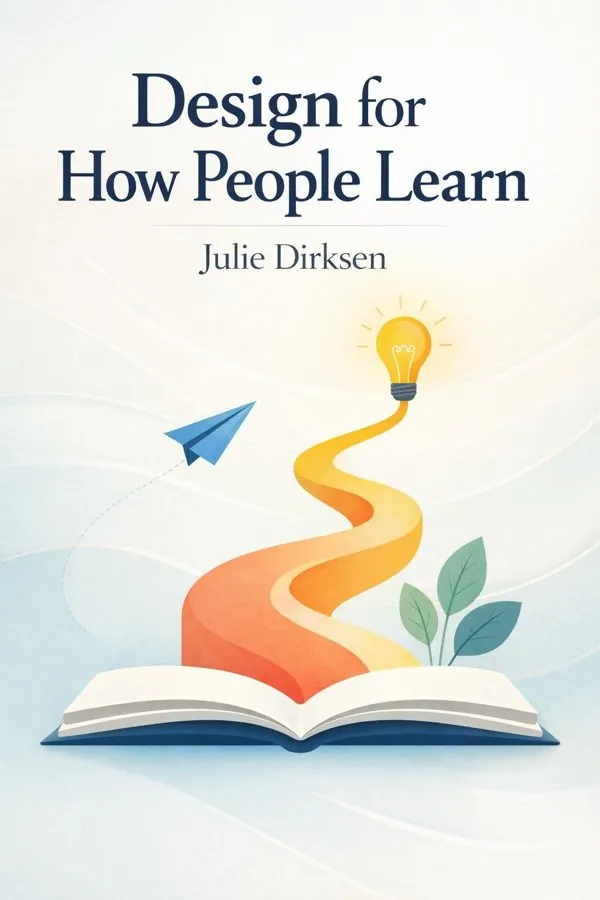
Design for How People Learn: Summary & Key Insights
 10 min11 chaptersAudio available
What Is Design for How People Learn About?
Design for How People Learn by Julie Dirksen is a education book spanning 11 pages. Design for How People Learn es un libro que explica cómo aplicar principios de la psicología cognitiva y del aprendizaje al diseño instruccional. Julie Dirksen ofrece estrategias prácticas para crear experiencias de aprendizaje efectivas, atractivas y memorables, basadas en cómo las personas realmente adquieren y retienen conocimientos.
This FizzRead summary covers all 11 key chapters of Design for How People Learn in approximately 10 minutes, distilling the most important ideas, arguments, and takeaways from Julie Dirksen's work. Also available as an audio summary and Key Quotes Podcast.
Design for How People Learn
Design for How People Learn es un libro que explica cómo aplicar principios de la psicología cognitiva y del aprendizaje al diseño instruccional. Julie Dirksen ofrece estrategias prácticas para crear experiencias de aprendizaje efectivas, atractivas y memorables, basadas en cómo las personas realmente adquieren y retienen conocimientos.
Who Should Read Design for How People Learn?
This book is perfect for anyone interested in education and looking to gain actionable insights in a short read. Whether you're a student, professional, or lifelong learner, the key ideas from Design for How People Learn by Julie Dirksen will help you think differently.
- ✓Readers who enjoy education and want practical takeaways
- ✓Professionals looking to apply new ideas to their work and life
- ✓Anyone who wants the core insights of Design for How People Learn in just 10 minutes
Want the full summary?
Get instant access to this book summary and 100K+ more with Fizz Moment.
Get Free SummaryAvailable on App Store • Free to download
Key Chapters
Every effective learning design begins with understanding who we’re creating it for. Learners are not all the same—they differ in experience, prior knowledge, goals, and motivation. Too often we design materials around what the expert knows rather than what the learner needs. One of the first steps I describe is building empathy for the learner. Instead of guessing, talk to them, observe their context, and explore what success looks like from their perspective.
Prior knowledge plays a crucial role. If learners have little background, introducing advanced concepts will only cause frustration. If their prior understanding includes misconceptions, you have to uncover and address those first. Every new piece of information connects to something that already exists in memory, so we must help learners make meaningful connections rather than dumping facts in isolation.
Motivation is another foundation. People rarely learn just because we tell them to. They learn because they see value—personal or professional—in mastering the skill. In this book, I walk through frameworks for understanding external and internal motivation. Sometimes external triggers—rewards, deadlines, requirements—get learners started, but long-term engagement depends on intrinsic interest and relevance. When people want to learn, they will overcome obstacles.
Understanding the learner also means recognizing their realities: time constraints, work pressures, and distractions. The most beautifully structured course means little if the learner never engages deeply. Designing for real human behavior requires humility. It’s about meeting learners where they are and helping them move one step further, not where we wish they were.
Human memory often feels mysterious, yet for learning designers, it’s the core of our craft. We can’t change how memory functions, but we can design in harmony with it. In the book, I explain that memory operates through several systems—working memory, long-term memory, and sensory memory. Working memory is transient; it can handle only a few pieces of information at once, often for less than half a minute. This limitation explains why dense slides or nonstop lectures fail—people simply can’t process that much at once.
The goal of design is to help learners move knowledge from short-term to long-term storage. The brain does this through repetition, association, and meaningful use. When we tie new concepts to prior experience, create visual or emotional cues, and offer opportunities to retrieve information over time, retention strengthens.
The spacing effect is one of the most powerful memory principles. Instead of cramming everything into one session, learning should be spaced. Each revisit deepens the memory trace and makes retrieval easier. I discuss practical ways to embed spacing into your design—through reminders, follow-up activities, or modular content.
Retrieval practice is another key. Asking learners to recall, apply, or teach material enhances memory far more than re-reading. When learners struggle a bit to remember, they consolidate learning. Good design creates safe opportunities for this effort—short quizzes, reflection exercises, or scenarios that prompt recall.
In the end, memory works best when information feels relevant and emotionally engaging. Facts tethered to stories or tasks are simply more memorable. As designers, we shouldn’t fight memory’s limits; we should build experiences that cooperate with them.
+ 9 more chapters — available in the FizzRead app
All Chapters in Design for How People Learn
About the Author
Julie Dirksen es diseñadora instruccional y consultora especializada en aprendizaje y comportamiento. Ha trabajado con organizaciones internacionales ayudándolas a mejorar sus programas de formación mediante el uso de principios de diseño centrados en el aprendizaje.
Get This Summary in Your Preferred Format
Read or listen to the Design for How People Learn summary by Julie Dirksen anytime, anywhere. FizzRead offers multiple formats so you can learn on your terms — all free.
Available formats: App · Audio · PDF · EPUB — All included free with FizzRead
Download Design for How People Learn PDF and EPUB Summary
Key Quotes from Design for How People Learn
“Every effective learning design begins with understanding who we’re creating it for.”
“Human memory often feels mysterious, yet for learning designers, it’s the core of our craft.”
Frequently Asked Questions about Design for How People Learn
Design for How People Learn by Julie Dirksen is a education book that explores key ideas across 11 chapters. Design for How People Learn es un libro que explica cómo aplicar principios de la psicología cognitiva y del aprendizaje al diseño instruccional. Julie Dirksen ofrece estrategias prácticas para crear experiencias de aprendizaje efectivas, atractivas y memorables, basadas en cómo las personas realmente adquieren y retienen conocimientos.
You Might Also Like

Bedtime Biography: Florence Nightingale
Isabel Thomas
10 min
Introduction To Museum Studies
Howard H. Hoyt
10 min
A Mind for Numbers: How to Excel at Math and Science (Even If You Flunked Algebra)
Barbara Oakley
10 min
AI for Educators: Learning Strategies, Teacher Empowerment, and the Future of Education
Matt Miller
10 min
Animation For Beginners
Morr Meroz
10 min
Artificial Intelligence for Learning
Donald Clark
10 minBrowse by Category
Ready to read Design for How People Learn?
Get the full summary and 100K+ more books with Fizz Moment.