
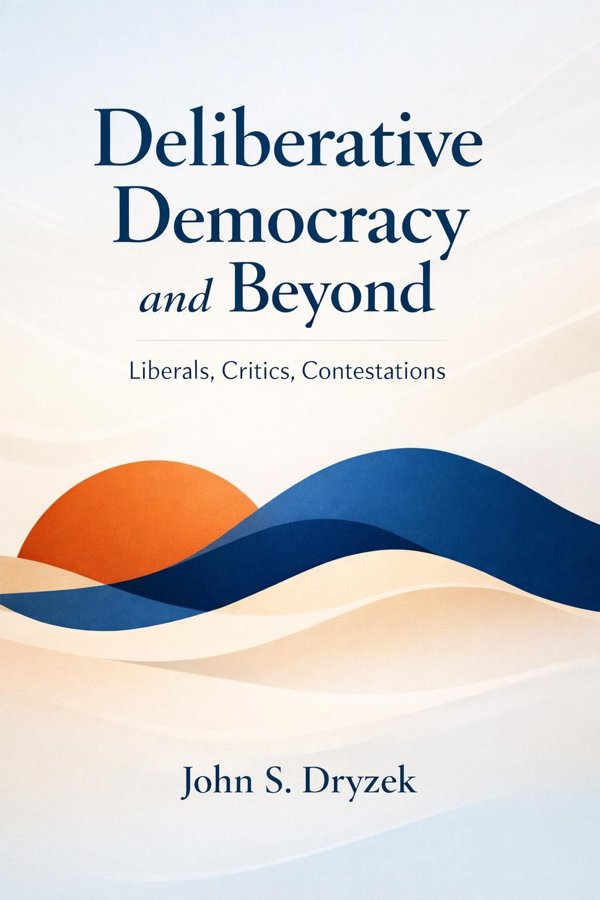
Deliberative Democracy and Beyond: Liberals, Critics, Contestations: Summary & Key Insights
 10 min8 chaptersAudio available
What Is Deliberative Democracy and Beyond: Liberals, Critics, Contestations About?
Deliberative Democracy and Beyond: Liberals, Critics, Contestations by John S. Dryzek is a politics book spanning 8 pages. This book explores the theory and practice of deliberative democracy, examining its liberal foundations and the critiques that challenge its assumptions. Dryzek argues for a more inclusive and pluralistic model of deliberation that extends beyond traditional liberal frameworks, engaging with diverse voices and contestations in democratic discourse.
This FizzRead summary covers all 8 key chapters of Deliberative Democracy and Beyond: Liberals, Critics, Contestations in approximately 10 minutes, distilling the most important ideas, arguments, and takeaways from John S. Dryzek's work. Also available as an audio summary and Key Quotes Podcast.
Deliberative Democracy and Beyond: Liberals, Critics, Contestations
This book explores the theory and practice of deliberative democracy, examining its liberal foundations and the critiques that challenge its assumptions. Dryzek argues for a more inclusive and pluralistic model of deliberation that extends beyond traditional liberal frameworks, engaging with diverse voices and contestations in democratic discourse.
Who Should Read Deliberative Democracy and Beyond: Liberals, Critics, Contestations?
This book is perfect for anyone interested in politics and looking to gain actionable insights in a short read. Whether you're a student, professional, or lifelong learner, the key ideas from Deliberative Democracy and Beyond: Liberals, Critics, Contestations by John S. Dryzek will help you think differently.
- ✓Readers who enjoy politics and want practical takeaways
- ✓Professionals looking to apply new ideas to their work and life
- ✓Anyone who wants the core insights of Deliberative Democracy and Beyond: Liberals, Critics, Contestations in just 10 minutes
Want the full summary?
Get instant access to this book summary and 100K+ more with Fizz Moment.
Get Free SummaryAvailable on App Store • Free to download
Key Chapters
Deliberative democracy grew initially from the soil of liberal thought, a tradition that prizes rational autonomy, procedural fairness, and the moral equality of citizens. Thinkers like John Rawls, Jürgen Habermas, and others set the intellectual tone here, building models in which reasoned discussion serves as the foundation of legitimacy. In the liberal imagination, democracy realizes its noblest form when citizens offer arguments that others could, in principle, accept — when preferences give way to reasons.
Yet as I examine in this first part, liberal deliberative theory also bears the marks of its origins. It assumes that rational discourse is universal and that consensus is both possible and desirable. This is most evident in Rawls’s idea of ‘public reason,’ which encourages citizens to bracket particular identities and commitments in favor of principles that all could endorse. Similarly, Habermas’s theory of communicative action treats ideal deliberation as unconstrained communication, in which the force of the better argument prevails.
These models transformed democratic theory, lifting it out of the narrowness of voting and interest aggregation. However, their strength — their emphasis on reason, procedure, and neutrality — also exposes their limitation. By positing a sharp divide between reason and emotion, universal and particular, private and public, liberal theorists inadvertently drain democracy of its lived social diversity. In practice, asking participants to shed their particularities often silences the very voices most in need of being heard. Thus, while liberal deliberation aspires to inclusion, it risks replicating exclusion beneath the guise of neutrality. Understanding this paradox is where our exploration must begin.
By the late twentieth century, a chorus of critical voices began to challenge the liberal conception of deliberation. Communitarian critics reminded us that individuals are not isolated reasoners floating above society; they are embedded in traditions and narratives that shape what counts as reasonable. Feminist scholars such as Iris Marion Young and Seyla Benhabib deepened this critique by showing that norms of rational discourse often privilege masculine-coded speech — confident, assertive, impersonal — while devaluing emotional or narrative forms of expression that many women and marginalized groups use to make sense of their experience.
Postmodern theorists added a further layer, questioning whether deliberation can ever escape power. Michel Foucault made clear that discourse is never merely a neutral medium for truth-seeking; it is an arena in which power operates through classification, exclusion, and normalization. When liberal theorists imagine an ideal speech situation free from domination, they risk effacing the subtle operations of power that structure real communicative contexts.
In engaging these critiques, I did not seek to dismantle deliberative democracy but to push it into new territory. Critics expose blind spots — who is excluded, which languages of legitimacy dominate, how reason itself carries cultural baggage — but deliberation remains a vital democratic ideal. The task is to see deliberation as a contested terrain rather than a settled formula, one capable of evolving through its interactions with critique.
+ 6 more chapters — available in the FizzRead app
All Chapters in Deliberative Democracy and Beyond: Liberals, Critics, Contestations
About the Author
John S. Dryzek is a political theorist and professor known for his work on deliberative democracy, environmental politics, and political theory. He has published extensively on democratic theory and global governance, contributing significantly to the development of deliberative democratic thought.
Get This Summary in Your Preferred Format
Read or listen to the Deliberative Democracy and Beyond: Liberals, Critics, Contestations summary by John S. Dryzek anytime, anywhere. FizzRead offers multiple formats so you can learn on your terms — all free.
Available formats: App · Audio · PDF · EPUB — All included free with FizzRead
Download Deliberative Democracy and Beyond: Liberals, Critics, Contestations PDF and EPUB Summary
Key Quotes from Deliberative Democracy and Beyond: Liberals, Critics, Contestations
“Deliberative democracy grew initially from the soil of liberal thought, a tradition that prizes rational autonomy, procedural fairness, and the moral equality of citizens.”
“By the late twentieth century, a chorus of critical voices began to challenge the liberal conception of deliberation.”
Frequently Asked Questions about Deliberative Democracy and Beyond: Liberals, Critics, Contestations
Deliberative Democracy and Beyond: Liberals, Critics, Contestations by John S. Dryzek is a politics book that explores key ideas across 8 chapters. This book explores the theory and practice of deliberative democracy, examining its liberal foundations and the critiques that challenge its assumptions. Dryzek argues for a more inclusive and pluralistic model of deliberation that extends beyond traditional liberal frameworks, engaging with diverse voices and contestations in democratic discourse.
More by John S. Dryzek

You Might Also Like

Antifa: The Anti-Fascist Handbook
Mark Bray
10 min
Attack from Within: How Disinformation Is Sabotaging America
Barbara McQuade
10 min
Coercion, Capital, and European States, AD 990–1992
Charles Tilly
10 min
Digital Democracy: Concepts, Methodologies, Tools, and Applications
Various Authors
10 min
Fascism
Stanley G. Payne
10 min
Fire And Fury: Inside The Trump White House
Michael Wolff
10 minBrowse by Category
Ready to read Deliberative Democracy and Beyond: Liberals, Critics, Contestations?
Get the full summary and 100K+ more books with Fizz Moment.