
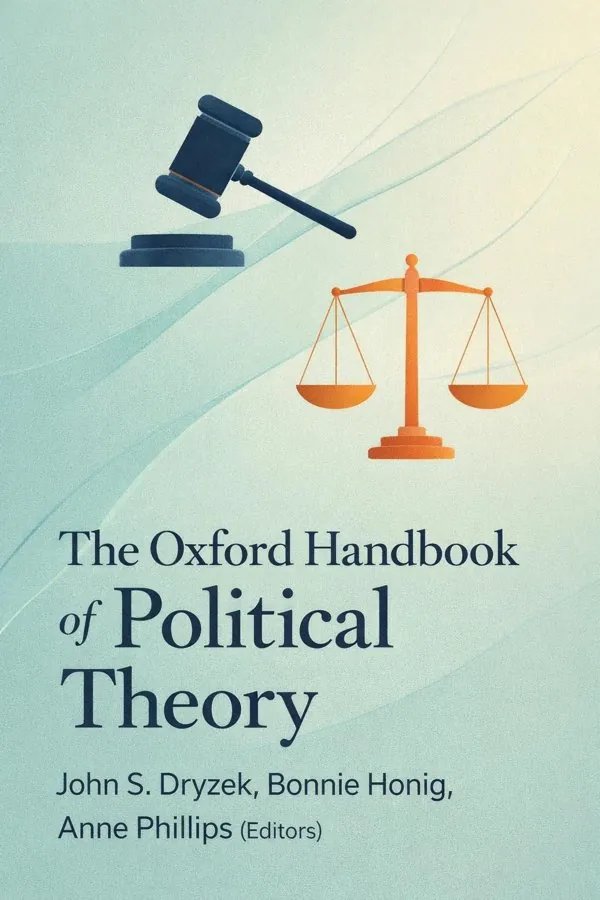
The Oxford Handbook of Political Theory: Summary & Key Insights
by John S. Dryzek, Bonnie Honig, Anne Phillips (Editors)
 10 min11 chaptersAudio available
What Is The Oxford Handbook of Political Theory About?
The Oxford Handbook of Political Theory by John S. Dryzek, Bonnie Honig, Anne Phillips (Editors) is a politics book spanning 11 pages. This comprehensive volume surveys the major topics, traditions, and debates in contemporary political theory. It brings together leading scholars to explore themes such as democracy, justice, equality, power, and the role of political institutions. The handbook provides an authoritative overview of the field, combining historical perspectives with cutting-edge theoretical developments.
This FizzRead summary covers all 11 key chapters of The Oxford Handbook of Political Theory in approximately 10 minutes, distilling the most important ideas, arguments, and takeaways from John S. Dryzek, Bonnie Honig, Anne Phillips (Editors)'s work. Also available as an audio summary and Key Quotes Podcast.
The Oxford Handbook of Political Theory
This comprehensive volume surveys the major topics, traditions, and debates in contemporary political theory. It brings together leading scholars to explore themes such as democracy, justice, equality, power, and the role of political institutions. The handbook provides an authoritative overview of the field, combining historical perspectives with cutting-edge theoretical developments.
Who Should Read The Oxford Handbook of Political Theory?
This book is perfect for anyone interested in politics and looking to gain actionable insights in a short read. Whether you're a student, professional, or lifelong learner, the key ideas from The Oxford Handbook of Political Theory by John S. Dryzek, Bonnie Honig, Anne Phillips (Editors) will help you think differently.
- ✓Readers who enjoy politics and want practical takeaways
- ✓Professionals looking to apply new ideas to their work and life
- ✓Anyone who wants the core insights of The Oxford Handbook of Political Theory in just 10 minutes
Want the full summary?
Get instant access to this book summary and 100K+ more with Fizz Moment.
Get Free SummaryAvailable on App Store • Free to download
Key Chapters
Any coherent grasp of political theory begins with its history—not a relic of the past, but a sequence of living arguments that continue to define the discipline. The handbook opens by guiding readers from the classical foundations of political thought, through early modern transformations, to the theoretical revolutions of the twentieth century.
From Plato and Aristotle through Machiavelli, Hobbes, Locke, and Rousseau, the historical chapters do more than recite canonical figures. They interrogate how each thinker’s context—Athenian democracy, Renaissance humanism, the birth of capitalism, or the Enlightenment’s faith in reason—produced distinct visions of the political. Plato’s *Republic* and Aristotle’s *Politics* define politics as a moral enterprise; Machiavelli privileges necessity; Hobbes creates the modern state from fear; Locke grounds legitimacy in consent and property; Rousseau reclaims virtue through the general will.
These thinkers provide the vocabulary through which later theorists argue. Yet the editors ensure that the reader understands history as a set of interpretive layers rather than a linear progression. Modern political theory is not a neat accumulation of truths but a dialogue across centuries. Marx’s critique of capitalism exposes the limitations of liberal freedom; Mill’s defense of liberty confronts the tyranny of custom; Nietzsche and Weber unmask the hidden forces of power behind rationalization and morality. The historical groundwork reminds us that political theory has never been monolithic—it is built on tensions between authority and freedom, individual and collective, order and justice.
The purpose here is not antiquarian. These traditions remain the grammar of modern politics, shaping how we read democracy, global inequality, or the ethics of governance. By retrieving these founding debates, the reader is better prepared to see how contemporary theorists continue to wrestle with the same dilemmas, now amplified by globalization, technology, and environmental crisis.
At the heart of political theory lies its normative vocation: the effort to imagine a just and legitimate order. This section of the handbook focuses on justice, equality, liberty, and rights—not as fixed doctrines but as evolving frameworks.
Justice is first addressed through the legacy of John Rawls’s *A Theory of Justice*, which reinvigorated normative theory in the late twentieth century. Yet the contributors emphasize the debates Rawls catalyzed rather than settled: communitarian critics who argued that justice cannot be separated from community; feminists who exposed the gendered assumptions of contract theory; cosmopolitans who extended justice beyond state borders; and critical theorists who questioned whether fairness alone suffices in systems of domination.
Equality is examined not simply as the distribution of goods but as recognition and status. The focus turns to debates between luck egalitarians, who separate moral desert from social fortune, and relational egalitarians, who insist equality concerns the moral relations among persons. Meanwhile, liberty—so central to both liberal and republican traditions—is parsed through contrasting lenses: negative liberty’s focus on non-interference versus positive liberty’s emphasis on self-mastery and participation.
By weaving these arguments, the handbook demonstrates that normative theory is both timeless and context-bound. Rights discourse, for instance, must contend with pluralism and global interdependence; freedom must be balanced against the cohesion necessary for shared political life. The voice that emerges is one of critical optimism: though perfect justice may elude us, reflective engagement with normative ideals gives politics its moral compass.
+ 9 more chapters — available in the FizzRead app
All Chapters in The Oxford Handbook of Political Theory
About the Authors
John S. Dryzek is a political theorist known for his work on deliberative democracy and environmental politics. Bonnie Honig is a professor of political science recognized for her contributions to democratic theory and feminist political thought. Anne Phillips is a distinguished political theorist focusing on issues of gender, equality, and representation.
Get This Summary in Your Preferred Format
Read or listen to the The Oxford Handbook of Political Theory summary by John S. Dryzek, Bonnie Honig, Anne Phillips (Editors) anytime, anywhere. FizzRead offers multiple formats so you can learn on your terms — all free.
Available formats: App · Audio · PDF · EPUB — All included free with FizzRead
Download The Oxford Handbook of Political Theory PDF and EPUB Summary
Key Quotes from The Oxford Handbook of Political Theory
“Any coherent grasp of political theory begins with its history—not a relic of the past, but a sequence of living arguments that continue to define the discipline.”
“At the heart of political theory lies its normative vocation: the effort to imagine a just and legitimate order.”
Frequently Asked Questions about The Oxford Handbook of Political Theory
The Oxford Handbook of Political Theory by John S. Dryzek, Bonnie Honig, Anne Phillips (Editors) is a politics book that explores key ideas across 11 chapters. This comprehensive volume surveys the major topics, traditions, and debates in contemporary political theory. It brings together leading scholars to explore themes such as democracy, justice, equality, power, and the role of political institutions. The handbook provides an authoritative overview of the field, combining historical perspectives with cutting-edge theoretical developments.
You Might Also Like
Antifa: The Anti-Fascist Handbook
Mark Bray
10 min
Attack from Within: How Disinformation Is Sabotaging America
Barbara McQuade
10 min
Coercion, Capital, and European States, AD 990–1992
Charles Tilly
10 min
Digital Democracy: Concepts, Methodologies, Tools, and Applications
Various Authors
10 min
Fascism
Stanley G. Payne
10 min
Fire And Fury: Inside The Trump White House
Michael Wolff
10 minBrowse by Category
Ready to read The Oxford Handbook of Political Theory?
Get the full summary and 100K+ more books with Fizz Moment.