
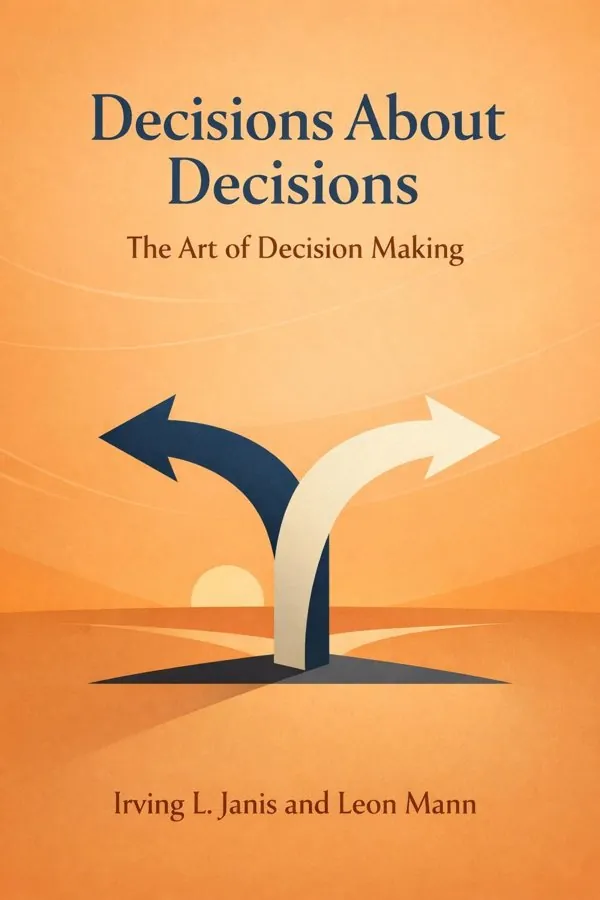
Decisions About Decisions: The Art of Decision Making: Summary & Key Insights
 10 min5 chaptersAudio available
What Is Decisions About Decisions: The Art of Decision Making About?
Decisions About Decisions: The Art of Decision Making by Irving L. Janis and Leon Mann is a cognition book spanning 5 pages. This influential work explores the psychological processes underlying decision making, particularly under conditions of stress and uncertainty. Janis and Mann analyze how individuals and groups evaluate alternatives, manage risk, and cope with the consequences of their choices. The book introduces the concept of 'vigilant decision making' and provides a framework for understanding both rational and maladaptive decision patterns.
This FizzRead summary covers all 5 key chapters of Decisions About Decisions: The Art of Decision Making in approximately 10 minutes, distilling the most important ideas, arguments, and takeaways from Irving L. Janis and Leon Mann's work. Also available as an audio summary and Key Quotes Podcast.
Decisions About Decisions: The Art of Decision Making
This influential work explores the psychological processes underlying decision making, particularly under conditions of stress and uncertainty. Janis and Mann analyze how individuals and groups evaluate alternatives, manage risk, and cope with the consequences of their choices. The book introduces the concept of 'vigilant decision making' and provides a framework for understanding both rational and maladaptive decision patterns.
Who Should Read Decisions About Decisions: The Art of Decision Making?
This book is perfect for anyone interested in cognition and looking to gain actionable insights in a short read. Whether you're a student, professional, or lifelong learner, the key ideas from Decisions About Decisions: The Art of Decision Making by Irving L. Janis and Leon Mann will help you think differently.
- ✓Readers who enjoy cognition and want practical takeaways
- ✓Professionals looking to apply new ideas to their work and life
- ✓Anyone who wants the core insights of Decisions About Decisions: The Art of Decision Making in just 10 minutes
Want the full summary?
Get instant access to this book summary and 100K+ more with Fizz Moment.
Get Free SummaryAvailable on App Store • Free to download
Key Chapters
Early theories of decision-making portrayed people as perfectly rational agents—calculating probabilities, weighing costs and benefits, and selecting the option that maximized utility. This classical model, elegant in theory, assumed that human cognition operates like a flawless computer. It disregarded the turbulence of emotion, the distortions of stress, and the complexity of real-world uncertainty. As I observed through research and case studies, such models may describe ideals but rarely capture how decisions actually unfold.
When people face high-stakes choices—especially those involving moral, personal, or irreversible consequences—they encounter psychological conflict. Fear of loss, guilt, and doubt distort perception. Under pressure, memory narrows, imagination falters, and what was formerly rational becomes reactive. The traditional framework cannot accommodate these human realities. It prescribes logical procedures but overlooks the emotional weight that makes decision-making a moment of truth rather than an exercise in arithmetic.
So in this chapter, we question those rationalist assumptions and move toward a more humane psychology of choice. We examine how uncertainty triggers defensive reactions—ranging from denial to procrastination—how stress reshapes priorities, and how the simple models of logic collapse under emotional load. Through vivid examples from medical diagnoses, military planning, and corporate strategy, the reader begins to see that every major decision contains an internal drama. The rational mind struggles with anxiety and self-deception; it needs structure and awareness to remain vigilant.
Recognizing the limitations of rational models is not a dismissal of logic—it is a call for integration. Sound decisions require reason, but they also demand emotional discipline and psychological insight. Once we grasp this, we can proceed to construct a model of decision-making that honors both the intellectual and emotional dimensions of human life. This prepares the ground for the concept of vigilant decision-making—the art of thinking clearly in the midst of pressure.
Vigilant decision-making is our proposed ideal—the process through which an individual or group systematically seeks information, thoroughly evaluates alternatives, anticipates the consequences of each option, and remains responsive to feedback. Vigilance is not about being perpetually nervous or cautious; it is about being consciously attentive. It embodies the discipline to look beyond immediate comfort and face complexity with patience.
The vigilant decision-maker resists impulsivity and defensive avoidance. They do not rush decisions merely to escape tension. Instead, they embrace the conflict inherent in choice as a signal to deepen understanding. In our research, we found that individuals who maintain vigilance display five consistent behaviors: they identify all relevant options, seek both confirming and disconfirming evidence, assess future outcomes realistically, consult trusted advisers without surrendering judgment, and remain ready to revise conclusions as new information emerges.
This process stands in stark contrast to maladaptive patterns—those psychological shortcuts that lead to disaster. Under stress, many succumb to hypervigilance: frantic, chaotic seeking that ends in confusion. Others drift into unconflicted adherence: blindly sticking with a familiar course to avoid anxiety. And some engage in defensive avoidance: delaying or denying responsibility until the decision is made by circumstances. The vigilant approach restores balance by combining resolute focus with reflective calm.
Think of vigilance as a conscious stance—a way of being in relation to complex situations. It requires courage to face uncertainty, humility to accept error, and insight to recognize bias. In our examples—from air-traffic controllers under pressure to executives navigating moral dilemmas—you’ll see how vigilance translates into real outcomes. Those who sustain it tend to make decisions not only more correctly but more confidently, accepting consequences with psychological resilience. Through cultivation of vigilance, decision-making becomes an act of integrity rather than a struggle for escape.
+ 3 more chapters — available in the FizzRead app
All Chapters in Decisions About Decisions: The Art of Decision Making
About the Authors
Irving L. Janis (1918–1990) was an American research psychologist best known for his theory of groupthink and studies on decision making. Leon Mann is an Australian social psychologist recognized for his contributions to decision theory and behavioral science.
Get This Summary in Your Preferred Format
Read or listen to the Decisions About Decisions: The Art of Decision Making summary by Irving L. Janis and Leon Mann anytime, anywhere. FizzRead offers multiple formats so you can learn on your terms — all free.
Available formats: App · Audio · PDF · EPUB — All included free with FizzRead
Download Decisions About Decisions: The Art of Decision Making PDF and EPUB Summary
Key Quotes from Decisions About Decisions: The Art of Decision Making
“Early theories of decision-making portrayed people as perfectly rational agents—calculating probabilities, weighing costs and benefits, and selecting the option that maximized utility.”
“Vigilance is not about being perpetually nervous or cautious; it is about being consciously attentive.”
Frequently Asked Questions about Decisions About Decisions: The Art of Decision Making
Decisions About Decisions: The Art of Decision Making by Irving L. Janis and Leon Mann is a cognition book that explores key ideas across 5 chapters. This influential work explores the psychological processes underlying decision making, particularly under conditions of stress and uncertainty. Janis and Mann analyze how individuals and groups evaluate alternatives, manage risk, and cope with the consequences of their choices. The book introduces the concept of 'vigilant decision making' and provides a framework for understanding both rational and maladaptive decision patterns.
You Might Also Like
A Field Guide to Lies: Critical Thinking in the Information Age
Daniel J. Levitin
10 min
A Theory of Cognitive Dissonance
Leon Festinger
10 min
Black-And-White Thinking: The Burden of a Binary Brain in a Complex World
Kevin Dutton
10 min
Born Liars: Why We Can’t Live Without Deceit
Ian Leslie
10 min
Collective Illusions: Conformity, Complicity, and the Science of Why We Make Bad Decisions
Todd Rose
10 min
Concrete Mathematics: A Foundation for Computer Science
Ronald L. Graham, Donald E. Knuth, Oren Patashnik
10 minBrowse by Category
Ready to read Decisions About Decisions: The Art of Decision Making?
Get the full summary and 100K+ more books with Fizz Moment.