
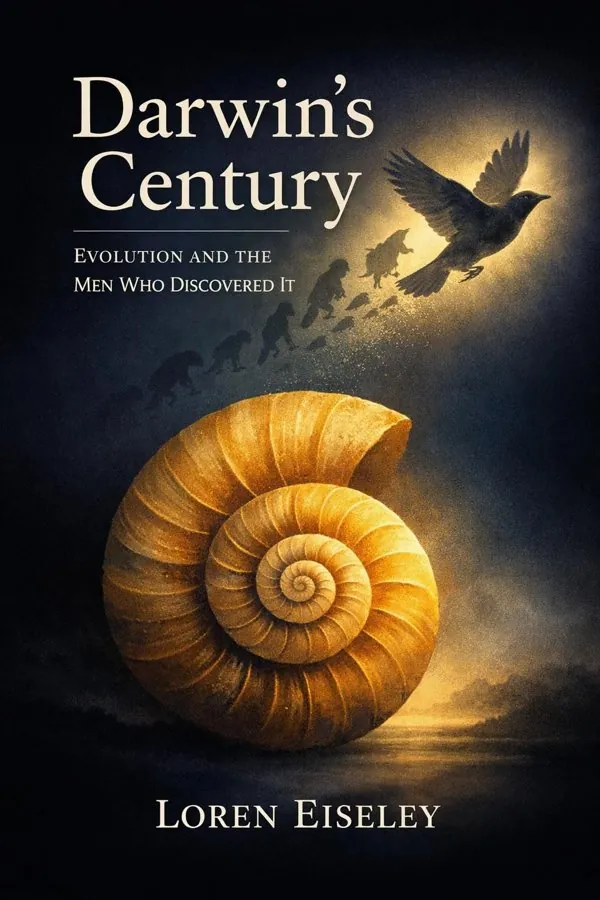
Darwin's Century: Evolution and the Men Who Discovered It: Summary & Key Insights
 10 min9 chaptersAudio available
Key Takeaways from Darwin's Century: Evolution and the Men Who Discovered It
Every scientific revolution begins when someone dares to treat the obvious as uncertain.
An evolutionary theory is impossible without enough time for change to accumulate.
Some of the most powerful ideas come from crossing disciplines.
Great theories are often built by people willing to notice what others dismiss.
A theory becomes powerful when it explains many different facts at once.
What Is Darwin's Century: Evolution and the Men Who Discovered It About?
Darwin's Century: Evolution and the Men Who Discovered It by Loren Eiseley is a world_history book spanning 9 pages. Scientific revolutions rarely begin with a single flash of genius. In Darwin's Century, Loren Eiseley shows that the theory of evolution emerged from a century-long struggle among naturalists, geologists, philosophers, and restless observers who slowly learned to see life as dynamic rather than fixed. The book is not simply a biography of Charles Darwin. It is a sweeping intellectual history of the ideas, debates, and discoveries that made Darwin possible, while also revealing why his achievement was so extraordinary. Eiseley’s great strength is that he writes science as a human drama. He traces how figures such as Buffon, Lamarck, Lyell, Malthus, Wallace, and others contributed pieces of a puzzle that Darwin would eventually assemble into a coherent theory of natural selection. Along the way, he captures the uncertainty, resistance, rivalry, and wonder that accompanied this transformation in human thought. As an anthropologist, historian of ideas, and gifted literary stylist, Eiseley brings both scholarly depth and narrative power to the subject. The result is a rich, reflective account of how modern biology was born and why the story still matters today.
This FizzRead summary covers all 9 key chapters of Darwin's Century: Evolution and the Men Who Discovered It in approximately 10 minutes, distilling the most important ideas, arguments, and takeaways from Loren Eiseley's work. Also available as an audio summary and Key Quotes Podcast.
Darwin's Century: Evolution and the Men Who Discovered It
Scientific revolutions rarely begin with a single flash of genius. In Darwin's Century, Loren Eiseley shows that the theory of evolution emerged from a century-long struggle among naturalists, geologists, philosophers, and restless observers who slowly learned to see life as dynamic rather than fixed. The book is not simply a biography of Charles Darwin. It is a sweeping intellectual history of the ideas, debates, and discoveries that made Darwin possible, while also revealing why his achievement was so extraordinary.
Eiseley’s great strength is that he writes science as a human drama. He traces how figures such as Buffon, Lamarck, Lyell, Malthus, Wallace, and others contributed pieces of a puzzle that Darwin would eventually assemble into a coherent theory of natural selection. Along the way, he captures the uncertainty, resistance, rivalry, and wonder that accompanied this transformation in human thought. As an anthropologist, historian of ideas, and gifted literary stylist, Eiseley brings both scholarly depth and narrative power to the subject. The result is a rich, reflective account of how modern biology was born and why the story still matters today.
Who Should Read Darwin's Century: Evolution and the Men Who Discovered It?
This book is perfect for anyone interested in world_history and looking to gain actionable insights in a short read. Whether you're a student, professional, or lifelong learner, the key ideas from Darwin's Century: Evolution and the Men Who Discovered It by Loren Eiseley will help you think differently.
- ✓Readers who enjoy world_history and want practical takeaways
- ✓Professionals looking to apply new ideas to their work and life
- ✓Anyone who wants the core insights of Darwin's Century: Evolution and the Men Who Discovered It in just 10 minutes
Want the full summary?
Get instant access to this book summary and 100K+ more with Fizz Moment.
Get Free SummaryAvailable on App Store • Free to download
Key Chapters
Every scientific revolution begins when someone dares to treat the obvious as uncertain. Before Darwin, many educated Europeans assumed that species had been separately created and remained essentially unchanged. Yet a number of early naturalists began noticing facts that did not fit this fixed picture of life. Fossils hinted at vanished worlds. Geographic variation suggested that living things adapted to local conditions. Comparative anatomy revealed deep structural similarities among animals that seemed too patterned to be accidental.
Loren Eiseley emphasizes figures such as Buffon, who challenged rigid classification and proposed that species might change over time, even if he did not fully embrace evolution in the modern sense. These thinkers often worked cautiously, constrained by religious orthodoxy, incomplete evidence, and the intellectual habits of their age. Even so, they loosened the foundations of old belief. They replaced the image of nature as a finished museum with the more unsettling idea of nature as a historical process.
This matters because Darwin did not invent the question of evolution out of nothing. He inherited a century of curiosity, speculation, and partial insight. In modern terms, this is how innovation usually works. New frameworks emerge when many observers identify anomalies before one mind synthesizes them into a compelling explanation. In business, medicine, or technology, breakthrough ideas often begin as scattered doubts about what everyone else takes for granted.
Actionable takeaway: When studying any major breakthrough, look first at the overlooked precursors. Ask what assumptions are starting to crack in your own field, because that is often where tomorrow’s transformation begins.
An evolutionary theory is impossible without enough time for change to accumulate. One of Eiseley’s central insights is that geology prepared the intellectual ground for Darwin by vastly expanding humanity’s sense of Earth’s age. Earlier traditions often imagined a young world shaped by sudden catastrophes. Geologists such as James Hutton and especially Charles Lyell argued instead that the Earth had been formed by slow, continuous processes still visible in the present: erosion, uplift, sedimentation, and volcanic action.
Lyell’s uniformitarianism was revolutionary because it replaced dramatic, one-time events with gradual transformation across immense spans of time. If mountains, valleys, and coastlines could be shaped by patient forces acting over ages, then living forms might also be shaped by cumulative pressures. Darwin carried Lyell’s work aboard the Beagle, and it profoundly influenced how he interpreted fossils, island species, and geographical distribution.
The practical significance of this idea goes far beyond geology. It teaches us to respect the power of incremental change. Many outcomes that seem sudden are actually the product of long accumulation. A company’s decline, an ecosystem’s recovery, a person’s mastery of a skill, or a society’s political shift usually reflects countless small forces acting over time. Lyell trained Darwin to think historically, and that historical imagination became essential to natural selection.
Eiseley also shows that changing time scales changes moral and intellectual horizons. Once humans grasp deep time, they are forced to see themselves not as the center of creation but as participants in a much larger natural story.
Actionable takeaway: In complex problems, widen your time horizon. Ask what slow, steady forces may be shaping the present in ways that short-term thinking cannot detect.
Some of the most powerful ideas come from crossing disciplines. Darwin’s theory of natural selection took decisive shape when he read Thomas Robert Malthus on population. Malthus argued that populations tend to grow faster than resources, creating inevitable competition, scarcity, and struggle. Darwin recognized immediately that this logic applied not just to humans but to all living organisms.
The result was a conceptual breakthrough. If more individuals are born than can survive, then even slight variations that improve survival or reproduction will matter. Over many generations, these favorable variations will become more common, while less advantageous traits will disappear. This transformed evolution from a vague notion of change into a mechanism. Species did not merely drift; they were filtered by the relentless pressures of existence.
Eiseley presents this moment as one of synthesis rather than isolated inspiration. Darwin had already accumulated observations about variation, adaptation, and distribution. Malthus gave him the dynamic principle that tied them together. It was the missing engine.
This idea remains broadly useful because it highlights how constraints create selection. In organizations, when resources are limited, certain strategies outcompete others. In culture, attention scarcity selects for memorable messages. In innovation, tight constraints often reveal which designs are robust and which are fragile. Selection occurs wherever variation meets pressure.
Eiseley also reminds us that nature’s economy is unsentimental. Evolution has no built-in goal of fairness, perfection, or moral progress. It produces what can survive in given conditions, not what humans might prefer.
Actionable takeaway: When evaluating any system, identify three things: the source of variation, the limiting resource, and the selection pressure. That simple framework often reveals why some patterns persist while others vanish.
Great theories are often built by people willing to notice what others dismiss. Eiseley portrays Darwin’s formative years as a training in disciplined observation. Though not initially considered a prodigy, Darwin developed an unusual capacity to collect facts, compare details, and withhold judgment until patterns emerged. His voyage on HMS Beagle exposed him to fossils in South America, volcanic islands, coral reefs, finches, tortoises, and striking geographical distributions that challenged conventional explanations.
These experiences mattered because Darwin did not merely gather specimens; he learned to think in relationships. Why did island species resemble those on nearby continents while differing in crucial ways? Why did extinct mammals resemble living local forms? Why were species adapted to particular environments, yet still linked to broader structural families? Such questions gradually pushed him toward descent with modification.
Eiseley’s account also highlights Darwin’s methodological virtues: patience, self-criticism, and an ability to let evidence mature. He delayed publication for years, testing objections, breeding pigeons, studying barnacles, and refining arguments. In an age that celebrates speed, this is a useful corrective. Serious understanding often requires prolonged contact with reality.
Applied today, Darwin’s example is relevant to research, entrepreneurship, and leadership. People often rush from data to conclusion. Darwin moved from observation to comparison to hypothesis to prolonged verification. That sequence reduced error and increased depth.
Eiseley suggests that Darwin’s genius was not flamboyant originality alone but a rare steadiness of mind. He was teachable before he was transformative.
Actionable takeaway: In your own work, slow down the leap to explanation. Spend more time collecting anomalies, comparing cases, and asking what recurring pattern the evidence is trying to reveal.
A theory becomes powerful when it explains many different facts at once. Eiseley shows that Darwin’s achievement was not simply proposing that species change, but providing a unifying framework that connected variation, heredity, adaptation, extinction, and the branching diversity of life. Natural selection explained how small inherited differences, filtered through the struggle for existence, could generate complex forms without requiring separate acts of creation.
This synthesis mattered because previous thinkers had seen pieces of the truth. Lamarck recognized that life was not static, but his mechanism was weak. Breeders understood selection in domesticated animals, but few had applied the principle fully to nature. Geologists had established vast time, but not biological transformation. Darwin’s brilliance lay in making these fragments cohere.
Eiseley underscores how radical this was. Natural selection implied that design in nature could arise without a designer intervening at every step. The fit between organism and environment no longer proved fixed intention; it could emerge from cumulative filtering over time. This changed biology from a descriptive science into a historical and explanatory one.
The broader lesson is that insight often comes from integration, not from discovering entirely new facts. In public policy, health care, education, or product design, progress can depend on connecting known data through a better model. People may possess all the necessary pieces long before they see the pattern.
Natural selection also teaches humility. Adaptations are local and provisional, not perfect. What works in one environment may fail in another. Success is always conditional.
Actionable takeaway: When facing a complex problem, ask which existing observations seem disconnected. A breakthrough may come from finding the simple principle that links them into one explanatory story.
History often remembers a single name, but discovery is usually crowded. Eiseley gives welcome attention to Darwin’s contemporaries and rivals, especially Alfred Russel Wallace, whose independent formulation of natural selection forced Darwin to act. Wallace, working under difficult conditions in the Malay Archipelago, reached conclusions strikingly similar to Darwin’s. His famous 1858 letter shocked Darwin because it mirrored ideas Darwin had been developing privately for years.
Rather than treating this episode as a simple contest, Eiseley presents it as evidence that the intellectual climate was ripe. Multiple investigators, exposed to similar data and conceptual tools, were moving toward the same theory. This does not diminish Darwin’s greatness; it clarifies it. Darwin’s contribution was broader, deeper, and more heavily documented, but Wallace’s role proves that ideas emerge within networks of inquiry, not in isolation.
The presence of rivals also improved the theory. Competition forced clearer argument, publication, and public defense. In practical life, this pattern is common. A strong competitor can refine your thinking, expose your blind spots, and accelerate execution. Healthy rivalry can turn private intuition into public achievement.
Eiseley also touches on other figures whose contributions were substantial yet incomplete. Some saw evolution but not selection. Others saw struggle but not descent. The history of science is full of near-discoveries. That should make us less simplistic in how we assign credit and more attentive to collaboration, timing, and context.
Actionable takeaway: Don’t fear parallel thinkers. If someone else is approaching your idea, use that pressure to clarify your evidence, articulate your contribution, and move from private reflection to decisive action.
The truth of an idea does not guarantee its easy acceptance. Eiseley vividly recounts the resistance that greeted Darwin’s theory after the publication of On the Origin of Species. The opposition was scientific, religious, philosophical, and emotional. Evolution challenged not only technical beliefs about species but also cherished assumptions about human uniqueness, divine purpose, and the stability of the natural order.
Some critics objected to the evidence. Others rejected the implications. Could blind natural processes really produce the intricate forms of life? Did evolution strip nature of meaning? Was humanity merely another animal lineage? These were not minor disputes. They touched identity, morality, and worldview. Eiseley’s historical approach helps modern readers see that paradigm shifts are unsettling precisely because they reorganize many beliefs at once.
At the same time, controversy helped refine the theory. Public debate forced defenders of evolution to improve the evidence, distinguish stronger claims from weaker ones, and confront misunderstandings. The famous debates involving figures like Thomas Huxley show that persuasion in science depends not only on data but also on communication, rhetoric, and institutional support.
This remains relevant whenever new ideas challenge established systems. Whether in climate science, artificial intelligence, medicine, or social policy, people resist frameworks that threaten existing identities or structures of authority. Evidence matters, but so do narrative, trust, and timing.
Eiseley suggests that intellectual courage involves more than being right. It involves enduring misunderstanding while continuing to refine and communicate the truth.
Actionable takeaway: When presenting a disruptive idea, prepare for resistance on emotional and cultural grounds, not just factual ones. Address what people fear losing, not only what they fail to understand.
Few scientific ideas have altered human self-perception as deeply as evolution. Eiseley argues that Darwin’s century culminated in more than a biological theory; it produced a new image of humanity. If humans emerged through the same long natural processes that shaped all organisms, then we are not detached spectators of nature but expressions of it. This was a profound philosophical shift.
The broader impact reached beyond biology into anthropology, psychology, theology, history, and literature. Human behavior could be studied in continuity with animal life. Social thought had to reckon with adaptation, inheritance, environment, and deep ancestry. Even when later thinkers misused evolutionary language, the underlying change in perspective remained immense: life had a history, and humans belonged within it.
Eiseley is sensitive to both the grandeur and the danger of this shift. Evolution can inspire humility, kinship with other life forms, and a deeper appreciation of Earth’s history. But it can also be distorted into crude social doctrines if people confuse descriptive biology with moral guidance. Understanding evolution properly means recognizing both connection and caution.
In contemporary life, this perspective influences conservation, medicine, ecology, and even personal identity. We better understand antibiotic resistance, changing viruses, biodiversity loss, and human genetic variation because we think evolutionarily. More broadly, we become less arrogant when we see ourselves as one branch on a vast tree of life rather than the unquestioned endpoint of creation.
Actionable takeaway: Use evolutionary thinking to widen empathy and perspective. Let the idea of shared ancestry deepen your sense of responsibility toward other people, other species, and the environments that sustain us all.
One of Eiseley’s most enduring contributions is his insistence that science is not a cold procession of facts but a deeply human adventure. Darwin’s Century is filled with ambition, hesitation, rivalry, loneliness, courage, and imagination. The men who shaped evolutionary theory were not detached machines of reason. They were vulnerable thinkers wrestling with evidence, prejudice, illness, reputation, and the limits of their age.
This human framing matters because it changes how we understand knowledge itself. Scientific progress is neither perfectly linear nor purely objective. It advances through flawed individuals who notice something real, misinterpret part of it, revise their views, and pass the work forward. Eiseley’s literary style helps readers feel the contingency of discovery: how close some ideas came to being lost, how much depended on timing, and how fragile new truths can seem before they become common sense.
There is also a practical lesson here for anyone engaged in creative or analytical work. You do not need perfect certainty to contribute meaningfully. Many of evolution’s precursors were partly wrong, yet still indispensable. Progress often depends on people who ask brave questions before they can supply complete answers.
Eiseley’s larger reflection is that knowledge grows within culture, language, and personal character. Curiosity, patience, intellectual honesty, and resilience are not decorative virtues; they are engines of discovery.
Actionable takeaway: Approach your own learning as a living process rather than a test of perfection. Contribute the best question, observation, or partial insight you can, because major advances are often built from imperfect but courageous beginnings.
All Chapters in Darwin's Century: Evolution and the Men Who Discovered It
About the Author
Loren Eiseley (1907–1977) was an American anthropologist, historian of ideas, and celebrated essayist whose work brought science and the humanities into rare conversation. Educated at the University of Pennsylvania, he taught anthropology and wrote extensively about human origins, evolution, nature, and the meaning of scientific discovery. Eiseley became known for his distinctive style: intellectually rigorous yet lyrical, reflective, and deeply humane. Rather than treating science as a collection of dry facts, he explored it as a way of confronting time, mortality, and humanity’s place in the natural world. His books, essays, and lectures earned him a wide readership beyond academia. In Darwin's Century, Eiseley combined scholarly insight with narrative grace to illuminate the people and ideas that transformed modern biology.
Get This Summary in Your Preferred Format
Read or listen to the Darwin's Century: Evolution and the Men Who Discovered It summary by Loren Eiseley anytime, anywhere. FizzRead offers multiple formats so you can learn on your terms — all free.
Available formats: App · Audio · PDF · EPUB — All included free with FizzRead
Download Darwin's Century: Evolution and the Men Who Discovered It PDF and EPUB Summary
Key Quotes from Darwin's Century: Evolution and the Men Who Discovered It
“Every scientific revolution begins when someone dares to treat the obvious as uncertain.”
“An evolutionary theory is impossible without enough time for change to accumulate.”
“Some of the most powerful ideas come from crossing disciplines.”
“Great theories are often built by people willing to notice what others dismiss.”
“A theory becomes powerful when it explains many different facts at once.”
Frequently Asked Questions about Darwin's Century: Evolution and the Men Who Discovered It
Darwin's Century: Evolution and the Men Who Discovered It by Loren Eiseley is a world_history book that explores key ideas across 9 chapters. Scientific revolutions rarely begin with a single flash of genius. In Darwin's Century, Loren Eiseley shows that the theory of evolution emerged from a century-long struggle among naturalists, geologists, philosophers, and restless observers who slowly learned to see life as dynamic rather than fixed. The book is not simply a biography of Charles Darwin. It is a sweeping intellectual history of the ideas, debates, and discoveries that made Darwin possible, while also revealing why his achievement was so extraordinary. Eiseley’s great strength is that he writes science as a human drama. He traces how figures such as Buffon, Lamarck, Lyell, Malthus, Wallace, and others contributed pieces of a puzzle that Darwin would eventually assemble into a coherent theory of natural selection. Along the way, he captures the uncertainty, resistance, rivalry, and wonder that accompanied this transformation in human thought. As an anthropologist, historian of ideas, and gifted literary stylist, Eiseley brings both scholarly depth and narrative power to the subject. The result is a rich, reflective account of how modern biology was born and why the story still matters today.
More by Loren Eiseley

You Might Also Like
The Age of Capital
Eric Hobsbawm
10 min
The Gulag Archipelago
Aleksandr Solzhenitsyn
10 min
Jerusalem: The Biography
Simon Sebag Montefiore
10 min
The Anglo-Saxons
James Campbell
10 min
The Boer War
Thomas Pakenham
10 min
The Industrial Revolutionaries: The Making of the Modern World 1776–1914
Gavin Weightman
10 minBrowse by Category
Ready to read Darwin's Century: Evolution and the Men Who Discovered It?
Get the full summary and 100K+ more books with Fizz Moment.