
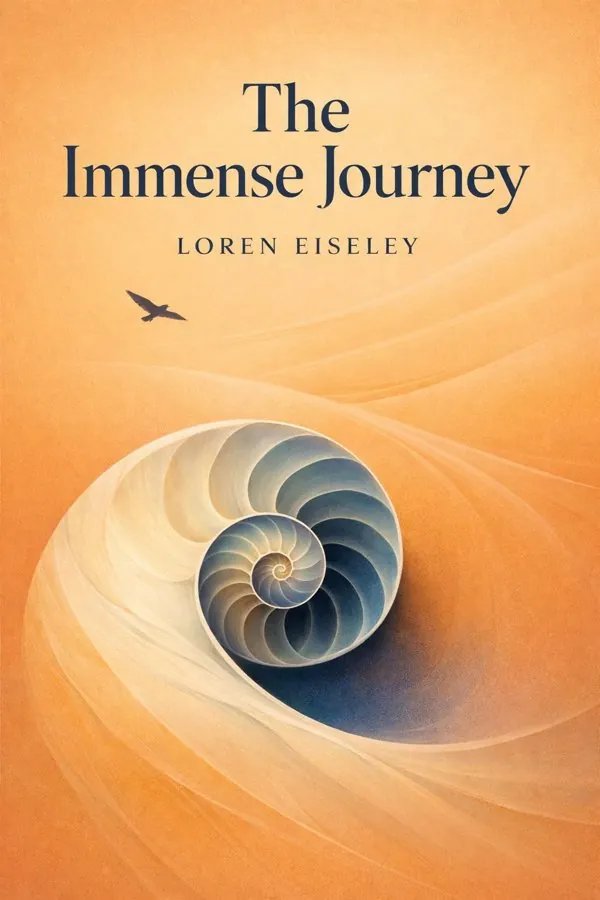
The Immense Journey: Summary & Key Insights
 10 min9 chaptersAudio available
Key Takeaways from The Immense Journey
One of the book’s most important insights is that human beings are not separate from nature but a late expression of it.
A common misunderstanding is that evolution makes life feel mechanical or meaningless.
Few ideas in The Immense Journey are as transformative as the reality of deep time.
Eiseley treats careful observation as more than a scientific method; he treats it as an ethical act.
A central strength of The Immense Journey is its refusal to choose between scientific rigor and imaginative insight.
What Is The Immense Journey About?
The Immense Journey by Loren Eiseley is a popular_sci book. The Immense Journey is a luminous collection of essays in which anthropologist and naturalist Loren Eiseley explores evolution, deep time, memory, mortality, and the fragile relationship between humanity and the natural world. Rather than presenting science as a set of cold facts, Eiseley writes as a poetic observer who sees fossils, shorelines, birds, deserts, and ancient bones as clues to a far larger story: the long, improbable emergence of life and the uneasy place of human beings within it. The book matters because it bridges two worlds that are often kept apart: scientific inquiry and spiritual wonder. Eiseley asks readers not only what humans are, but how we came to be, what we owe to other forms of life, and how humility can deepen understanding. As an anthropologist, archaeologist, and essayist, he brings both scholarly authority and literary power to these reflections. The result is a work of popular science unlike most others: intimate, philosophical, and enduring. The Immense Journey remains valuable for anyone seeking a deeper, more humane way to think about science, nature, and the mystery of existence.
This FizzRead summary covers all 9 key chapters of The Immense Journey in approximately 10 minutes, distilling the most important ideas, arguments, and takeaways from Loren Eiseley's work. Also available as an audio summary and Key Quotes Podcast.
The Immense Journey
The Immense Journey is a luminous collection of essays in which anthropologist and naturalist Loren Eiseley explores evolution, deep time, memory, mortality, and the fragile relationship between humanity and the natural world. Rather than presenting science as a set of cold facts, Eiseley writes as a poetic observer who sees fossils, shorelines, birds, deserts, and ancient bones as clues to a far larger story: the long, improbable emergence of life and the uneasy place of human beings within it. The book matters because it bridges two worlds that are often kept apart: scientific inquiry and spiritual wonder. Eiseley asks readers not only what humans are, but how we came to be, what we owe to other forms of life, and how humility can deepen understanding. As an anthropologist, archaeologist, and essayist, he brings both scholarly authority and literary power to these reflections. The result is a work of popular science unlike most others: intimate, philosophical, and enduring. The Immense Journey remains valuable for anyone seeking a deeper, more humane way to think about science, nature, and the mystery of existence.
Who Should Read The Immense Journey?
This book is perfect for anyone interested in popular_sci and looking to gain actionable insights in a short read. Whether you're a student, professional, or lifelong learner, the key ideas from The Immense Journey by Loren Eiseley will help you think differently.
- ✓Readers who enjoy popular_sci and want practical takeaways
- ✓Professionals looking to apply new ideas to their work and life
- ✓Anyone who wants the core insights of The Immense Journey in just 10 minutes
Want the full summary?
Get instant access to this book summary and 100K+ more with Fizz Moment.
Get Free SummaryAvailable on App Store • Free to download
Key Chapters
One of the book’s most important insights is that human beings are not separate from nature but a late expression of it. Eiseley resists the comforting illusion that humanity stands outside the living world, looking down on it from a privileged height. Instead, he reminds us that we are made of the same elements, shaped by the same evolutionary pressures, and dependent on the same fragile conditions as every other organism. This is not a reduction of human significance. It is a correction to human arrogance.
Throughout the essays, Eiseley presents nature not as scenery but as kinship. Ancient fossils, animal behavior, and geological traces reveal that the human story is inseparable from the story of life itself. We are descendants of creatures that survived catastrophe, adapted to changing worlds, and carried forward the improbable thread of consciousness. Recognizing this lineage changes how we think about ourselves. It encourages humility, patience, and reverence rather than conquest and control.
This idea has practical implications. In environmental debates, for example, people often speak as though protecting ecosystems is a charitable act toward something external. Eiseley’s perspective suggests otherwise: damaging nature is ultimately damaging the web that sustains us. The same principle applies psychologically. Many modern people feel alienated, overstimulated, or ungrounded. Reconnecting with the natural world through observation, walking, gardening, or quiet study can restore a sense of continuity and belonging.
Eiseley’s deeper claim is that wisdom begins when we stop imagining ourselves as masters of life and begin seeing ourselves as participants in it. Actionable takeaway: spend time each week observing one natural setting closely and ask not, “How is this separate from me?” but “What does this reveal about the larger living system I belong to?”
A common misunderstanding is that evolution makes life feel mechanical or meaningless. Eiseley turns that assumption upside down. For him, evolution is not a story that strips the world of mystery; it is the very source of mystery. The immense timescales, accidental survivals, strange adaptations, and improbable emergence of mind make existence more astonishing, not less. To understand that humans arose through countless precarious turns is to feel awe at the delicacy and improbability of being here at all.
Eiseley writes about evolution as a vast unfolding drama in which chance and necessity are intertwined. Species emerge, vanish, transform, and leave traces behind. Life experiments ceaselessly. Seen this way, evolution does not flatten existence into biology alone. It enlarges it. The human mind becomes one remarkable outcome of a long and unfinished process, not a fixed endpoint. This perspective encourages intellectual openness because it teaches that life is dynamic, adaptive, and full of surprise.
In everyday life, this view can shift how people face uncertainty. Careers change, societies evolve, technologies disrupt old habits, and identities develop over time. Evolutionary thinking encourages flexibility rather than rigidity. It suggests that adaptation is not failure but a fundamental law of life. In education, too, Eiseley’s approach matters. Science becomes more engaging when taught as a living narrative of discovery instead of a list of conclusions.
The practical lesson is to treat change as natural and to meet complexity with curiosity rather than fear. Actionable takeaway: when facing a major transition, ask yourself, “What kind of adaptation is this moment asking of me?” Then respond experimentally, as nature does, with small adjustments and attentive learning.
Few ideas in The Immense Journey are as transformative as the reality of deep time. Eiseley invites readers to imagine ages so vast that human history becomes a brief flicker within a much older planetary drama. Rocks, fossils, extinct creatures, and ancient landscapes reveal that the earth has undergone immense changes long before people began recording names and empires. This temporal perspective dissolves many of the assumptions that feed pride, impatience, and self-importance.
Eiseley does not use deep time to diminish human life into insignificance. Rather, he uses it to place human life in context. Our achievements matter, but they are not absolute. Our civilizations are real, yet temporary. Our conflicts often appear less monumental when measured against oceans that advance and retreat, species that rise and vanish, and continents that drift across unimaginable eras. This perspective can be emotionally clarifying. It weakens the ego’s demand to control everything and strengthens the capacity to see beyond immediate turbulence.
In practical terms, deep time can alter both personal and public thinking. On a personal level, it helps reduce anxiety driven by urgency and comparison. Not every setback is final; not every success is permanent. On a collective level, deep time reinforces the seriousness of environmental stewardship. If geological and biological processes took millions of years to produce today’s conditions, then reckless destruction is not merely shortsighted but tragic.
Eiseley’s point is that maturity requires scale. We think better when we think beyond the present hour. Actionable takeaway: the next time you feel trapped in a short-term crisis, zoom out deliberately. Read about natural history, visit a museum, or walk through an old landscape to remind yourself that perspective is a form of wisdom.
Eiseley treats careful observation as more than a scientific method; he treats it as an ethical act. To observe closely is to resist indifference. It means slowing down enough to notice patterns, lives, and details that hurried people overlook. In his essays, beaches, bones, birds, foxes, and fragments of landscape become meaningful not because they are exotic but because they are truly seen. Attention, in his hands, is a way of honoring reality.
This matters because modern life encourages abstraction. People move quickly, consume information rapidly, and often form judgments without direct encounter. Eiseley offers a corrective. He shows that knowledge begins in patient contact with the world. The observer must listen before explaining, watch before categorizing, and remain open to surprise. That attitude improves science, but it also improves character. It develops humility, empathy, and restraint.
The idea applies well beyond fieldwork. In relationships, observation means noticing how others actually feel instead of assuming. In leadership, it means studying conditions before imposing solutions. In creative work, it means attending to texture, contradiction, and lived experience. Even in problem-solving, careful observation often reveals that the issue is different from what first appears.
Eiseley suggests that many human errors begin with failure of attention. We harm what we do not truly see. We misunderstand what we do not patiently observe. To notice the world accurately is therefore both an intellectual and a moral achievement. Actionable takeaway: practice one session of deliberate observation each day, even for ten minutes. Choose a person, place, or problem and describe what is actually there before deciding what it means.
A central strength of The Immense Journey is its refusal to choose between scientific rigor and imaginative insight. Eiseley demonstrates that facts alone do not create understanding, and imagination alone does not create truth. We need both. Science gives disciplined methods for testing reality; imagination gives the metaphors, questions, and emotional openness that allow humans to grasp why those realities matter.
Eiseley’s writing embodies this union. He does not distort scientific knowledge into fantasy, but neither does he present knowledge in a dry or detached way. Instead, he reveals the emotional and philosophical depth inside scientific discovery. A fossil is not just data; it is a message from another age. A shoreline is not merely geography; it is a threshold between forms of life, eras, and possibilities. By writing this way, he makes science feel intimate, memorable, and humane.
This lesson is especially useful today. Public discussions often separate analysis from meaning. Technical experts provide data, while others search elsewhere for significance. Eiseley suggests that such separation is unhealthy. In education, students learn more deeply when science is connected to story and wonder. In business or policy, numbers become more useful when interpreted with imagination and ethical sensitivity. In personal life, understanding your own habits or health requires both evidence and reflective insight.
The takeaway is not to sentimentalize science, but to humanize it. Knowledge becomes richer when facts are joined to wonder and disciplined thought is joined to metaphor. Actionable takeaway: when learning something scientific, ask two questions: “What does the evidence show?” and “What larger meaning or pattern does this reveal?” That simple pairing can transform information into understanding.
Eiseley repeatedly reminds readers that the world remains larger than any system built to explain it. Science expands knowledge, but it also enlarges the borderlands of mystery. Every discovery opens further questions about origins, consciousness, adaptation, extinction, and the hidden complexity of life. Instead of treating uncertainty as a defect to be eliminated, Eiseley approaches it as an honest condition of inquiry.
This attitude is especially refreshing because people often seek certainty too quickly. They want neat conclusions, stable labels, and final explanations. Eiseley resists that impulse. He sees the unknown not as failure, but as invitation. It keeps thought alive. It protects us from dogmatism. It encourages humility, since no matter how much we uncover, existence still exceeds us.
Respect for the unknown has practical value. In science, it prevents overconfidence and keeps investigation open. In relationships, it reminds us that other people are never fully transparent to us; they require patience and curiosity. In decision-making, it encourages contingency planning and intellectual flexibility. In spiritual or philosophical life, it allows wonder to coexist with reason.
Eiseley’s essays model a rare balance: confidence in inquiry without arrogance about conclusion. He teaches that mature intelligence can say, “I know something real,” while also saying, “Much remains hidden.” That balance is crucial in a complex world where false certainty often causes great harm. Actionable takeaway: the next time you feel pressure to have a complete answer, name what is known, what is uncertain, and what remains to be explored. That habit builds wiser judgment and deeper curiosity.
Another powerful idea in the book is that human civilization, for all its sophistication, rests on precarious biological and environmental foundations. Eiseley’s natural history perspective shows that life is not guaranteed, stability is not permanent, and the conditions supporting culture are thinner than modern people like to believe. Behind cities, institutions, and technological systems stand air, water, soil, climate, and countless living processes that humans did not invent and cannot fully replace.
This recognition punctures the fantasy of invulnerability. People often assume that progress has freed humanity from dependence on nature, yet Eiseley’s broader view shows the opposite. The more complex civilization becomes, the more catastrophic it can be to ignore the ecological systems beneath it. Human beings may build machines and theories, but they still eat from the earth, breathe from the atmosphere, and inhabit a planetary web shaped over immense spans of time.
The practical relevance is obvious in an age of environmental crisis, resource depletion, and technological overconfidence. Eiseley’s perspective encourages resilience thinking. Communities should protect ecosystems, diversify resources, preserve scientific literacy, and plan for uncertainty rather than assuming endless control. On an individual level, it encourages gratitude and realism. Food, clean water, stable weather, and biodiversity are not background details. They are the basis of everything else.
Eiseley does not argue against civilization, but against forgetfulness. We become dangerous when we neglect the conditions that make our achievements possible. Actionable takeaway: identify one system you rely on daily—water, food, energy, climate, pollinators—and learn how it actually works. Respect begins with understanding dependence.
Many of Eiseley’s most memorable reflections emerge from solitude: walking alone, observing landscapes, encountering animals, or reflecting in quiet places where noise falls away. For him, solitude is not withdrawal from life but a method of entering it more deeply. In stillness, the mind becomes capable of perceiving relationships and meanings that constant distraction conceals. Nature is not merely looked at; it is encountered.
This theme matters because modern culture often equates value with speed, visibility, and constant interaction. Eiseley suggests that some forms of understanding require the opposite conditions. Solitude slows perception enough for subtle details to register. It sharpens attention, enriches inner life, and allows a person to hear questions that busier settings suppress. It also tempers ego. Alone before desert, shoreline, or night sky, one feels both small and connected.
The practical applications are broad. Writers, researchers, and thinkers often need solitude for original insight. Professionals facing burnout may recover clarity by stepping away from overstimulation. People struggling with purpose may find that quiet contact with the natural world restores perspective more effectively than endless digital input. Solitude can also improve relationships by making a person less reactive and more reflective.
Eiseley’s point is not that humans should escape society, but that they need intervals of silence in order to reenter society more wisely. A life without reflective space becomes shallow and mechanical. Actionable takeaway: create a regular ritual of undistracted solitude outdoors if possible—even twenty minutes without phone, conversation, or task—and use it to observe, reflect, and let deeper questions surface.
Beneath the scientific observations of The Immense Journey lies a profound meditation on mortality. Eiseley understands that human consciousness is shaped by the knowledge that life is finite. Fossils, extinct species, vanished worlds, and the passing of individual creatures all remind readers that impermanence is not an exception but a law of existence. Yet he does not present this as bleakness. Instead, mortality sharpens gratitude and deepens attention.
Because things end, they matter. Because life is fragile, it deserves reverence. Eiseley’s essays often carry a quiet awareness that every living being occupies a brief interval in an immense historical stream. Humans inherit a world they did not create and pass through it only temporarily. This realization can be sobering, but it can also be liberating. It reduces trivial vanity and invites fuller engagement with what is present now.
In practical life, this perspective can change priorities. People often postpone wonder, relationships, creativity, or ethical action as though time were unlimited. Eiseley’s naturalistic vision argues otherwise. To know that life is brief should not produce panic, but presence. It should encourage kindness, honest work, and deeper attention to beauty. It can also foster compassion, since all beings share vulnerability and eventual disappearance.
The final lesson is that awareness of death can make life more vivid, not less. The temporary nature of existence is part of what makes consciousness precious. Actionable takeaway: choose one neglected source of meaning—a relationship, a place, a creative impulse, or a daily ritual—and give it deliberate attention this week as if you truly remembered that time is limited.
All Chapters in The Immense Journey
About the Author
Loren Eiseley was an American anthropologist, archaeologist, educator, and essayist whose writing brought science and the humanities into rare and beautiful conversation. Born in 1907 in Lincoln, Nebraska, he developed a lifelong fascination with nature, human origins, and the deep history of life on earth. He studied anthropology and went on to teach and hold major academic positions, including at the University of Pennsylvania. Although highly respected as a scholar, Eiseley became best known for his essays and books, which combined scientific knowledge with poetic language and philosophical reflection. Works such as The Immense Journey helped establish him as one of the twentieth century’s most distinctive popular science writers. His legacy endures through his ability to make evolution, natural history, and human existence feel intellectually rigorous and emotionally profound.
Get This Summary in Your Preferred Format
Read or listen to the The Immense Journey summary by Loren Eiseley anytime, anywhere. FizzRead offers multiple formats so you can learn on your terms — all free.
Available formats: App · Audio · PDF · EPUB — All included free with FizzRead
Download The Immense Journey PDF and EPUB Summary
Key Quotes from The Immense Journey
“One of the book’s most important insights is that human beings are not separate from nature but a late expression of it.”
“A common misunderstanding is that evolution makes life feel mechanical or meaningless.”
“Few ideas in The Immense Journey are as transformative as the reality of deep time.”
“Eiseley treats careful observation as more than a scientific method; he treats it as an ethical act.”
“A central strength of The Immense Journey is its refusal to choose between scientific rigor and imaginative insight.”
Frequently Asked Questions about The Immense Journey
The Immense Journey by Loren Eiseley is a popular_sci book that explores key ideas across 9 chapters. The Immense Journey is a luminous collection of essays in which anthropologist and naturalist Loren Eiseley explores evolution, deep time, memory, mortality, and the fragile relationship between humanity and the natural world. Rather than presenting science as a set of cold facts, Eiseley writes as a poetic observer who sees fossils, shorelines, birds, deserts, and ancient bones as clues to a far larger story: the long, improbable emergence of life and the uneasy place of human beings within it. The book matters because it bridges two worlds that are often kept apart: scientific inquiry and spiritual wonder. Eiseley asks readers not only what humans are, but how we came to be, what we owe to other forms of life, and how humility can deepen understanding. As an anthropologist, archaeologist, and essayist, he brings both scholarly authority and literary power to these reflections. The result is a work of popular science unlike most others: intimate, philosophical, and enduring. The Immense Journey remains valuable for anyone seeking a deeper, more humane way to think about science, nature, and the mystery of existence.
More by Loren Eiseley
You Might Also Like
Structures: Or Why Things Don"t Fall Down
J.E. Gordon
10 min
The Road to Wigan Pier
George Orwell
10 min
Bonk: The Curious Coupling of Science and Sex
Mary Roach
10 min
First Bite: How We Learn to Eat
Bee Wilson
10 min
In Pursuit Of The Unknown: 17 Equations That Changed The World
Ian Stewart
10 min
Napoleon's Buttons: 17 Molecules That Changed History
Penny Le Couteur and Jay Burreson
10 minBrowse by Category
Ready to read The Immense Journey?
Get the full summary and 100K+ more books with Fizz Moment.