
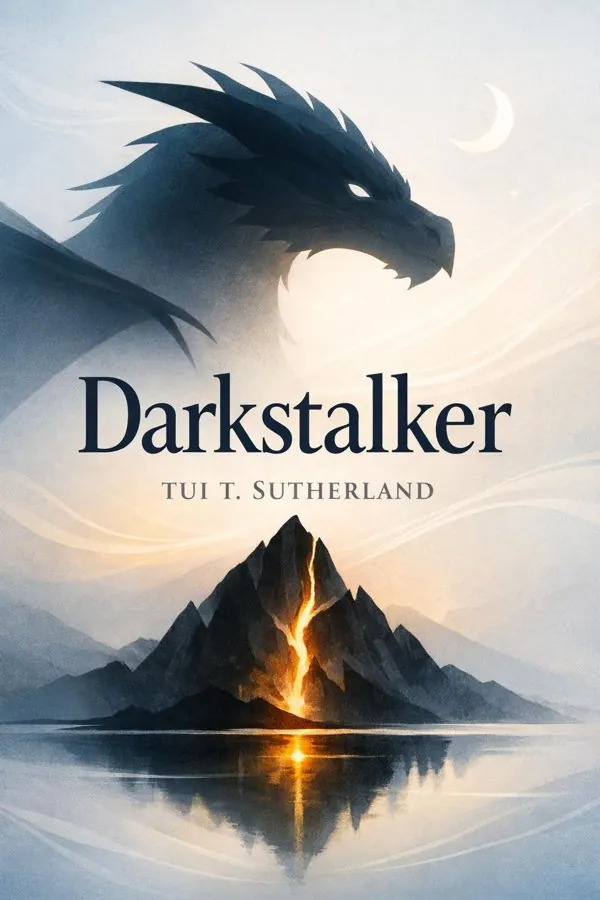
Darkstalker: Summary & Key Insights
 10 min10 chaptersAudio available
Key Takeaways from Darkstalker
People rarely fear power only after they see it; more often, they fear the idea of it first.
Some births symbolize hope, but they can also expose old wounds.
Power often seems harmless at first because it begins in intimacy.
Seeing the future does not automatically make choices easier; sometimes it makes them almost unbearable.
Affection becomes destructive when it stops respecting freedom.
What Is Darkstalker About?
Darkstalker by Tui T. Sutherland is a scifi_fantasy book spanning 10 pages. Darkstalker is a sweeping young adult fantasy novel set in the distant past of Tui T. Sutherland’s Wings of Fire universe, long before the main series begins. At its center is one of the saga’s most fascinating figures: Darkstalker, a gifted NightWing-IceWing dragon born with staggering abilities, including animus magic and prophetic power. What begins as the story of a brilliant, loving, deeply charismatic dragon gradually becomes the story of how fear, pride, and certainty can twist noble intentions into tyranny. That tragic transformation is what gives the novel its unusual power. More than a prequel, Darkstalker is a psychological origin story about power, fate, loyalty, and self-deception. It asks difficult questions: If you can change the future, should you? If you love someone, does that give you the right to control them? And when does protecting others become an excuse for domination? Tui T. Sutherland brings authority to these questions through her gift for layered worldbuilding and emotionally complex characters. She writes fantasy that is accessible to younger readers yet rich enough for older audiences, making Darkstalker both an exciting adventure and a sharp moral study.
This FizzRead summary covers all 10 key chapters of Darkstalker in approximately 10 minutes, distilling the most important ideas, arguments, and takeaways from Tui T. Sutherland's work. Also available as an audio summary and Key Quotes Podcast.
Darkstalker
Darkstalker is a sweeping young adult fantasy novel set in the distant past of Tui T. Sutherland’s Wings of Fire universe, long before the main series begins. At its center is one of the saga’s most fascinating figures: Darkstalker, a gifted NightWing-IceWing dragon born with staggering abilities, including animus magic and prophetic power. What begins as the story of a brilliant, loving, deeply charismatic dragon gradually becomes the story of how fear, pride, and certainty can twist noble intentions into tyranny. That tragic transformation is what gives the novel its unusual power.
More than a prequel, Darkstalker is a psychological origin story about power, fate, loyalty, and self-deception. It asks difficult questions: If you can change the future, should you? If you love someone, does that give you the right to control them? And when does protecting others become an excuse for domination?
Tui T. Sutherland brings authority to these questions through her gift for layered worldbuilding and emotionally complex characters. She writes fantasy that is accessible to younger readers yet rich enough for older audiences, making Darkstalker both an exciting adventure and a sharp moral study.
Who Should Read Darkstalker?
This book is perfect for anyone interested in scifi_fantasy and looking to gain actionable insights in a short read. Whether you're a student, professional, or lifelong learner, the key ideas from Darkstalker by Tui T. Sutherland will help you think differently.
- ✓Readers who enjoy scifi_fantasy and want practical takeaways
- ✓Professionals looking to apply new ideas to their work and life
- ✓Anyone who wants the core insights of Darkstalker in just 10 minutes
Want the full summary?
Get instant access to this book summary and 100K+ more with Fizz Moment.
Get Free SummaryAvailable on App Store • Free to download
Key Chapters
People rarely fear power only after they see it; more often, they fear the idea of it first. Darkstalker opens in an atmosphere charged by rumor, prophecy, and political tension. Even before the dragon who will become Darkstalker fully enters the world, whispers spread that an animus dragon with extraordinary gifts could reshape the future of Pyrrhia. This matters because the book immediately frames power as something interpreted through anxiety. A prophecy is not just a prediction in this world; it is a force that changes behavior. Tribes prepare, mistrust deepens, and expectations begin to shape the life of someone who has not yet chosen who he will become.
This opening idea gives the novel much of its psychological depth. Darkstalker is not born into neutrality. He is born into stories others are already telling about him. That is true in real life as well. Families, schools, workplaces, and societies often place identities on people before they have had the chance to define themselves. A child may be called gifted, difficult, dangerous, or special, and those labels can become self-fulfilling. Expectations create pressure, and pressure can distort judgment.
The prologue also establishes one of the novel’s central tensions: the relationship between destiny and choice. If a future has been foreseen, does that future become inevitable? Or does knowing it change the outcome? Sutherland uses prophecy not as a simple fantasy device but as a way to explore how people react when they believe the future is already decided.
A practical lesson emerges here: be careful with the stories you tell about others and yourself. Labels, predictions, and assumptions can quietly shape behavior long before any real decision is made. Actionable takeaway: question any narrative that claims someone’s future is fixed, because belief itself can become a powerful form of influence.
Some births symbolize hope, but they can also expose old wounds. Darkstalker is born to Clearsight, a brilliant NightWing seer, and Arctic, an IceWing prince who gave up his homeland for love. Their union is extraordinary because it joins two tribes marked by mistrust, cultural difference, and incompatible loyalties. On the surface, Darkstalker’s bloodline suggests possibility: maybe old enemies can create something new together. Yet from the beginning, that same heritage becomes a source of instability. He is living proof that love can cross borders, but also that unresolved conflict follows families into the next generation.
Sutherland uses Darkstalker’s parentage to show how identity is rarely simple. He is not merely NightWing or IceWing; he carries competing traditions, expectations, and emotional inheritances. Arctic’s bitterness, loss, and resentment contrast sharply with Clearsight’s warmth and moral imagination. Darkstalker grows up absorbing both. His gifts are immense, but so are the tensions inside his home. Family in this book is not just a shelter; it is the first battlefield where values are formed.
This has a clear real-world parallel. Many people grow up between cultures, between family systems, or between conflicting expectations. That position can create empathy and breadth, but it can also produce confusion if the adults involved do not resolve their own pain. Children often become the stage on which parental conflicts continue to play out.
The novel suggests that heritage does not determine character, but it does shape the pressures around it. Darkstalker is given the chance to become a bridge between worlds. Instead, he increasingly treats his difference as evidence of exceptionalism. That shift is crucial.
Actionable takeaway: honor complexity in identity without turning it into superiority. Being shaped by multiple worlds can be a strength, but only if it is grounded in humility rather than entitlement.
Power often seems harmless at first because it begins in intimacy. As Darkstalker grows, he forms important bonds, especially with Clearsight and his friend Fathom, another dragon linked to the dangerous legacy of animus magic. These relationships reveal his charm, intelligence, humor, and genuine capacity for love. This is one reason the novel is so effective: Darkstalker is not evil from the beginning. He is magnetic. He protects, entertains, and dazzles those around him. His abilities feel thrilling, even comforting, because they are first expressed among people who care about him.
That is exactly how moral compromise often begins. We do not usually encounter dangerous control in its ugliest form immediately. It often appears as help, talent, confidence, or problem-solving. Darkstalker uses magic to remove obstacles, impress others, and make life easier. In isolation, many of these choices seem understandable. Why not fix injustice if you have the power? Why not protect the people you love? Why not solve what others cannot?
Fathom becomes especially important because he offers a contrast. He understands the temptation of animus power but fears its corrupting potential. Where Darkstalker sees magic as an extension of his will, Fathom sees it as a moral burden. Their friendship becomes a quiet debate between restraint and self-justification.
In everyday life, this dynamic appears whenever gifted people are praised more for results than for ethics. A brilliant leader, creator, or strategist may begin to assume that being effective makes them right. Friends who admire talent can become blind to warning signs. Admiration, if unexamined, can enable harm.
The lesson is not to fear strength but to examine how it is used in close relationships. Actionable takeaway: when someone’s ability impresses you, also ask how they treat limits, disagreement, and the autonomy of others. Character appears there first.
Seeing the future does not automatically make choices easier; sometimes it makes them almost unbearable. Clearsight’s prophetic abilities place her in one of the most painful positions in the novel. She loves Darkstalker deeply, understands his brilliance, and wants to believe in the best possible version of him. At the same time, her visions repeatedly reveal terrible futures shaped by his ambition, possessiveness, and hunger for control. She must live with the emotional strain of loving someone while seeing what they might become.
This makes Clearsight more than a supporting character. She represents the moral pain of foresight. Many people experience a version of this in ordinary life: noticing troubling patterns in someone they care about, hoping those patterns will change, and struggling to decide when concern must become action. Clearsight’s visions are fantastical, but the emotional truth is recognizable. She sees warning signs before others do. The harder question is what responsibility comes with that knowledge.
Sutherland avoids making prophecy simplistic. Clearsight sees multiple futures, not a single unavoidable path. That detail matters because it preserves moral agency. Darkstalker is not doomed in a mechanical sense. He is making choices that narrow his future into darker forms. Clearsight therefore becomes a witness to gradual corruption rather than a passive observer of fate.
Her role also highlights how love can complicate judgment. Because she cares for Darkstalker, she hesitates, rationalizes, and searches for better outcomes. This is deeply human. We often want evidence that our loved ones are redeemable, even when patterns suggest otherwise.
A practical application is to treat early warning signs seriously, especially when they involve manipulation, contempt for boundaries, or belief in one’s own moral exemption. Love does not cancel evidence. Actionable takeaway: if you repeatedly see harmful patterns in someone, stop asking only what they intend and start asking what their choices consistently produce.
Affection becomes destructive when it stops respecting freedom. One of Darkstalker’s most unsettling qualities is that his love is often sincere, yet increasingly possessive. He cares deeply for Clearsight and for those close to him, but he begins to act as if love grants authority. Instead of protecting others by supporting their choices, he protects them by narrowing those choices. He wants safety, loyalty, and permanence, and he uses power to secure them. This is the novel’s sharpest moral warning: devotion can become domination when it fears loss more than it values another person’s independence.
The relationship between Darkstalker and Clearsight captures this perfectly. He admires her intelligence and foresight, but he also resists the limits she places on him. He wants to be understood, trusted, and chosen, yet he increasingly behaves as though disagreement is betrayal. The tragedy is that he does not see himself as cruel. He sees himself as necessary. That self-image allows him to justify escalating control.
This pattern extends beyond romance. Darkstalker also applies it to family, tribe, and destiny. He believes that because he loves his people and knows what is best, he has earned the right to decide for them. In real life, this mindset appears in relationships where one person monitors, manipulates, or "helps" in ways that erase the other’s agency. It can also appear in leadership, parenting, or institutions that use care as a cover for control.
The book invites readers to distinguish between sacrifice and possession. Genuine love makes room for uncertainty, disagreement, and separate will. Possessive love seeks guarantees and becomes angry when it cannot obtain them.
Actionable takeaway: examine whether your care for others leaves them freer or more constrained. If your love depends on control, reassurance, or obedience, it is time to step back and rebuild it on respect.
The first truly shocking act is rarely isolated; it grows from a story someone tells themselves. Darkstalker’s conflict with his father Arctic marks a decisive turning point because it transforms resentment into irrevocable action. Their relationship is already poisoned by bitterness, exile, pride, and mutual misunderstanding. Arctic is cold, unhappy, and often cruel, while Darkstalker feels judged, constrained, and increasingly contemptuous. Yet what matters most is not simply that violence occurs, but how Darkstalker explains it to himself. He frames extreme action as deserved, efficient, and even righteous.
This is one of the novel’s most sobering insights. People do not need to feel monstrous in order to do monstrous things. They often need only a narrative that casts harm as justified correction. Darkstalker’s gifts make this especially dangerous because he can act on impulse with catastrophic power. But the psychological mechanism is familiar. Once someone believes they are morally exceptional, patience and accountability begin to look like obstacles rather than safeguards.
The scene also shows how longstanding emotional injuries can harden into a hunger for decisive resolution. Instead of tolerating pain, grief, or ambiguity, Darkstalker chooses domination. He would rather end conflict through force than endure the vulnerability of unresolved relationships. This is a temptation many people face in lesser forms: trying to win, silence, expose, punish, or overpower instead of facing discomfort honestly.
Sutherland does not excuse Arctic’s failures, but she refuses to let those failures absolve Darkstalker. Being hurt does not give someone unlimited moral permission. That distinction is crucial, both in fiction and in life.
Actionable takeaway: when you feel most certain that harm is justified, pause longest. Moral certainty under emotional pressure is one of the clearest warning signs that anger is beginning to masquerade as wisdom.
The real danger of unlimited power is not only what it can do to others, but what it teaches its owner to believe. Darkstalker’s animus magic allows him to reshape reality itself, and as his confidence grows, so does his willingness to solve every problem through enchantment. At first, magic is a tool. Soon, it becomes a worldview. If every obstacle can be removed, every risk reduced, and every person influenced, then patience, compromise, and humility begin to look unnecessary. Darkstalker does not merely use magic; he starts to think like someone who should never have to accept limits.
This idea is central to the novel’s moral architecture. Magic here functions as a metaphor for extraordinary capability of any kind—intelligence, charisma, authority, wealth, political influence, or technological reach. The more power someone has, the easier it becomes to mistake capacity for permission. Darkstalker repeatedly crosses ethical lines because he judges actions by effectiveness rather than consent or principle. If a spell works and produces the desired outcome, he treats it as validated.
Fathom’s contrasting fear of animus magic becomes increasingly important in this context. He understands that some powers damage the user’s inner life even when they appear externally successful. Every shortcut weakens the habit of restraint. Every manipulation makes direct honesty less appealing. Every "necessary" exception prepares the mind for the next one.
In practical terms, this applies wherever people rely too heavily on leverage. A manager can force compliance, a parent can overcontrol, a partner can manipulate emotions, and a government can sacrifice liberty for order. The question is not only whether power can solve a problem, but what kind of person repeated use of that power creates.
Actionable takeaway: build limits before you think you need them. Whether your power is social, professional, emotional, or material, create boundaries that protect other people’s autonomy and your own moral judgment.
Tyranny rarely arrives all at once; it advances by a series of choices that each seem explainable. One of the most compelling aspects of Darkstalker is how carefully Sutherland depicts the gradual expansion of control. Darkstalker does not begin by declaring himself a monster. He takes one step, then another, each defended as practical, loving, or unavoidable. He protects friends by limiting risk. He secures loyalty by influencing behavior. He removes threats before they can act. At every stage, there is a reason. That is what makes the descent believable.
This incremental pattern is deeply relevant beyond the novel. In personal life, manipulation often starts with small intrusions framed as care: checking messages "for safety," discouraging certain friendships, making decisions "to help." In institutions, overreach may begin with temporary emergency measures that become permanent habits. The most dangerous systems are often built from individually defensible choices that no one stops to evaluate in total.
Clearsight recognizes this accumulation through her visions. She sees not just isolated acts, but the future architecture those acts create. That perspective is vital. Ethical failure often becomes obvious only when viewed across time. A single action may seem minor; a pattern reveals character.
Darkstalker’s tragedy lies partly in his inability to understand that ends do not erase means. He believes good goals can absorb moral cost. But once a person repeatedly overrides consent, truth, and accountability, the structure of their thinking changes. They no longer need explicit cruelty to become dangerous. Their normal process becomes domination.
Actionable takeaway: evaluate patterns, not just incidents. If your choices repeatedly require secrecy, coercion, or exceptions to your own values, do not ask whether each step is defensible. Ask what direction those steps are taking you.
The hardest moral decisions often require us to act against our deepest desires. Clearsight’s final arc is so powerful because it refuses the fantasy that love alone can save someone who will not restrain himself. She wants to believe in Darkstalker. She sees his intelligence, his tenderness, and the many possible futures in which he could choose differently. But as his behavior becomes more manipulative and dangerous, she is forced to confront a painful truth: love cannot replace accountability, and insight cannot substitute for consent.
Her eventual choice to oppose him is not a rejection of feeling but an expression of moral clarity. She does not stop caring. Instead, she recognizes that caring without boundaries would make her complicit in the harm he creates. This distinction gives the novel emotional maturity. It acknowledges that people can be tragic, gifted, wounded, and still intolerable in what they choose to become.
This idea has strong practical resonance. Many readers will recognize situations in which loyalty to a friend, partner, relative, or leader clashes with the evidence of real harm. Clearsight models a difficult but necessary principle: understanding someone’s pain does not require enabling their behavior. Compassion without limits can become permission.
Her choice also reframes courage. In many fantasies, bravery means standing by the person you love no matter what. Here, bravery means refusing to stand by when love is being used to excuse control. It is the courage to disappoint, leave, resist, or expose when silence would be easier.
Actionable takeaway: when loyalty and conscience come into conflict, treat that conflict as a moral signal rather than an inconvenience. Real care sometimes means drawing a firm line, even when your heart would prefer one more chance.
Defeating a destructive force is not the same as undoing its influence. The sealing of Darkstalker beneath the mountain provides the novel with a dramatic ending, but Sutherland is careful to make that ending uneasy rather than clean. Darkstalker is stopped, yet not erased. His ideas, his enchantments, his emotional impact, and the legend surrounding him remain. The epilogue reinforces this point by showing that what has been buried can still shape the future. Legacy persists through memory, fear, fascination, and unfinished consequences.
This ending matters because it broadens the book’s meaning. Darkstalker is not only about one dragon’s fall; it is about how charisma and power echo across generations. Harm does not vanish when the central figure disappears. Communities still live with the distortions left behind. People still interpret the story in ways that may repeat the original mistakes. Some will fear too much, some will admire too much, and some will forget why boundaries were needed in the first place.
The same dynamic appears in real life after abusive leaders, manipulative relationships, or unjust systems formally end. Removal is only the first step. Healing requires memory, honest retelling, and structural change. Otherwise, the conditions that enabled the problem remain intact.
The novel’s final lesson is therefore not merely cautionary but practical. Prevention is better than containment. Once destructive power is fully formed, the cost of stopping it is enormous and the damage is lasting. It is wiser to recognize harmful patterns early, respond collectively, and refuse the seductions of exceptionalism before they harden into legend.
Actionable takeaway: do not measure success only by whether a threat is stopped. Ask what traces remain, what lessons must be preserved, and what systems need to change so the same pattern does not return in a different form.
All Chapters in Darkstalker
About the Author
Tui T. Sutherland is a bestselling American children’s and young adult author best known for creating the Wings of Fire series. Born in Venezuela, she spent parts of her childhood in different countries, experiences that helped shape her imagination and interest in stories about identity, conflict, and belonging. In addition to writing, she has worked as an editor, which contributed to her strong sense of pacing, structure, and audience. Sutherland is especially admired for combining accessible fantasy adventures with emotionally layered characters and serious moral themes. Her books often feature memorable worldbuilding, high-stakes choices, and protagonists who must navigate loyalty, destiny, and power. With Darkstalker, she demonstrates her skill at writing a villain origin story that is both thrilling and psychologically nuanced.
Get This Summary in Your Preferred Format
Read or listen to the Darkstalker summary by Tui T. Sutherland anytime, anywhere. FizzRead offers multiple formats so you can learn on your terms — all free.
Available formats: App · Audio · PDF · EPUB — All included free with FizzRead
Download Darkstalker PDF and EPUB Summary
Key Quotes from Darkstalker
“People rarely fear power only after they see it; more often, they fear the idea of it first.”
“Some births symbolize hope, but they can also expose old wounds.”
“Power often seems harmless at first because it begins in intimacy.”
“Seeing the future does not automatically make choices easier; sometimes it makes them almost unbearable.”
“Affection becomes destructive when it stops respecting freedom.”
Frequently Asked Questions about Darkstalker
Darkstalker by Tui T. Sutherland is a scifi_fantasy book that explores key ideas across 10 chapters. Darkstalker is a sweeping young adult fantasy novel set in the distant past of Tui T. Sutherland’s Wings of Fire universe, long before the main series begins. At its center is one of the saga’s most fascinating figures: Darkstalker, a gifted NightWing-IceWing dragon born with staggering abilities, including animus magic and prophetic power. What begins as the story of a brilliant, loving, deeply charismatic dragon gradually becomes the story of how fear, pride, and certainty can twist noble intentions into tyranny. That tragic transformation is what gives the novel its unusual power. More than a prequel, Darkstalker is a psychological origin story about power, fate, loyalty, and self-deception. It asks difficult questions: If you can change the future, should you? If you love someone, does that give you the right to control them? And when does protecting others become an excuse for domination? Tui T. Sutherland brings authority to these questions through her gift for layered worldbuilding and emotionally complex characters. She writes fantasy that is accessible to younger readers yet rich enough for older audiences, making Darkstalker both an exciting adventure and a sharp moral study.
More by Tui T. Sutherland
You Might Also Like
Red Rising
Pierce Brown
10 min
Stranger in a Strange Land
Robert A. Heinlein
10 min
AI Valley
Chen Qiufan
10 min
Bloodchild
Octavia E. Butler
10 min
Do Androids Dream of Electric Sheep?
Philip K. Dick
10 min
Jujutsu Kaisen, Vol. 24
Gege Akutami
10 minBrowse by Category
Ready to read Darkstalker?
Get the full summary and 100K+ more books with Fizz Moment.