
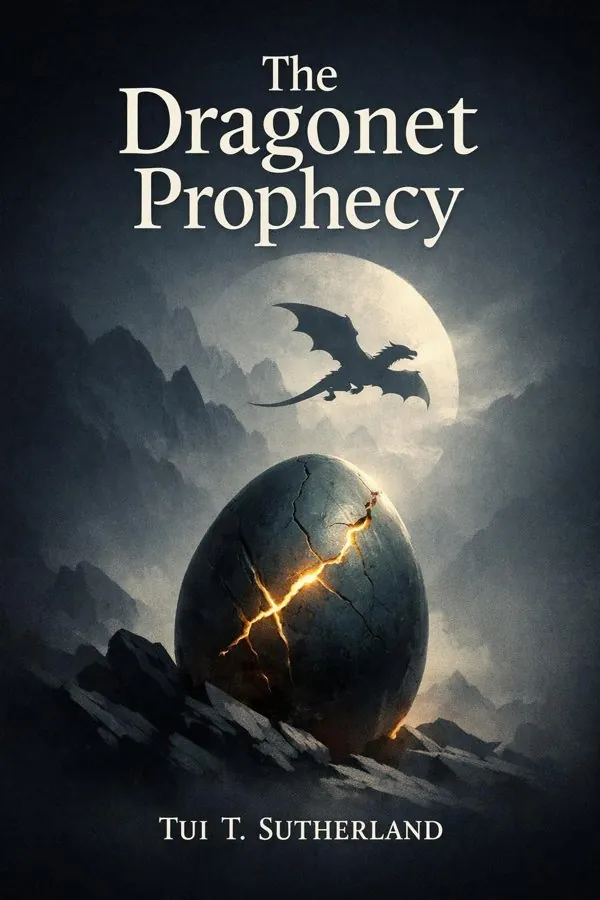
The Dragonet Prophecy: Summary & Key Insights
 10 min9 chaptersAudio available
Key Takeaways from The Dragonet Prophecy
A prophecy may sound like hope, but in this story it first functions as a cage.
The most underestimated trait in a violent world is often compassion.
Sometimes the first act of growth is simply walking out of the world that shaped you.
One of the novel’s sharpest insights is that cruelty often survives by making itself entertaining.
Shared destiny does not automatically create trust; trust has to be built through repeated acts of loyalty.
What Is The Dragonet Prophecy About?
The Dragonet Prophecy by Tui T. Sutherland is a bestsellers book spanning 5 pages. The Dragonet Prophecy, the opening novel in Tui T. Sutherland’s bestselling Wings of Fire series, begins with a powerful idea: what happens when children are raised to save a world they barely understand? Set in the war-torn dragon continent of Pyrrhia, the story follows five young dragonets who have been hidden underground since hatching. According to a prophecy, they are destined to end a brutal succession war between rival queens and restore peace to the land. But once they escape the guardians who shaped their lives, they discover that destiny is far messier, scarier, and more personal than prophecy suggests. What makes this book stand out is how it combines fast-paced fantasy adventure with emotionally sharp questions about identity, loyalty, freedom, and moral choice. Sutherland creates a vivid dragon society with distinct tribes, political tensions, and cultural differences, but the heart of the novel lies in its characters—especially Clay, whose kindness becomes as important as strength. A longtime fantasy author known for rich worldbuilding and accessible storytelling, Sutherland delivers a story that appeals to younger readers while offering deeper themes about power, manipulation, and choosing who you want to become.
This FizzRead summary covers all 9 key chapters of The Dragonet Prophecy in approximately 10 minutes, distilling the most important ideas, arguments, and takeaways from Tui T. Sutherland's work. Also available as an audio summary and Key Quotes Podcast.
The Dragonet Prophecy
The Dragonet Prophecy, the opening novel in Tui T. Sutherland’s bestselling Wings of Fire series, begins with a powerful idea: what happens when children are raised to save a world they barely understand? Set in the war-torn dragon continent of Pyrrhia, the story follows five young dragonets who have been hidden underground since hatching. According to a prophecy, they are destined to end a brutal succession war between rival queens and restore peace to the land. But once they escape the guardians who shaped their lives, they discover that destiny is far messier, scarier, and more personal than prophecy suggests.
What makes this book stand out is how it combines fast-paced fantasy adventure with emotionally sharp questions about identity, loyalty, freedom, and moral choice. Sutherland creates a vivid dragon society with distinct tribes, political tensions, and cultural differences, but the heart of the novel lies in its characters—especially Clay, whose kindness becomes as important as strength. A longtime fantasy author known for rich worldbuilding and accessible storytelling, Sutherland delivers a story that appeals to younger readers while offering deeper themes about power, manipulation, and choosing who you want to become.
Who Should Read The Dragonet Prophecy?
This book is perfect for anyone interested in bestsellers and looking to gain actionable insights in a short read. Whether you're a student, professional, or lifelong learner, the key ideas from The Dragonet Prophecy by Tui T. Sutherland will help you think differently.
- ✓Readers who enjoy bestsellers and want practical takeaways
- ✓Professionals looking to apply new ideas to their work and life
- ✓Anyone who wants the core insights of The Dragonet Prophecy in just 10 minutes
Want the full summary?
Get instant access to this book summary and 100K+ more with Fizz Moment.
Get Free SummaryAvailable on App Store • Free to download
Key Chapters
A prophecy may sound like hope, but in this story it first functions as a cage. Pyrrhia is a continent shattered by war after the death of Queen Oasis leaves the SandWing throne contested by three heirs. Around that conflict, the seven dragon tribes take sides, turning old rivalries into generations of bloodshed. Into this chaos comes a prophecy: five dragonets, taken from different tribes, will end the war and choose the rightful queen. On the surface, that sounds heroic. In practice, it means five children are denied normal lives and raised as tools for someone else’s plan.
Sutherland uses this setup to ask a larger question: when people are told from birth who they must be, how much freedom do they really have? The dragonets’ guardians treat destiny as justification for control. Their food, education, movement, and relationships are all shaped by an agenda. This mirrors real-world situations in which institutions, families, or communities impose identities on the young before they can form their own. Expectations can create purpose, but they can also erase individuality.
The prophecy also drives the novel’s political tension. Different dragons believe different versions of what peace should look like, and each interprets the prophecy in self-serving ways. This makes the world feel believable: in times of conflict, even sacred ideals become instruments of power.
Readers can apply this insight by examining the expectations placed on them. A path chosen for you is not always the same as a path chosen by you. The actionable takeaway is simple: question inherited roles, especially when they demand sacrifice without consent.
The most underestimated trait in a violent world is often compassion. Clay, a MudWing dragonet, begins the novel believing he may be the least impressive member of the prophecy group. He is large, physically strong, and loyal, but he does not feel naturally heroic. He is not cunning like Tsunami, mysterious like Starflight, graceful like Sunny, or fierce like Glory. Instead, his defining qualities are gentleness, protectiveness, and a constant concern for others. In another fantasy story, those traits might be sidelined. Here, they become central.
Clay’s journey is an awakening. Raised in confinement, he has absorbed the idea that he exists to fulfill a grand purpose, yet he rarely feels certain about what that purpose requires. As danger increases after the dragonets escape, Clay repeatedly chooses care over cruelty. He protects weaker companions, tries to understand enemies, and resists becoming the brutal warrior others expect. This is especially meaningful in a world where military power dominates politics. Clay demonstrates that moral strength is not softness in a negative sense; it is restraint, empathy, and courage under pressure.
This idea has clear practical value. Many readers, especially younger ones, are told that leadership means confidence, forcefulness, or dominance. Clay offers another model. He leads not by commanding others but by creating safety, listening closely, and acting from loyalty. In teams, families, and friendships, the person who notices fear and responds with steadiness often becomes the real anchor.
The book suggests that identity is not discovered through labels but through repeated choices. Clay is not powerful because the prophecy says so. He becomes powerful when he decides what kind of dragon he will be. The actionable takeaway: do not dismiss kindness as weakness; in hard moments, let empathy guide your version of strength.
Sometimes the first act of growth is simply walking out of the world that shaped you. For the dragonets, the hidden cave where they are raised is both shelter and prison. It protects them from the war above, but it also keeps them ignorant, dependent, and easy to control. Their guardians insist the outside world is too dangerous and that obedience is necessary for a higher mission. Yet the cave’s safety comes at a steep cost: the dragonets know almost nothing about the tribes they supposedly represent, and even less about themselves.
The escape is therefore more than a plot event. It is a symbolic break from manufactured reality. Once the dragonets enter the open world, they begin discovering that the stories they were told are incomplete or distorted. Tribes are more complex than stereotypes. Allies are not always trustworthy. Enemies are not always monstrous. The transition from the cave to the sky reflects a universal developmental experience: moving from protected certainty into complicated truth.
Sutherland captures the emotional price of freedom as well. Liberation is exhilarating, but it is also disorienting. The dragonets must make decisions without clear guidance and accept the consequences. Readers can relate this to moments such as leaving home, questioning a belief system, or stepping outside a familiar social role. Growth often feels like confusion before it feels like confidence.
The practical lesson is that information and experience matter. You cannot make meaningful choices if your world has been narrowly defined by others. Seeking wider perspectives is a necessary part of becoming independent. The actionable takeaway: when your environment limits your understanding, step beyond it deliberately and learn from direct experience, even when that process is uncomfortable.
One of the novel’s sharpest insights is that cruelty often survives by making itself entertaining. When the dragonets fall into the control of Queen Scarlet of the SkyWings, they enter a world where violence is not just political—it is theatrical. Scarlet’s arena transforms fear, punishment, and death into public spectacle. She does not merely rule through power; she performs power, using drama and humiliation to prove that everyone exists at her mercy.
This section of the story raises the stakes while deepening the book’s moral complexity. Scarlet is dangerous because she understands psychology. She pits dragons against one another, manipulates appearances, and feeds off emotional reactions. The arena reveals how authoritarian systems work: they normalize suffering by packaging it as justice, tradition, or entertainment. Once pain becomes a show, empathy erodes. Observers stop asking whether something is right and begin asking only whether it is exciting.
For Clay, the arena becomes a test of his inner values. He is forced into situations where survival may require aggression, yet he never fully accepts Scarlet’s worldview. This matters because oppressive environments often pressure individuals to become like their oppressors. Clay’s resistance shows that maintaining compassion under coercion is a form of rebellion.
Readers can connect this idea to modern life in subtle ways. Public shaming, outrage culture, and entertainment built on humiliation can desensitize people to others’ pain. The novel invites us to question systems that reward spectacle over dignity.
The actionable takeaway is to refuse participation in cruelty disguised as amusement. Whether in media, social settings, or institutions, choose empathy over spectacle and do not let another person’s suffering become your entertainment.
Shared destiny does not automatically create trust; trust has to be built through repeated acts of loyalty. The five dragonets—Clay, Tsunami, Glory, Starflight, and Sunny—begin as companions bound by circumstance, not by full understanding. They have been raised together, but captivity has amplified their tensions as much as their affection. They argue, compete, and misunderstand one another. Their different tribal backgrounds carry assumptions and stereotypes that shape how they see themselves and each other. Yet as the story unfolds, their bond becomes the emotional core of the novel.
What makes this friendship compelling is that it is chosen, not guaranteed. Once they escape, each dragonet faces opportunities to prioritize personal safety, tribal identity, or individual ambition. Again and again, they return to one another. Tsunami’s boldness, Glory’s sarcasm, Starflight’s intelligence, Sunny’s optimism, and Clay’s steadiness begin to function as complementary strengths rather than clashing flaws. The group survives not because each member is perfect, but because each contributes something essential.
This is a useful model for real relationships. Healthy groups do not require sameness. In fact, diversity of temperament often makes a team stronger. The challenge is learning to interpret difference as value instead of threat. The dragonets gradually stop asking, “Why isn’t everyone like me?” and begin asking, “What can each of us do that the others cannot?”
The book also shows that loyalty includes honesty. The dragonets do not always agree, and their conflicts matter. Real friendship is not silence or constant harmony; it is commitment strong enough to withstand disagreement.
The actionable takeaway: invest in relationships where differences can become strengths, and practice loyalty through support, truth-telling, and mutual protection rather than simple closeness.
One of the most important themes in The Dragonet Prophecy is that inherited categories never fully define a person. Pyrrhia’s tribes are vivid and culturally distinct, and those differences matter politically and socially. MudWings, SeaWings, SkyWings, SandWings, RainWings, NightWings, and IceWings all carry reputations, traditions, and prejudices. In wartime, these tribal identities harden into assumptions: some dragons are seen as noble, others as lazy, savage, weak, or dangerous. The dragonets grow up hearing these stories, and they absorb more of them than they realize.
As they move through the wider world, those assumptions begin to crack. Glory, dismissed by others because she is a RainWing, proves sharp, brave, and deeply capable. Clay, expected to embody MudWing toughness, struggles with self-doubt yet shows uncommon emotional intelligence. Tsunami’s confidence coexists with vulnerability. The novel repeatedly undermines the easy equation between category and character.
This theme resonates well beyond fantasy. People in real life are often sorted by nationality, class, family expectations, gender roles, race, or institutional labels. Such identities can provide belonging, but they can also become boxes that reduce complexity. Sutherland does not erase tribal identity; instead, she shows that meaningful identity emerges where background meets choice.
The practical application is to become suspicious of any system that claims it can predict someone’s value from where they come from. In classrooms, workplaces, and communities, people often surprise us when given room to define themselves. The dragonets grow stronger as they stop treating tribe as destiny.
The actionable takeaway: honor where you come from without letting it limit who you can become, and extend that same generosity of judgment to others.
War in Pyrrhia does not continue simply because dragons hate one another; it continues because leaders use fear, pride, and ambition to preserve power. Throughout the novel, the young dragonets confront versions of authority that claim legitimacy while causing harm. Their guardians insist control is necessary for peace. Queen Scarlet treats domination as brilliance. Other political actors maneuver around the prophecy for strategic gain rather than moral conviction. Together, these examples reveal a central lesson: leadership without conscience becomes exploitation.
Sutherland is especially effective at showing how power justifies itself. Harmful leaders rarely describe themselves as cruel. They call themselves practical, strong, visionary, or necessary. This matters because it trains readers to look beyond rhetoric. A ruler’s words mean little if their methods rely on deception, coercion, or disregard for life. The dragonets slowly learn that authority deserves scrutiny, not automatic trust.
This theme has broad relevance. In schools, organizations, and governments, people often confuse confidence with wisdom. Yet the book suggests that true leadership should protect the vulnerable, welcome accountability, and make room for dissent. The adults in The Dragonet Prophecy frequently fail these tests, which is why the younger characters must start thinking independently.
An important practical lesson follows: when evaluating leaders, watch what happens to the least powerful people around them. Do they become safer, freer, and more respected, or more frightened and disposable? That question often reveals the moral reality behind impressive titles.
The actionable takeaway is to judge leadership by its impact rather than its image. Support authority rooted in responsibility, and be wary of any power that demands obedience while avoiding accountability.
Many adventure stories present courage as certainty in action, but The Dragonet Prophecy offers a more honest version: courage is acting when you are frightened, confused, and unsure of the outcome. The dragonets do not possess complete knowledge, mature judgment, or reliable adult guidance. They are young, hunted, and burdened by a prophecy they did not choose. If they waited until everything was clear, they would never move forward. Instead, they make imperfect decisions under pressure and learn through the consequences.
This is especially visible in Clay. He rarely feels like the obvious hero, and that is precisely why his bravery feels real. He hesitates, worries, and doubts himself, yet he keeps protecting others. Tsunami rushes ahead with bold instinct, while Starflight thinks through risks, and Sunny pushes toward hope. Each dragonet models a different style of courage. Together they show that bravery is not one personality type. It can look like persistence, truth-telling, self-restraint, or refusing to abandon friends.
For readers, this is a valuable corrective to perfectionism. Many people delay action because they feel unprepared, whether in relationships, creative work, or difficult conversations. The novel suggests that growth comes from moving forward with limited certainty, not from waiting for impossible guarantees.
Practical application is straightforward. When facing a hard choice, ask not whether fear is present, but whether your values are clear enough to guide a next step. Small acts of courage often matter more than dramatic ones.
The actionable takeaway: do not wait to feel fearless before acting. Identify the right next move, however modest, and take it even if doubt comes with you.
The book begins by centering prophecy, but it grows more interesting by questioning prophecy’s authority. At first, the dragonets seem defined by fate. Their lives have been organized around a prediction, and adults speak as though the future has already been written. Yet the deeper the story goes, the clearer it becomes that prophecy alone cannot create justice, wisdom, or peace. What matters is how individuals respond to the roles assigned to them.
This tension between fate and choice gives the novel much of its emotional power. If the dragonets simply fulfilled a script, their actions would have little moral weight. Instead, they continually interpret, resist, reshape, or reject what others expect from them. Their decisions carry meaning precisely because obedience is not enough. Peace, if it comes, will not emerge from magic words but from courageous, ethical action.
That idea has enduring relevance. People often speak of destiny in many forms: talent, background, family tradition, social expectations, or supposedly fixed personality traits. These forces can influence our lives, but they do not eliminate responsibility. The novel encourages readers to distinguish between being given a role and earning a character.
There is also a liberating message here. You do not need perfect certainty about your grand purpose to make meaningful choices today. The dragonets matter because of what they do for one another and what they refuse to become under pressure.
The actionable takeaway is to treat predictions, labels, and expectations as starting points rather than final definitions. Your future may be shaped by circumstance, but your character is built by repeated moral choices.
All Chapters in The Dragonet Prophecy
About the Author
Tui T. Sutherland is a bestselling Venezuelan-American children’s and middle-grade author best known for the hugely popular Wings of Fire series. She has written fantasy, humor, and adventure fiction, and she has also contributed to the Warriors franchise under the shared pseudonym Erin Hunter. Sutherland is widely admired for her ability to create vivid imaginative worlds while keeping her stories emotionally grounded and accessible to younger readers. Her books often focus on themes such as identity, friendship, leadership, courage, and the tension between destiny and choice. With Wings of Fire, she built a richly developed dragon universe that has earned a devoted international readership, multiple spin-offs, and a lasting place in contemporary children’s fantasy literature.
Get This Summary in Your Preferred Format
Read or listen to the The Dragonet Prophecy summary by Tui T. Sutherland anytime, anywhere. FizzRead offers multiple formats so you can learn on your terms — all free.
Available formats: App · Audio · PDF · EPUB — All included free with FizzRead
Download The Dragonet Prophecy PDF and EPUB Summary
Key Quotes from The Dragonet Prophecy
“A prophecy may sound like hope, but in this story it first functions as a cage.”
“The most underestimated trait in a violent world is often compassion.”
“Sometimes the first act of growth is simply walking out of the world that shaped you.”
“One of the novel’s sharpest insights is that cruelty often survives by making itself entertaining.”
“Shared destiny does not automatically create trust; trust has to be built through repeated acts of loyalty.”
Frequently Asked Questions about The Dragonet Prophecy
The Dragonet Prophecy by Tui T. Sutherland is a bestsellers book that explores key ideas across 9 chapters. The Dragonet Prophecy, the opening novel in Tui T. Sutherland’s bestselling Wings of Fire series, begins with a powerful idea: what happens when children are raised to save a world they barely understand? Set in the war-torn dragon continent of Pyrrhia, the story follows five young dragonets who have been hidden underground since hatching. According to a prophecy, they are destined to end a brutal succession war between rival queens and restore peace to the land. But once they escape the guardians who shaped their lives, they discover that destiny is far messier, scarier, and more personal than prophecy suggests. What makes this book stand out is how it combines fast-paced fantasy adventure with emotionally sharp questions about identity, loyalty, freedom, and moral choice. Sutherland creates a vivid dragon society with distinct tribes, political tensions, and cultural differences, but the heart of the novel lies in its characters—especially Clay, whose kindness becomes as important as strength. A longtime fantasy author known for rich worldbuilding and accessible storytelling, Sutherland delivers a story that appeals to younger readers while offering deeper themes about power, manipulation, and choosing who you want to become.
More by Tui T. Sutherland
You Might Also Like

The Godfather
Mario Puzo
10 min
The Handmaid's Tale
Margaret Atwood
10 min
The Hunger Games
Suzanne Collins
10 min
The Nightingale
Kristin Hannah
10 min
The Seven Husbands of Evelyn Hugo
Taylor Jenkins Reid
10 min
Backwater Justice
Fern Michaels
10 minBrowse by Category
Ready to read The Dragonet Prophecy?
Get the full summary and 100K+ more books with Fizz Moment.