
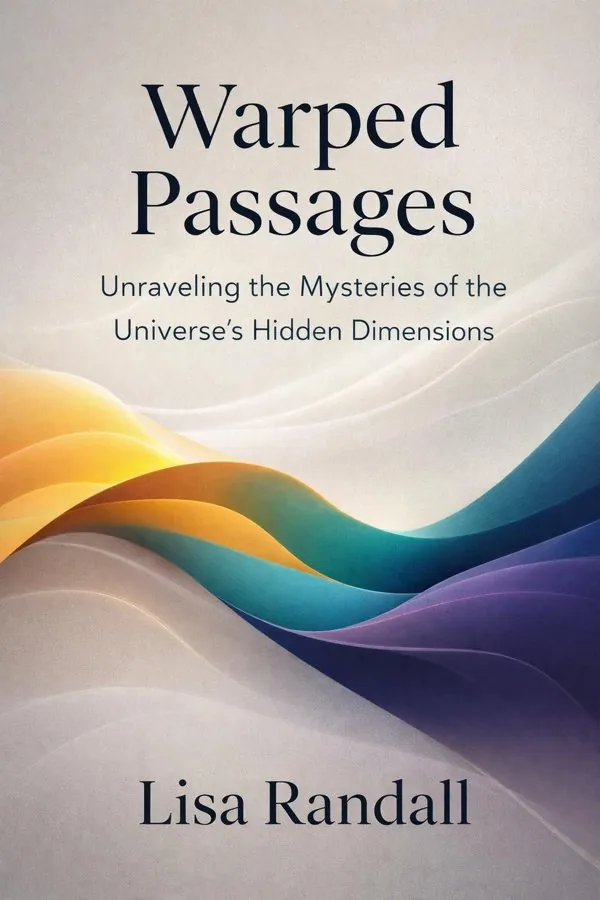
Warped Passages: Unraveling the Mysteries of the Universe's Hidden Dimensions: Summary & Key Insights
by Lisa Randall
 10 min6 chaptersAudio available
What Is Warped Passages: Unraveling the Mysteries of the Universe's Hidden Dimensions About?
Warped Passages: Unraveling the Mysteries of the Universe's Hidden Dimensions by Lisa Randall is a space_physics book spanning 6 pages. This book explores the concept of extra dimensions in physics and cosmology, explaining how modern theories such as string theory and brane-world scenarios propose that our universe may have hidden dimensions beyond the familiar three of space and one of time. Lisa Randall, a theoretical physicist, presents complex ideas about particle physics and cosmology in an accessible way, guiding readers through the scientific reasoning behind these revolutionary concepts.
This FizzRead summary covers all 6 key chapters of Warped Passages: Unraveling the Mysteries of the Universe's Hidden Dimensions in approximately 10 minutes, distilling the most important ideas, arguments, and takeaways from Lisa Randall's work. Also available as an audio summary and Key Quotes Podcast.
Warped Passages: Unraveling the Mysteries of the Universe's Hidden Dimensions
This book explores the concept of extra dimensions in physics and cosmology, explaining how modern theories such as string theory and brane-world scenarios propose that our universe may have hidden dimensions beyond the familiar three of space and one of time. Lisa Randall, a theoretical physicist, presents complex ideas about particle physics and cosmology in an accessible way, guiding readers through the scientific reasoning behind these revolutionary concepts.
Who Should Read Warped Passages: Unraveling the Mysteries of the Universe's Hidden Dimensions?
This book is perfect for anyone interested in space_physics and looking to gain actionable insights in a short read. Whether you're a student, professional, or lifelong learner, the key ideas from Warped Passages: Unraveling the Mysteries of the Universe's Hidden Dimensions by Lisa Randall will help you think differently.
- ✓Readers who enjoy space_physics and want practical takeaways
- ✓Professionals looking to apply new ideas to their work and life
- ✓Anyone who wants the core insights of Warped Passages: Unraveling the Mysteries of the Universe's Hidden Dimensions in just 10 minutes
Want the full summary?
Get instant access to this book summary and 100K+ more with Fizz Moment.
Get Free SummaryAvailable on App Store • Free to download
Key Chapters
Our understanding of space and time has evolved dramatically over centuries. Newton’s universe was a rigid stage—a vast arena where objects move according to clear rules. In that world, the three dimensions of space and one of time were separate, absolute, and immutable. Every action could be predicted if you knew the forces at play and the positions of the bodies involved.
But this picture began to crumble with Einstein. His theory of relativity taught us that space and time are intertwined, forming a dynamic fabric that curves under the influence of mass and energy. A massive object doesn’t merely sit in space—it bends spacetime around it, creating what we experience as gravity. This insight unified what had seemed separate: geometry and physics became inseparable. Relativity also showed that our measurements depend on the observer’s perspective; time can stretch, and space can contract depending on your motion.
When I first encountered these ideas as a physicist, I was struck by how simple yet radical they are. Relativity isn’t just a new description of motion—it’s a new way of perceiving reality. The symmetry and elegance of Einstein’s equations hint that our universe may have deeper structures beyond those four familiar dimensions. And indeed, as scientists explored the quantum world, the classical picture proved inadequate. Something else lay beneath the visible.
If relativity reshaped our view of space and time, quantum mechanics rewrote our understanding of matter and energy. In the quantum world, particles and waves merge into a single strange duality. They can exist in multiple states at once, and only when we measure do they 'choose' a reality. This probabilistic nature challenged every intuitive notion we had about how the universe should behave.
Through decades of work, physicists developed what we now call the Standard Model—a framework that accounts for all known particles and their interactions, except for gravity. It’s an elegant theory that explains the electromagnetic, weak, and strong forces using quantum field theory. But it is not complete. It requires arbitrary constants, cannot naturally explain mass hierarchies, and leaves gravity out of the picture entirely.
It was this gap—the separation between quantum physics and gravity—that drove me and many others to explore the possibility of extra dimensions. When forces behave differently across dimensional boundaries, new symmetries and patterns arise. Perhaps gravity seems weak not because it is intrinsically feeble, but because it spreads through hidden dimensions while other forces remain confined to our familiar space.
+ 4 more chapters — available in the FizzRead app
All Chapters in Warped Passages: Unraveling the Mysteries of the Universe's Hidden Dimensions
About the Author
Lisa Randall is an American theoretical physicist and professor at Harvard University. Her research has focused on particle physics and cosmology, particularly on extra dimensions and the fundamental structure of the universe. She is known for her influential work on the Randall–Sundrum model and for her efforts to make advanced physics accessible to the public through her writing.
Get This Summary in Your Preferred Format
Read or listen to the Warped Passages: Unraveling the Mysteries of the Universe's Hidden Dimensions summary by Lisa Randall anytime, anywhere. FizzRead offers multiple formats so you can learn on your terms — all free.
Available formats: App · Audio · PDF · EPUB — All included free with FizzRead
Download Warped Passages: Unraveling the Mysteries of the Universe's Hidden Dimensions PDF and EPUB Summary
Key Quotes from Warped Passages: Unraveling the Mysteries of the Universe's Hidden Dimensions
“Our understanding of space and time has evolved dramatically over centuries.”
“If relativity reshaped our view of space and time, quantum mechanics rewrote our understanding of matter and energy.”
Frequently Asked Questions about Warped Passages: Unraveling the Mysteries of the Universe's Hidden Dimensions
Warped Passages: Unraveling the Mysteries of the Universe's Hidden Dimensions by Lisa Randall is a space_physics book that explores key ideas across 6 chapters. This book explores the concept of extra dimensions in physics and cosmology, explaining how modern theories such as string theory and brane-world scenarios propose that our universe may have hidden dimensions beyond the familiar three of space and one of time. Lisa Randall, a theoretical physicist, presents complex ideas about particle physics and cosmology in an accessible way, guiding readers through the scientific reasoning behind these revolutionary concepts.
More by Lisa Randall
You Might Also Like
The Means Of Prediction
Mark P. Silverman
10 min
AstroTech
Various Authors
10 min
Black Holes and Time Warps: Einstein’s Outrageous Legacy
Kip S. Thorne
10 min
Dark Matter and the Dinosaurs: The Astounding Interconnectedness of the Universe
Lisa Randall
10 min
Helgoland
Carlo Rovelli
10 min
Hyperspace: A Scientific Odyssey Through Parallel Universes, Time Warps, and the 10th Dimension
Michio Kaku
10 minBrowse by Category
Ready to read Warped Passages: Unraveling the Mysteries of the Universe's Hidden Dimensions?
Get the full summary and 100K+ more books with Fizz Moment.