
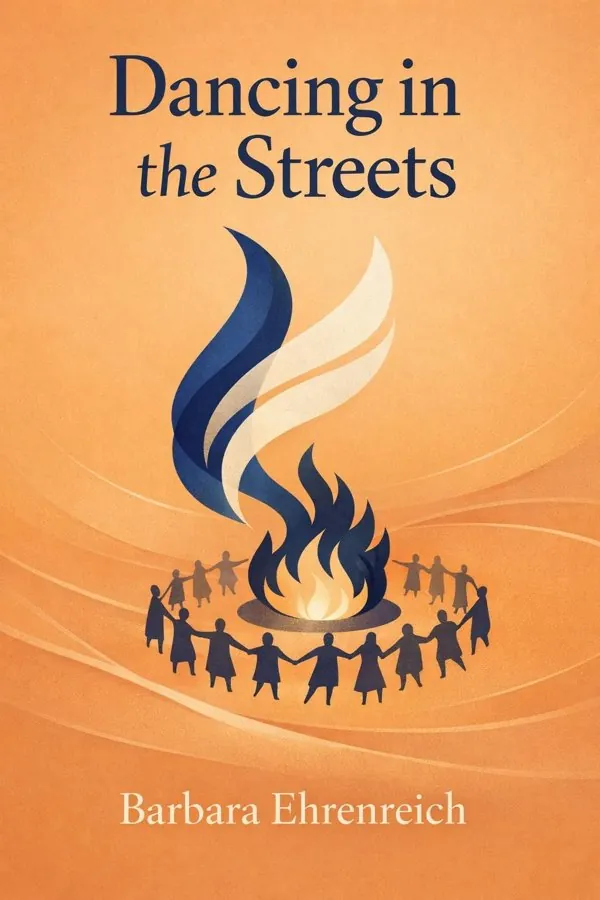
Dancing in the Streets: A History of Collective Joy: Summary & Key Insights
 10 min9 chaptersAudio available
Key Takeaways from Dancing in the Streets: A History of Collective Joy
One of Ehrenreich’s most provocative claims is that before humans built states, wrote laws, or organized economies, they likely gathered in rhythm.
Civilization did not eliminate collective joy—it reorganized it.
Modern readers often assume religion has mainly suppressed bodily pleasure and emotional excess, but Ehrenreich complicates that story.
A striking part of Ehrenreich’s history is her treatment of medieval and early modern festivals, especially carnival traditions.
Ehrenreich repeatedly returns to one historical pattern: ruling classes tend to fear gatherings they cannot fully control.
What Is Dancing in the Streets: A History of Collective Joy About?
Dancing in the Streets: A History of Collective Joy by Barbara Ehrenreich is a civilization book spanning 11 pages. Barbara Ehrenreich’s Dancing in the Streets: A History of Collective Joy is a sweeping cultural history of one of the most neglected forces in human life: the ecstatic pleasure people experience when they gather to dance, sing, feast, march, and celebrate together. Rather than treating joy as a private feeling or entertainment as a modern luxury, Ehrenreich argues that communal exhilaration is ancient, socially meaningful, and deeply human. Across prehistory, religion, medieval festivals, political movements, and modern mass culture, she traces how collective joy has repeatedly erupted—and how elites have often tried to suppress, regulate, or commercialize it. What makes the book so powerful is that it challenges a deeply modern assumption: that self-control, seriousness, and individualism are signs of civilization, while ecstatic crowds are irrational or dangerous. Ehrenreich shows that this view is historically narrow. Collective celebration has helped create solidarity, dissolve hierarchy, heal grief, and remind people that life is more than labor and discipline. A renowned journalist and social critic, Ehrenreich brings together anthropology, history, religion, politics, and cultural analysis to reveal why shared joy matters—not just in the past, but in an anxious, fragmented present.
This FizzRead summary covers all 9 key chapters of Dancing in the Streets: A History of Collective Joy in approximately 10 minutes, distilling the most important ideas, arguments, and takeaways from Barbara Ehrenreich's work. Also available as an audio summary and Key Quotes Podcast.
Dancing in the Streets: A History of Collective Joy
Barbara Ehrenreich’s Dancing in the Streets: A History of Collective Joy is a sweeping cultural history of one of the most neglected forces in human life: the ecstatic pleasure people experience when they gather to dance, sing, feast, march, and celebrate together. Rather than treating joy as a private feeling or entertainment as a modern luxury, Ehrenreich argues that communal exhilaration is ancient, socially meaningful, and deeply human. Across prehistory, religion, medieval festivals, political movements, and modern mass culture, she traces how collective joy has repeatedly erupted—and how elites have often tried to suppress, regulate, or commercialize it.
What makes the book so powerful is that it challenges a deeply modern assumption: that self-control, seriousness, and individualism are signs of civilization, while ecstatic crowds are irrational or dangerous. Ehrenreich shows that this view is historically narrow. Collective celebration has helped create solidarity, dissolve hierarchy, heal grief, and remind people that life is more than labor and discipline. A renowned journalist and social critic, Ehrenreich brings together anthropology, history, religion, politics, and cultural analysis to reveal why shared joy matters—not just in the past, but in an anxious, fragmented present.
Who Should Read Dancing in the Streets: A History of Collective Joy?
This book is perfect for anyone interested in civilization and looking to gain actionable insights in a short read. Whether you're a student, professional, or lifelong learner, the key ideas from Dancing in the Streets: A History of Collective Joy by Barbara Ehrenreich will help you think differently.
- ✓Readers who enjoy civilization and want practical takeaways
- ✓Professionals looking to apply new ideas to their work and life
- ✓Anyone who wants the core insights of Dancing in the Streets: A History of Collective Joy in just 10 minutes
Want the full summary?
Get instant access to this book summary and 100K+ more with Fizz Moment.
Get Free SummaryAvailable on App Store • Free to download
Key Chapters
One of Ehrenreich’s most provocative claims is that before humans built states, wrote laws, or organized economies, they likely gathered in rhythm. Long before civilization formalized social life, people seem to have discovered the intoxicating power of moving together—through drumming, chanting, dancing, and synchronized motion. Anthropologists and historians have often emphasized human survival through hunting, tool-making, and cooperation, but Ehrenreich asks us to notice another survival skill: the ability to dissolve into a joyful group.
This matters because collective ecstasy is not presented as a decorative extra added after material needs were met. Instead, it may have helped early humans bond, reduce fear, generate courage, and experience belonging. A group moving in unison creates emotional intensity and trust. Even today, this is visible in military drills, sports crowds, music festivals, religious revivals, and protest marches. The feeling of being carried by a larger pulse is not accidental—it reflects something deeply rooted in human biology and social life.
Ehrenreich’s broader point is that modern societies often misunderstand these experiences because they privilege individual consciousness over group feeling. We are taught to value control, privacy, and restraint, so ecstatic togetherness can seem primitive or suspicious. But if communal joy is ancient, then the hunger for it is not a cultural weakness; it is part of being human.
A practical way to apply this insight is to stop dismissing group joy as trivial. Whether through neighborhood festivals, community singing, dance classes, or shared rituals, make space in your life for experiences that involve coordinated movement and collective emotion. The takeaway: treat communal joy not as escapism, but as a basic human need.
Civilization did not eliminate collective joy—it reorganized it. In the ancient world, ecstatic celebration was often woven into religion, politics, and public life. Ehrenreich points to festivals in Greece and elsewhere where dancing, music, intoxication, theatrical performance, and public procession connected ordinary people to gods, seasons, and one another. Rather than separating the sacred from the festive, many ancient cultures understood celebration as a path to transcendence.
The Dionysian festivals in Greece are especially important in Ehrenreich’s account. They honored a god associated with wine, transformation, and the loosening of ordinary social boundaries. These celebrations were not merely recreational. They made room for emotional release, inversion of norms, and temporary freedom from hierarchy. Theater itself grew from such contexts, showing that major cultural institutions can emerge from ecstatic, collective practices rather than from sober rational planning alone.
At the same time, institutionalization changed the nature of joy. Once festivals became part of state religion or civic life, they could be both enabling and controlling. Authorities might sponsor large celebrations to create unity, but they could also channel spontaneity into approved forms. This tension remains familiar today. National holidays, sports spectacles, and large concerts can produce genuine communal exhilaration while also serving commercial or political aims.
The lesson is not to romanticize the past, but to recognize that joy has always been socially organized. If you plan community events, teach history, or work in culture, ask how rituals can foster participation rather than passive consumption. The takeaway: collective celebration is most powerful when it invites people to become co-creators, not just spectators.
Modern readers often assume religion has mainly suppressed bodily pleasure and emotional excess, but Ehrenreich complicates that story. In many historical periods, religious life preserved forms of collective joy that modern secular societies later weakened or privatized. Pilgrimages, feast days, processions, call-and-response worship, and sacred dancing offered socially legitimate occasions for people to gather in emotionally intense ways.
This does not mean all religions welcomed ecstasy equally. Ehrenreich shows that religious traditions have often contained an internal struggle between order and abandon, doctrine and experience, priestly control and popular participation. On one side are institutional authorities who worry about disorder, heresy, sexuality, or class mixing. On the other are ordinary people seeking emotional release, sacred excitement, and embodied belonging. Mystical movements, revivalist gatherings, and ecstatic sects repeatedly emerged because formal religion alone could not satisfy that desire.
You can see echoes of this dynamic in many settings. Gospel churches, Sufi traditions, charismatic worship, and communal chanting practices all preserve the idea that transcendence is not only intellectual or moral—it is rhythmic, bodily, and shared. Even outside formal religion, people often seek “spiritual” intensity through music festivals, yoga gatherings, breathwork circles, or meditation retreats. The forms change, but the longing remains.
Ehrenreich encourages us to notice that collective joy can serve not only entertainment but meaning. It can reduce isolation, create moral solidarity, and bring people into contact with something larger than themselves. If you are building communities—religious or secular—consider how song, movement, repetition, and ritual can deepen connection beyond words. The takeaway: meaningful communities need embodied shared experiences, not just ideas or rules.
A striking part of Ehrenreich’s history is her treatment of medieval and early modern festivals, especially carnival traditions. These celebrations temporarily overturned ordinary structures of authority. Peasants mocked nobles, fools mimicked priests, masks disrupted identity, and public revelry suspended daily discipline. Carnival was not a revolution in the formal political sense, but it offered a vivid social experience of inversion—an imaginative world where hierarchy could be laughed at, crossed, or forgotten.
This matters because joy here was not just happiness; it had a social edge. Collective festivity created zones where people could express tensions that normal life kept contained. Laughter, dancing, feasting, and rowdy public performance made visible the artificial nature of rank and etiquette. By relaxing rules, carnival reminded people that social order is maintained, not natural. That is one reason elites so often distrusted it.
Ehrenreich does not suggest these festivals permanently liberated anyone. They could function as release valves, allowing frustration without structural change. Yet they also generated solidarity among ordinary people and preserved memories of a world less tightly controlled. Modern equivalents might include satirical parades, street festivals, drag performance, fan conventions, or public art events that play with identity and status. When people can temporarily step outside rigid roles, they often return to daily life with sharper awareness of its constraints.
For readers today, the key insight is that communal joy can carry critique without becoming dour or ideological. Humor, play, and reversal are powerful social tools. If you lead groups or organize events, create spaces where people can experiment with roles, express irreverence, and laugh at power. The takeaway: shared joy becomes transformative when it loosens the grip of status and invites playful freedom.
Ehrenreich repeatedly returns to one historical pattern: ruling classes tend to fear gatherings they cannot fully control. Joyful crowds may look harmless, but they represent a form of energy that escapes hierarchy. When people are synchronized in movement and emotion, they experience their collective strength directly. That feeling can be exhilarating—and politically unsettling.
Across centuries, authorities have tried to regulate festivals, ban dancing, suppress drumming, limit public assembly, and moralize against “disorderly” pleasure. Religious reformers condemned revelry as sinful. Political leaders treated crowds as threats to public order. Industrial employers preferred disciplined workers to festival-goers. The modern suspicion of crowds as irrational mobs has deep historical roots, and Ehrenreich argues that this suspicion often reflects class anxiety as much as genuine concern.
The issue is not that every crowd is benevolent. Collective emotion can be manipulated or become violent. Ehrenreich’s contribution is to challenge the one-sided assumption that ecstatic assemblies are inherently dangerous while atomized, disciplined life is inherently civilized. In reality, joy can produce solidarity, generosity, courage, and mutual recognition. What authorities often fear is not chaos itself, but the breakdown of social distance.
You can apply this insight by examining how institutions respond to spontaneous gathering. Does your city encourage public music and celebration, or does it over-police them? Does your workplace create moments of real communal life, or only scripted team-building? Does your community trust ordinary people with public space? The takeaway: when joyful assembly is treated as a threat, it is worth asking whose power depends on keeping people separate.
Industrialization did more than change economies; it transformed time, bodies, and social rhythms. Ehrenreich argues that as labor became clock-regulated and urban life increasingly organized around productivity, older traditions of communal festivity came under intense pressure. Seasonal celebrations, saints’ days, and irregular periods of collective revelry did not fit easily into factory schedules and disciplined wage labor.
Under industrial capitalism, time became measurable, monetized, and managed. Workers were expected to show up reliably, conserve energy, and internalize regularity. Public festivities, by contrast, were messy, disruptive, and often physically exhausting in ways that did not serve employers’ needs. Urban authorities also became more invested in policing crowds, noise, and street life. The result was not the total disappearance of collective joy, but its marginalization.
At the same time, industrial cities generated new longings for mass feeling. Workers deprived of communal festivity sought it in taverns, labor rallies, music halls, sports events, and political movements. In modern cities today, we see similar substitutions: nightlife, concerts, stadium events, and demonstrations often supply the collective energy once embedded more naturally in communal calendars.
Ehrenreich’s insight invites us to reflect on how economic systems shape emotional life. If people are exhausted, overscheduled, and socially fragmented, they have fewer opportunities for genuine collective joy. On a practical level, that means protecting time for community events, supporting public arts, and resisting the idea that every gathering must be efficient or profitable. The takeaway: when work colonizes all of life, joy becomes scarce—so communities must defend spaces and schedules for shared celebration.
Modern mass culture did not eliminate the desire for collective joy; it learned how to package it. Ehrenreich is especially sharp on the difference between authentic participation and commercialized spectatorship. In older festivals, people danced, sang, processed, and celebrated together. In modern entertainment culture, they are often arranged as audiences—watching performers, buying tickets, consuming experiences, and mistaking proximity for participation.
This does not mean concerts, sports, or popular spectacles are empty. Crowds at a match or music festival can experience real exhilaration. But Ehrenreich asks us to notice how often modern institutions capture collective energy without fully releasing it. The audience is permitted excitement, even frenzy, but usually within tightly managed boundaries. Commercial systems can monetize the human hunger for ecstatic togetherness while minimizing the unpredictability of true public festivity.
The distinction matters in everyday life. Streaming entertainment, branded festivals, and curated experiences can create the illusion of social connection while keeping people fundamentally passive. By contrast, local dance nights, amateur choirs, block parties, participatory theater, social clubs, and grassroots celebrations involve co-creation. They may be less polished, but they often satisfy more deeply because people are not merely observing joy; they are generating it.
A useful application is to audit your own leisure habits. How much of your entertainment is passive consumption, and how much is active participation? Can your community invest more in public, low-cost, locally produced forms of celebration? The takeaway: whenever possible, choose forms of culture that turn crowds into participants rather than consumers.
All Chapters in Dancing in the Streets: A History of Collective Joy
About the Author
Barbara Ehrenreich (1941–2022) was an American author, journalist, and public intellectual celebrated for her incisive writing on class, labor, culture, politics, and social inequality. Trained in science but drawn to social criticism, she became one of the most influential nonfiction writers of her generation. Her best-known book, Nickel and Dimed, exposed the realities of low-wage work in America and cemented her reputation as a fearless observer of systems that shape ordinary life. Ehrenreich wrote with unusual range, moving from economics and ideology to health, feminism, optimism, and culture. In Dancing in the Streets, she brings that same analytical power to the neglected subject of collective joy, showing how celebration, ritual, and ecstatic gathering reveal important truths about human nature and social control.
Get This Summary in Your Preferred Format
Read or listen to the Dancing in the Streets: A History of Collective Joy summary by Barbara Ehrenreich anytime, anywhere. FizzRead offers multiple formats so you can learn on your terms — all free.
Available formats: App · Audio · PDF · EPUB — All included free with FizzRead
Download Dancing in the Streets: A History of Collective Joy PDF and EPUB Summary
Key Quotes from Dancing in the Streets: A History of Collective Joy
“One of Ehrenreich’s most provocative claims is that before humans built states, wrote laws, or organized economies, they likely gathered in rhythm.”
“Civilization did not eliminate collective joy—it reorganized it.”
“Modern readers often assume religion has mainly suppressed bodily pleasure and emotional excess, but Ehrenreich complicates that story.”
“A striking part of Ehrenreich’s history is her treatment of medieval and early modern festivals, especially carnival traditions.”
“Ehrenreich repeatedly returns to one historical pattern: ruling classes tend to fear gatherings they cannot fully control.”
Frequently Asked Questions about Dancing in the Streets: A History of Collective Joy
Dancing in the Streets: A History of Collective Joy by Barbara Ehrenreich is a civilization book that explores key ideas across 9 chapters. Barbara Ehrenreich’s Dancing in the Streets: A History of Collective Joy is a sweeping cultural history of one of the most neglected forces in human life: the ecstatic pleasure people experience when they gather to dance, sing, feast, march, and celebrate together. Rather than treating joy as a private feeling or entertainment as a modern luxury, Ehrenreich argues that communal exhilaration is ancient, socially meaningful, and deeply human. Across prehistory, religion, medieval festivals, political movements, and modern mass culture, she traces how collective joy has repeatedly erupted—and how elites have often tried to suppress, regulate, or commercialize it. What makes the book so powerful is that it challenges a deeply modern assumption: that self-control, seriousness, and individualism are signs of civilization, while ecstatic crowds are irrational or dangerous. Ehrenreich shows that this view is historically narrow. Collective celebration has helped create solidarity, dissolve hierarchy, heal grief, and remind people that life is more than labor and discipline. A renowned journalist and social critic, Ehrenreich brings together anthropology, history, religion, politics, and cultural analysis to reveal why shared joy matters—not just in the past, but in an anxious, fragmented present.
More by Barbara Ehrenreich


You Might Also Like

The Structure of Scientific Revolutions
Thomas S. Kuhn
10 min
Genius
Harold Bloom
10 min
A Cultural History of the Medieval Age
Various Editors
10 min
A History of God: The 4,000-Year Quest of Judaism, Christianity and Islam
Karen Armstrong
10 min
A History of the World in 10½ Chapters
Julian Barnes
10 min
A Short History of Progress
Ronald Wright
10 minBrowse by Category
Ready to read Dancing in the Streets: A History of Collective Joy?
Get the full summary and 100K+ more books with Fizz Moment.