
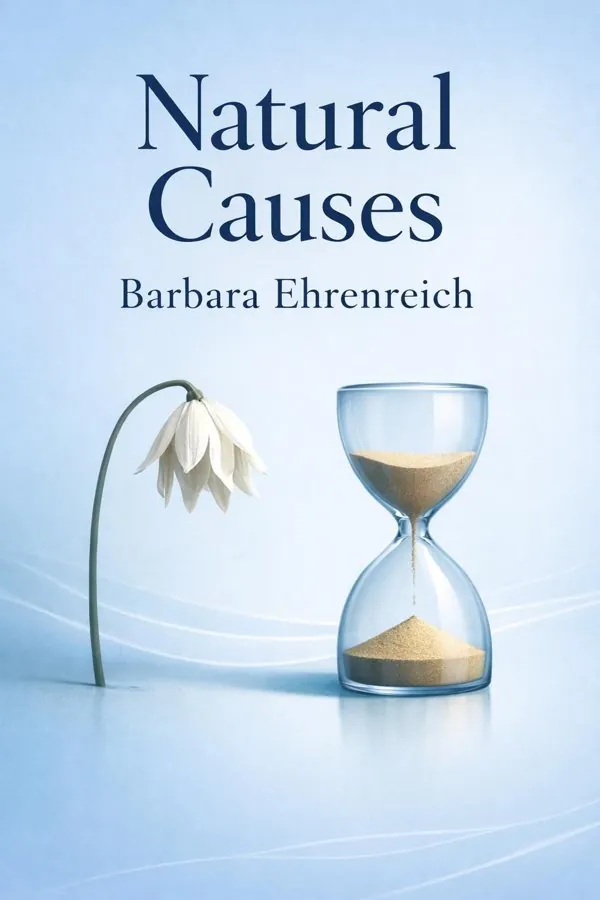
Natural Causes: An Epidemic of Wellness, the Certainty of Dying, and Killing Ourselves to Live Longer: Summary & Key Insights
 10 min9 chaptersAudio available
Key Takeaways from Natural Causes: An Epidemic of Wellness, the Certainty of Dying, and Killing Ourselves to Live Longer
One of the most powerful modern myths is that death is negotiable.
Wellness often presents itself as liberation, but much of it functions like a marketplace for anxiety.
Modern medicine saves lives, but it also has a tendency to widen its territory.
We are often told to treat the body like a machine we can discipline into compliance.
Practices like meditation, breathwork, and mindfulness are often sold as tools for peace, but Ehrenreich warns that they can also be absorbed into a culture of self-surveillance.
What Is Natural Causes: An Epidemic of Wellness, the Certainty of Dying, and Killing Ourselves to Live Longer About?
Natural Causes: An Epidemic of Wellness, the Certainty of Dying, and Killing Ourselves to Live Longer by Barbara Ehrenreich is a health_med book spanning 11 pages. Barbara Ehrenreich’s Natural Causes is a sharp, unsettling, and often darkly funny critique of modern health culture. Rather than celebrating the endless pursuit of self-optimization, Ehrenreich asks a more uncomfortable question: what if our obsession with wellness is not making us wiser, freer, or even much healthier, but simply more anxious and more controlled? Drawing on her background in cellular immunology, her experience as a cancer survivor, and her lifelong talent for social criticism, she examines the ways medicine, the wellness industry, and popular culture promise mastery over aging and death while ignoring the basic fact that mortality cannot be defeated. The book challenges the moral language surrounding exercise, diet, preventive screening, and positive thinking, showing how easily “healthy living” turns into self-surveillance and blame. What makes this book matter is not that it rejects medicine altogether, but that it questions the fantasy of total control. Ehrenreich ultimately argues for a more realistic, humane approach to the body: one that values living fully over endlessly trying to postpone the inevitable.
This FizzRead summary covers all 9 key chapters of Natural Causes: An Epidemic of Wellness, the Certainty of Dying, and Killing Ourselves to Live Longer in approximately 10 minutes, distilling the most important ideas, arguments, and takeaways from Barbara Ehrenreich's work. Also available as an audio summary and Key Quotes Podcast.
Natural Causes: An Epidemic of Wellness, the Certainty of Dying, and Killing Ourselves to Live Longer
Barbara Ehrenreich’s Natural Causes is a sharp, unsettling, and often darkly funny critique of modern health culture. Rather than celebrating the endless pursuit of self-optimization, Ehrenreich asks a more uncomfortable question: what if our obsession with wellness is not making us wiser, freer, or even much healthier, but simply more anxious and more controlled? Drawing on her background in cellular immunology, her experience as a cancer survivor, and her lifelong talent for social criticism, she examines the ways medicine, the wellness industry, and popular culture promise mastery over aging and death while ignoring the basic fact that mortality cannot be defeated. The book challenges the moral language surrounding exercise, diet, preventive screening, and positive thinking, showing how easily “healthy living” turns into self-surveillance and blame. What makes this book matter is not that it rejects medicine altogether, but that it questions the fantasy of total control. Ehrenreich ultimately argues for a more realistic, humane approach to the body: one that values living fully over endlessly trying to postpone the inevitable.
Who Should Read Natural Causes: An Epidemic of Wellness, the Certainty of Dying, and Killing Ourselves to Live Longer?
This book is perfect for anyone interested in health_med and looking to gain actionable insights in a short read. Whether you're a student, professional, or lifelong learner, the key ideas from Natural Causes: An Epidemic of Wellness, the Certainty of Dying, and Killing Ourselves to Live Longer by Barbara Ehrenreich will help you think differently.
- ✓Readers who enjoy health_med and want practical takeaways
- ✓Professionals looking to apply new ideas to their work and life
- ✓Anyone who wants the core insights of Natural Causes: An Epidemic of Wellness, the Certainty of Dying, and Killing Ourselves to Live Longer in just 10 minutes
Want the full summary?
Get instant access to this book summary and 100K+ more with Fizz Moment.
Get Free SummaryAvailable on App Store • Free to download
Key Chapters
One of the most powerful modern myths is that death is negotiable. We act as though enough discipline, enough data, and enough compliance can keep mortality at bay. Fitness trackers, strict diets, vitamin regimens, and annual screenings all carry the same emotional promise: if you work hard enough, you can stay ahead of decline. Ehrenreich argues that this belief is not merely optimistic but deeply misleading. Human beings can influence some aspects of health, but we cannot abolish aging, randomness, or the final outcome of being alive.
Her point is not that exercise or preventive care are useless. Rather, she challenges the inflated claim that every illness is preventable and every death is somehow a failure of management. Much of life unfolds through genetics, environmental exposure, accidents, and biological processes far outside personal control. Yet contemporary culture often converts health into a morality play, where illness suggests negligence and longevity signals virtue.
This illusion of control can produce constant vigilance. Instead of living in our bodies, we monitor them. A slightly elevated lab result, a new ache, or a bad sleep score can become evidence that the body is betraying us or that we have failed to protect it. The result is not peace but anxiety.
A practical example is the person who structures every meal, workout, and social activity around longevity metrics, only to feel guilty whenever reality intrudes. Ehrenreich asks us to notice the hidden cost: the pursuit of control can consume the very life it claims to preserve.
Actionable takeaway: care for your health, but reject the fantasy that perfect habits guarantee safety. Replace total-control thinking with a more balanced question: does this choice help me live well now, not just hypothetically later?
Wellness often presents itself as liberation, but much of it functions like a marketplace for anxiety. Ehrenreich shows how the wellness industry transformed ordinary health concerns into a vast commercial system selling purity, optimization, and self-improvement. Juices, supplements, boutique fitness classes, sleep devices, mindfulness apps, anti-aging treatments, and branded lifestyles all promise not just better health, but superior character. The message is subtle but relentless: responsible people invest in themselves, while those who do not are careless.
What makes this industry so effective is that it blends aspiration with moral judgment. A green smoothie is never just a drink; it signals discipline. A gym membership is not only exercise; it becomes proof of seriousness. Wellness products frequently borrow the language of science while operating through branding, trends, and identity. This allows companies to profit from insecurity while framing consumption as self-care.
Ehrenreich is especially alert to the class dimensions of this culture. Wellness often requires time, money, flexible schedules, safe neighborhoods, and access to premium services. Yet it is advertised as a universally available choice. That creates a cruel distortion: structural inequalities disappear, and individuals are told to solve health through shopping and routine.
A practical example is corporate wellness programming that offers stress workshops and step challenges while ignoring overwork, low pay, and job insecurity. The burden is placed on the employee to cope better, not on the institution to become less damaging.
Actionable takeaway: when evaluating a wellness claim, ask two questions: is there strong evidence behind it, and who profits from making me feel inadequate without it?
Modern medicine saves lives, but it also has a tendency to widen its territory. Ehrenreich argues that ordinary experiences of aging, discomfort, and uncertainty are increasingly pulled into medical categories. Risk factors become conditions, minor variations become abnormalities, and healthy people become patients-in-waiting. In this model, you do not need to be sick to enter the medical system; you only need to be potentially sick someday.
This shift is driven partly by genuine advances in diagnosis and prevention, but also by institutional incentives. Screening technologies, pharmaceutical marketing, defensive medicine, and public fear all encourage more monitoring. The result is a culture of permanent medical attention, where even symptom-free individuals are expected to pursue tests, scans, and interventions in the name of vigilance.
Ehrenreich does not deny that early detection can help in some cases. Her warning is about overreach. Screening can produce false positives, incidental findings, unnecessary biopsies, overtreatment, and long periods of needless distress. More information is not always more wisdom. Sometimes it simply creates new labels and new worries.
A practical example is the healthy adult who undergoes repeated elective testing, discovers a borderline irregularity, and is then drawn into months of follow-up procedures that never improve well-being. The process can feel productive because it is active, but action itself is not always benefit.
The deeper problem is philosophical. If every bodily variation is treated as a prelude to disease, then normal life becomes a medical emergency waiting to happen. We stop inhabiting our bodies as living organisms and start treating them as projects under continuous clinical review.
Actionable takeaway: discuss tests and screenings in terms of actual benefits, risks, and likely outcomes. Ask not only what a test can find, but what meaningful difference the result is likely to make.
We are often told to treat the body like a machine we can discipline into compliance. Ehrenreich pushes back against that idea by describing the body as a complex, partly independent biological system. Beneath conscious intention, trillions of cells are dividing, repairing, competing, mutating, and dying. Much of this activity is necessary, some of it goes wrong, and very little of it is under direct personal command.
Her background in biology gives this argument special force. The immune system, for example, is not a wise internal guardian always acting in our best interests. It can overreact, misfire, attack the body itself, or fail to detect danger. Cells that support life can also become malignant. Processes that sustain us in youth can contribute to degeneration in age. The body is not a harmonious temple. It is dynamic, improvisational, and sometimes dangerous.
This view undercuts the simplistic narrative that health is mainly the reward for correct behavior. You can eat carefully, exercise consistently, and still develop serious disease. You can also make questionable choices and remain relatively healthy for years. Biology is not fair, and it does not distribute outcomes according to moral desert.
A practical application of this idea is emotional relief. People facing illness often carry shame, as if their diagnosis proves they failed at self-care. Ehrenreich insists that this is both scientifically weak and psychologically cruel. Understanding the body’s unpredictability helps replace self-blame with realism.
It also changes how we think about aging. Decline is not always the consequence of negligence; often it is simply what bodies do over time. Fighting every sign of wear as a personal defeat can become exhausting.
Actionable takeaway: stop treating every health outcome as a verdict on your character. Respect the body, support it sensibly, but remember that biology is complex and not fully governable.
Practices like meditation, breathwork, and mindfulness are often sold as tools for peace, but Ehrenreich warns that they can also be absorbed into a culture of self-surveillance. In theory, mindfulness helps people become more present and less reactive. In practice, especially in commercial settings, it can become another demand placed on individuals: regulate your stress, monitor your thoughts, optimize your focus, and adapt to harmful conditions without complaint.
This is especially visible in workplaces. Rather than reducing unreasonable workloads, increasing job security, or addressing toxic management, organizations may offer resilience training and meditation apps. Structural problems are reframed as personal coping deficits. If you are exhausted, anxious, or burned out, the system implies that you need better breathing techniques rather than better working conditions.
Ehrenreich is skeptical of any practice that turns inward attention into a form of discipline detached from social reality. The problem is not mindfulness itself, but the ideology around it. When self-awareness becomes compulsory, people are encouraged to police their emotions and detach from legitimate anger. Stress is individualized, and collective solutions fade from view.
A practical example is the employee encouraged to join lunchtime mindfulness sessions while still expected to answer emails at all hours. The program may reduce visible friction, but it leaves the source of distress intact. Calmness becomes a performance of adjustment.
This critique applies more broadly to wellness culture. Sleep scores, mood tracking, productivity rituals, and gratitude routines can all become endless projects of self-correction. The language of care is used, but the feeling is often scrutiny.
Actionable takeaway: use reflective practices only if they genuinely increase freedom and clarity. If a wellness habit mainly makes you more obedient to unhealthy circumstances, reconsider its role in your life.
Modern societies speak of medicine with extraordinary faith, yet Ehrenreich insists that medicine is powerful without being omnipotent. It can cure infections, repair injuries, manage chronic conditions, and relieve suffering, but it cannot suspend mortality. Still, both medical institutions and the public often drift toward the belief that there must always be one more procedure, one more specialist, or one more intervention capable of defeating decline.
This belief becomes especially intense in old age. As bodies weaken, the medical system may respond with escalating tests, medications, surgeries, and hospitalizations. Some of this care is beneficial. Some of it merely extends treatment rather than life in any meaningful sense. Ehrenreich asks whether the default imperative to do more can become a form of denial, especially when quality of life steadily erodes.
Her critique is not anti-doctor or anti-science. It is a plea for honesty about trade-offs. Aggressive interventions can produce pain, confusion, loss of independence, and emotional strain for both patients and families. The existence of a treatment option does not automatically mean it serves the person receiving it. What matters is not only whether life can be prolonged, but what that prolongation looks like.
A practical example is the elderly patient repeatedly hospitalized, subjected to invasive procedures, and discharged weaker each time. Families may feel that choosing less intervention means giving up, when in fact it may reflect a deeper respect for comfort and dignity.
Ehrenreich invites readers to separate medical possibility from medical necessity. More treatment is not always more care.
Actionable takeaway: have explicit conversations about goals of care before a crisis. Ask what outcomes matter most to you or your loved ones, and weigh interventions against those values rather than assuming that maximum treatment is always best.
Much of contemporary health culture is built on evasion. We talk endlessly about prevention, optimization, and healthy aging, but rarely about the plain fact that every life ends. Ehrenreich argues that this refusal to confront death distorts how we live. By trying to manage mortality as a technical problem, we neglect the emotional and philosophical work of accepting finitude.
Acceptance, in her view, is not passivity or despair. It is a way of seeing clearly. Once we abandon the fantasy that death is a personal failure, we become freer to ask what makes a life meaningful within limits. The question shifts from “How can I avoid dying?” to “How should I live, knowing I will?” That shift has practical consequences. It can reduce panic, soften perfectionism, and help people prioritize relationships, pleasure, creativity, and solidarity over endless self-maintenance.
Ehrenreich also resists sentimental narratives about dying gracefully. Death remains difficult, often frightening, and not inherently ennobling. But denying it does not make it easier. A culture that hides aging and treats mortality as scandal leaves people less prepared when loss inevitably arrives.
A practical example is advance planning. People who are willing to talk about death often make clearer decisions about care, funeral preferences, possessions, and end-of-life values. Those conversations can spare families confusion and conflict later. On a daily level, acceptance can also loosen the pressure to treat every choice as a longevity calculation.
The philosophical payoff is significant: mortality gives life urgency. Limits do not empty life of meaning; they create the conditions for meaning.
Actionable takeaway: make one concrete move toward mortality acceptance this month, whether by creating an advance directive, discussing end-of-life wishes, or simply questioning a habit driven more by fear of death than by love of life.
Ehrenreich’s most liberating argument is that life should not be organized entirely around bodily preservation. There comes a point when healthy living ceases to be a support for life and becomes its central burden. Endless dietary rules, exercise regimens, screenings, supplements, and self-monitoring can crowd out spontaneity, pleasure, and meaningful risk. In trying to maximize survival, we may minimize living.
Reclaiming autonomy does not mean recklessness. Ehrenreich is not urging people to ignore symptoms, refuse all treatment, or embrace self-destruction. Her point is subtler: health practices should serve a life you value, not become a totalizing regime that dictates every choice. Autonomy means deciding that not every recommendation deserves obedience, not every optimization matters, and not every year gained is worth any cost.
This idea is especially important in later life, when the pressure to comply with medical routines can become overwhelming. But it applies at any age. A person might choose restorative movement over punishing exercise, shared meals over dietary purity, or time with loved ones over yet another self-improvement protocol. These are not irrational choices. They may reflect a more mature understanding of what well-being includes.
A practical example is the individual who declines a marginally useful intervention because its side effects, inconvenience, or emotional burden outweigh the likely benefit. In a culture that celebrates constant treatment, saying no can be an act of dignity.
Ehrenreich ultimately asks us to trust that a good life cannot be reduced to biomarkers. Health matters, but it is not the only value.
Actionable takeaway: review one health routine, purchase, or medical habit you maintain out of fear or social pressure. Ask whether it genuinely improves your life, and if not, consider simplifying your approach.
All Chapters in Natural Causes: An Epidemic of Wellness, the Certainty of Dying, and Killing Ourselves to Live Longer
About the Author
Barbara Ehrenreich (1941–2022) was an American author, journalist, and political activist celebrated for her incisive critiques of American culture, work, health, and inequality. She earned a Ph.D. in cellular immunology, a scientific background that informed her skeptical and intellectually rigorous approach to public issues. Ehrenreich became widely known for books such as Nickel and Dimed, Bait and Switch, and Bright-sided, which examined low-wage labor, white-collar insecurity, and the ideology of forced positivity. Her writing combined investigative reporting, social analysis, and sharp wit, making complex structural problems accessible to broad audiences. In Natural Causes, she brought together her scientific training, personal experience with illness, and lifelong resistance to comforting myths to challenge the modern fixation on wellness, self-optimization, and the illusion that death can be mastered.
Get This Summary in Your Preferred Format
Read or listen to the Natural Causes: An Epidemic of Wellness, the Certainty of Dying, and Killing Ourselves to Live Longer summary by Barbara Ehrenreich anytime, anywhere. FizzRead offers multiple formats so you can learn on your terms — all free.
Available formats: App · Audio · PDF · EPUB — All included free with FizzRead
Download Natural Causes: An Epidemic of Wellness, the Certainty of Dying, and Killing Ourselves to Live Longer PDF and EPUB Summary
Key Quotes from Natural Causes: An Epidemic of Wellness, the Certainty of Dying, and Killing Ourselves to Live Longer
“One of the most powerful modern myths is that death is negotiable.”
“Wellness often presents itself as liberation, but much of it functions like a marketplace for anxiety.”
“Modern medicine saves lives, but it also has a tendency to widen its territory.”
“We are often told to treat the body like a machine we can discipline into compliance.”
“Practices like meditation, breathwork, and mindfulness are often sold as tools for peace, but Ehrenreich warns that they can also be absorbed into a culture of self-surveillance.”
Frequently Asked Questions about Natural Causes: An Epidemic of Wellness, the Certainty of Dying, and Killing Ourselves to Live Longer
Natural Causes: An Epidemic of Wellness, the Certainty of Dying, and Killing Ourselves to Live Longer by Barbara Ehrenreich is a health_med book that explores key ideas across 9 chapters. Barbara Ehrenreich’s Natural Causes is a sharp, unsettling, and often darkly funny critique of modern health culture. Rather than celebrating the endless pursuit of self-optimization, Ehrenreich asks a more uncomfortable question: what if our obsession with wellness is not making us wiser, freer, or even much healthier, but simply more anxious and more controlled? Drawing on her background in cellular immunology, her experience as a cancer survivor, and her lifelong talent for social criticism, she examines the ways medicine, the wellness industry, and popular culture promise mastery over aging and death while ignoring the basic fact that mortality cannot be defeated. The book challenges the moral language surrounding exercise, diet, preventive screening, and positive thinking, showing how easily “healthy living” turns into self-surveillance and blame. What makes this book matter is not that it rejects medicine altogether, but that it questions the fantasy of total control. Ehrenreich ultimately argues for a more realistic, humane approach to the body: one that values living fully over endlessly trying to postpone the inevitable.
More by Barbara Ehrenreich


You Might Also Like

On Immunity
Eula Biss
10 min
The Three-Body Problem
Liu Cixin
10 min
Community Health Volunteer Toolkit: Training and Practical Activities
World Health Organization
10 min
Healing Back Pain: The Mind-Body Connection
John E. Sarno
10 min
Health Literacy for All: Practical Guides to Communicate Health Information (Compilations)
World Health Organization
10 min
The Complete Guide to Sports Supplements: An Evidence-Based Review
Anita Bean
10 minBrowse by Category
Ready to read Natural Causes: An Epidemic of Wellness, the Certainty of Dying, and Killing Ourselves to Live Longer?
Get the full summary and 100K+ more books with Fizz Moment.