
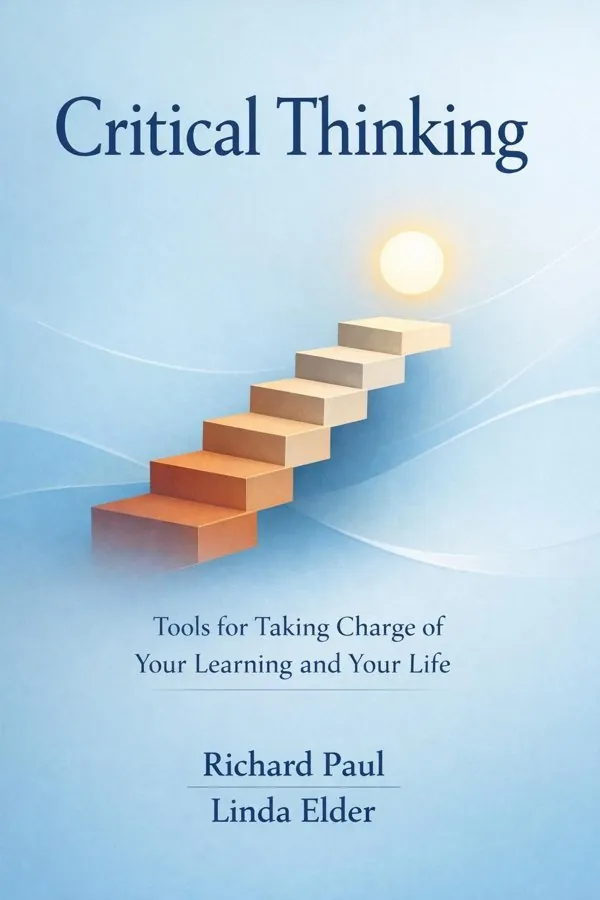
Critical Thinking: Tools for Taking Charge of Your Learning and Your Life: Summary & Key Insights
 10 min9 chaptersAudio available
Key Takeaways from Critical Thinking: Tools for Taking Charge of Your Learning and Your Life
Every thought has a shape, whether we notice it or not.
Thinking is inevitable, but quality thinking is rare.
Some of our worst thinking feels completely natural.
Insight changes little unless it becomes habit.
The quality of your learning depends on the quality of your questions.
What Is Critical Thinking: Tools for Taking Charge of Your Learning and Your Life About?
Critical Thinking: Tools for Taking Charge of Your Learning and Your Life by Richard Paul, Linda Elder is a education book spanning 4 pages. Most people assume they are thinking well simply because they are thinking at all. Richard Paul and Linda Elder challenge that comforting illusion. In Critical Thinking: Tools for Taking Charge of Your Learning and Your Life, they argue that good thinking is not automatic; it must be cultivated through discipline, self-awareness, and intellectual humility. The book offers a practical framework for examining how we reason, where our judgments go wrong, and how we can improve the quality of our decisions in school, work, relationships, and citizenship. What makes this book especially valuable is its balance of theory and application. Paul and Elder break thinking into clear structures, introduce standards for evaluating reasoning, and show how bias, self-interest, and social pressure distort judgment. Rather than treating critical thinking as an abstract academic skill, they present it as a daily practice for living more deliberately and responsibly. Their authority is unmatched. Richard Paul was one of the most influential thinkers in the field of critical thinking, and Linda Elder has helped bring these ideas into classrooms and organizations worldwide. Together, they provide a rigorous, accessible guide for anyone who wants to think better and live wiser.
This FizzRead summary covers all 9 key chapters of Critical Thinking: Tools for Taking Charge of Your Learning and Your Life in approximately 10 minutes, distilling the most important ideas, arguments, and takeaways from Richard Paul, Linda Elder's work. Also available as an audio summary and Key Quotes Podcast.
Critical Thinking: Tools for Taking Charge of Your Learning and Your Life
Most people assume they are thinking well simply because they are thinking at all. Richard Paul and Linda Elder challenge that comforting illusion. In Critical Thinking: Tools for Taking Charge of Your Learning and Your Life, they argue that good thinking is not automatic; it must be cultivated through discipline, self-awareness, and intellectual humility. The book offers a practical framework for examining how we reason, where our judgments go wrong, and how we can improve the quality of our decisions in school, work, relationships, and citizenship.
What makes this book especially valuable is its balance of theory and application. Paul and Elder break thinking into clear structures, introduce standards for evaluating reasoning, and show how bias, self-interest, and social pressure distort judgment. Rather than treating critical thinking as an abstract academic skill, they present it as a daily practice for living more deliberately and responsibly.
Their authority is unmatched. Richard Paul was one of the most influential thinkers in the field of critical thinking, and Linda Elder has helped bring these ideas into classrooms and organizations worldwide. Together, they provide a rigorous, accessible guide for anyone who wants to think better and live wiser.
Who Should Read Critical Thinking: Tools for Taking Charge of Your Learning and Your Life?
This book is perfect for anyone interested in education and looking to gain actionable insights in a short read. Whether you're a student, professional, or lifelong learner, the key ideas from Critical Thinking: Tools for Taking Charge of Your Learning and Your Life by Richard Paul, Linda Elder will help you think differently.
- ✓Readers who enjoy education and want practical takeaways
- ✓Professionals looking to apply new ideas to their work and life
- ✓Anyone who wants the core insights of Critical Thinking: Tools for Taking Charge of Your Learning and Your Life in just 10 minutes
Want the full summary?
Get instant access to this book summary and 100K+ more with Fizz Moment.
Get Free SummaryAvailable on App Store • Free to download
Key Chapters
Every thought has a shape, whether we notice it or not. One of the central insights of Paul and Elder’s work is that human thinking is not a vague mental fog but a system with identifiable parts. Whenever we think, we are pursuing a purpose, addressing a question, using information, making inferences, relying on assumptions, working from concepts, and moving toward implications and consequences. These are the basic elements of reasoning, and learning to recognize them gives us a powerful tool for understanding our own minds.
This matters because poor thinking often remains invisible until we break it apart. A student who says, “I’m bad at math,” may actually be making an unsupported inference based on limited information. A manager who rejects a proposal may be acting on hidden assumptions rather than evidence. A voter may accept a political claim without clarifying the question being asked or the consequences that follow from the position taken. By identifying the elements of thought, we gain a way to diagnose confusion instead of merely feeling it.
Paul and Elder encourage readers to apply this structure deliberately. If you are facing a difficult decision, ask: What is my goal? What facts do I actually have? What assumptions am I making? What conclusions am I drawing? What might follow if I am right or wrong? This simple discipline can transform impulsive reactions into reasoned judgment.
A practical example is workplace conflict. If a colleague seems dismissive, instead of concluding they are hostile, examine the elements: your purpose may be to improve collaboration, the question may be why communication has broken down, the information may be incomplete, and your inference may be premature. That shift creates space for better action.
Actionable takeaway: When you feel confused, frustrated, or certain, pause and map your thinking using the elements of reasoning before making a judgment.
Thinking is inevitable, but quality thinking is rare. Paul and Elder insist that reasoning should be evaluated, not merely expressed. To do that, they introduce intellectual standards such as clarity, accuracy, precision, relevance, depth, breadth, logic, significance, and fairness. These standards act like a checklist for strong reasoning. They help us distinguish between ideas that sound persuasive and ideas that truly deserve confidence.
Consider how often arguments fail because they are unclear rather than false. Someone may say, “The system is broken,” but what does that mean exactly? Clarity asks us to define terms. Accuracy pushes us to verify facts. Relevance asks whether a point actually connects to the issue at hand. Depth reminds us that complex problems rarely have simple explanations. Breadth requires us to consider other viewpoints. Logic asks whether the parts fit together coherently. Fairness challenges us to judge without distorting reality in our own favor.
These standards are useful far beyond the classroom. In meetings, they improve discussion by forcing participants to move beyond vague claims. In personal relationships, they reduce conflict by encouraging careful listening and precise communication. In media consumption, they help us resist headlines designed to provoke emotion instead of understanding. A social media post may feel significant, but if it lacks accuracy or breadth, it should not shape our worldview.
The beauty of these standards is that they can be turned into questions. Is this claim clear? Is it true? Is it specific enough? Does it address the real issue? What perspective is missing? That habit steadily strengthens judgment.
Actionable takeaway: Choose one intellectual standard each day, such as clarity or relevance, and deliberately apply it to a conversation, article, or decision you encounter.
Some of our worst thinking feels completely natural. Paul and Elder argue that human beings are not neutral reasoners but deeply prone to egocentric and sociocentric thinking. Egocentric thinking places the self at the center, making us interpret reality in ways that protect our desires, beliefs, and status. Sociocentric thinking extends that distortion to groups, leading us to favor the assumptions and interests of our family, culture, profession, political tribe, or nation without critical examination.
This is a crucial insight because many reasoning failures are not caused by lack of intelligence but by hidden self-protection. We justify our mistakes while condemning others for the same behavior. We seek evidence that confirms what we already believe. We treat our group’s norms as obviously sensible while viewing outsiders as misguided. These habits feel rational from the inside, which is why they are so dangerous.
The authors urge readers to notice how self-interest shapes interpretation. A student may blame a poor grade entirely on an unfair teacher while ignoring weak preparation. A company leader may overvalue a strategy because it was their idea. A citizen may consume only news that flatters their ideological identity. In each case, the problem is not simply error but a mind organized around comfort and loyalty rather than truth.
Critical thinking requires intellectual humility and courage. We must become willing to ask uncomfortable questions: Am I judging fairly? Would I accept this argument if it came from an opponent? Am I protecting my identity instead of pursuing truth? These questions weaken the grip of self-serving reasoning.
Actionable takeaway: Once a day, identify one belief or reaction that benefits your ego or your group, and ask what a fair-minded outsider might say about it.
Insight changes little unless it becomes habit. One of the most practical messages in this book is that critical thinking is not a one-time skill but an ongoing discipline. It must be practiced in ordinary moments: reading the news, planning your week, solving a problem at work, arguing with a partner, or reflecting on a failure. The goal is not to become endlessly skeptical, but to become more deliberate, more self-correcting, and more responsible in how you think.
Paul and Elder emphasize that improvement comes through routine self-examination. We should regularly analyze our decisions, assess our assumptions, identify emotional influences, and review where our reasoning was strong or weak. This turns critical thinking into a lived method rather than a set of admirable ideas. Like physical fitness, it develops through repeated effort, not occasional inspiration.
A useful application is keeping a thinking journal. At the end of the day, you might write about one situation that triggered frustration or confusion. What was your purpose? What assumptions did you make? Were your conclusions justified? Which intellectual standards did you ignore? Over time, patterns emerge. You may discover that you often jump to conclusions under stress, avoid opposing views, or substitute confidence for evidence.
The authors also encourage readers to focus on one dimension of improvement at a time. Rather than trying to become perfectly rational overnight, work on asking better questions, listening more accurately, or checking assumptions before reacting. Incremental growth is more realistic and more sustainable.
Actionable takeaway: Build a five-minute daily reflection practice in which you review one decision or interaction and evaluate the quality of your thinking.
The quality of your learning depends on the quality of your questions. Paul and Elder show that passive exposure to information is not real education. True learning begins when we actively interrogate ideas, identify problems, and pursue understanding with curiosity and discipline. Students often believe learning means memorizing what others say, but critical thinkers know that knowledge grows through questioning.
This shift changes how we read, listen, and study. Instead of asking, “What do I need to remember for the test?” a stronger learner asks, “What problem is this chapter trying to solve? What assumptions is it making? How does this connect with what I already know? What evidence supports the conclusion?” These questions move us from recall to comprehension and from dependence to intellectual independence.
In everyday life, questioning protects us from manipulation. Advertising, political rhetoric, workplace messaging, and even friendly advice all contain assumptions and implied claims. A person who asks, “What is being left unsaid?” is much less likely to be misled than someone who passively accepts polished language.
The authors also distinguish between superficial and essential questions. Superficial questions seek quick closure. Essential questions open up complexity and guide long-term inquiry. For example, instead of asking, “Who is to blame for this problem?” we might ask, “What factors contributed to this outcome, and what evidence can clarify them?” The second question invites thought rather than tribal reaction.
Actionable takeaway: Whenever you read or hear an important claim, write down three questions about its purpose, evidence, and assumptions before deciding what you think.
Good reasoning requires more than techniques; it requires character. Paul and Elder argue that critical thinking is inseparable from intellectual virtues such as humility, courage, empathy, integrity, perseverance, confidence in reason, and fair-mindedness. Without these traits, even smart people misuse logic to defend prejudice, status, or convenience. In other words, better tools alone do not guarantee better thinking if the thinker lacks the willingness to use them honestly.
Intellectual humility means recognizing the limits of your knowledge. Intellectual courage means examining ideas that challenge your identity or comfort. Intellectual empathy requires entering viewpoints you do not share. Integrity asks whether you hold yourself to the same standards you expect of others. Perseverance helps you stay with difficult problems instead of settling for easy answers. Confidence in reason reflects trust that disciplined inquiry is better than impulse or authority alone. Fair-mindedness ties these virtues together by directing them toward justice and truth.
These traits are especially important in emotionally charged situations. During a disagreement, for instance, most people want victory, not understanding. Intellectual empathy changes the goal: before rebutting the other side, you try to state their view in a way they would recognize as fair. That alone can transform conflict. In professional settings, intellectual humility makes teams stronger because it allows people to admit uncertainty, ask for evidence, and revise conclusions.
The authors’ deeper point is that critical thinking is a moral project as well as a cognitive one. It asks us not merely to think effectively, but to think responsibly.
Actionable takeaway: Pick one intellectual virtue you lack most under pressure, such as humility or empathy, and practice it consciously in your next disagreement.
Information without understanding creates the illusion of competence. A major theme in this book is the difference between rote learning and genuine intellectual development. Many educational systems reward students for memorizing facts, reproducing lectures, and following formulas, yet these habits often produce shallow knowledge that collapses outside familiar settings. Paul and Elder challenge readers to move beyond passive learning toward active reasoning.
Fragile knowledge appears impressive until conditions change. A student may memorize definitions but fail to apply them in a new context. An employee may master company procedures but struggle when a problem falls outside the manual. A citizen may repeat public talking points but be unable to explain or defend them. In each case, knowledge is disconnected from understanding because the learner never examined the logic behind the material.
Critical thinking turns learning into a process of reconstruction. Instead of merely storing information, the learner asks how ideas fit together, what problem they address, and what assumptions support them. For example, when studying history, a critical thinker does not just memorize dates. They ask why events unfolded as they did, whose perspective shaped the record, and what alternative interpretations exist. In science, they do not just learn results; they explore methods, evidence, and limitations.
This approach makes knowledge more durable and transferable. When you understand the reasoning behind an idea, you can adapt it to unfamiliar situations. That is the real power of education.
Actionable takeaway: The next time you study something important, explain it in your own words, identify its underlying logic, and apply it to one new situation.
Reasoning becomes dangerous when it serves only private advantage. Paul and Elder repeatedly return to fair-mindedness as a defining mark of mature critical thought. Fair-minded thinkers are willing to judge all viewpoints by the same standards, including their own. They do not confuse sincerity with truth or loyalty with justice. This matters not only for private growth but for the health of communities, institutions, and democracies.
In public life, unfair thinking fuels polarization. People dismiss evidence from the other side, exaggerate their opponents’ flaws, and forgive contradictions in their own camp. The result is not debate but mutual distortion. Fair-mindedness interrupts that pattern by demanding consistency. If evidence matters when criticizing others, it must matter when defending your own position. If nuance is needed for your side, it is needed for your opponent’s as well.
In personal life, fair-mindedness deepens trust. In friendships, marriages, and workplaces, conflict intensifies when people selectively apply standards. We want our own intentions to be understood generously while judging others only by outcomes. A fair-minded person resists that double standard. They ask, “Am I being as charitable, patient, and evidence-based with this person as I want them to be with me?”
This does not mean abandoning judgment or pretending all views are equal. It means committing to honest evaluation rather than biased advocacy. Fair-mindedness is difficult because it often requires sacrifice of pride, certainty, or group loyalty. Yet without it, critical thinking becomes a clever tool for rationalization.
Actionable takeaway: In your next disagreement, state the strongest version of the other person’s view before presenting your own, and evaluate both by the same criteria.
A mind that never examines itself remains trapped in its own habits. One of the book’s most enduring lessons is that critical thinking depends on metacognition: the ability to think about your thinking. Paul and Elder treat self-reflection not as occasional introspection but as a disciplined method for continuous improvement. The thinker becomes both participant and observer, learning to notice patterns of impulsiveness, defensiveness, confusion, and bias.
This reflective stance is what makes growth possible. Without it, we simply repeat our mental habits and call them personality or instinct. With it, we begin to see that many of our recurring problems have predictable cognitive roots. Perhaps we overreact because we infer motives too quickly. Perhaps we procrastinate because we avoid the discomfort of complexity. Perhaps we cling to poor decisions because admitting error threatens our self-image. Reflection turns these invisible patterns into workable problems.
The authors suggest using regular self-assessment to cultivate stronger reasoning. After a difficult conversation or important decision, ask what standards you met and where you failed. Were you clear? Did you consider relevant evidence? Did you fairly represent opposing views? Did emotion narrow your thinking? Over time, such questions build a more honest relationship with your own mind.
This process is not about perfection. It is about becoming increasingly self-corrective. The best thinkers are not those who never err, but those who catch and revise their errors more quickly and more willingly.
Actionable takeaway: End each week by reviewing one success and one mistake in your thinking, then identify a single mental habit you want to improve in the week ahead.
All Chapters in Critical Thinking: Tools for Taking Charge of Your Learning and Your Life
About the Authors
Richard Paul was a pioneering scholar in the field of critical thinking and the founder of the Foundation for Critical Thinking. He spent decades developing influential frameworks for analyzing reasoning, intellectual standards, and fair-minded judgment, helping shape how critical thinking is taught in schools, universities, and professional settings. Linda Elder is an educational psychologist, author, and president of the Foundation for Critical Thinking. Her work has focused on intellectual development, ethical reasoning, and practical strategies for cultivating disciplined thought. Together, Paul and Elder authored numerous books and guides that made critical thinking more accessible and actionable for educators, students, and general readers worldwide. Their collaboration remains among the most respected and widely used in the field of critical thinking education.
Get This Summary in Your Preferred Format
Read or listen to the Critical Thinking: Tools for Taking Charge of Your Learning and Your Life summary by Richard Paul, Linda Elder anytime, anywhere. FizzRead offers multiple formats so you can learn on your terms — all free.
Available formats: App · Audio · PDF · EPUB — All included free with FizzRead
Download Critical Thinking: Tools for Taking Charge of Your Learning and Your Life PDF and EPUB Summary
Key Quotes from Critical Thinking: Tools for Taking Charge of Your Learning and Your Life
“Every thought has a shape, whether we notice it or not.”
“Thinking is inevitable, but quality thinking is rare.”
“Some of our worst thinking feels completely natural.”
“Insight changes little unless it becomes habit.”
“The quality of your learning depends on the quality of your questions.”
Frequently Asked Questions about Critical Thinking: Tools for Taking Charge of Your Learning and Your Life
Critical Thinking: Tools for Taking Charge of Your Learning and Your Life by Richard Paul, Linda Elder is a education book that explores key ideas across 9 chapters. Most people assume they are thinking well simply because they are thinking at all. Richard Paul and Linda Elder challenge that comforting illusion. In Critical Thinking: Tools for Taking Charge of Your Learning and Your Life, they argue that good thinking is not automatic; it must be cultivated through discipline, self-awareness, and intellectual humility. The book offers a practical framework for examining how we reason, where our judgments go wrong, and how we can improve the quality of our decisions in school, work, relationships, and citizenship. What makes this book especially valuable is its balance of theory and application. Paul and Elder break thinking into clear structures, introduce standards for evaluating reasoning, and show how bias, self-interest, and social pressure distort judgment. Rather than treating critical thinking as an abstract academic skill, they present it as a daily practice for living more deliberately and responsibly. Their authority is unmatched. Richard Paul was one of the most influential thinkers in the field of critical thinking, and Linda Elder has helped bring these ideas into classrooms and organizations worldwide. Together, they provide a rigorous, accessible guide for anyone who wants to think better and live wiser.
You Might Also Like

Bedtime Biography: Florence Nightingale
Isabel Thomas
10 min
Introduction To Museum Studies
Howard H. Hoyt
10 min
A Mind for Numbers: How to Excel at Math and Science (Even If You Flunked Algebra)
Barbara Oakley
10 min
AI for Educators: Learning Strategies, Teacher Empowerment, and the Future of Education
Matt Miller
10 min
Animation For Beginners
Morr Meroz
10 min
Artificial Intelligence for Learning
Donald Clark
10 minBrowse by Category
Ready to read Critical Thinking: Tools for Taking Charge of Your Learning and Your Life?
Get the full summary and 100K+ more books with Fizz Moment.