
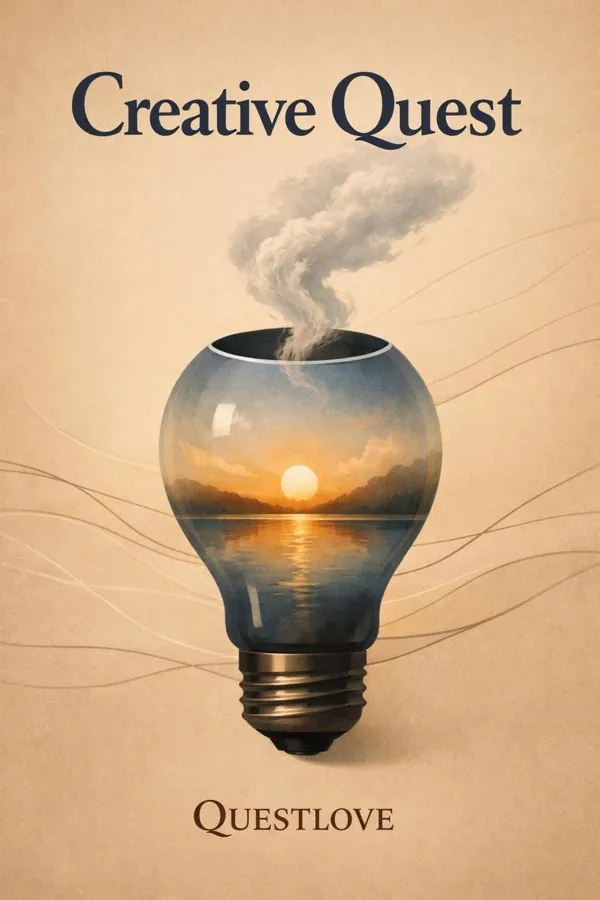
Creative Quest: Summary & Key Insights
by Questlove
 10 min10 chaptersAudio available
Key Takeaways from Creative Quest
Inspiration is not something you wait for; it is something you train yourself to notice.
Creativity often begins long before you know you are being formed by it.
Creativity becomes meaningful when it moves from desire to practice.
Some of the best creative breakthroughs happen when your vision meets someone else’s perspective.
If you are serious about making things, disappointment is not an exception; it is part of the curriculum.
What Is Creative Quest About?
Creative Quest by Questlove is a creativity book spanning 11 pages. Creative Quest is Questlove’s lively, generous exploration of what creativity really looks like in practice. Rather than treating inspiration as a rare lightning strike, he presents it as a way of paying attention, building habits, and staying open to influence. Drawing on decades of experience as the drummer and co-founder of The Roots, as well as his work as a producer, DJ, writer, filmmaker, and cultural curator, Questlove shows that creativity is both deeply personal and intensely social. It grows through discipline, collaboration, curiosity, and the willingness to keep learning. What makes this book matter is its refusal to romanticize the artistic life. Questlove writes with the perspective of someone who has spent years making, performing, studying, and refining his craft in public. He understands that great work is shaped not only by talent, but by routine, failure, community, timing, and integrity. Creative Quest is not just for musicians or professional artists. It is for anyone who wants to generate better ideas, develop a meaningful practice, and live with greater originality. At its core, the book argues that creativity is less a gift than a lifelong pursuit.
This FizzRead summary covers all 10 key chapters of Creative Quest in approximately 10 minutes, distilling the most important ideas, arguments, and takeaways from Questlove's work. Also available as an audio summary and Key Quotes Podcast.
Creative Quest
Creative Quest is Questlove’s lively, generous exploration of what creativity really looks like in practice. Rather than treating inspiration as a rare lightning strike, he presents it as a way of paying attention, building habits, and staying open to influence. Drawing on decades of experience as the drummer and co-founder of The Roots, as well as his work as a producer, DJ, writer, filmmaker, and cultural curator, Questlove shows that creativity is both deeply personal and intensely social. It grows through discipline, collaboration, curiosity, and the willingness to keep learning.
What makes this book matter is its refusal to romanticize the artistic life. Questlove writes with the perspective of someone who has spent years making, performing, studying, and refining his craft in public. He understands that great work is shaped not only by talent, but by routine, failure, community, timing, and integrity. Creative Quest is not just for musicians or professional artists. It is for anyone who wants to generate better ideas, develop a meaningful practice, and live with greater originality. At its core, the book argues that creativity is less a gift than a lifelong pursuit.
Who Should Read Creative Quest?
This book is perfect for anyone interested in creativity and looking to gain actionable insights in a short read. Whether you're a student, professional, or lifelong learner, the key ideas from Creative Quest by Questlove will help you think differently.
- ✓Readers who enjoy creativity and want practical takeaways
- ✓Professionals looking to apply new ideas to their work and life
- ✓Anyone who wants the core insights of Creative Quest in just 10 minutes
Want the full summary?
Get instant access to this book summary and 100K+ more with Fizz Moment.
Get Free SummaryAvailable on App Store • Free to download
Key Chapters
Inspiration is not something you wait for; it is something you train yourself to notice. One of Questlove’s central insights is that creativity starts with attention. The people we call creative are often the ones who observe more carefully, listen more deeply, and connect ideas other people overlook. Inspiration does not descend from nowhere. It usually arrives after long periods of collecting impressions, studying patterns, and remaining alert to what moves you.
Questlove’s own life in music shows how this works. Growing up surrounded by records, performances, and conversations about rhythm and sound, he learned to treat the world as material. A drum pattern, a passing phrase, a fashion trend, a film scene, or a casual conversation could all become creative fuel. This way of living turns everyday experience into a library of references.
For readers, this means creativity can be cultivated through deliberate noticing. Keep a notebook of ideas. Save quotes, melodies, visuals, and questions that spark something in you. Revisit old influences with fresh ears or eyes. Study why certain works affect you emotionally instead of simply consuming them passively. Over time, your creative instincts become sharper because your internal archive grows richer.
The point is not to force brilliance on demand. It is to become someone who is receptive enough to recognize possibility when it appears. The more attention you give the world, the more material the world gives back.
Actionable takeaway: Build a daily inspiration practice by recording three things each day that catch your attention and noting why they matter to you.
Creativity often begins long before you know you are being formed by it. Questlove reflects on his upbringing in a musical household to show that creative identity is built through environment, exposure, and repetition. Before he had language for artistic ambition, he was already absorbing rhythms, sounds, standards, and values from the world around him. Early influences do not determine your future, but they give you a vocabulary from which your style can emerge.
This idea matters because many people assume creativity starts when they choose a medium or begin a project. Questlove suggests it starts earlier, in what you are surrounded by and what you return to instinctively. Family culture, local scenes, childhood obsessions, formative albums, memorable teachers, and even constraints all shape the way you think and make things. Creative work is rarely invented from nothing; it is assembled from a lifetime of inputs.
Understanding your origins can help you work with greater clarity. If you map your own influences, you may discover patterns in what you love. Maybe you are drawn to structure because you grew up in chaos, or maybe your sense of humor developed as a survival tool. Maybe your aesthetic preferences come from the music in your home, the neighborhood you lived in, or the media that fascinated you as a child.
Instead of trying to imitate someone else’s creative journey, Questlove encourages readers to mine their own histories. Your background is not a limitation. It is often your greatest source of distinctiveness.
Actionable takeaway: Make a list of ten early influences that shaped you and identify what each one contributed to your taste, voice, or way of thinking.
Creativity becomes meaningful when it moves from desire to practice. Questlove emphasizes that ideas alone are not enough; what matters is the routine that allows ideas to become finished work. Artistic success can look spontaneous from the outside, but behind it is usually repetition, discipline, and a willingness to show up whether inspiration feels strong or not.
This is one of the book’s most useful lessons. Many people think habits threaten creativity, as if structure kills originality. Questlove argues the opposite: habits create the conditions where originality can thrive. A regular practice lowers the barrier to starting. It helps you develop muscle memory, refine taste, and produce enough volume that your best ideas have a chance to emerge.
In practical terms, creative habits can take many forms. A musician may practice scales daily, not because scales are glamorous, but because they sharpen responsiveness. A writer may keep a fixed drafting hour every morning. A designer may collect references and sketch concepts every week. These routines are not meant to produce masterpieces every session. Their purpose is to keep the creative channel open.
Questlove also recognizes that habits should support your life, not imitate someone else’s schedule. The best routine is the one you can sustain. Consistency matters more than intensity. Short daily sessions often outperform occasional heroic bursts.
Creativity flourishes when the work becomes normal rather than precious. When you stop waiting for the perfect mood, you gain momentum. And momentum often creates inspiration.
Actionable takeaway: Choose one small creative ritual you can repeat five days a week for the next month, and track completion rather than quality.
Some of the best creative breakthroughs happen when your vision meets someone else’s perspective. Questlove sees collaboration not as a compromise of individuality, but as a way to deepen it. Working with others exposes your blind spots, tests your assumptions, and introduces possibilities you would not have reached alone.
His career with The Roots and across music culture illustrates this clearly. Bands, producers, engineers, vocalists, and live performers all contribute to outcomes that no single person could fully author. In a healthy collaboration, each participant brings distinct strengths while remaining open to surprise. The result is not diluted creativity, but multiplied creativity.
This principle applies beyond music. In any field, collaboration can improve the work when people contribute different forms of knowledge. A writer may need an editor who sees structure more clearly. An entrepreneur may need a designer who understands emotional experience. A teacher may create better lessons by working with colleagues who bring different pedagogical styles. Creative community does more than share labor; it expands imagination.
Questlove also hints at an important balance: collaboration works best when ego is managed well. You need enough confidence to contribute honestly and enough humility to let the idea evolve. That means listening, adapting, and occasionally letting go of your original preference for the sake of a stronger result.
If creativity is partly about making connections, then other people are among the richest sources of connection available to you. The right collaborators challenge you to become better than your habits, your assumptions, and your solo instincts.
Actionable takeaway: Identify one project you are doing alone and invite someone with a different skill set to give input or co-create a piece of it.
If you are serious about making things, disappointment is not an exception; it is part of the curriculum. Questlove treats failure as one of creativity’s essential teachers. Projects fall short, audiences misunderstand, experiments collapse, and brilliant ideas sometimes produce weak results. None of this means you are not creative. It means you are working honestly enough to encounter risk.
This is a crucial shift in mindset. Many people stop creating because they interpret failure as personal proof of inadequacy. Questlove reframes it as information. A failed performance can reveal what preparation was missing. A rejected idea can show where communication broke down. A creative dead end can uncover habits that have become stale. Failure hurts, but it also clarifies.
The most resilient artists do not avoid mistakes; they learn how to metabolize them. They review what happened without turning every setback into a crisis of identity. This allows them to improve craft, adjust process, and keep moving. In creative work, persistence is often less about confidence than about recovery.
There is also a practical benefit to accepting failure: it makes experimentation possible. If every attempt must prove your worth, you will play too safe. But when you treat outcomes as feedback, you can take bolder swings, combine unlikely influences, and discover unexpected strengths.
Questlove’s message is both sobering and freeing. You cannot build a creative life without missteps, but you can turn those missteps into refinement. In that sense, failure is not the opposite of creative success. It is one of its ingredients.
Actionable takeaway: After your next creative setback, write down three lessons from it before judging yourself, and use those lessons to shape your next attempt.
New tools can transform how art is made, shared, and discovered, but they do not remove the need for taste, judgment, and originality. Questlove explores the role of technology and culture with a nuanced view: innovation expands access and possibility, yet it also creates noise, speed, and pressure. The challenge is to use technology as a tool without becoming controlled by its rhythms.
For artists, digital platforms can make production easier and distribution faster. Musicians can create tracks on laptops, filmmakers can edit with affordable software, and creators can reach audiences directly online. This democratization is powerful. It gives more people the chance to participate in culture and experiment without institutional gatekeepers.
But Questlove also recognizes the risks. Constant consumption can crowd out reflection. Fast feedback can encourage imitation over originality. Cultural trends can become so dominant that creators lose touch with their own instincts. The availability of tools does not automatically produce meaningful work. In some cases, too many options make it harder to hear your own voice.
The deeper lesson is that technology should support your creative intention rather than replace it. Use digital tools to learn, document, test, and distribute, but protect the slower processes that good work requires: attention, revision, boredom, listening, and depth. Culture moves quickly; craft develops more slowly.
In a hyperconnected world, maintaining a point of view becomes a creative act in itself. You need not reject technology to stay original. You simply need to use it consciously, with an awareness of what it gives and what it takes away.
Actionable takeaway: Audit your creative tools and media habits, then remove one digital distraction that consistently interrupts your ability to think or make deeply.
A creative block is rarely just a lack of ideas; it is often a sign that something in your process, energy, or expectations needs attention. Questlove treats creative droughts as natural rather than shameful. Even highly productive people hit periods of exhaustion, doubt, repetition, or disconnection. The mistake is assuming that force alone will solve them.
Blocks can come from many sources. Sometimes you are overworked and need recovery. Sometimes you are overstimulated and need silence. Sometimes you are afraid the next piece will not match your past work, so you avoid starting. Sometimes your methods have become too predictable, and your imagination needs new inputs. Recognizing the real cause matters because each type of block calls for a different response.
Questlove suggests renewal often comes through movement rather than panic. Change your environment. Study a different form. Return to play. Collaborate. Revisit what first made you curious. Rest can be productive if it restores your ability to notice and respond. So can experimentation that lowers the stakes. Instead of demanding a masterpiece, make something small, strange, or unfinished.
This perspective protects creativity from perfectionism. A block does not mean the source has dried up forever. It often means your system is asking for recalibration. Artists who endure are not those who never lose momentum, but those who know how to regain it.
The practical wisdom here is simple: when the work feels impossible, stop interpreting resistance as failure. Ask what your creative life is missing right now—energy, novelty, honesty, structure, or permission.
Actionable takeaway: When you feel blocked, diagnose the cause before reacting, then choose one remedy: rest, new input, lower stakes, or a change in routine.
Creative growth is shaped not only by what you practice, but by who guides your attention. Questlove highlights the role of mentorship and influence as essential parts of artistic development. Mentors may teach technique, but they also model standards, discipline, values, and ways of seeing. Often, what they give you is not a formula for success, but a sharper understanding of what matters.
Influence can come from direct teachers, collaborators, elders in a field, or even artists you study from afar. The key is active engagement. Instead of merely admiring great figures, Questlove suggests learning from how they work: how they listen, revise, prepare, lead, and stay curious. This makes influence dynamic rather than imitative.
At the same time, he implicitly warns against becoming trapped by influence. Mentorship should strengthen your own voice, not replace it. The goal is to absorb principles without turning into a copy. A good mentor helps you become more fully yourself.
This applies in any creative discipline. A young writer may benefit from an editor who demands precision. A musician may learn timing and patience from a bandleader. A designer may gain confidence from a senior colleague who knows when to push and when to simplify. The right influence accelerates growth because it shortens the distance between aspiration and practice.
There is also a reciprocal dimension. As you gain experience, you become part of someone else’s creative ecology. Passing on encouragement, standards, and insight helps sustain culture across generations.
Actionable takeaway: Choose one mentor figure, living or historical, and study their process closely for a week, focusing on principles you can adapt rather than surface style you might imitate.
Every creator eventually faces a difficult question: how do you make work that is true to your vision while surviving in a marketplace that rewards trends, speed, and visibility? Questlove addresses the tension between art and commerce without pretending it is easy to solve. Creative work exists in economic systems, and artists must often navigate money, audience expectations, branding, and institutional pressures. The challenge is to engage these realities without letting them hollow out the work.
Questlove’s perspective is practical rather than cynical. Commerce is not inherently corrupting. Artists need resources, platforms, and compensation. The problem arises when external demands completely replace inner standards. If every decision is driven by market approval, the work can lose its urgency and particularity. But if you ignore practical realities altogether, you may never build a sustainable creative life.
This balance requires clarity. You need to know what parts of your work are negotiable and what parts are not. Maybe the format can adapt but the message cannot. Maybe a commercial project can fund more personal work. Maybe audience feedback is useful up to the point where it starts dictating your identity. Integrity is not rigid purity; it is the ability to make trade-offs consciously.
Questlove also brings ethics into creativity more broadly. Borrowing from culture, collaborating with others, and using influence responsibly all require respect. Creativity does not happen in a moral vacuum. How you make things matters as much as what you make.
Actionable takeaway: Define your top three non-negotiable creative values so you can make career and business decisions without losing your artistic center.
The real challenge is not having one great idea; it is building a life in which creativity can continue over decades. Questlove closes the loop by treating creativity as a long-term practice of renewal, curiosity, discipline, and self-preservation. Sustaining a creative life requires more than productivity. It requires a way of working that can survive success, failure, boredom, change, and time.
One of the book’s strongest contributions is its rejection of the burnout myth. Many people equate creativity with nonstop output, but Questlove’s broader philosophy suggests endurance matters more than intensity. To keep making meaningful work, you need rhythms of effort and restoration. You need relationships that nourish you, interests that evolve, and enough self-knowledge to notice when your process needs to change.
A sustainable creative life also depends on staying teachable. The moment you think you already know how creativity works, you begin to repeat yourself. Questlove’s own career reflects continual reinvention across music, writing, education, film, and cultural commentary. The lesson is not that you must constantly pivot for novelty’s sake, but that growth often comes from remaining open to new forms, new questions, and new collaborations.
For readers, this means defining success more broadly than recognition. A creative life is not measured only by public milestones. It is also measured by whether you remain engaged, challenged, and alive to possibility. Longevity belongs to those who protect their curiosity as carefully as their craft.
Actionable takeaway: Design a sustainable creative system by scheduling regular time for practice, recovery, learning, and reflection so your creativity can deepen over the long term.
All Chapters in Creative Quest
About the Author
Questlove, born Ahmir Khalib Thompson, is an American musician, producer, author, filmmaker, DJ, and cultural historian. He is best known as the drummer and co-founder of The Roots, one of the most influential hip-hop bands of the modern era and the house band for The Tonight Show Starring Jimmy Fallon. Over the course of his career, he has worked across music, film, journalism, and education, building a reputation as both a gifted performer and a serious student of culture. Questlove has authored multiple books, directed acclaimed documentaries, and become a respected voice on creativity, Black music history, and artistic collaboration. His wide-ranging career gives him unusual authority to write about how creative work is inspired, developed, and sustained over time.
Get This Summary in Your Preferred Format
Read or listen to the Creative Quest summary by Questlove anytime, anywhere. FizzRead offers multiple formats so you can learn on your terms — all free.
Available formats: App · Audio · PDF · EPUB — All included free with FizzRead
Download Creative Quest PDF and EPUB Summary
Key Quotes from Creative Quest
“Inspiration is not something you wait for; it is something you train yourself to notice.”
“Creativity often begins long before you know you are being formed by it.”
“Creativity becomes meaningful when it moves from desire to practice.”
“Some of the best creative breakthroughs happen when your vision meets someone else’s perspective.”
“If you are serious about making things, disappointment is not an exception; it is part of the curriculum.”
Frequently Asked Questions about Creative Quest
Creative Quest by Questlove is a creativity book that explores key ideas across 10 chapters. Creative Quest is Questlove’s lively, generous exploration of what creativity really looks like in practice. Rather than treating inspiration as a rare lightning strike, he presents it as a way of paying attention, building habits, and staying open to influence. Drawing on decades of experience as the drummer and co-founder of The Roots, as well as his work as a producer, DJ, writer, filmmaker, and cultural curator, Questlove shows that creativity is both deeply personal and intensely social. It grows through discipline, collaboration, curiosity, and the willingness to keep learning. What makes this book matter is its refusal to romanticize the artistic life. Questlove writes with the perspective of someone who has spent years making, performing, studying, and refining his craft in public. He understands that great work is shaped not only by talent, but by routine, failure, community, timing, and integrity. Creative Quest is not just for musicians or professional artists. It is for anyone who wants to generate better ideas, develop a meaningful practice, and live with greater originality. At its core, the book argues that creativity is less a gift than a lifelong pursuit.
You Might Also Like
Dimensions Of Creativity
Margaret A. Boden
10 min
How to Fly a Horse: The Secret History of Creation, Invention, and Discovery
Kevin Ashton
10 min
Imagine: How Creativity Works
Jonah Lehrer
10 min
The Accidental Creative: How to Be Brilliant at a Moment's Notice
Todd Henry
10 min
The Origins of Creativity
Edward O. Wilson
10 min
Wired to Create: Unraveling the Mysteries of the Creative Mind
Scott Barry Kaufman, Carolyn Gregoire
10 minFeatured In
Browse by Category
Ready to read Creative Quest?
Get the full summary and 100K+ more books with Fizz Moment.